



Tandem OLED devices have already been mass-produced by brands such as Huawei (Mate series) and Honor (Magic series). Recently, LG also announced the launch of Tandem OLED products. Tandem OLED is not a brand-new technology—its concept was well-established decades ago, and related patents have already expired. In the future, we can expect to see technologies such as quantum dots being applied in Tandem structures.
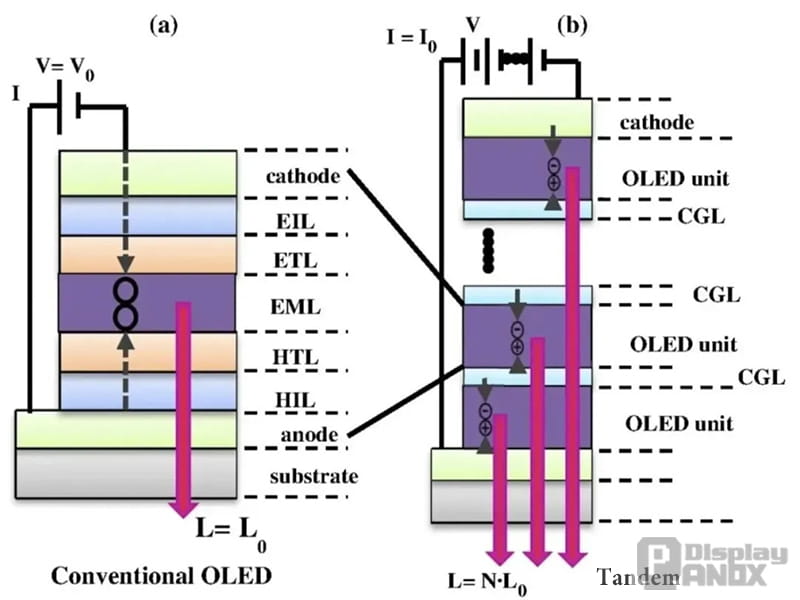
The term "Tandem" means "connected in series." Compared to conventional OLEDs, a Tandem OLED stacks multiple light-emitting layers (electroluminescent units) connected via intermediate charge-generation layers (CGL). These connection layers are typically composed of mixed p-type and n-type materials, allowing electrons and holes injected from the electrodes to separate within them and power each OLED emitting layer. To use an analogy: if a conventional OLED is like a single battery cell, a Tandem OLED is like multiple battery cells connected in series—though in display technology, the purpose is light emission.
I. Advantages
1. Doubled Brightness
In a single-layer OLED, the brightness may be limited to, for example, 1000 nits. With a two-layer Tandem structure, brightness can reach up to 2000 nits, and further layers can increase it proportionally.2. Improved Light Emission Efficiency
OLED efficiency typically increases and then decreases as brightness rises. At high brightness levels, the exciton-to-photon conversion efficiency drops. For instance, at 250 nits, 100 excitons might yield 30 photons, but at 500 nits, the same number of excitons might produce only 20 photons. In a dual-layer Tandem OLED, each layer only needs to emit 250 nits to achieve 500 nits total, maintaining higher efficiency (e.g., 30%) compared to a single-layer device at 500 nits (e.g., 20%).3. Extended Screen Lifespan
In a Tandem structure operating at 500 nits, each layer bears only part of the voltage (e.g., 3V per layer, 6V total). A single-layer OLED would require the full voltage (possibly 6.5V) applied across one layer, resulting in roughly twice the electric field stress. This accelerates aging in conventional OLEDs.4. Reduced Power Consumption
Due to lower current and slightly higher voltage, Tandem OLEDs achieve modest power savings—though not as dramatically as the lifespan improvement—contributing to better overall energy efficiency.Related: More high-luminance display panel products.
II. Disadvantages
1. Challenges in Display Calibration
Current Control Difficulty: At low brightness levels, OLED efficiency varies significantly among red, green, and blue subpixels. Tandem OLEDs require half the current of conventional OLEDs for the same brightness, demanding more precise current control from the driving TFTs. Temperature-induced mobility shifts in TFTs make low-brightness color accuracy harder to maintain, often leading to visible color shift, especially in low-temperature environments. Solutions include temperature sensing and real-time compensation via display driver ICs.Horizontal Crosstalk: The intermediate connection layers, being bipolar, can allow lateral carrier movement, causing unintended illumination of adjacent pixels. This is mitigated through material selection, isolation structures, or patterning of the pixel definition layer (PDL).
2. Higher Cost
Due to complex processes, yield considerations, and supply chain factors, Tandem OLEDs are significantly more expensive than conventional OLEDs, with cost increases often in the range of tens of US dollars per panel.III. Application Prospects
1. High-Brightness & Power-Efficient Products
With Apple introducing High Brightness Mode (HBM) up to 1600–2000 nits, Tandem OLEDs will become essential as brightness demands exceed the limits of single-layer OLEDs. Power efficiency remains a key consumer concern, making Tandem an attractive option when other power-saving technologies reach their limits.2. Foldable Devices (Left-Right Folding)
In foldable phones, "hover mode" often leads to asymmetric screen usage and uneven aging between the two displays. Over time, brightness inconsistency becomes noticeable. Tandem OLED’s improved longevity can help mitigate this issue.3. Medium- to Large-Size OLED Products
Tablets and laptops (NB) require longer display lifespans and benefit from Tandem OLED’s efficiency and durability, making them ideal candidates for this technology.Looking for more OLED options? Discover our cutting-edge range here.