



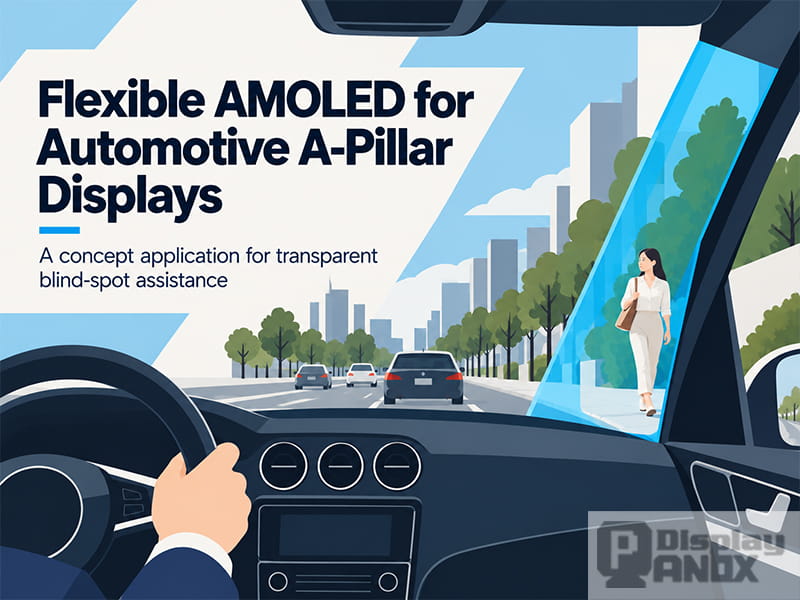
Automotive displays are extending beyond conventional dashboards and infotainment systems. As vehicle interiors adopt increasingly complex shapes, display technologies must accommodate curved surfaces, limited installation space, and new approaches to driver assistance.
One emerging application is the automotive A-pillar display, which uses camera imagery to help drivers see areas normally obstructed by the vehicle's front pillars. Flexible AMOLED technology offers an interesting opportunity for this application, allowing display modules to follow curved interior surfaces while maintaining high pixel density and contrast.
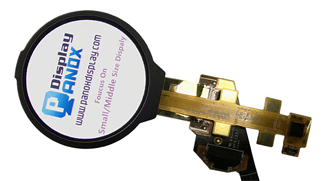
Compact panels such as the 5.99-inch 1440 × 2880 Flexible AMOLED Display from Panox Display provide a useful starting point for exploring these automotive display concepts.
1. How Flexible AMOLED Can Support Virtual A-Pillar Displays
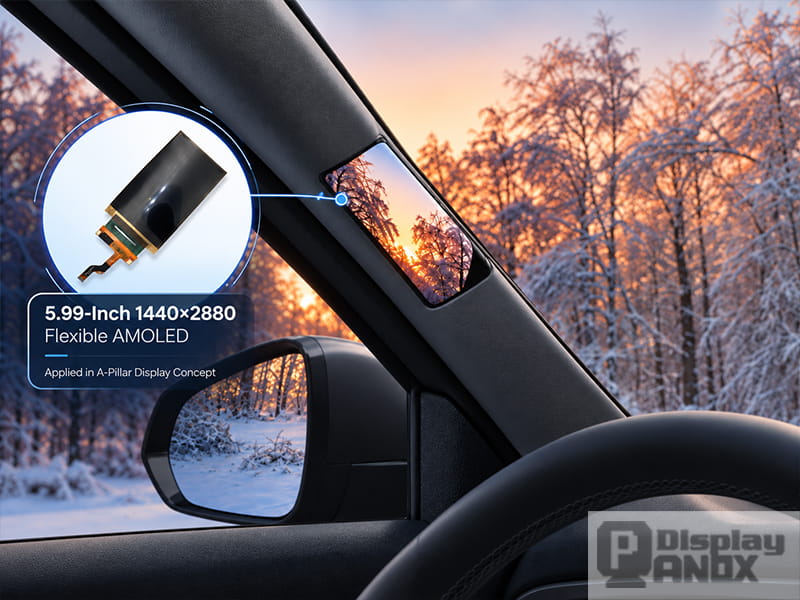
The A-pillars are structural components located on either side of a vehicle's windshield. Although essential for vehicle rigidity and occupant protection, they can obstruct a driver's view of pedestrians, cyclists, and approaching vehicles, particularly at intersections and during turns.
A virtual A-pillar system addresses this limitation by combining external cameras, image processing, and displays integrated into the interior pillar surfaces.
How Does a Virtual A-Pillar Work?
The system generally involves three components:
-
External cameras: Capture areas outside the vehicle that are obscured by its A-pillars.
-
Image processing and perspective correction: Adjust the camera imagery to match the driver's viewpoint. Advanced systems may use head-tracking cameras for dynamic perspective compensation.
-
Integrated display panels: Present the corrected imagery on the interior A-pillar surfaces.
The intended result is a visual continuation of the surrounding environment. Roads, buildings, pedestrians, and other objects hidden behind the physical pillar can appear in the corresponding display area.
Unlike a transparent glass panel, the structural A-pillar remains physically opaque. The apparent transparency is created electronically using camera images and perspective correction.
This distinction is essential to understanding the application: the display creates a virtual see-through effect without removing the vehicle's structural pillar.
An Industry Example: Continental's Virtual A-Pillar
In October 2018, Continental introduced a Virtual A-Pillar concept combining flexible OLED displays, exterior SurroundView cameras, and an interior camera for driver head tracking.
By adjusting the displayed camera image to the driver's changing viewing position, the system was designed to make the A-pillar appear visually transparent rather than presenting an ordinary camera-monitor image.
The demonstration illustrates how flexible display technology can contribute to automotive visibility systems when integrated with suitable cameras, electronics, and image-processing algorithms.
2. Why Flexible AMOLED Is Suitable for A-Pillar Integration
A-pillars are narrow, inclined structures with surfaces that vary between vehicle models. Integrating a conventional flat display into these areas can create packaging challenges, including additional protrusion, limited viewing angles, and discontinuity between the screen and surrounding interior trim.
Flexible AMOLED offers several potential advantages.
Curved Surface Integration
Flexible AMOLED panels use bendable substrates that allow the display to conform to selected curved geometries, subject to the module's specified bending limits.
For A-pillar applications, a display could be mounted with a fixed curvature that follows the interior trim, providing a more integrated appearance.
Most such applications would use a fixed-curved configuration, meaning the panel maintains its designed curvature during operation rather than repeatedly folding or rolling.
Thin and Lightweight Construction
AMOLED pixels generate their own light, eliminating the separate backlight assembly required by conventional LCD technology.
Combined with a flexible substrate, this supports relatively thin display structures and can help reduce packaging constraints in narrow interior components.
High Pixel Density and Contrast
A virtual A-pillar display may need to reproduce detailed environmental features such as lane markings, pedestrian outlines, road signs, and nearby vehicles.
High pixel density helps preserve detail in compact display areas, while AMOLED's high contrast and wide viewing characteristics support visual clarity across different viewing positions.
However, overall visibility also depends on ambient brightness, surface reflections, optical bonding, and the image-processing system.
3. Exploring the 5.99-Inch 1440 × 2880 Flexible AMOLED Display
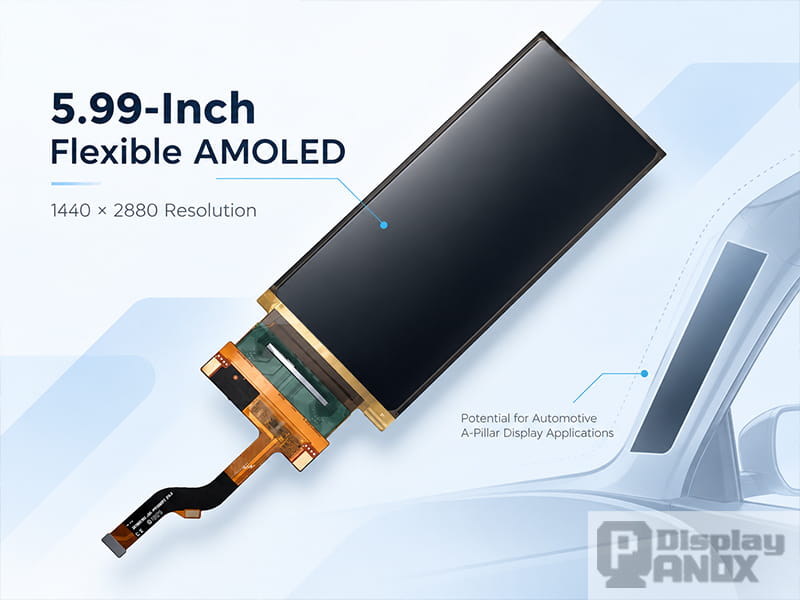
The HW599FF2KM 5.99-inch Flexible AMOLED Display, supplied by Panox Display, is an example of a compact, high-resolution flexible screen that can be considered during early automotive display research and prototyping.
Originally developed for smartphone applications, this BOE-manufactured AMOLED panel combines a narrow portrait format with a flexible display structure.
Key Display Specifications
| Parameter | Specification |
|---|---|
| Model | HW599FF2KM |
| Display Size | 5.99 inches |
| Display Technology | Flexible AMOLED |
| Resolution | 1440 × 2880 |
| Active Area | 70.24 × 139.78 mm |
| Typical Brightness | 495 cd/m² |
| Contrast Ratio | 90,000:1 (Typ.) |
| Refresh Rate | 60 Hz |
| Interface | MIPI DSI, 4 Lanes |
| Operating Temperature | −30°C to +70°C |
| Touch Technology | In-cell Touch |
Its portrait-oriented format and high resolution make it relevant to investigations involving compact vertical displays, including A-pillar display prototypes, auxiliary camera monitors, and other narrow automotive interfaces.
For example, engineers developing a virtual A-pillar proof of concept could use an appropriate controller board to feed camera imagery to the AMOLED panel and evaluate visual alignment, image quality, installation geometry, and display latency.
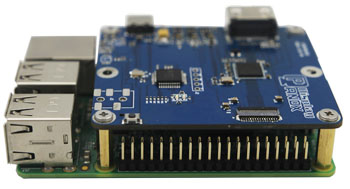
Panox Display also offers an HDMI controller board solution for this panel, which can simplify initial display testing.
Application consideration: The HW599FF2KM is presented here as a potential development and integration candidate. Its suitability for a particular A-pillar design depends on available mounting dimensions, allowable bending radius, optical requirements, and environmental testing. Automotive-grade qualification has not been established by the published product specifications.
4. Other Flexible OLED Options for Automotive Display Designs
Automotive interior layouts vary considerably, and a single display size cannot accommodate every design.
Beyond the 5.99-inch model, different flexible AMOLED form factors offer opportunities for exploring specific vehicle interior applications.
6.52-Inch Flexible OLED for Narrow Display Surfaces
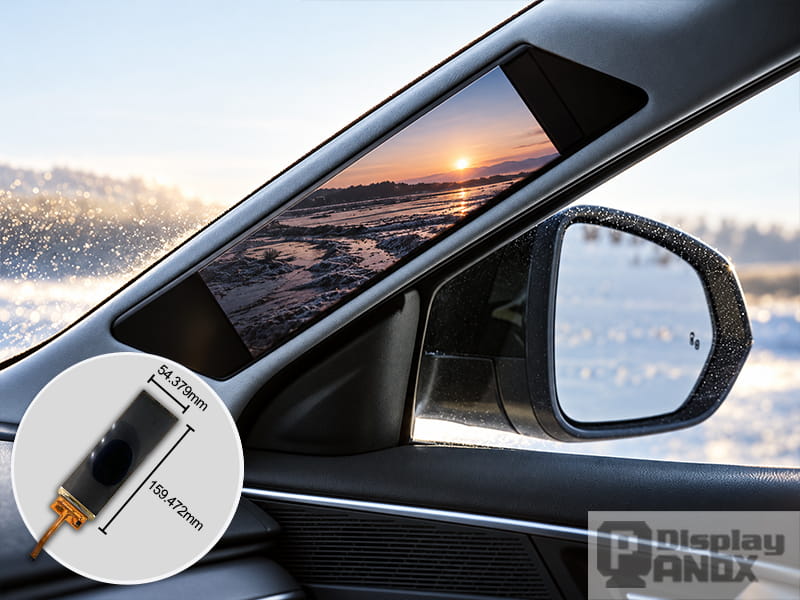
The 6.52-inch Flexible OLED Display features a 2520 × 840 resolution and an elongated 3:1 aspect ratio.
Its approximately 52.4 × 157.2 mm active area makes it particularly interesting for narrow installation spaces where a conventional rectangular display may be difficult to accommodate.
Potential development concepts include vertically oriented pillar displays, slim auxiliary information panels, and compact curved control interfaces.
7.8-Inch Flexible OLED for Curved Interior Panels
The 7.8-inch Flexible OLED Display provides a larger display area with a 1440 × 1920 resolution.
Its flexible construction makes it suitable for evaluating curved display layouts in interior surfaces with more available installation space, such as auxiliary dashboard sections, passenger information areas, and custom control panels.
Panel selection should begin with the available installation geometry and viewing requirements rather than diagonal screen size alone.
5. Beyond A-Pillars: Additional Automotive Applications
Virtual A-pillars represent one specialized automotive application, but flexible AMOLED panels can also support other interior display concepts.
Curved Dashboard and Auxiliary Instrument Displays
Curved dashboard surfaces often require display modules that can follow non-flat interior geometries.
Flexible AMOLED panels can support compact secondary instrument displays, vehicle status interfaces, and supplementary information areas alongside the main digital cluster.
These displays may present driving modes, battery information, climate settings, or other contextual vehicle data.
Door Trim and Side Information Panels
Vehicle doors offer additional opportunities for integrated displays.
Depending on the interior design, narrow or curved AMOLED panels could present camera views, passenger information, vehicle settings, or context-sensitive controls.
The thin structure of flexible OLED is especially relevant where the available space behind decorative trim is limited.
Compact Curved Control Interfaces
Another potential application involves small control displays integrated into curved center consoles and other interior surfaces.
Rather than attaching separate flat screens, designers can investigate ways to integrate display areas more naturally into the vehicle's interior geometry.
Such applications may support climate controls, seat settings, or other functions, provided the overall human-machine interface remains appropriate for in-vehicle use.
6. Important Engineering Considerations for Automotive Integration
Although flexible AMOLED provides valuable design possibilities, automotive integration involves requirements extending beyond basic panel specifications.
Sunlight visibility and reflection control: Displays near windshields and side windows may experience intense sunlight. Optical bonding, antireflective treatments, brightness management, and sufficient display luminance are important. A panel's published brightness value alone does not establish its suitability under direct sunlight.
Temperature and environmental reliability: Automotive displays must withstand the operating conditions associated with their installation locations. Temperature cycling, humidity, ultraviolet exposure, vibration, and long-term display stability should be evaluated against the intended vehicle requirements.
Mechanical bending and mounting: Flexible displays still have minimum bending limits. The selected curvature, supporting structure, cover lens, adhesive materials, and FPC routing must remain compatible with the panel's mechanical specifications.
Camera synchronization and visual accuracy: Virtual A-pillar systems require accurate perspective mapping and sufficiently low end-to-end latency. Display response time alone cannot guarantee a suitable real-time viewing experience.
Vehicle safety and installation: A-pillar components may be located near side-curtain airbag systems. Any integrated display assembly must be developed in accordance with vehicle structural and occupant-safety requirements.
For these reasons, commercially qualified automotive applications require comprehensive system-level evaluation, even when a flexible panel performs well in a laboratory prototype.
7. Developing Automotive Display Prototypes with Panox Display
Early automotive display development often begins by evaluating the physical dimensions, electrical interface, image quality, and mechanical integration of available panels.
Panox Display provides a range of Flexible OLED Display Screens with different sizes, resolutions, and form factors for product development and customized display projects.
For engineers evaluating automotive concepts, available options include compact flexible AMOLED modules, elongated display formats, and customized controller and driver board solutions.
The 5.99-inch 1440 × 2880 Flexible AMOLED display is one example that can be used to explore high-resolution display integration in compact spaces.
Whether the project involves a virtual A-pillar demonstration, a curved dashboard interface, or a custom auxiliary vehicle display, selecting the appropriate panel requires careful consideration of the intended geometry, brightness, interface, operating environment, and qualification requirements.
Conclusion
Flexible AMOLED technology creates new possibilities for integrating displays into the curved and space-constrained surfaces of modern vehicles.
Virtual A-pillar systems are a particularly compelling example. By combining integrated displays with exterior cameras and perspective-corrected imagery, these systems can help address visibility limitations caused by structural vehicle pillars.
Compact flexible AMOLED panels, including Panox Display's 5.99-inch 1440 × 2880 model, provide potential building blocks for investigating such concepts, while alternative formats can support other curved interior interfaces.
As automotive display designs continue to evolve, flexible screen technologies offer engineers greater freedom to explore new integration methods and intelligent vehicle interfaces.
Explore Panox Display's Flexible OLED collection or contact [email protected] to discuss display specifications, prototype testing, and customized display integration requirements.