



Smart speakers have become a familiar part of modern homes, combining music playback, voice assistants, and smart home control in a single device. Yet their physical designs often follow a similar pattern: a cylindrical or compact speaker body with a small indicator light, a few control buttons, or a conventional flat display.
As manufacturers explore more distinctive product designs, flexible OLED displays are creating new possibilities for integrating visual interfaces into smart audio devices.
Unlike rigid displays, flexible OLED panels can be integrated into curved surfaces, allowing digital content to follow the contours of a product. Music controls, album artwork, audio visualizations, and smart home information can become part of the speaker's exterior design.
Two particularly interesting applications are wraparound displays on cylindrical smart speakers and curved OLED screens integrated into transparent speaker enclosures.
These concepts demonstrate how flexible display technology can expand the relationship between audio products, visual interfaces, and industrial design.
Why Flexible OLED Fits Modern Smart Speaker Design
Most smart speakers are designed around circular or cylindrical acoustic structures. This creates a natural challenge when adding a conventional flat screen: the display often requires a separate housing or a flattened section of the product.
Flexible OLED technology allows designers to explore more integrated arrangements.
A curved display can follow the surface of a cylindrical speaker, creating a continuous visual interface without requiring a large flat display enclosure. Its slim profile also makes it suitable for products where space and exterior dimensions are important.
OLED technology offers several additional advantages for smart audio interfaces.
High contrast and deep blacks help music controls, text, and colorful graphics remain visually distinct against dark backgrounds. Since OLED pixels generate their own light, a separate backlight is unnecessary.
Wide viewing angles are valuable for speakers positioned on desks, shelves, and living room furniture, where information may be viewed from different positions.
Flexible installation possibilities give product designers more freedom to integrate displays into curved surfaces, provided the required bending radius and mechanical support conditions are satisfied.
These characteristics are particularly relevant to two speaker concepts: an externally mounted wraparound display and a compact display integrated inside a transparent enclosure.
Application 1: 7.8-Inch Flexible OLED for Wraparound Smart Speakers
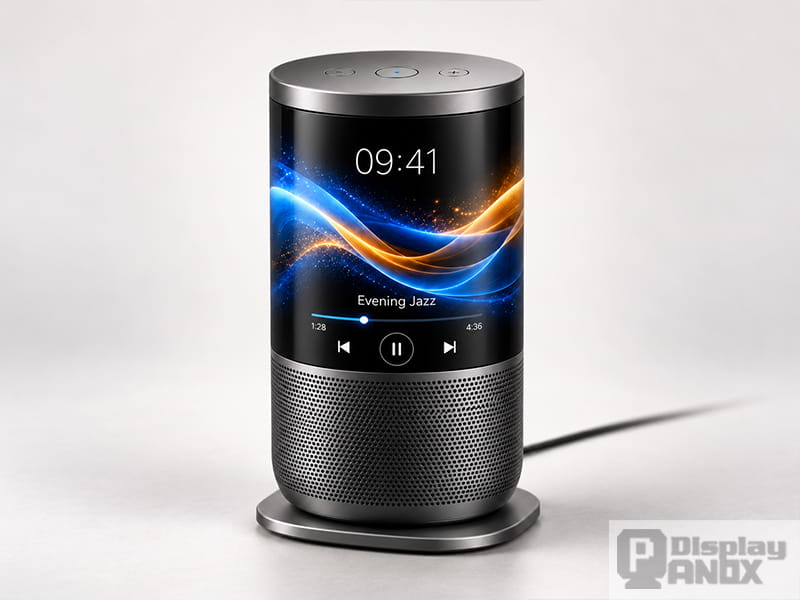
One of the most direct applications of flexible OLED technology is a cylindrical smart speaker with a display integrated around its exterior.
Instead of installing a conventional rectangular screen on one side, a flexible display can follow the curved surface of the speaker body.
This arrangement provides a larger visual interface while preserving the cylindrical form often preferred for compact audio products.
A Curved Display That Becomes Part of the Speaker
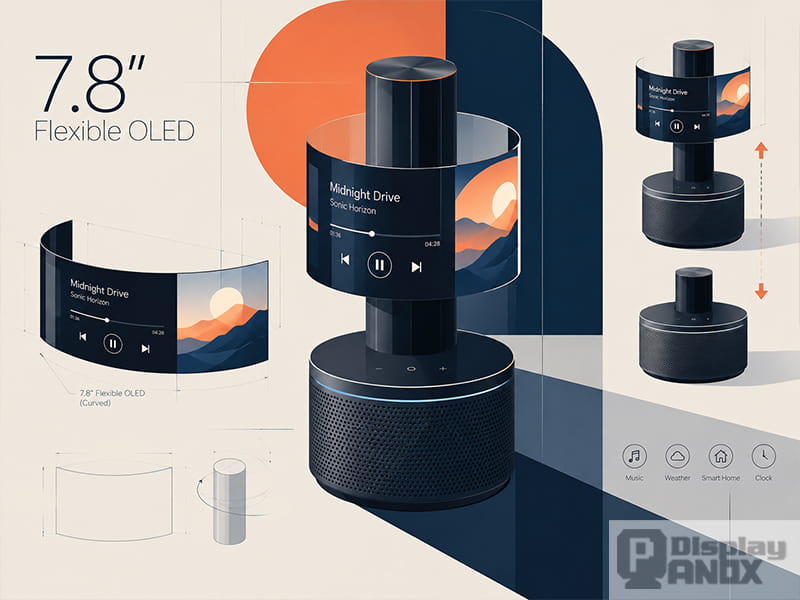
The 7.8-inch flexible OLED display, model RO780FA1920M, offers a resolution of 1440 × 1920 pixels, a 118.8 × 158.4 mm active area, and a typical contrast ratio of 100,000:1.
Its flexible construction makes it a candidate for cylindrical display applications. Panox Display has demonstrated that the version without cover glass can be bent into a cylindrical shape.
In a smart speaker concept, the display can be mounted on a curved supporting surface above the main acoustic enclosure.
The screen could present album covers, song information, playback progress, volume controls, and colorful audio visualizations. Weather information, clocks, and smart home status panels could also be incorporated into the interface.
A curved display provides additional freedom in how this information is organized. For example, the front-facing area could prioritize playback controls while adjacent portions display ambient graphics or supplementary information.
Actual visibility depends on the speaker diameter, display curvature, and viewing position.
A Height-Adjustable Wraparound Display Concept
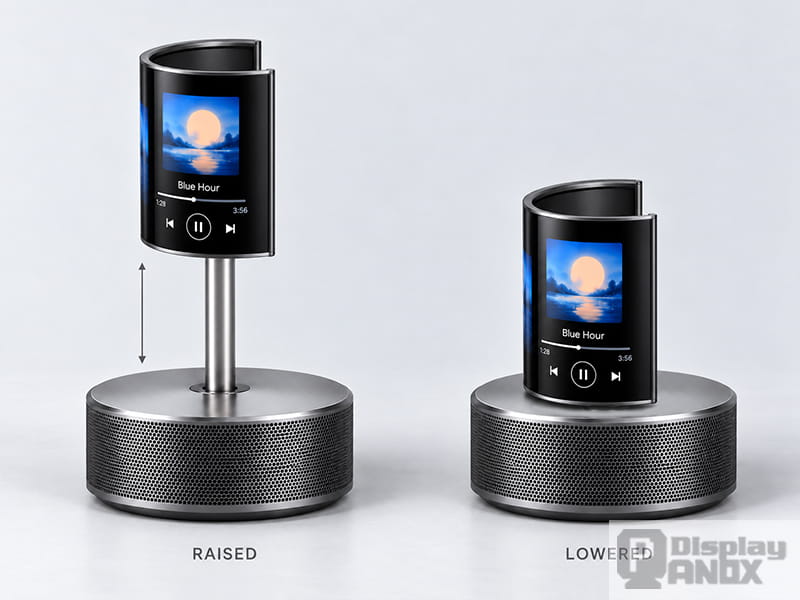
Flexible OLED can also inspire more experimental mechanical designs.
Consider a smart speaker with a compact acoustic base and a central vertical support. A curved OLED display assembly surrounds part of the support and can move vertically between a lowered position and a raised position.
When lowered, the device maintains a compact appearance. Raising the display brings music information, smart home controls, or visual content closer to the user's preferred viewing height.
Such a concept could be useful for tabletop audio systems, multifunctional home assistants, or premium smart speakers that combine sound reproduction with a more substantial visual interface.
Importantly, the OLED panel would maintain a fixed curvature on its supporting structure while the complete display assembly moves along a mechanical guide.
This approach separates the movement of the display housing from repeated bending of the OLED itself. The motorized mechanism, cable routing, structural support, and bending limits would still require engineering validation.
The concept illustrates an opportunity to develop more adaptable smart speaker designs using flexible displays.
Real-World Inspiration: The Cleer Mirage Smart Speaker
An early example of this application appeared at CES 2020.
Developed through a collaboration between Cleer Audio and Royole, the Mirage Smart Speaker incorporated a 7.8-inch flexible AMOLED touchscreen around its cylindrical body.
The device combined a curved visual interface with Amazon Alexa functionality and an integrated audio system.
Its display demonstrated how music information, graphical interfaces, and video could be presented on a curved speaker surface.
The Mirage provides an important reference for designers exploring flexible OLED integration in smart audio products. It demonstrates that a wraparound display can be incorporated into a publicly demonstrated smart speaker design.
For new developments, the selected panel version, mechanical configuration, and display interface must be evaluated independently.
Application 2: 5.99-Inch Flexible OLED Inside a Transparent Smart Speaker
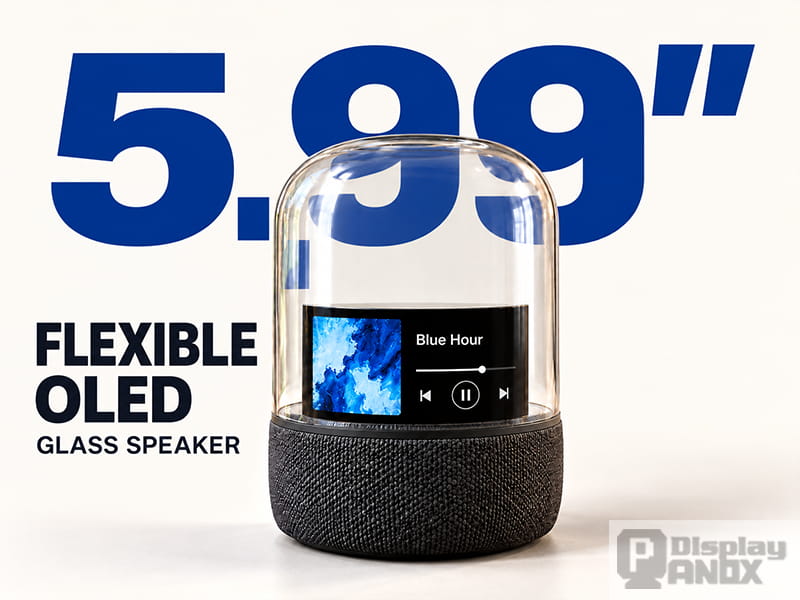
Another promising direction combines flexible OLED technology with transparent speaker enclosures.
Transparent dome speakers already have a distinctive presence in home audio design. Their clear outer shells reveal internal structures and create opportunities for decorative lighting and visual effects.
A flexible OLED display could introduce another visual element by integrating a curved digital interface into the transparent enclosure.
Integrating a Curved Display into the Enclosure
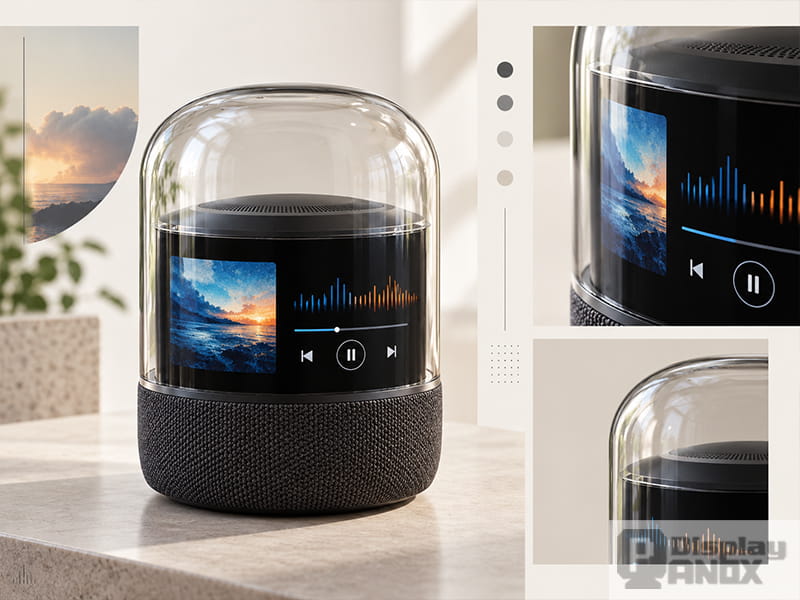
One possible concept uses a speaker with a rounded transparent upper dome, a cylindrical lower section, and an acoustic base covered in fabric or perforated material.
A flexible OLED panel is positioned against the inner surface of the enclosure's cylindrical section, following its curvature.
The result is a curved display window integrated into the speaker's design. The display occupies only part of the enclosure's circumference, leaving the remaining sections transparent.
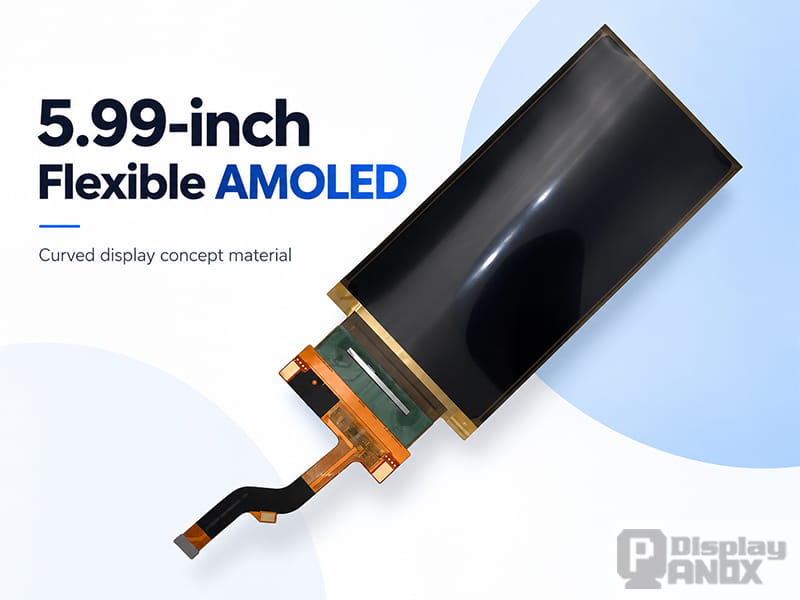
The 5.99-inch flexible AMOLED display, model HW599FF2KM, provides a compact option for exploring this configuration.
Manufactured by BOE, the panel offers a resolution of 1440 × 2880 pixels, a typical contrast ratio of 90,000:1, and a typical luminance of 450 cd/m² in normal mode.
Its active display area measures approximately 68.04 × 136.08 mm.
By orienting the longer dimension horizontally and using an appropriate supporting structure, the panel could form a relatively compact curved display window within a cylindrical enclosure, subject to the module's actual bending limits.
The screen could show album artwork, track information, animated sound waves, or a clock. Dark interface backgrounds would allow selected graphics and information to stand out against the surrounding structure.
The transparent enclosure would remain visible around the display, helping preserve the product's decorative character.
Combining Music, Information, and Interior Design
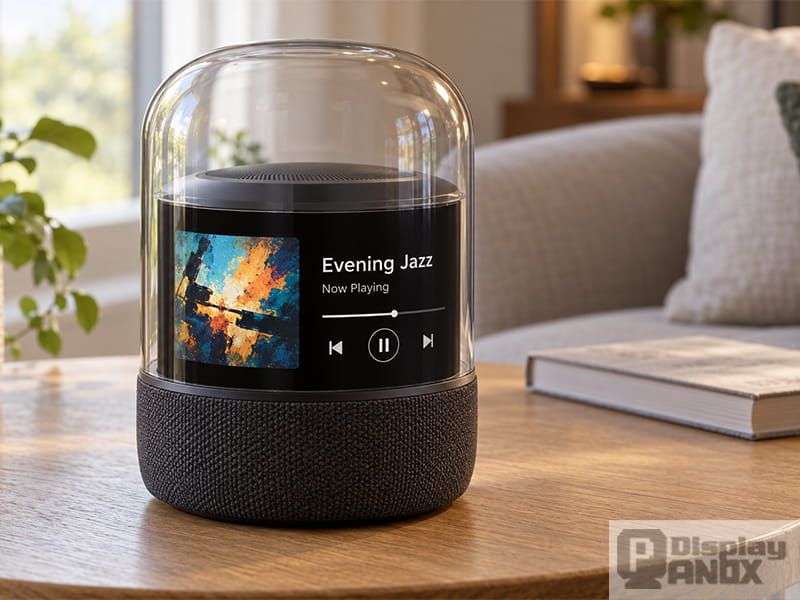
For many home audio products, appearance is an important part of the user experience.
A speaker placed in a living room or bedroom is often visible even when it is not playing music. Integrating an OLED screen offers opportunities to change its visual presentation according to the operating state.
During music playback, the screen could show artwork and audio-reactive animations.
In standby mode, it could display a minimal clock or a subtle visual pattern.
When connected to a smart home system, the same display could present selected information such as room temperature, device status, or notifications.
This type of design could be particularly interesting for decorative desktop speakers, bedside audio devices, and premium home entertainment products.
The transparent cover would also provide physical separation between the display and the external environment.
However, placing an OLED behind an enclosure introduces optical and interaction considerations. Reflections, protective material properties, and the relationship between the display and touch interface must be evaluated.
Although the HW599FF2KM includes In-cell Touch technology, its integration behind a transparent protective enclosure should not be assumed to provide direct touch operation without a suitable mechanical and electrical design.
Key Engineering Considerations for Curved OLED Speaker Integration
Flexible displays create additional industrial design possibilities, but successful integration depends on the complete mechanical and electronic system.
Several factors require particular attention during product development.
Bending Radius and Mechanical Support
A flexible OLED panel must operate within its specified bending conditions.
The minimum permitted bending radius, bending direction, cover layers, and supporting materials determine how the panel can be installed.
A cylindrical surface is generally more suitable for single-axis bending than a spherical or dome-shaped surface requiring curvature in multiple directions.
For transparent speaker concepts, a straight cylindrical section can therefore provide a more practical mounting area than the rounded top of the enclosure.
A dedicated supporting structure should maintain the intended curvature and help prevent localized stress on the display.
The final design must be validated using the mechanical specifications of the selected module.
Display Interface and Driver Board Integration
Display control electronics are another important consideration.
The 7.8-inch RO780FA1920M uses a dual-port MIPI interface, while the 5.99-inch HW599FF2KM uses a four-lane MIPI DSI interface.
Both require suitable display-driving hardware and compatible signal configurations.
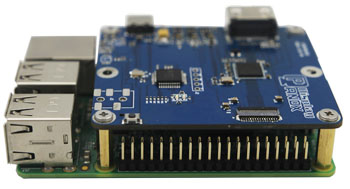
Panox Display offers HDMI controller board solutions for these panels, which can simplify display evaluation during prototype development.
For compact smart speakers, the controller board, power supply, and flexible printed circuit connection must fit within the available enclosure space.
Moving display assemblies introduce further challenges, since electrical connections must remain reliable throughout the intended range of movement.
Touch Control and User Interaction
The two display modules have different touch configurations.
The 5.99-inch HW599FF2KM incorporates In-cell Touch technology.
For the 7.8-inch RO780FA1920M, the standard version is supplied without a touch panel, while an additional version with cover glass and touch functionality is available.
Product designers should determine whether direct screen interaction is necessary or whether voice commands, physical controls, or companion applications provide a more suitable user experience.
For curved or enclosed displays, touch performance must be assessed together with the cover material and mounting arrangement.
Acoustic Performance and Thermal Management
A display should also be integrated without compromising the speaker's primary audio function.
The placement of the OLED, supporting frame, and electronics must account for acoustic openings, internal air volume, vibration, and heat dissipation.
In transparent dome concepts, the enclosure should be designed around the intended acoustic system rather than assuming that a sealed decorative cover will work with any loudspeaker arrangement.
OLED temperature, brightness settings, and prolonged static interface elements also require consideration during continuous operation.
Careful system-level design helps ensure that visual functionality complements the audio product.
Choosing Between 5.99-Inch and 7.8-Inch Flexible OLED Displays
Both displays offer opportunities for curved smart speaker applications, although their dimensions and configurations support different design approaches.
| Specification | 5.99-Inch Flexible AMOLED | 7.8-Inch Flexible OLED |
|---|---|---|
| Model | HW599FF2KM | RO780FA1920M |
| Resolution | 1440 × 2880 | 1440 × 1920 |
| Active Area | 68.04 × 136.08 mm | 118.8 × 158.4 mm |
| Typical Luminance | 450 cd/m² | 300 cd/m² |
| Contrast Ratio | 90,000:1 | 100,000:1 |
| Interface | 4-lane MIPI DSI | Dual-port MIPI |
| Touch | In-cell Touch | Optional version |
| Concept Application | Curved display inside a transparent speaker enclosure | External wraparound or height-adjustable display assembly |
The 5.99-inch panel is worth evaluating for compact display windows and speaker concepts that prioritize a smaller visual interface.
The 7.8-inch panel offers a larger display area and demonstrated cylindrical bending capability in its version without cover glass, making it especially relevant to wraparound smart speaker concepts.
Final selection depends on enclosure geometry, permitted bending conditions, display interface requirements, and the intended interaction method.
Exploring Flexible OLED Solutions with Panox Display
As smart speakers evolve, curved displays offer manufacturers additional ways to combine visual information, audio functionality, and industrial design.
Wraparound OLED screens can bring digital interfaces onto cylindrical speaker surfaces, while compact flexible panels can introduce visual functions into transparent enclosure designs.
Both applications illustrate how display integration can influence the appearance and functionality of future smart audio products.
Panox Display supplies flexible OLED modules and supporting display-driving solutions for product development and evaluation.
For projects involving curved displays, developers can explore the 5.99-inch flexible AMOLED display, the 7.8-inch flexible OLED display, or the broader range of Flexible OLED Displays.
Planning a smart speaker or curved-display product? Contact Panox Display at [email protected] to discuss available display modules, driver board options, mechanical requirements, and technical specifications for your application.
Note: The smart speaker designs described in this article include conceptual applications intended to illustrate potential flexible OLED integration. Final mechanical feasibility, touch functionality, and system performance require product-specific engineering validation.