



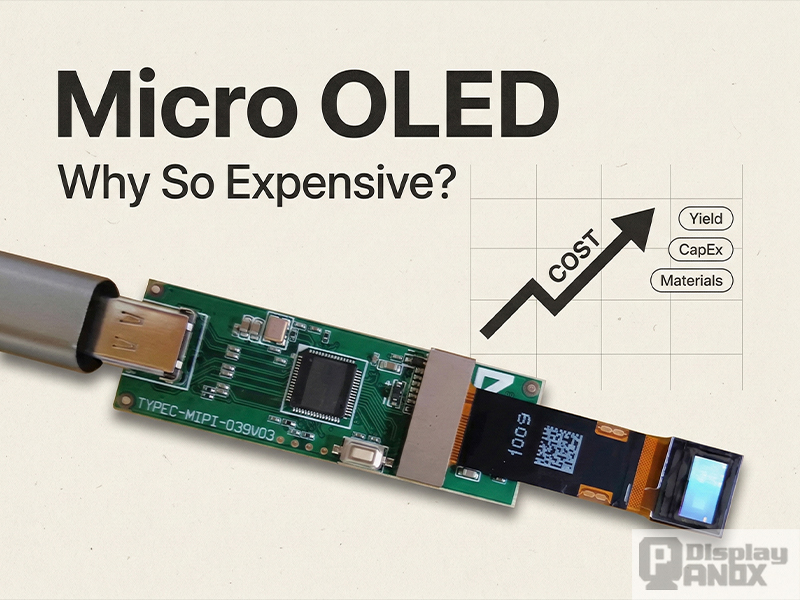
If you have been following the latest trends in display technology, you have likely noticed that Micro OLED screens come with a massive price tag. Typically costing 3 to 5 times more than standard or Flexible OLEDs, and over 10 times more than traditional LCDs, these miniature powerhouses are the driving force behind premium devices like the Apple Vision Pro.
But what exactly justifies this premium? This comprehensive Micro OLED cost analysis breaks down the manufacturing hurdles, yield rate bottlenecks, and future price trends of this cutting-edge technology.
Ready to upgrade? Explore our high-performance [Micro OLED display modules].
1. The Core Components Driving Up Micro OLED Costs
The fundamental architecture of a Micro OLED display is vastly different from traditional screens, leading to significantly higher baseline costs:
-
Silicon-Based Backplanes: Unlike standard displays that use affordable glass substrates, Micro OLED requires high-cost 8-inch silicon wafers manufactured using complex CMOS processes.
-
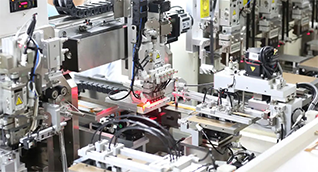
High-Precision Evaporation: Because the pixels are microscopic (micron-level), traditional evaporation machines are inadequate. Manufacturers must use custom, high-end equipment (such as Canon Tokki machines). The vacuum requirements are stricter, and the single production cycle is much longer.
-
Specialized Raw Materials: To ensure longevity, Micro OLED panels require high-stability organic materials (Red, Green, Blue) and premium encapsulation layers that offer extreme resistance to water and oxygen. Auxiliary materials like black matrices and photoresists also add to the bill.
-
Massive R&D Investments: Because the silicon-based OLED process is relatively new, companies are spending billions on process development, lengthy equipment debugging, and continuous capacity optimization.
2. The Yield Rate Bottleneck
In the semiconductor and display industries, yield rate (the percentage of usable products from a production run) dictates the final price. Low yield is currently the biggest bottleneck for Micro OLED.
-
Complex Stacking: A single Micro OLED panel requires 6 to 8 layers of OLED stacking on the silicon base. A single microscopic defect in any layer ruins the entire chip.
-
Extreme Pixel Density: Achieving 3000+ PPI means packing over 9 million pixels into a single square centimeter. At this microscopic scale, even the tiniest speck of dust is catastrophic.
-
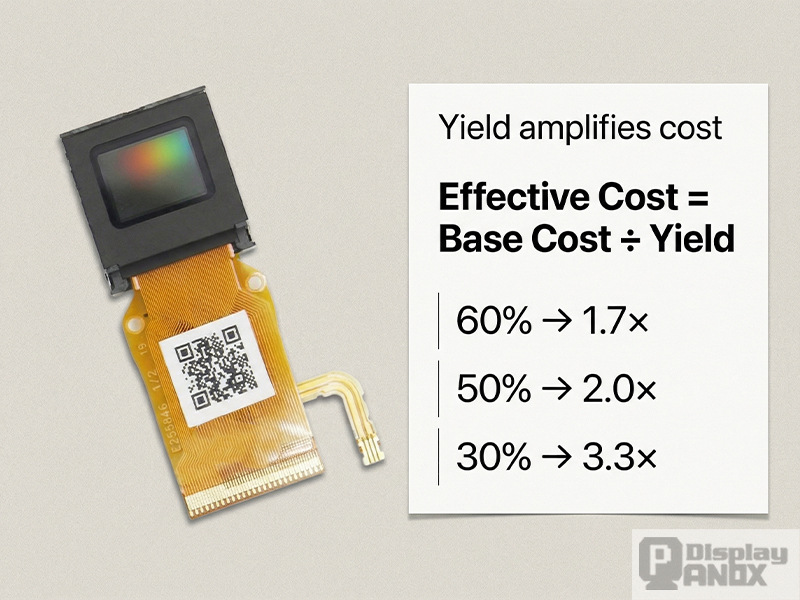
The Cost Math: The industry average yield for Micro OLED sits between 30% and 50% (though top-tier players like Sony can reach 60%).
-
If the base manufacturing cost is $100, a 50% yield effectively makes the final cost $200 per panel. A 30% yield skyrockets that cost to $333.
-
3. Production Line Investment Breakdown
Setting up a factory for Micro OLED requires a massive upfront capital investment, especially when compared to the production capacity it yields. Below is a comparison of different display technology production lines:
| Production Line Type | Estimated Investment (RMB) | Estimated Monthly Capacity |
| LCD Gen 8 Line | 20 - 30 Billion | 150,000 sheets |
| OLED Gen 6 Line | 30 - 40 Billion | 30,000 sheets |
| Micro OLED Pilot Line | 1 - 2 Billion | Thousands of sheets |
| Micro OLED Mass Production | 5 - 10 Billion | Tens of thousands of sheets |
Note: A single high-end OLED evaporation machine alone can cost between 300 and 500 million RMB.
4. Current Market Pricing and Future Trends
How much does a Micro OLED screen actually cost today, and when will it get cheaper?
-
Current Consumer Market: The premium Micro OLED displays used in the Apple Vision Pro cost an estimated $300 to $500 per unit. Sony's M3-Z micro-displays can range from $800 to $1500, while emerging Chinese modules are targeting the $200 to $400 range.
-
The Downward Trend: In 2020, a single panel cost roughly $800-$1000. Today, it averages $300-$500. By 2025, industry experts project the cost will drop to $150-$300 per unit.
5. When Will Micro OLED Become Affordable?
The timeline for cost reduction is clear, mapped out over three phases:
-
Short-Term (1-2 Years): Costs will drop as average yield rates push past 60% and equipment becomes more localized, reducing initial investment burdens.
-
Medium-Term (3-5 Years): The industry will transition from 8-inch to 12-inch silicon wafers, drastically improving material utilization. Costs are expected to drop by 50%.
-
Long-Term (5+ Years): As the technology fully matures and enters large-scale consumer electronics, the cost of a Micro OLED panel could plummet to just 20-30% of its current price.
Learn more:Why AR MR Glass Need High Brightness Micro OLED?
Frequently Asked Questions (FAQ)
Q1: Why is Micro OLED more expensive than Flexible OLED or QLED?
A: While Flexible OLED uses plastic substrates and QLED relies on quantum dots over traditional backplanes, Micro OLED is built directly onto expensive silicon wafers using semiconductor-grade CMOS processes. This requires completely different, highly specialized, and expensive manufacturing equipment.
Q2: Will the high cost of Micro OLED prevent VR/AR mainstream adoption?
A: In the short term, yes. High costs are why headsets like the Vision Pro are priced at $3,499. However, as production scales and costs drop by an expected 50% over the next few years, mid-range VR devices featuring Micro OLED will likely drop to a much more accessible consumer price point.
Q3: What other devices will use Micro OLED in the future?
A: Beyond VR/AR headsets, you can expect to see Micro OLED technology heavily integrated into advanced Automotive HUDs (Heads-Up Displays), professional camera viewfinders, and high-end medical and military imaging equipment where extreme clarity is non-negotiable.
Q4: Can traditional display manufacturers easily switch to making Micro OLED?
A: No. The manufacturing process is fundamentally different. It represents a crossover between the traditional display industry and the semiconductor industry, requiring a completely new learning curve and billions in fresh equipment investments.
Not sure which to choose? Browse our [Micro OLED and QLED solutions].
| Panel model | Interface | Type | Size (inch) | Resolution | P.S |
| S032WEM01 | MIPI/RGB | Micro OLED | 0.32 | 800x600 | |
| PMOF039XGAM | RGB | Micro OLED | 0.39 | 1024x768 | Full Color/Monochrome |
| BO039M1920M | MIPI | Micro OLED | 0.39 | 1920x1080 | Highest PPI =5644 |
| EP047M800T | TTL | LCOS | 0.47 | 800x600 | |
| BO049FHPMO | SPI,MIPI | Micro OLED | 0.49 | 1920x1080 | |
| S050M1600M | MIPI | Micro OLED | 0.5 | 1600x1200 | |
| ECX331DB-6 | Mini LVDS | Micro OLED | 0.5 | 1024x768 | |
| S060LDM01 | MIPI | Micro OLED | 0.6 | 1920x1080 | |
| ECX335AF | Mini LVDS | Micro OLED | 0.71 | 1920x1080 | 200 nits brightness version |
| ECX335B | Mini LVDS | Micro OLED | 0.71 | 1920x1080 | 500 nits brightness version |
| ECX335SN | Mini LVDS | Micro OLED | 0.71 | 1920x1080 | 3000 nits brightness version |
| BO071M1920M | MIPI | Micro OLED | 0.71 | 1920x1080 | |
| S072WCM04 | MIPI | Micro OLED | 0.72 | 1920x1080 | |
| S103WAM01 | MIPI | Micro OLED | 1.03 | 2560x2560 |