



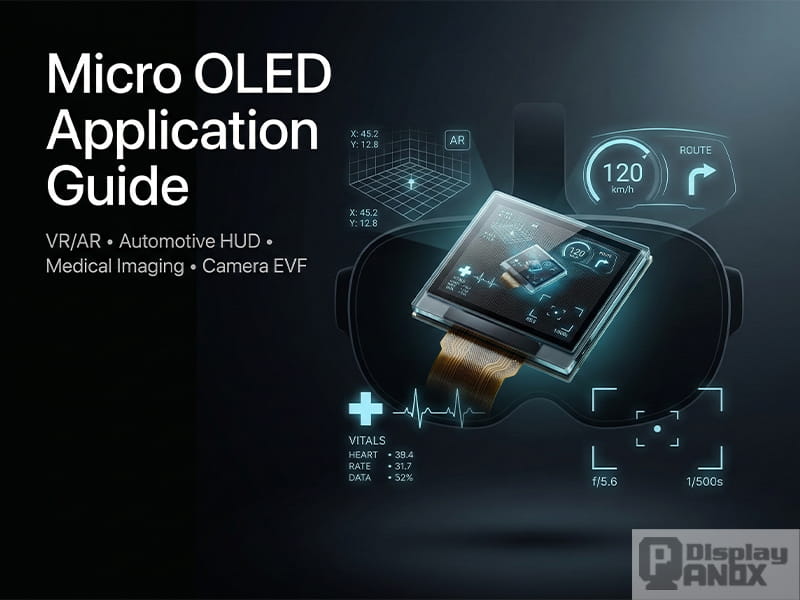
Micro OLED is rapidly transforming the display industry with its ultra-high pixel density, ultra-thin and light form factor, and extremely fast response times. As manufacturing costs decrease and production capacity increases, this revolutionary technology is poised for explosive growth over the next 5 to 10 years.
If you are wondering where this advanced display technology is making its mark, here is a comprehensive breakdown of the top Micro OLED applications across various industries.
To stay ahead in the competitive hardware market, discovering the right Micro OLED solutions is crucial for your product's success.
1. VR/AR Headsets: The Largest Current Market
Virtual Reality (VR) and Augmented Reality (AR) headsets represent the biggest and most mature market for Micro OLED today.
-
Industry Leaders: The Apple Vision Pro uses Micro OLED displays featuring over 4K resolution per eye and a pixel density of around 4000+ PPI, setting an industry benchmark. Brands like Meta (Quest Pro/Quest 3), ByteDance (PICO series), Sony (PlayStation VR2), Samsung, and LG are also actively transitioning to or investing in this technology.
-
The "Screen Door" Solution: Traditional LCDs max out at 800-1000 PPI, which is insufficient for retina-level VR viewing. Micro OLED is currently the only mass-producible solution capable of reaching the 2000+ PPI required to eliminate the distracting "screen door effect".
2. Camera Electronic Viewfinders (EVF)
Professional photographers rely on Micro OLED for critical shooting scenarios.
-
Flagship Adoption: Top-tier cameras like the Sony A7S III, Canon R5, Nikon Z9, and Panasonic S5 II utilize Micro OLED EVFs.
-
Key Advantages: These viewfinders provide 100% sRGB/Adobe RGB color gamut coverage, flicker-free 120Hz refresh rates, and infinite contrast that reveals rich details in dark areas. They meet the strict demands for high brightness, zero-delay response, and true-to-life color reproduction.
3. Automotive Displays and HUDs
As smart cars evolve, Micro OLED is becoming a key differentiator for interior displays.
-
Head-Up Displays (HUD): Automakers like NIO (ET series standard AR-HUD), Li Auto (L series), and BYD are actively adopting large-size HUDs.
-
Strict Requirements: Automotive applications demand ultra-high brightness (5000-10000 nits) for glare resistance, high reliability against heat and vibration, and a lifespan exceeding 10 years. Broad adoption will depend on significant cost reductions.
4. Medical Imaging Displays
In precision medicine, flawless visualization is a necessity, not a luxury.
-
Surgical Use Cases: Micro OLEDs are used in endoscopes (for digestive, respiratory, and joint examinations) and surgical microscopes for neurosurgery and ophthalmology.
-
Display Demands: They fulfill critical medical requirements such as 4K+ resolution, medical-grade color accuracy (DCI-P3 95%+), 24/7 stability, and low latency with zero ghosting.
5. Military, Security, and Other Consumer Electronics
Beyond the major sectors, Micro OLED is finding niche yet highly impactful applications.
-
Military/Security: Ideal for night vision goggles, drone control displays, and fighter pilot helmet displays due to their low power consumption, lightweight design, and fast response times in complex environments.
-
Smartwatches & AR Glasses: Devices like the Apple Watch Ultra series and AR glasses (e.g., Thunderbird X2, Rokid Max) benefit from the thinness and high brightness of Micro OLED, though high costs currently limit smartwatch penetration. FPV drones also utilize them for high-speed, blur-free real-time image transmission.
Projected Micro OLED Market Growth (2026-2030)
The market size for Micro OLED applications is projected to grow exponentially as costs decrease:
| Year | Market Size (Estimated) | Primary Market Breakdown |
| 2024 | ~$1.5 Billion | VR/AR (70%), EVF (20%), Others (10%) |
| 2026 | ~$2.5 Billion | VR/AR (65%), EVF (15%), Automotive (10%) |
| 2027 | ~$5.0 Billion | VR/AR (55%), Automotive (20%), Medical (15%) |
| 2030 | ~$10.0+ Billion | Diversified, with Automotive and Medical shares rising significantly |
Frequently Asked Questions (FAQ)
Why is Micro OLED better than LCD for VR headsets?
Traditional LCD screens max out around 800-1000 PPI, which causes a "screen door effect" when placed close to the eyes. Micro OLED is the only mass-producible solution capable of reaching 2000 to 4000+ PPI, enabling crystal-clear, retina-level displays.
What are the main requirements for automotive Micro OLED displays?
Automotive Micro OLEDs must withstand extreme conditions. They require ultra-high brightness between 5000 and 10000 nits to remain visible in direct sunlight, need to resist high temperatures and vibrations, and must offer a lifespan of over 10 years (100,000 hours).
Will Micro OLED replace screens on everyday consumer electronics like smartwatches?
While Micro OLED offers fantastic benefits for smartwatches—such as being lightweight, thin, and very bright (as seen in the Apple Watch Ultra series)—its current market penetration remains low. Wide adoption in everyday consumer electronics depends heavily on reducing manufacturing costs.
Ready to elevate your device's visual experience? Discover our industry-leading Micro OLED products and find the perfect fit for your manufacturing needs.
| Panel model | Interface | Type | Size (inch) | Resolution | P.S |
| S032WEM01 | MIPI/RGB | Micro OLED | 0.32 | 800x600 | |
| PMOF039XGAM | RGB | Micro OLED | 0.39 | 1024x768 | Full Color/Monochrome |
| BO039M1920M | MIPI | Micro OLED | 0.39 | 1920x1080 | Highest PPI =5644 |
| EP047M800T | TTL | LCOS | 0.47 | 800x600 | |
| BO049FHPMO | SPI,MIPI | Micro OLED | 0.49 | 1920x1080 | |
| S050M1600M | MIPI | Micro OLED | 0.5 | 1600x1200 | |
| ECX331DB-6 | Mini LVDS | Micro OLED | 0.5 | 1024x768 | |
| S060LDM01 | MIPI | Micro OLED | 0.6 | 1920x1080 | |
| ECX335AF | Mini LVDS | Micro OLED | 0.71 | 1920x1080 | 200 nits brightness version |
| ECX335B | Mini LVDS | Micro OLED | 0.71 | 1920x1080 | 500 nits brightness version |
| ECX335SN | Mini LVDS | Micro OLED | 0.71 | 1920x1080 | 3000 nits brightness version |
| BO071M1920M | MIPI | Micro OLED | 0.71 | 1920x1080 | |
| S072WCM04 | MIPI | Micro OLED | 0.72 | 1920x1080 | |
| S103WAM01 | MIPI | Micro OLED | 1.03 | 2560x2560 |