



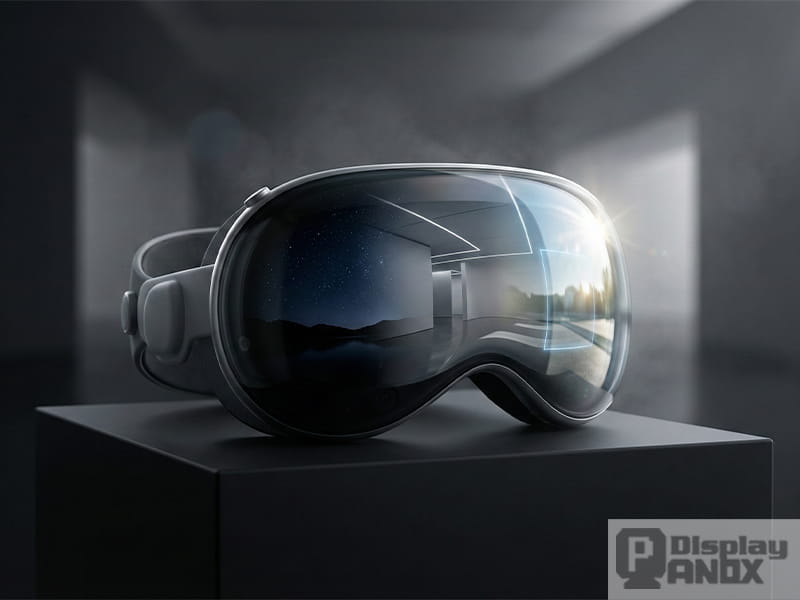
The hardware race for the next generation of spatial computing is heating up. With the launch of the Apple Vision Pro and the reveal of Meta’s Orion prototype, the spotlight has shifted to the most critical component of these devices: the display.
However, not all "screens" are created equal. The industry is currently split between three dominant microdisplay technologies: Micro OLED, LCoS, and MicroLED. Each offers distinct advantages and significant trade-offs depending on whether the goal is immersive Virtual Reality (VR) or lightweight Augmented Reality (AR).
This article breaks down the technical differences, performance metrics, and ideal use cases for Micro OLED, LCoS, and MicroLED to determine which technology will rule the future of XR.
Explore More Displays for AR/VR Applications
The Core Challenge: Immersion vs. Transparency
Before diving into the technologies, it is essential to understand the diverging requirements of XR hardware.
VR and Mixed Reality (Video Pass-Through)
Devices like the Apple Vision Pro or Meta Quest 3 block out the real world. They rely on cameras to show the outside view (Video Pass-Through).
-
Key Requirement: Extreme pixel density (to remove the "screen door effect") and infinite contrast for immersion.
-
Less Critical: Extreme brightness (since the optical path is closed).
Augmented Reality (Optical See-Through)
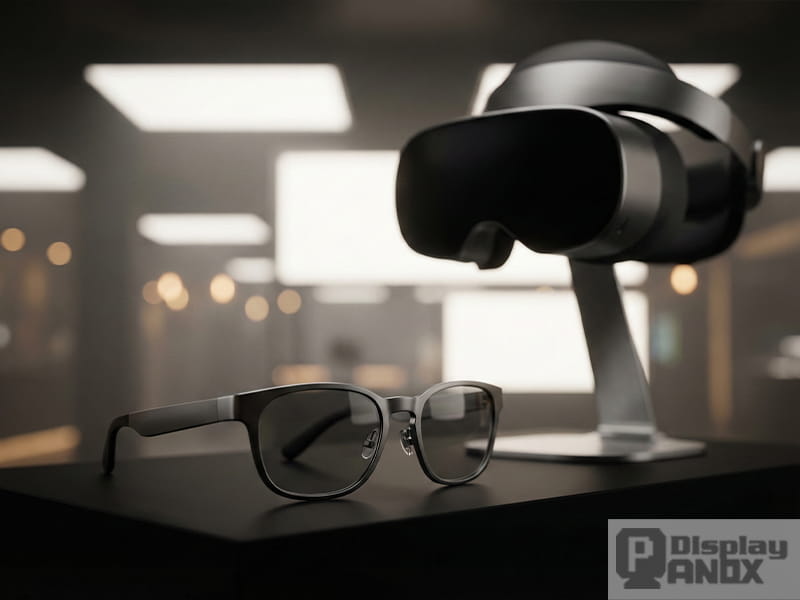
Devices like Magic Leap 2 or RayNeo X2 use transparent lenses (waveguides) to overlay digital images onto the real world.
-
Key Requirement: Extreme brightness. Waveguides are notoriously inefficient, often losing 99% of the light before it hits the eye. The display must compete with sunlight.
- Constraint: Form factor must be tiny to fit into regular glasses frames.
Micro OLED: The King of VR and MR
Micro OLED (Organic Light Emitting Diode on Silicon), also known as OLEDoS, deposits organic light-emitting materials directly onto a silicon wafer rather than a glass substrate.
The Advantages
-
Superior Image Quality: Micro OLED offers perfect blacks and infinite contrast ratios. This is vital for VR, where a "grayish black" ruins immersion.
-
High Pixel Density (PPI): Because it uses silicon backplanes, manufacturers can pack thousands of pixels per inch (3,000+ PPI). This creates a "Retina-level" experience where individual pixels are indistinguishable.
-
Fast Response Time: Microsecond-level response times significantly reduce motion blur and motion sickness in VR.
The Limitations
-
Brightness Ceiling: Organic materials degrade quickly under high heat and high current. While Micro OLEDs are hitting 3,000–5,000 nits, this is insufficient for outdoor optical AR, which often requires millions of nits at the source to be visible against daylight.
Verdict: Micro OLED is the current standard for high-end VR and Video Pass-Through MR headsets (e.g., Apple Vision Pro, Bigscreen Beyond).
LCoS: The Proven Workhorse for AR
LCoS (Liquid Crystal on Silicon) is a reflective technology. Unlike OLED, it does not emit its own light. Instead, it acts as a microscopic shutter that reflects light from an external source (usually RGB LEDs or Lasers).
The Advantages
-
High Brightness Potential: Since the light source is external, LCoS displays can be blasted with incredibly bright light, making them viewable outdoors.
-
Maturity and Cost: LCoS has been around for decades (used in projectors). The manufacturing process is mature, yields are high, and costs are relatively low compared to newer technologies.
-
High Resolution: It easily supports high resolutions required for detailed data overlays.
The Limitations
-
Contrast Issues: LCoS struggles with "pure black." Even when a pixel is "off," some light leaks through, leading to a glowing rectangular background (the "always-on" rectangle effect) in AR glasses.
-
Form Factor: Because it requires an external light source and a polarizing beam splitter (PBS), the optical engine is physically bulkier than self-emissive displays.
Verdict: LCoS remains the pragmatic choice for enterprise AR and waveguide-based smart glasses where brightness and cost outweigh contrast (e.g., Magic Leap 2, Microsoft HoloLens 2).
MicroLED: The Holy Grail of Spatial Computing
MicroLED consists of microscopic inorganic LEDs (usually smaller than 10 micrometers) that emit light individually. It combines the self-emissive properties of OLED with the brightness and durability of LEDs.
The Advantages
-
Extreme Brightness: MicroLED can achieve source brightness levels exceeding 2 million nits. Even after passing through inefficient diffractive waveguides, the image remains crisp in direct sunlight.
-
Inorganic Durability: Unlike OLED, MicroLED uses inorganic materials (Gallium Nitride), making it immune to burn-in and capable of lasting much longer.
-
Tiny Footprint: It does not require a backlight or bulky prisms, allowing for the creation of truly slim, fashionable eyewear.
-
Efficiency: It consumes significantly less power than LCoS for the same brightness, extending battery life.
The Limitations
-
Manufacturing Difficulty: The process involves "Mass Transfer"—moving millions of microscopic LED chips from a growth wafer to a display backplane with 99.9999% precision. This is incredibly expensive and prone to defects.
-
Full-Color Challenge: Producing efficient red MicroLEDs at tiny scales is physically difficult due to efficiency droop. Many current MicroLED glasses are still monochromatic (green only) for this reason.
Verdict: MicroLED is the future of consumer AR glasses. It is currently used in high-end prototypes and early adopter products (e.g., Meta Orion, Vuzix Shield, RayNeo X2).
Comparative Summary
To summarize the current landscape of the microdisplay market:
|
Feature |
Micro OLED |
LCoS |
MicroLED |
|
Technology |
Emissive (Organic) |
Reflective (Liquid Crystal) |
Emissive (Inorganic) |
|
Best For |
VR / Mixed Reality |
Enterprise AR |
Consumer AR |
|
Brightness |
Moderate |
High |
Extreme |
|
Contrast |
Infinite |
Low to Medium |
Infinite |
|
Maturity |
High |
Very High |
Low (Emerging) |
|
Cost |
High |
Low |
Very High |
Learn more:Why AR MR Glass Need High Brightness Micro OLED?
Conclusion: Who Wins the Market?
There is no single winner because AR and VR have diverged into two separate hardware paths.
For 2025 and beyond, Micro OLED will continue to dominate the immersive VR/MR market. Apple and Sony have proven that for isolating the user and replacing reality with a high-fidelity video feed, organic emissive displays are unbeatable.
However, for Augmented Reality (AR) glasses that look like everyday eyewear, MicroLED is the endgame. While LCoS serves as a reliable bridge technology today, the industry is aggressively investing in MicroLED manufacturing. Once the costs of mass transfer drop and full-color yields improve, MicroLED will likely render LCoS obsolete in the premium segment.
For developers and hardware manufacturers, the choice is clear: choose Micro OLED for immersion, and bet on MicroLED for the future of ubiquitous augmented reality.
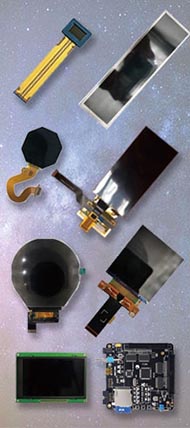
If you are seeking high-performance Micro OLED display solutions, we offer a comprehensive range of products for your selection.
| Panel model | Interface | Type | Size (inch) | Resolution | P.S |
| S032WEM01 | MIPI/RGB | Micro OLED | 0.32 | 800x600 | |
| PMOF039XGAM | RGB | Micro OLED | 0.39 | 1024x768 | Full Color/Monochrome |
| BO039M1920M | MIPI | Micro OLED | 0.39 | 1920x1080 | Highest PPI =5644 |
| EP047M800T | TTL | LCOS | 0.47 | 800x600 | |
| BO049FHPMO | SPI,MIPI | Micro OLED | 0.49 | 1920x1080 | |
| S050M1600M | MIPI | Micro OLED | 0.5 | 1600x1200 | |
| ECX331DB-6 | Mini LVDS | Micro OLED | 0.5 | 1024x768 | |
| S060LDM01 | MIPI | Micro OLED | 0.6 | 1920x1080 | |
| ECX335AF | Mini LVDS | Micro OLED | 0.71 | 1920x1080 | 200 nits brightness version |
| ECX335B | Mini LVDS | Micro OLED | 0.71 | 1920x1080 | 500 nits brightness version |
| ECX335SN | Mini LVDS | Micro OLED | 0.71 | 1920x1080 | 3000 nits brightness version |
| BO071M1920M | MIPI | Micro OLED | 0.71 | 1920x1080 | |
| S072WCM04 | MIPI | Micro OLED | 0.72 | 1920x1080 | |
| S103WAM01 | MIPI | Micro OLED | 1.03 | 2560x2560 |