



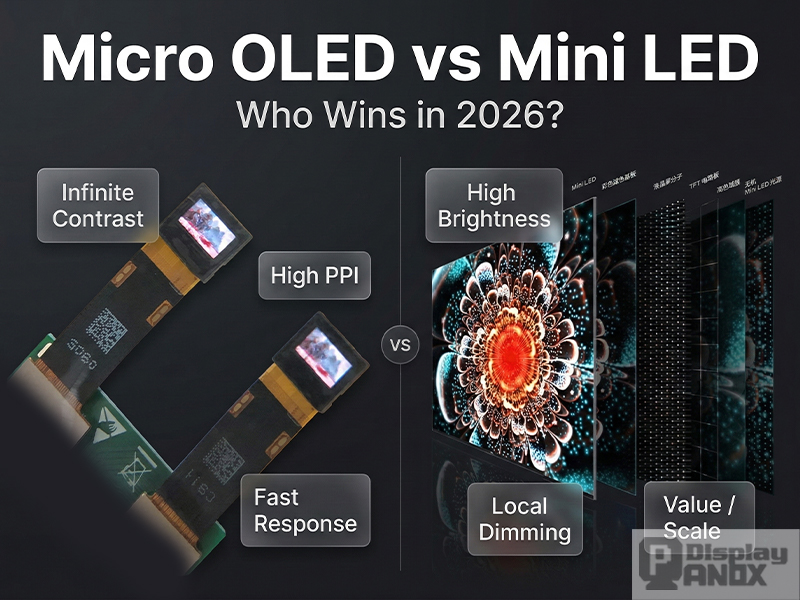
In the rapidly evolving world of display technology, two contenders have emerged as frontrunners for the next generation of visual experiences: Micro OLED and Mini LED. While both offer significant improvements over traditional screens, they utilize fundamentally different architectures to achieve high performance.
Understanding Micro OLED: The Self-Emissive Powerhouse
Micro OLED, also known as Silicon-based OLED (Micro OLED), represents a leap in display engineering. Unlike traditional OLEDs that use glass substrates, Micro OLED is built directly onto silicon wafers.
-
Self-Emissive Nature: Every pixel acts as its own light source, allowing for "true blacks" as pixels can be turned off completely.
-
Extreme Pixel Density: Micro OLED can achieve over 3000 PPI (pixels per inch), making it nearly impossible to see individual pixels even at close range.
-
Ultra-Thin Profile: By removing the need for a backlight, these displays are roughly 1/3 the thickness of a traditional LCD.
-
Instant Response: With microsecond-level response times, motion blur is virtually eliminated.
Understanding Mini LED: The Ultimate LCD Evolution
Mini LED is a sophisticated refinement of the traditional mini lcd display architecture. Instead of a few large backlights, it uses thousands of tiny LEDs to illuminate the screen.
-
Advanced Backlighting: Thousands of Mini LEDs are divided into local dimming zones to mimic the contrast of OLED.
-
Unmatched Brightness: These displays can easily hit 1000 to 3000 nits, making them ideal for HDR content and bright environments.
-
Cost Efficiency: Because it builds on existing LCD manufacturing lines, it is more affordable for large-scale production.
-
Durability: Unlike organic materials, Mini LED components do not suffer from the same degradation risks over time.
Core Comparison: Micro OLED vs. Mini LED
| Feature | Micro OLED | Mini LED |
| Light Source | Self-emissive | Backlit (LCD-based) |
| Pixel Density | 3000+ PPI | 200–400 PPI |
| Contrast Ratio | Infinite (True Black) | ~100,000:1 |
| Peak Brightness | 500–5,000 nits | 1,000–3,000 nits |
| Response Time | Microseconds | Milliseconds |
| Form Factor | Ultra-thin (<1mm) | Thicker (5–10mm) |
| Manufacturing Cost | Extremely High | Moderate |
To see these specs in action, you can browse our high-performance Micro OLED modules designed for extreme precision.
Strategic Applications: Where Each Shines
Micro OLED is the choice for:
-
VR/AR Headsets: Where high PPI is mandatory to eliminate the "screen-door effect".
-
Electronic Viewfinders (EVF): Used in professional cameras for real-time, high-fidelity monitoring.
-
Medical & Military: Critical for endoscopes and night-vision gear requiring precision and low weight.
Mini LED is the choice for:
-
Large Format TVs: Dominating the 65-inch+ market with superior brightness.
-
High-End Monitors: Providing professional-grade color accuracy for creators at a lower price point than OLED.
-
Laptops & Tablets: Balancing battery efficiency with high-quality HDR performance.
The Verdict: Which is Better?
The "better" technology depends entirely on the application:
-
For Portability and Immersion: Micro OLED is the winner for VR/AR and wearable tech where weight and pixel density are the top priorities.
-
For Large Screens and Value: Mini LED remains the superior option for televisions and desktop displays, offering high brightness and longevity without the premium price tag of silicon-based tech.
As manufacturing capacity grows—led by major players like BOE and SeeYA—we expect both technologies to coexist in their respective niches rather than one fully replacing the other.
Ready to elevate your visual experience? Discover our premium Micro OLED solutions and request a custom quote today.
| Panel model | Interface | Type | Size (inch) | Resolution | P.S |
| S032WEM01 | MIPI/RGB | Micro OLED | 0.32 | 800x600 | |
| PMOF039XGAM | RGB | Micro OLED | 0.39 | 1024x768 | Full Color/Monochrome |
| BO039M1920M | MIPI | Micro OLED | 0.39 | 1920x1080 | Highest PPI =5644 |
| EP047M800T | TTL | LCOS | 0.47 | 800x600 | |
| BO049FHPMO | SPI,MIPI | Micro OLED | 0.49 | 1920x1080 | |
| S050M1600M | MIPI | Micro OLED | 0.5 | 1600x1200 | |
| ECX331DB-6 | Mini LVDS | Micro OLED | 0.5 | 1024x768 | |
| S060LDM01 | MIPI | Micro OLED | 0.6 | 1920x1080 | |
| ECX335AF | Mini LVDS | Micro OLED | 0.71 | 1920x1080 | 200 nits brightness version |
| ECX335B | Mini LVDS | Micro OLED | 0.71 | 1920x1080 | 500 nits brightness version |
| ECX335SN | Mini LVDS | Micro OLED | 0.71 | 1920x1080 | 3000 nits brightness version |
| BO071M1920M | MIPI | Micro OLED | 0.71 | 1920x1080 | |
| S072WCM04 | MIPI | Micro OLED | 0.72 | 1920x1080 | |
| S103WAM01 | MIPI | Micro OLED | 1.03 | 2560x2560 |