



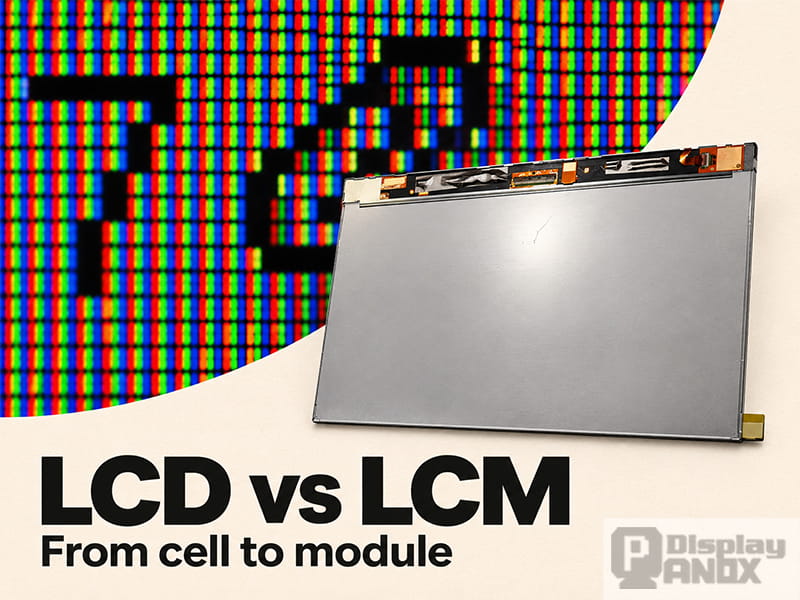
A common request in display sourcing sounds simple: "We need an LCD."
But before preparing a quotation, a supplier may ask one more question: Is the requirement for an LCD panel or cell, or for a complete LCD module?
This is where confusion often starts. Customers may use LCD, LCD panel, and LCM interchangeably, even though these terms do not describe exactly the same thing. In some cases, a technical drawing specifies an LCM while a purchase order simply says LCD module. Both may refer to the same assembled display product.
So, what is the difference between LCD and LCM?
The distinction is mainly about terminology and product integration. LCD stands for Liquid Crystal Display, the underlying display technology. LCM stands for Liquid Crystal Module, an assembled display unit built around an LCD panel.
When discussing the difference in practical sourcing terms, the comparison is usually between a less-integrated LCD panel or cell and a more complete LCD module.
What Does LCD Mean?
LCD stands for Liquid Crystal Display. It is a display technology that uses liquid crystal material to control how light passes through a screen.
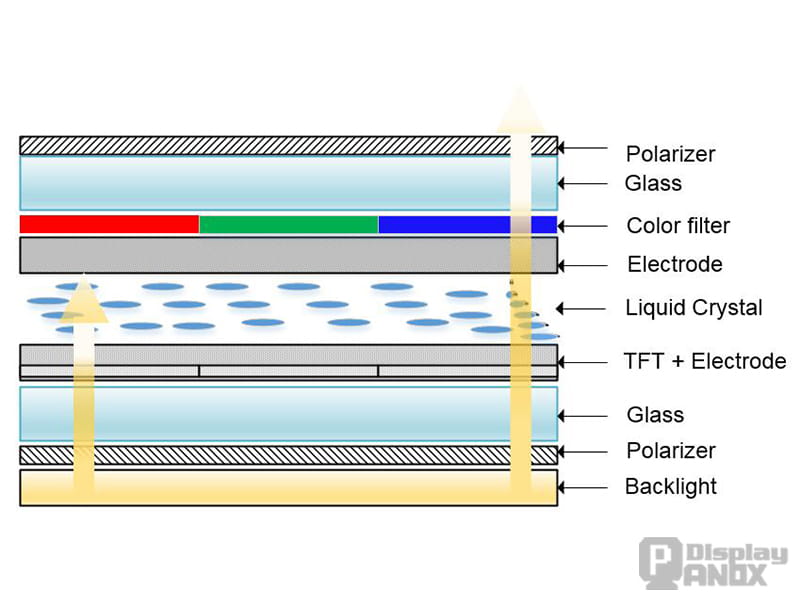
A typical color TFT LCD panel has a sandwich-like structure. Two glass substrates are assembled with a thin layer of liquid crystal material between them. One substrate carries the thin-film transistor (TFT) array, while the other contains the color filter. Polarizers are attached to the outer surfaces of the glass.
When electrical signals are applied, the liquid crystal molecules change their orientation, controlling the amount of light that passes through each pixel. The color filter separates the light into red, green, and blue components to produce a full-color image.
There is one important characteristic to understand: liquid crystals do not generate light by themselves.
A transmissive LCD relies on an external light source, usually an LED backlight positioned behind the panel. Without this light source, the image cannot be viewed under normal operating conditions.
However, not every LCD requires a backlight. Reflective LCDs use ambient light to produce a visible image, while transflective LCDs combine ambient light with an optional backlight. The lighting structure depends on the display technology and intended application.
LCD Glass, LCD Cell, and LCD Panel: Are They the Same?
These terms are closely related, but they should not always be treated as interchangeable.
-
LCD Glass: Refers to the glass substrates used in the display structure. In supplier conversations, the term may also be used informally to describe a liquid crystal cell.
-
LCD Cell: Refers to the assembled glass cell containing the liquid crystal layer and the associated electrode structures. Its exact manufacturing stage and included optical layers depend on the production process.
-
LCD Panel: A broader term for the image-forming display component. Depending on the manufacturer and product specification, it may refer to the cell itself or a more developed panel assembly.
Another term frequently used in display manufacturing is Open Cell. It generally describes an LCD panel assembly supplied without the complete backlight and module-level integration. However, the exact configuration should always be confirmed against the supplier's drawings and bill of materials.
This distinction matters because the word LCD alone does not tell a buyer whether the product is a bare cell, an open cell, or a more complete display assembly.
What Is an LCM (Liquid Crystal Module)?
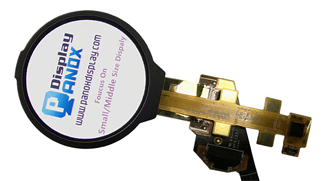
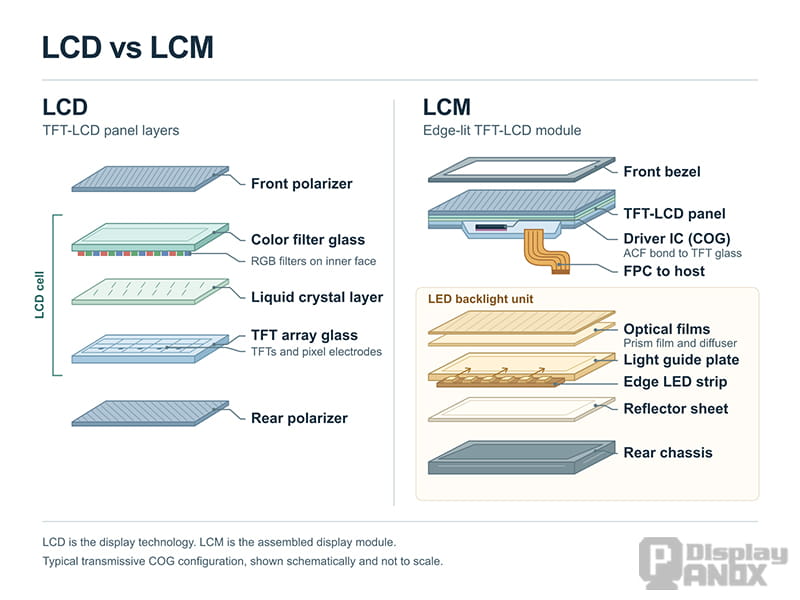
LCM stands for Liquid Crystal Module. It is an assembled display unit built around an LCD panel, with the necessary supporting components integrated according to the product design.
A typical transmissive TFT LCD module may include the following components:
-
LCD Panel: The image-forming component containing the liquid crystal cell.
-
Backlight Unit (BLU): Provides illumination for transmissive LCDs. It commonly includes LEDs, a light guide plate, a reflector, and optical films.
-
Driver IC: Provides the electrical signals required to control the LCD pixels.
-
FPC (Flexible Printed Circuit): Connects the display components to the host system and carries the required power, data, and control signals.
-
PCB and Mechanical Components: Depending on the design, a module may include a separate PCB, supporting frame, or other structural components.
The exact configuration varies between products. Some modules integrate the driver IC directly onto the glass or flexible film, while others use a separate PCB. Reflective LCD modules may not need a backlight at all.
The important point is that an LCM combines the LCD panel with the supporting components needed to function as a more complete display assembly.
How Is the Driver IC Integrated into an LCD Module?
One important part of LCM manufacturing is the integration of the driver IC.
For compact LCD modules, COG (Chip on Glass) is a commonly used approach.
With COG technology, the driver IC is mounted directly onto the LCD glass substrate. This reduces the need for a separate packaged IC on a larger PCB and helps keep the module compact.
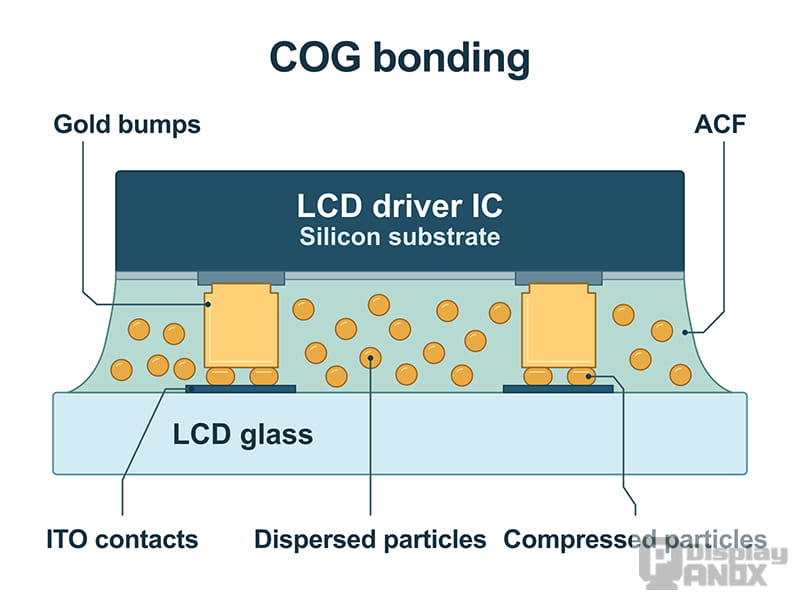
Another approach is COF (Chip on Film), where the driver IC is mounted on a flexible film connected to the display. Some designs use COB (Chip on Board), placing the driver IC on a PCB associated with the LCD.
These methods offer different advantages in terms of module thickness, connection layout, manufacturing processes, and mechanical design.
The FPC provides the electrical connection between the module and the host system. Once the LCD panel, driver circuitry, backlight where required, and other supporting components are assembled, the LCM becomes a functional display module.
For a closer look at the internal structure and light path, see How Does an LCD Screen Work? From the Backlight to Pixel Drive.
LCD Panel vs LCM: What Are the Main Differences?
The main difference between a less-integrated LCD panel and an LCM is the level of assembly and component integration.
An LCD panel is primarily responsible for forming the image. Depending on its configuration, it may still need a backlight, driver circuitry, FPC connections, or other supporting components.
An LCM combines the LCD panel with these components into a more integrated display assembly.
| Comparison | LCD Panel / Cell (Supplied Separately) | LCM (LCD Module) |
|---|---|---|
| What It Refers To | The image-forming LCD component | An assembled liquid crystal display module |
| Main Structure | Glass substrates, liquid crystal layer, and associated optical layers | LCD panel plus supporting optical, electrical, and mechanical components |
| Driver IC | May be supplied separately or integrated into the panel | Commonly included, depending on the module design |
| Backlight | May be supplied separately or omitted depending on display type | Typically included in transmissive TFT LCD modules |
| FPC / Connection | Configuration depends on the panel supply | Commonly integrated into the module |
| Integration Level | Depends on the supplied panel configuration | Generally more integrated |
| Typical Use | Further display assembly and manufacturing | Integration into electronic products |
The terminology can overlap in commercial specifications. Some suppliers use LCD panel to describe a product that already includes a backlight and driver IC. Others use it specifically for the cell or open-cell assembly.
For this reason, the actual product structure, datasheet, and bill of materials are more reliable than the product name alone.
Why Can't a Bare LCD Cell Be Used as a Complete Display?
A bare LCD cell may look like a finished screen, but its appearance does not mean it is ready for direct use.
The liquid crystal cell requires appropriate electrical driving signals to control its pixels. A transmissive LCD also needs a suitable backlight to make the image visible. The electrical connections, driver circuitry, and mechanical support must be properly configured.
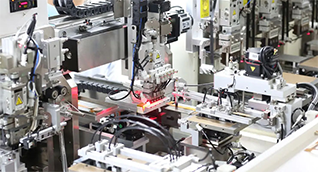
During LCM manufacturing, processes such as polarizer attachment, COG or COF bonding, backlight assembly, and FPC connection bring these elements together.
If a customer purchases an LCD cell or open cell without the required supporting components, additional assembly and integration work will be necessary.
It is worth clarifying that applying power alone does not make a bare LCD cell display an image. The panel needs the correct driving signals, voltage levels, and, for transmissive displays, an appropriate light source. It can be tested with compatible external driving electronics and a suitable backlight, but it is not a plug-and-play display.
Even when an LCM already includes a driver IC, it does not automatically mean that the module can connect directly to any computer or video source.
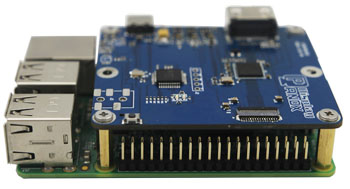
The host device must support a compatible display interface, such as RGB, MIPI DSI, or LVDS. If the host only provides HDMI or DisplayPort, an additional controller board may be required to convert the input signal into a format supported by the display.
This is particularly important during product development. A display may have the correct size and resolution but still fail to work with the existing mainboard because the interface, voltage, pin assignment, or initialization sequence does not match.
Panox Display provides customized display controller solutions for different interfaces. More information is available on the LCD/OLED Controller and Driver Board page.
What About a Touchscreen Assembly?
There is another term that frequently appears in display sourcing: the touchscreen assembly.
An ordinary LCM provides image output, but it does not necessarily include touch functionality.
When touch input is required, additional components may be integrated with the display, including a touch panel (TP), protective cover glass, and the corresponding touch controller.
A typical touchscreen assembly may contain:
-
Cover Glass: Protects the front surface and provides the required appearance and mechanical strength.
-
Touch Panel (TP): Detects touch input. Common options include capacitive touch panels (CTP) and resistive touch panels (RTP).
-
LCD Module (LCM): Provides the actual image output.
-
Bonding Materials: Secure the different layers and maintain the required optical and mechanical properties.
The way these components are assembled also matters.
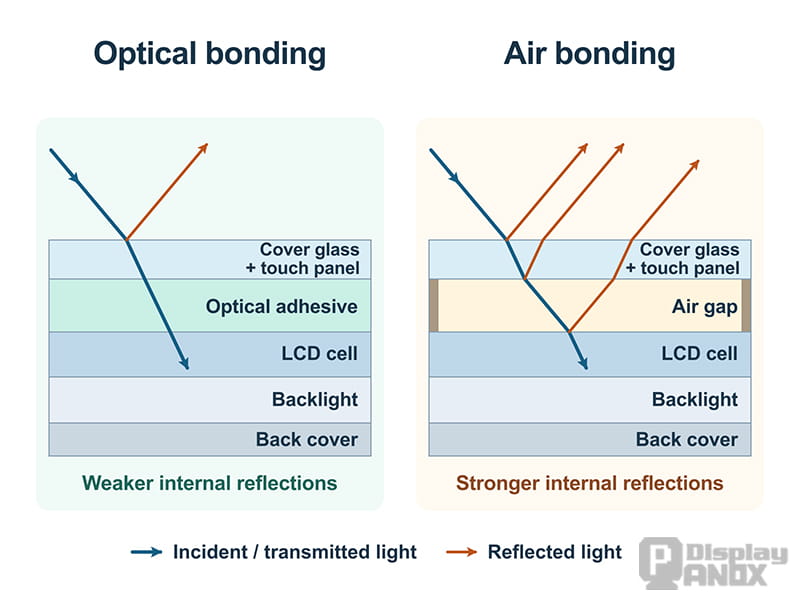
For example, a conventional frame-bonded structure uses adhesive around the perimeter, leaving an air gap between the display and touch panel. Full optical bonding fills the gap with transparent adhesive, reducing internal reflections and improving the visual connection between the layers.
This is why suppliers may ask whether a project requires frame bonding or full optical bonding when a customer requests a display with touch functionality.
There are also integrated touch technologies such as In-Cell and On-Cell, where the touch-sensing function is incorporated into the display structure rather than being treated as an entirely separate component.
For a closer look at these configurations, see In-Cell vs On-Cell vs OGS Touch Screens: Differences in Structure, Cost, and Reliability.
Which One Should Be Ordered: LCD Panel or LCM?
The right choice depends on how much of the display assembly has already been completed and what the final product requires.
If a manufacturer has its own display-driving solution and plans to handle the backlight, driver integration, and mechanical assembly, purchasing an LCD cell or open cell may be appropriate.
If the project requires a more integrated display component that can be incorporated into the main product, an LCM is generally the more practical choice.
However, simply specifying LCM is not enough to guarantee compatibility.
Before placing an order, the following details should be confirmed:
-
Display Specifications: Screen size, resolution, active area, brightness, and viewing angle.
-
Electrical Requirements: Operating voltage, current consumption, and backlight power requirements.
-
Interface: RGB, MIPI DSI, LVDS, SPI, or another supported interface.
-
Driver Configuration: Driver IC model, mounting method, and initialization requirements.
-
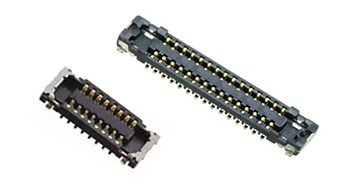
Mechanical Design: Overall dimensions, thickness, mounting points, FPC position, and connector specifications.
-
Touch Requirements: Whether a separate touch panel, cover glass, or integrated touch structure is needed.
At Panox Display, confirming the actual product structure is an important step in matching a display to its application. Different projects may require a standard TFT-LCD module, a customized FPC, a different backlight configuration, or additional driver integration.
The Panox Display TFT-LCD product range includes display options for different sizes, resolutions, interfaces, and applications.
Frequently Asked Questions
Are LCD and LCM Two Different Display Technologies?
No. LCD stands for Liquid Crystal Display and refers to the display technology. LCM stands for Liquid Crystal Module and describes an assembled display product based on LCD technology. The difference is in the product structure and level of integration.
Is LCM the Same as an LCD Module?
Yes. LCM stands for Liquid Crystal Module and is commonly used as an abbreviation for LCD module. Both terms generally refer to an assembled liquid crystal display unit.
Does Every LCM Include a Backlight?
No. Most transmissive TFT LCD modules include an LED backlight, but reflective LCD modules do not require one. Transflective LCDs may use an optional backlight depending on the application.
Does an LCM Always Include a Driver IC?
Most TFT LCD modules include the necessary driver circuitry, but the implementation varies. The driver IC may be mounted directly on the glass using COG, on a flexible film using COF, or on a PCB. The exact configuration should be confirmed in the product datasheet.
Does an LCD Module Include a Touch Panel?
Not necessarily. A standard LCM usually provides display functionality without touch input. A separate touch panel and cover glass may be added, or touch functionality may be integrated through In-Cell or On-Cell technology.
Can an LCD Panel Connect Directly to HDMI?
Generally, no. Most LCD panels and modules use interfaces such as RGB, MIPI DSI, or LVDS. An HDMI-compatible controller board is normally required to convert the HDMI signal into a format supported by the display.
What Information Should Be Provided When Ordering an LCD Module?
Customers should provide the required screen size, resolution, interface, brightness, operating voltage, mechanical dimensions, and touch requirements. If an existing display is being replaced, its model number, datasheet, or technical drawing can help the supplier confirm compatibility.
Conclusion
The difference between LCD and LCM comes down to terminology and product integration.
LCD stands for Liquid Crystal Display, the underlying display technology. In sourcing discussions, LCD may refer to the display panel, cell, or a complete LCD product, depending on the context.
LCM stands for Liquid Crystal Module and refers to an assembled display unit that combines an LCD panel with the supporting components required by its design.
For manufacturers and product developers, understanding this distinction helps avoid quotation errors, mismatched components, and unnecessary integration work.
Before requesting a quotation, it is always worth confirming whether the requirement is for an LCD cell, an open cell, a more integrated LCD panel, or a complete LCM. A clear component specification makes the sourcing process much more straightforward.