



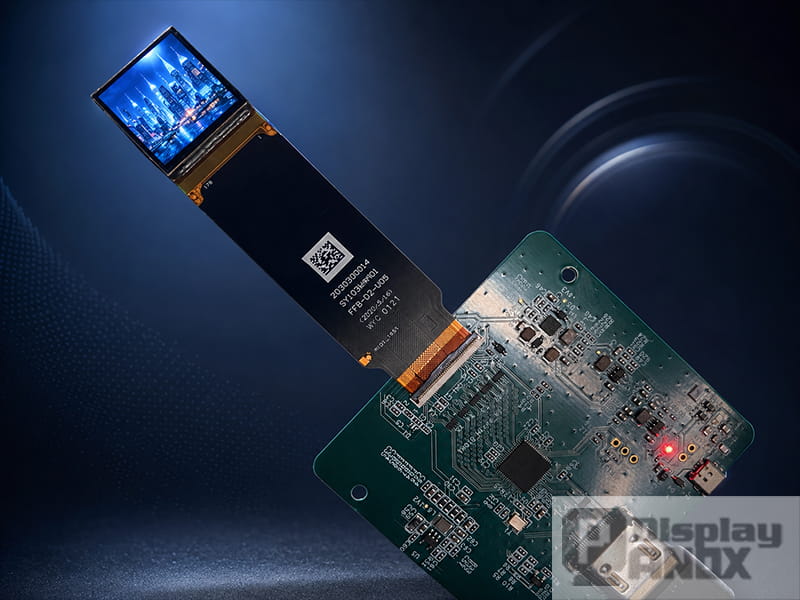
In near-eye hardware, the display is viewed through lenses only a short distance from the human eye. Any visible pixel grid, weak contrast, or motion blur becomes easy to notice. This is one reason engineers often look for a Micro OLED display when developing VR headsets, electronic viewfinders, optical viewers, and compact imaging systems.
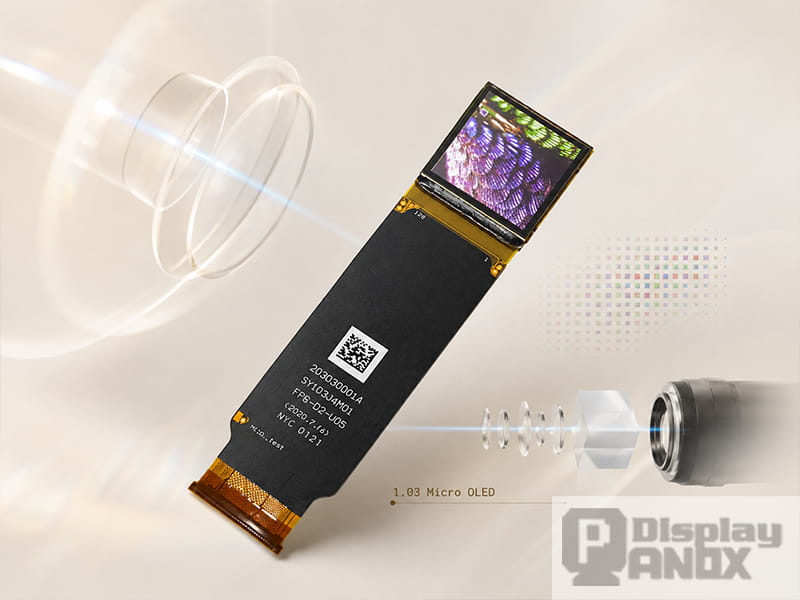
Among different Micro OLED sizes, the 1.03 inch Micro OLED display has a very practical position. It offers a larger square image area than many 0.5 inch or 0.71 inch microdisplays, while still keeping the optical engine compact. For product teams that need fine image detail, readable UI text, deep contrast, and fast response in a small module, this size is worth serious evaluation.
What Makes a Micro OLED Display Suitable for Near-Eye Devices?
Micro OLED, also called OLED-on-silicon or OLEDoS, is built on a silicon backplane. The driving circuit and pixel structure are integrated at a very small scale, allowing the panel to deliver extremely high pixel density in a tiny display area.
For near-eye products, this brings several clear advantages:
-
High pixel density for sharper images viewed through magnifying optics
-
Self-emissive pixels for deep black levels and high contrast
-
Fast response time for smoother motion and reduced blur
-
Compact module size for lighter optical engines
-
Wide color performance for more natural visual output
These qualities explain why Micro OLED is closely linked with VR, MR, AR, EVF, medical optics, and professional viewing systems.
Why the 1.03 Inch Format Matters
A 1.03 inch display may sound small compared with a phone or tablet screen, yet in an optical system it can provide a large and detailed virtual image. The key is how the panel works with lenses, prisms, waveguides, or other optical components.
This 1.03 inch Micro OLED offers a square 2560×2560 RGB resolution, which gives engineers a strong image canvas for near-eye design. The square format is useful for binocular headset systems, professional viewers, and optical modules where central image quality and symmetrical image processing matter.
For many products, the display choice affects much more than image quality. It also influences the size of the optical engine, heat management, power design, interface bandwidth, and overall product structure. Choosing a higher-resolution microdisplay early can help teams avoid redesign work later in the project.
Main Applications of 1.03 Inch Micro OLED Display
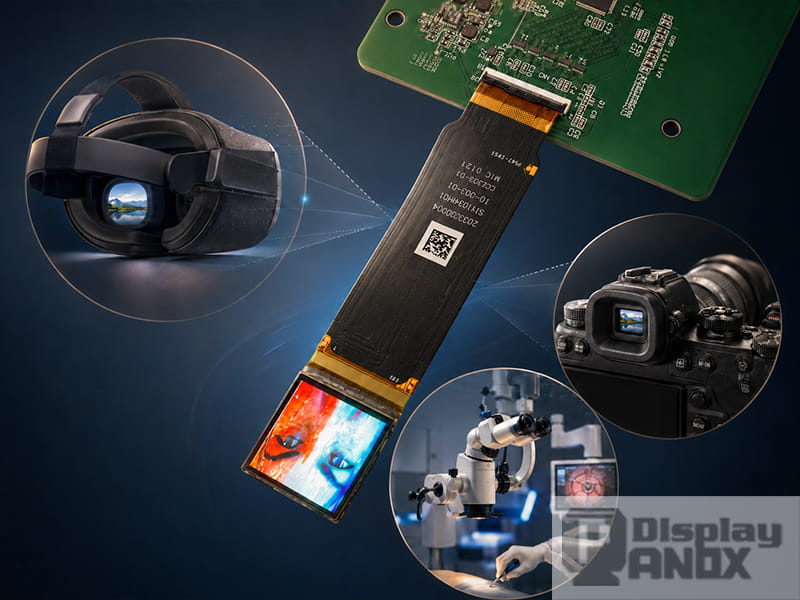
1. VR and MR Headsets
VR and mixed reality devices need a display that can make virtual scenes feel clean and stable. Text, menus, distant objects, and fine textures all become easier to perceive when the panel has high resolution and high pixel density.
A 2560×2560 Micro OLED display is especially attractive for compact VR and MR headset designs. It can support high image detail while helping reduce the size and weight of the display engine. For training headsets, professional simulation equipment, compact VR viewers, and premium prototype systems, this display size can offer a good balance between visual quality and integration space.
The high contrast of Micro OLED is also important in immersive content. Dark scenes, shadow details, and high-contrast UI elements can look more natural compared with many backlit display solutions.
2. Electronic Viewfinders for Cameras and Optical Devices
Electronic viewfinders are one of the most established markets for OLED microdisplays. In an EVF, users need to judge framing, focus, exposure, color, and motion in real time. A low-quality display can make the shooting experience feel less accurate, especially when working with fine details or low-light scenes.
The 1.03 inch Micro OLED display is well suited for camera EVFs, professional imaging viewers, and compact optical monitoring devices. Its high resolution helps users see more detail, while the OLED contrast supports clearer dark-area observation. For camera brands and optical product developers, this type of display can improve the perceived quality of the whole device.
3. Medical and Surgical Optical Equipment
Medical optics often require compact displays with high clarity. Endoscope viewers, surgical microscope systems, portable diagnostic viewers, and head-mounted medical displays all depend on stable and detailed visual output.
A Micro OLED display can be useful in these systems because it combines compact size, high contrast, and fast image response. For medical imaging, clear visual feedback is important when users need to identify fine structures, subtle color differences, or low-contrast details.
Of course, medical products also require full system-level validation, including optical calibration, thermal design, safety testing, and regulatory review. The display is only one part of the final device, yet it plays a major role in the viewing experience.
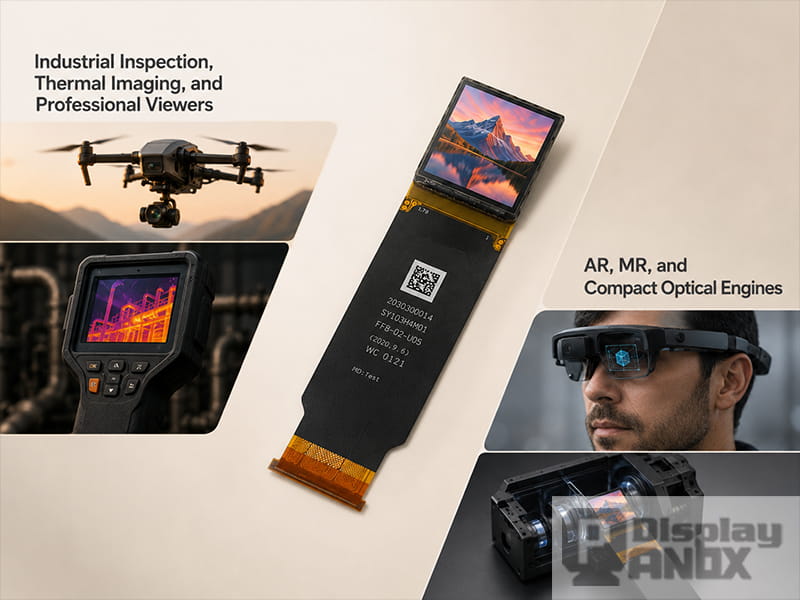
4. Industrial Inspection, Thermal Imaging, and Professional Viewers
Industrial optical equipment often works in space-limited environments. Inspection scopes, thermal imaging viewers, night vision systems, drone control viewers, and remote operation devices all need a compact screen that can display important information clearly.
The 1.03 inch Micro OLED format fits well into many of these professional devices. Its small size helps reduce module weight, while the high resolution supports detailed image monitoring. For systems that display thermal images, sensor feeds, overlays, or machine status information, sharp UI elements can improve usability.
The display’s wide operating temperature range also makes it suitable for products that may be used outside normal consumer environments.
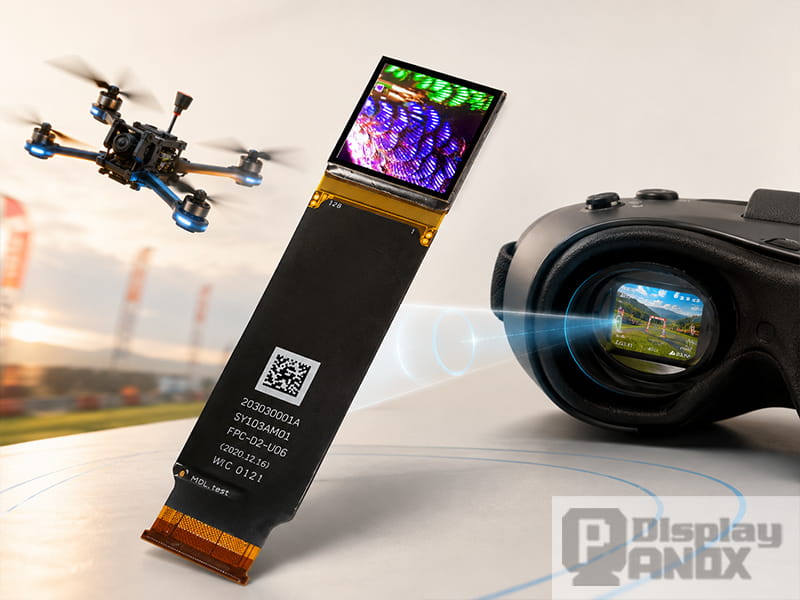
5. AR, MR, and Compact Optical Engines
For very slim AR glasses, smaller and ultra-high-brightness panels are often preferred. For MR headsets, birdbath-style optical modules, research prototypes, and viewer-type AR systems, a 1.03 inch Micro OLED can provide more image detail and a stronger visual foundation.
This makes the panel useful for product teams exploring different near-eye display architectures. If the project requires a larger virtual image, high per-eye resolution, and compact display hardware, the 1.03 inch size can be a practical option to test early.
A Closer Look at the 1.03 Inch Micro OLED Display
Below are key specifications that make this display suitable for high-resolution near-eye and optical applications.
| Feature | Specification |
|---|---|
| Display Type | Active matrix color Micro OLED |
| Size | 1.03 inch diagonal |
| Resolution | 2560 × 2560 RGB |
| Pixel Arrangement | Real RGB |
| Active Area | 18.432 mm × 18.432 mm |
| Pixel Size | 7.2 μm × 7.2 μm |
| Typical Brightness | 1800 cd/m² |
| Typical Contrast Ratio | 500,000:1 |
| Color | 16.7M colors |
| Color Gamut | 90% DCI-P3 typical |
| Interface | MIPI + I2C |
| MIPI Support | 1-port or 2-port D-PHY |
| Frame Rate | 60–90Hz, depending on input and scaling mode |
| Weight | 2g |
| Operating Temperature | -30°C to +70°C |
| Storage Temperature | -40°C to +80°C |
One detail worth noting is the interface flexibility. The module supports MIPI and I2C, with 1-port or 2-port D-PHY options. It also supports VESA DSC and scaling modes, which can help manage high-resolution signal transmission in compact systems.
For engineers, these features are useful because a high-resolution microdisplay requires careful coordination between the host processor, driver configuration, bandwidth, power design, and optical path.
What to Check Before Choosing a Micro OLED Display
Before selecting a MIPI Micro OLED display, it is helpful to evaluate the full system rather than the display alone.
The first point is optical design. The same panel can look very different depending on the lens, prism, eye box, field of view, and image magnification. Early optical testing can help confirm whether the 1.03 inch format matches your target product structure.
The second point is interface bandwidth. A 2560×2560 display carries a large amount of image data, so the host platform, MIPI lane configuration, frame rate target, and compression mode should be checked in advance.
Power and thermal design also matter. Micro OLED panels are compact, and high brightness operation can increase thermal pressure inside a small headset or optical viewer. Good brightness management and heat dissipation help maintain stable performance.
For products with static UI elements, it is also wise to consider image retention prevention. UI movement, brightness control, and display sleep strategies can improve long-term display behavior in real-world use.
Why Consider Panox Display for 1.03 Inch Micro OLED Projects?
For many product teams, choosing the right display is only the beginning. The real challenge is matching the panel with the optical structure, interface design, driver board, power sequence, mechanical space, and sourcing plan.
Panox Display supports OLED and LCD display sourcing for engineering teams, device makers, and OEM projects. For customers evaluating a 1.03 inch Micro OLED display, Panox Display can help with sample selection, specification matching, technical communication, and supply support.
This is especially valuable for near-eye display projects, where a small change in display size or interface can affect the whole product layout. Early evaluation with the right microdisplay can save time during optical testing, prototype development, and pilot production.
Conclusion
The 1.03 inch Micro OLED display is a strong fit for high-resolution near-eye and compact optical systems. With 2560×2560 RGB resolution, high brightness, high contrast, MIPI input, and a lightweight structure, it can support VR/MR headsets, EVFs, medical optics, industrial viewers, and professional imaging products.
For teams building devices where image quality, compactness, and fast response all matter, this display offers a practical path for product development. If your project needs a high-resolution Micro OLED solution for evaluation or production planning, Panox Display can help you review the right option based on your application.
FAQs
What is a Micro OLED display?
A Micro OLED display is an OLED microdisplay built on a silicon backplane. It offers very high pixel density, strong contrast, fast response, and a compact form factor, making it suitable for near-eye display and optical applications.
Is a 1.03 inch Micro OLED display suitable for VR headsets?
Yes. A 1.03 inch Micro OLED with 2560×2560 resolution can be used in VR and MR headset designs that require high image detail, compact display engines, and strong contrast.
Can this display be used for AR glasses?
It depends on the optical design. Slim waveguide AR glasses may require smaller, ultra-high-brightness panels. Viewer-type AR, MR modules, birdbath optics, and research prototypes can benefit from the larger image area and high resolution of a 1.03 inch Micro OLED.
What interface does this 1.03 inch Micro OLED use?
This display supports MIPI and I2C. It can work with 1-port or 2-port MIPI D-PHY configurations, making it suitable for high-resolution embedded display systems.
What should engineers check before integration?
Key points include optical compatibility, MIPI bandwidth, power sequence, driver support, FPC routing, thermal design, brightness settings, and long-term display behavior under the target use case.