



Micro OLED, frequently referred to as Silicon-based OLED, represents a significant leap forward in modern display technology by preparing active light-emitting OLED devices directly onto single crystal silicon wafers. The technology has undergone a fascinating evolution to reach its current state of maturity. In its early stages, MicroOLED was primarily restricted to military applications, powering aiming observation systems, advanced helmet interfaces, and sophisticated simulation training systems. As the underlying technology matured, it began its vital transition into the consumer market. This industrialization process has recently entered an acceleration stage, driven heavily by major technology players like Apple adopting the Micro OLED technology route for their entry into the mixed reality (MR) and AR/VR markets. Today, the technology has reached a maturity stage where it boasts preliminary mass production capabilities, setting the stage for widespread consumer adoption.
Core Technological Advantages and Principles
The fundamental difference between MicroOLED and traditional display technologies lies in its foundation. Unlike traditional OLEDs that utilize glass as a substrate, Micro OLED uses single crystal silicon wafers. This innovative approach allows manufacturers to utilize mature integrated circuit CMOS processes to seamlessly integrate pixel arrays, driver circuits, and signal processing circuits all on the exact same chip.
This architectural shift unlocks several core advantages that make it highly desirable for next-generation devices. First, it offers incredibly high pixel density, making it much easier to achieve a high PPI (pixels per inch) while displaying smaller OLEDs without sacrificing resolution. Second, because the technology is self-emitting, it completely eliminates the need for a bulky backlight module, resulting in a display that is exceptionally light and thin. Additionally, MicroOLED boasts low power consumption paired with high luminous efficiency, and its high response speed makes it perfectly suited for the demanding, high-frame-rate requirements of modern AR and VR applications.
Navigating Technical Challenges
Despite its impressive advantages, scaling MicroOLED technology presents distinct technical and manufacturing hurdles. The material and production process differences between Micro OLED and traditional OLED are significant, imposing stringent new requirements for testing optical, temperature, and display characteristics.
Manufacturers face specific testing equipment bottlenecks. The testing infrastructure must be capable of ultra-high pixel detection density and high-speed detection signal transmission. Furthermore, it requires precision temperature control and advanced semiconductor process testing capabilities.
Cost remains the primary disadvantage when comparing MicroOLED to mature LCD and standard OLED technologies. Because the technology is still bridging the gap to full maturity, production costs are inherently higher. Other technical bottlenecks include a lifespan limited by organic materials, brightness levels that, while higher than LCD, still fall short of Micro LED capabilities, and a heavy reliance on imported upstream core equipment and materials.
Key Innovation Breakthroughs
To overcome these challenges, the industry has seen rapid innovation across the four main stages of the Micro OLED process: silicon-based IC design and manufacturing, the OLED process (including microcavity top emission and full-color technology), the OLED thin-film packaging process (utilizing PECVD and ALD equipment), and the integration of display drivers and systems.
Several companies have recently achieved massive technical breakthroughs. Nanjing Yunguang has pioneered a unique digital drive solution that dramatically reduces power consumption to approximately one-third of traditional analog drive solutions. In the realm of visual fidelity, BOE has launched an industry-leading ultra-high resolution display at an astonishing 5644ppi. Simultaneously, manufacturing scale is expanding, highlighted by SeeYa Technology's massive $300 million investment to build the world's largest 12-inch wafer silicon-based OLED micro-display R&D and production base, which boasts an annual capacity of roughly 20 million displays.
Market Expansion and Applications
The primary driver for MicroOLED adoption is the VR and AR device market. For current mainstream VR devices, Micro OLED's high definition, high refresh rate, high contrast, and lightweight properties make it the most suitable display technology available, and it is positioned to rapidly cannibalize Fast-LCD's market share. In the AR field—which demands significantly higher brightness—Micro LED is viewed as the ultimate long-term solution, but Micro OLED remains an essential and highly capable choice for the short to medium term.
Beyond immersive headsets, MicroOLED is finding footing in various high-end sectors. With the commercial landing of 5G and supportive industry policies, it is being integrated into high-end medical equipment displays, industrial temperature measurement and ranging handheld devices, smart glasses, and electronic viewfinders for camera manufacturers like Sony.
This diverse application base is driving immense market growth. According to DSCC forecasts, global Micro OLED sales exceeded $1.3 billion in 2023 and are projected to double in 2024 to surpass $2.6 billion. By 2027, the AR/VR screen market alone is expected to reach $7.3 billion, growing at an average compound annual growth rate (CAGR) of 50.7% from 2022 to 2027. Global XR Micro OLED panel shipments are expected to eclipse 23 million pieces by 2027, moving from a 3% penetration rate in 2022 to an estimated 30% by 2027.
Industry Chain and Competitive Landscape
The MicroOLED industry chain is divided into upstream raw materials and equipment, midstream panel manufacturing, and downstream terminal applications.
Currently, the upstream segment is the most vulnerable. Key equipment for the array and evaporation segments, along with high-precision raw materials, remains heavily dependent on foreign manufacturers in Japan, South Korea, and the United States. Chinese enterprises are mostly concentrated in the intermediate and crude monomer fields, holding a lower proportion of the highly profitable finished OLED organic light-emitting materials, though a few manufacturers have begun to achieve domestic substitution.
In the midstream manufacturing sector, international giants like Sony (who is supplying 4K Micro OLED screens for Apple's MR devices), eMagin, and Kopin currently hold the largest market shares due to their early market entry. However, domestic manufacturers in China are progressing rapidly. SeeYa Technology is leading the 12-inch production line space, BOE is uniquely operating both 8-inch and 12-inch lines, and Qingyue Technology holds the largest 8-inch capacity domestically.
Potential Risks
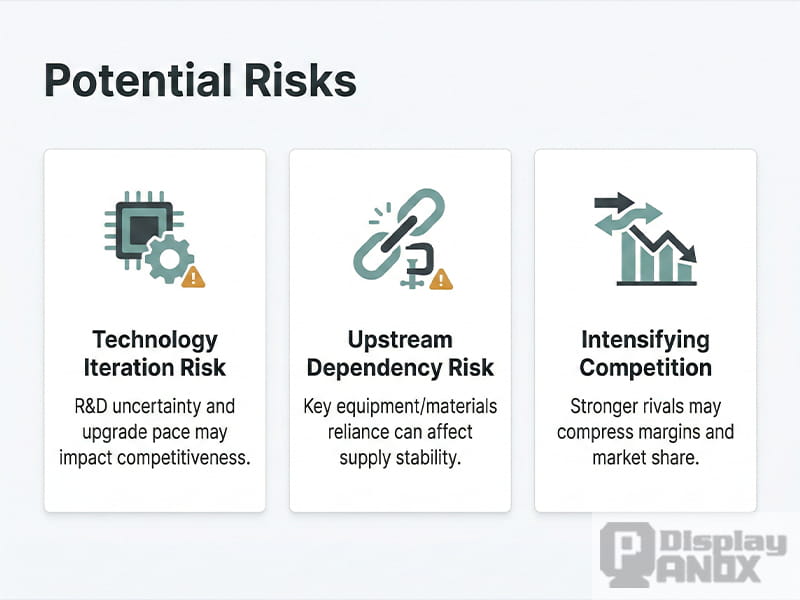
Potential Risks Overview (Micro OLED)
While the trajectory is incredibly positive, the industry faces distinct risk factors. Technology development and iteration upgrade risks are ever-present; companies that fail to keep pace with downstream application trends face immediate losses in market competitiveness. Furthermore, the lack of fully independent and controllable upstream technologies—specifically the reliance on imported high-precision equipment—poses a risk to supply chain stability. Finally, as the display panel market is heavily monopolized by leading foreign enterprises, intensifying competition could lead to sudden market share declines for manufacturers unable to maintain bleeding-edge technical capabilities.
Conclusion
The ascent of MicroOLED technology represents a critical turning point for the consumer electronics and professional display industries. By successfully merging the robust manufacturing capabilities of silicon-based CMOS processes with the visual superiority of organic light-emitting diodes, manufacturers have unlocked the exact specifications required to make truly immersive, lightweight computing a reality. As production scales up through multi-billion dollar investments in 12-inch manufacturing lines and technical yields continue to improve, the initial cost barriers will steadily erode. Ultimately, MicroOLED is not just a stepping stone, but the foundational display infrastructure that will power the next generation of spatial computing hardware and high-precision visual interfaces for the remainder of the decade.
Ready to spec a near-eye microdisplay? Explore our Micro OLED products here.
| Panel model | Interface | Type | Size (inch) | Resolution | P.S |
| S032WEM01 | MIPI/RGB | Micro OLED | 0.32 | 800x600 | |
| PMOF039XGAM | RGB | Micro OLED | 0.39 | 1024x768 | Full Color/Monochrome |
| BO039M1920M | MIPI | Micro OLED | 0.39 | 1920x1080 | Highest PPI =5644 |
| EP047M800T | TTL | LCOS | 0.47 | 800x600 | |
| BO049FHPMO | SPI,MIPI | Micro OLED | 0.49 | 1920x1080 | |
| S050M1600M | MIPI | Micro OLED | 0.5 | 1600x1200 | |
| ECX331DB-6 | Mini LVDS | Micro OLED | 0.5 | 1024x768 | |
| S060LDM01 | MIPI | Micro OLED | 0.6 | 1920x1080 | |
| ECX335AF | Mini LVDS | Micro OLED | 0.71 | 1920x1080 | 200 nits brightness version |
| ECX335B | Mini LVDS | Micro OLED | 0.71 | 1920x1080 | 500 nits brightness version |
| ECX335SN | Mini LVDS | Micro OLED | 0.71 | 1920x1080 | 3000 nits brightness version |
| BO071M1920M | MIPI | Micro OLED | 0.71 | 1920x1080 | |
| S072WCM04 | MIPI | Micro OLED | 0.72 | 1920x1080 | |
| S103WAM01 | MIPI | Micro OLED | 1.03 | 2560x2560 |