



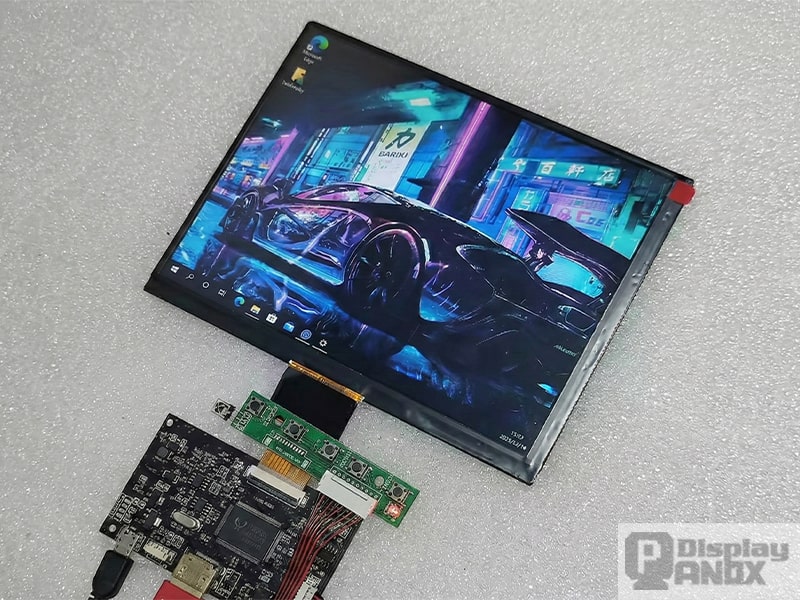
In today’s industrial and healthcare environments, the display is a core human–machine interface (HMI) component. Its performance directly affects operational efficiency, usability, and system reliability. With a balanced physical size and clear image quality, the 8-inch 1024×768 display has proven especially valuable in both industrial control and medical equipment. The following analysis reviews its value from three perspectives: technical characteristics, industrial use cases, and medical use cases.
Related:8 inch IPS TFT LCD 1024X768 LVDS Interface
1.Technical Characteristics and Fit-for-Use Advantages
An 8-inch 1024×768 panel is a high-spec option among small-to-mid-size displays. Its pixel density reaches 160 PPI, notably higher than many legacy industrial devices based on 800×600. This configuration achieves the XGA (Extended Graphics Array) standard within a compact footprint, allowing fine details to remain readable even in complex graphical interfaces.Compared with larger displays, the 8-inch format typically offers several practical advantages:
1. Space adaptability: Well-suited to compact embedded devices such as portable analyzers and surgical robot control consoles.
2. Power efficiency: Power consumption can be 30%–40% lower than displays above 10 inches, helping extend battery life in mobile systems.
3. Touch optimization: When paired with capacitive/resistive touch layers, finger operation can achieve high accuracy with an error of less than 0.5 mm.
Learn more: low-consumption display panel
2.Deep Adoption in Industrial Scenarios
In smart manufacturing, this class of display has become a common choice for key equipment interfaces. For example, on an automotive production line, a welding robot control terminal using an 8-inch 1024×768 screen can present a 3D welding path visualization (about 60% of the screen area) alongside a real-time parameter table (40%) at the same time. Typical benefits include:Parallel information display: The resolution supports showing pressure, temperature, and speed simultaneously—information that often required multiple pages on lower-resolution screens.
Anti-interference and visibility: Some photovoltaic panel inspection devices adopt sunlight readable displays that remain readable at 100,000 lux ambient illumination.
Mechanical compatibility: Certain industrial PLC designs integrate full-metal bezels to withstand common production-line vibration and shock.
Learn more: readable-under-sun display panel
In petrochemical environments, safety becomes even more critical. ATEX-certified explosion-proof models are designed for use in flammable atmospheres, reducing the risk of ignition from electrical sparks. In a 2024 offshore platform retrofit project by CNOOC, the failure rate of explosion-proof 8-inch displays reportedly dropped by 72% compared with the previous generation.
3.Precision Enablement in Medical Use
Medical equipment places stricter demands on display clarity and accuracy. At an 8-inch size, 1024×768 resolution can meet the DICOM requirement of 2.3 LP/mm (line pairs per millimeter) for medical image presentation. Typical examples include:1. Portable ultrasound: The GE Healthcare Vscan Air handheld ultrasound uses the same display class, enabling clear visualization of lesion features down to 0.5 mm.
2. Endoscopy systems: The latest Olympus GI endoscopy console adopts an 8-inch screen with sRGB 99% coverage, supporting more accurate differentiation of tissue color.3. Emergency/transport monitors: The Mindray BeneVision N1 transport monitor uses this display format to present 12-lead ECG and vital signs on the same screen for rapid clinical assessment.
Human factors also matter in healthcare workflows. An FDA survey indicates that, during one-handed operation, an 8-inch screen allows the thumb to cover about 83% of the touch area, reducing the need for frequent grip or posture adjustments and improving operational efficiency.
Conclusion
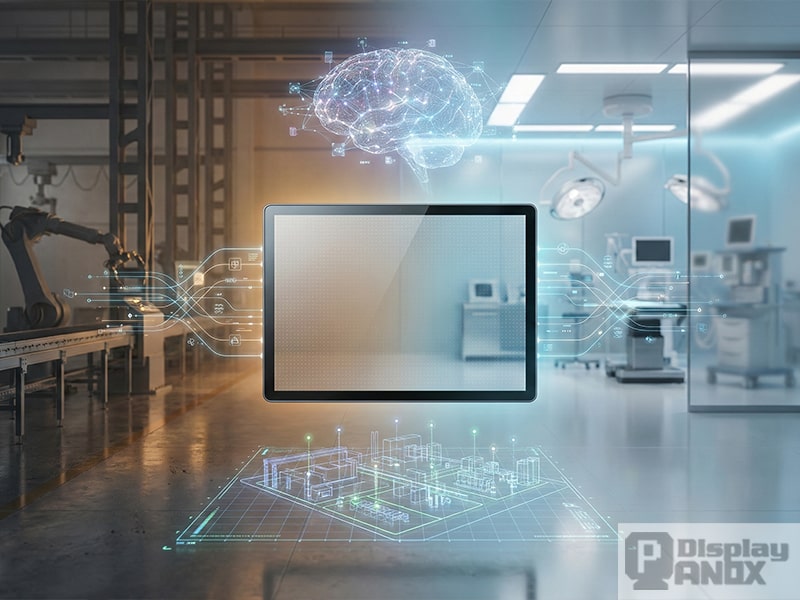
From the oil-contaminated environment of automotive plants to the sterile conditions of operating rooms, the 8-inch 1024×768 display provides a balanced performance profile that bridges digital information and real-world operation through a precise HMI. As medical AI-assisted diagnosis and industrial digital twin technologies continue to advance, this seemingly “traditional” specification is gaining renewed momentum in emerging applications. Its success highlights a key principle of specialized equipment design: rather than blindly pursuing higher specs, the goal is to align technical indicators with real application needs—deeply and effectively.