



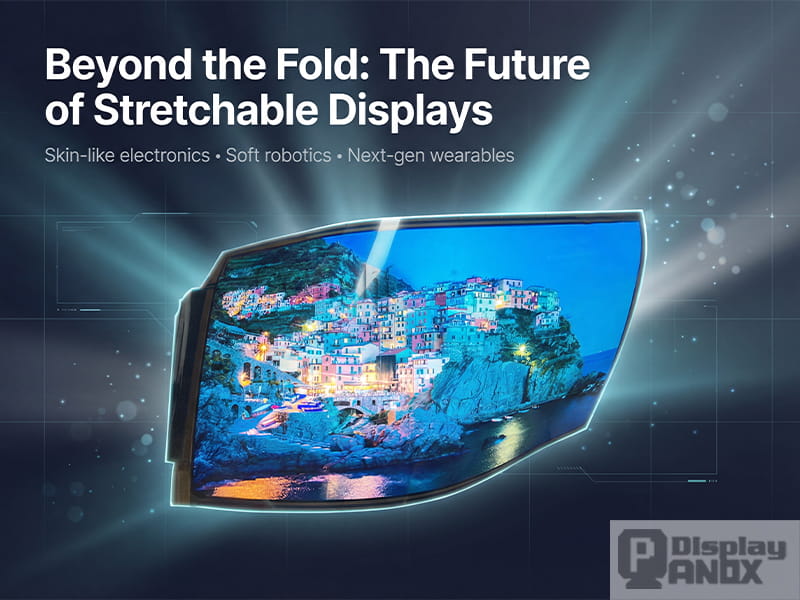
The evolution of display technology is currently undergoing a paradigm shift. While the market has grown accustomed to curved monitors and foldable smartphones, these form factors represent only the beginning of a much deeper transformation. The ultimate goal of display engineering is not just to bend a screen around a hinge, but to create stretchable, skin-like electronics that can conform to any three-dimensional surface.
This transition from rigid panels to elastomeric, fabric-like displays promises to redefine human-machine interaction (HMI). By enabling screens to function as dynamic materials rather than static windows, stretchable technology is opening new frontiers in wearable health monitoring, soft robotics, and automotive interiors.
Beyond the Fold: Defining the Next Generation
To understand where the industry is heading, it is crucial to distinguish between three terms often used interchangeably but which represent vastly different engineering challenges: Flexible, Foldable, and Stretchable.
-
Flexible Displays: These screens, often built on plastic substrates like polyimide, can be bent into fixed curves. They are commonly seen in curved gaming monitors or automotive dashboards. However, their shape is usually static once installed, or limited to simple, single-axis bending.
-
Foldable Displays: This technology, currently dominating the premium smartphone market, allows a screen to bend dynamically around a specific axis or hinge. While impressive, the deformation is strictly mechanical and localized to the folding area.
-
Stretchable Displays: This is the "Holy Grail" of electronics. A stretchable display can elongate, twist, and deform in multiple directions (omnidirectional strain) without losing functionality. It behaves like a rubber band or human skin, capable of covering complex, irregular, and moving 3D surfaces. This capability requires every layer of the device—from the substrate to the encapsulation—to endure significant mechanical strain.
Why "Stretchable" is the Next Growth Frontier
The driving force behind stretchable electronics is the concept of "imperceptible integration." Current devices are rigid blocks that we carry; future devices will be soft interfaces that we wear or apply.
The limitation of current flexible technology is that it cannot conform to spherical or irregular shapes without wrinkling—similar to how wrapping paper cannot perfectly cover a ball without folding. Stretchable displays solve this by changing their surface area. This property is essential for bio-integration, allowing electronics to adhere seamlessly to the curvilinear and dynamic surfaces of the human body, soft robots, or complex automotive pillars, effectively turning the screen into a functional "material" rather than a distinct component.
Engineering the Stretch: Three Core Technological Pathways
Achieving stretchability requires overcoming the inherent brittleness of traditional electronic materials. Researchers and manufacturers are currently pursuing three primary architectural strategies to solve this physics problem.
| Strategy | Mechanism | Pros | Cons |
| Geometric Engineering (Structural) | Uses standard rigid materials patterned in serpentine, wavy, or kirigami structures. Strain is converted into rotation or out-of-plane bending. | Uses high-performance, established materials (silicon, standard metals). | Lower fill factor (pixel density); complex fabrication processes. |
| Intrinsic Stretchability | Develops new polymer semiconductors and conductors that are inherently elastic at the molecular level. | Ideally suited for high-density, skin-like applications; simple structure. | Lower electrical mobility and conductivity compared to rigid counterparts. |
| Hybrid (Island-Bridge) | Combines rigid, functional "islands" (containing active components) with stretchable "bridges" (interconnects). | Balances high performance with high stretchability; currently the most viable commercial route. | Stress concentration at the interface between soft and hard materials is a failure point. |
The Battle of Emitters: Stretchable OLED vs. MicroLED
The choice of light-emitting technology is critical for determining the lifespan, brightness, and application of stretchable displays.
Stretchable MicroLED
MicroLEDs are inorganic, making them inherently robust against oxygen and moisture—a massive advantage for devices exposed to the elements. They offer high brightness and longevity. However, the mass transfer process remains a significant bottleneck. Moving millions of microscopic LEDs onto a stretchable rubber substrate with high yield is technically difficult and expensive. Despite this, companies like Samsung Display have showcased prototypes capable of significant deformation using microLEDs on island-bridge architectures.
Stretchable OLED
OLED technology is attractive due to its thin form factor and maturity in the flexible market. Recent academic and industrial breakthroughs have focused on intrinsically stretchable organic layers. For instance, researchers are developing viscoelastic conjugated polymers that maintain electroluminescence even under 50% strain. LG Display recently unveiled a groundbreaking prototype capable of stretching from 12 inches to 18 inches (a 50% elongation rate) while maintaining a high resolution of 100 ppi and full RGB color. This suggests that OLED may currently have the upper hand in manufacturing scalability for larger consumer applications.
Critical Engineering Hurdles
To move from prototype to product, engineers must solve several "grand challenges" where mechanical compliance fights against electronic performance.
Resolution vs. Elongation
When a screen stretches, the distance between pixels increases, potentially causing image distortion or the "screen door effect." Advanced algorithms and pixel density compensation techniques are required to maintain image quality. Furthermore, the geometric structures needed to allow stretching (like serpentine wiring) take up space, reducing the overall fill factor and effective resolution.
Brightness Uniformity and Electrical Stability
Stretching a conductor changes its dimensions, which typically increases electrical resistance. This can lead to voltage drops, causing uneven brightness or color shifts across the display during deformation. Researchers are developing nanocomposite conductors (such as silver nanowires or carbon nanotubes embedded in elastomers) that maintain stable conductivity even under high strain.
Encapsulation and Reliability
For OLEDs, this is the most difficult challenge. Organic materials degrade instantly upon contact with moisture or oxygen. Traditional barrier layers are brittle ceramics that crack when stretched. Developing stretchable gas barriers—often multi-layer stacks of organic and inorganic materials that can slide or deform—is essential for achieving a commercially viable lifespan.
System-Level Integration
A stretchable screen is useless if the battery and processor are rigid. The entire system must be compliant. This necessitates the development of stretchable batteries, soft sensors, and flexible logic boards. The challenge lies in creating rigid-island/soft-interconnect schemes that protect fragile components while allowing the overall device to twist and pull.
Learn more: What is the Difference Between Rigid and Flexible OLED? A Technical Guide to Display Panel Selection
Emerging Use Cases and Market Applications
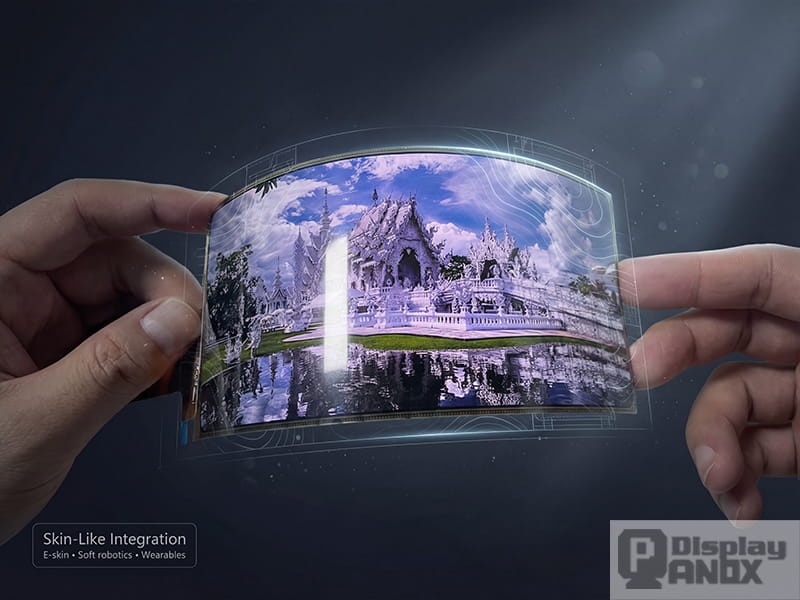
The transition to stretchable displays will unlock applications that were previously physically impossible.
-
Electronic Skin (E-Skin) & Health Monitoring:
Ultra-thin, adhesive patches that act as a second skin can display real-time biometrics (heart rate, glucose levels) directly on the body. Unlike rigid watches, these eliminate motion artifacts by moving precisely with the skin.
-
Smart Textiles and Fashion:
Integration into clothing requires displays that can survive the rigorous movement of fabric and washing cycles. Stretchable displays can be woven into uniforms for safety signaling or high-fashion responsive garments.
-
Soft Robotics:
Robots made of soft materials for safer human interaction need faces and interfaces that deform with them. Stretchable skins allow these robots to display expressions or status updates without rigid, breakable panels.
-
Automotive Free-Form Interiors:
Car interiors are full of complex curves (A-pillars, steering wheels, door knobs). Stretchable displays can wrap around these 3D shapes, turning previously "dead" surfaces into active control interfaces or information displays.
-
Next-Generation Wearables:
Beyond the wrist, we will see devices like smart bandages or joint sleeves. These require displays that can accommodate the high strain of elbow or knee flexion without delaminating.
-
Biomedical Phototherapy:
Flexible light-emitting patches can provide uniform light therapy for wound healing or cancer treatment (photodynamic therapy) on curved body parts, ensuring consistent dosage delivery that rigid lamps cannot provide.
Bring your next form factor to life with our Flexible OLED modules—find the best fit now.
The Path to Commercialization: A Reality Check
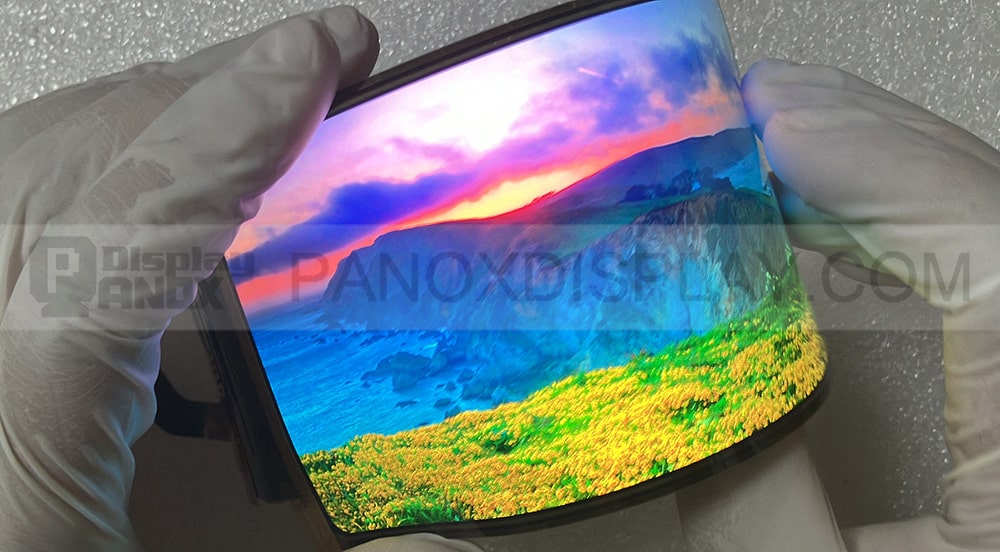
While prototypes are promising, "true commercialization" faces a tripartite threshold: Yield, Reliability, and Ecosystem.
Current manufacturing yields for stretchable interconnects are too low for mass production. Furthermore, reliability testing standards for stretchable electronics are still being defined—devices must survive hundreds of thousands of stretch cycles, not just folding cycles. Finally, the supply chain for elastomeric substrates and stretchable encapsulation is nascent compared to the established glass and PI supply chains.
However, with major players like LG and Samsung heavily investing in the island-bridge architecture and material science advancing rapidly, we expect to see the first niche professional applications (medical and industrial) emerge within the next 3 years, followed by broader consumer adoption in the latter half of the decade.
Ready to go thinner and bend further? Explore our Flexible OLED modules and find your perfect fit.
| Model | Size(inch) | Display Type | Resolution | Interface |
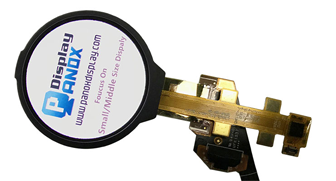
| 1.39 inch Round/Circular OLED Flexible For Wearable Smartwatch | 1.39 | AMOLED | 400(RGB)×400 | MIPI |
| 1.5 inch Flexible OLED For Wearable Smart Watch | 1.5 | AMOLED | 120(RGB)×240 180PPI | SPI, MIPI |
| 1.8 inch Flexible PMOLED For Wearable Bracelet | 1.8 | PMOLED | 160×32 | SPI |
| 5.1 inch Flexible OLED On-Cell PACP For Cellphone | 5.1 | AMOLED | 720(RGB)×1520 330PPI | MIPI |
| 5.99 inch Flexible OLED On-Cell PACP For Cellphone | 5.99 inch | AMOLED | 1080(RGB)×2160 329PPI | MIPI |
| 5.99-Inch 1440x2880 Flexible AMOLED Display | BOE OLED for Huawei Smartphone | 5.99 | AM-OLED, OLED | 1440 x 2880 | MIPI |
| 6.52 inch Flexible OLED 2520x840 Touch Panel | 6.52 | AM-OLED, OLED | 2520(RGB)×840 407 PPI | MIPI |
| 6.67inch Flexible AMOLED 2K for Smartphone | 6.67 | OLED, AM-OLED | 1080x 2400 | MIPI |
| 7.8 inch Flexible Full Color OLED 1920x1440 MIPI | 7.8 | AMOLED | 1440 x 1920 | MIPI |
| 8 inch Flexible/Foldable OLED | 8.01 | AMOLED | 2480x1860 | MIPI |
| 13.3 inch 1536 x 2048 Flexible OLED Touch Screen | 13.3 | AM-OLED, OLED | 1536 (H) × 2048 (V) | eDP |