



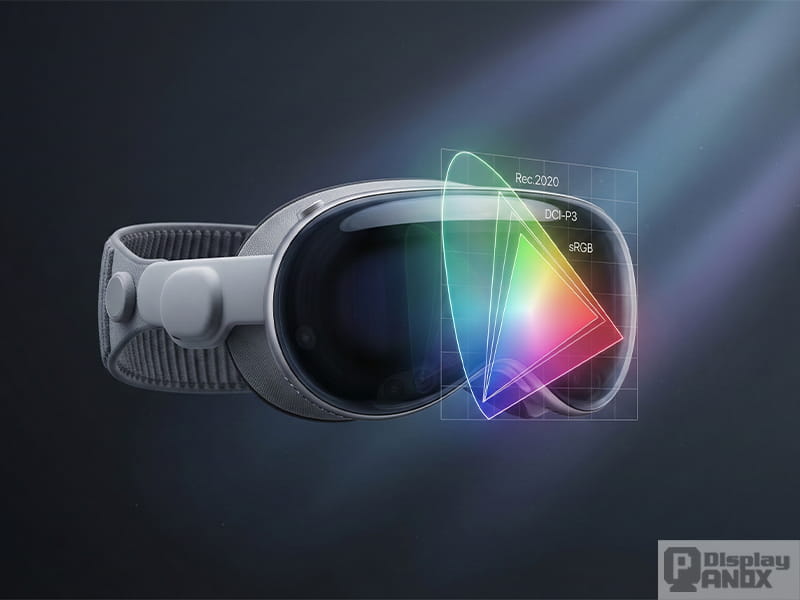
In the rapidly evolving landscape of near-eye displays (NED), Micro-OLED technology has emerged as the gold standard for high-end spatial computing and Extended Reality (XR). Marketing materials often lead with a single, impressive figure: Wide Color Gamut (WCG), frequently expressed as a high percentage of the DCI-P3 or even Rec.2020 color spaces. However, for display engineers and discerning users, these percentages only describe the size of the palette, not the quality of the painting. To understand the true visual fidelity of a Micro-OLED system, one must look beyond the gamut at the intricate interplay of color management, optical shifts, and the physiological demands of near-eye consistency.
If you’re evaluating Micro-OLED options for an XR build, see our available modules here.
The Gamut Foundation: Moving from sRGB to DCI-P3 and Beyond
For decades, the sRGB color space was the universal language of the web and standard monitors. It was designed for the limitations of CRT technology and remains the baseline for most digital content. However, as we move into the immersive realms of AR and VR, the demand for "lifelike" saturation has pushed the industry toward DCI-P3. Originally defined for digital cinema, DCI-P3 offers a color space approximately 25% larger than sRGB, particularly in the green and red primaries.
While a Micro-OLED panel boasting 100% DCI-P3 coverage sounds superior on a spec sheet, it introduces a significant challenge: oversaturation. Without a robust color management system, standard sRGB content viewed on a wide-gamut panel looks "neon" and unnatural—skin tones become orange, and subtle gradients disappear. Therefore, a wide gamut is merely a "containment vessel." The real engineering feat lies in how accurately the display maps colors within that vessel to ensure they remain faithful to the creator's intent.
The 3D Constraint: Color Volume vs. Peak Luminance
A common misconception is treating color gamut as a static 2D triangle on a CIE chromaticity diagram. In reality, color is three-dimensional, incorporating Luminance (brightness). This is known as Color Volume.
Most current Micro-OLEDs utilize a WOLED+CF (White OLED with Color Filter) architecture. In this setup, a white organic stack emits light through red, green, and blue filters. To achieve the high brightness levels required to overcome the "duty cycle" of low-persistence displays or the light loss in AR waveguides, manufacturers often face a "Filter Tax." Thinner filters allow more light through for higher nits but result in "spectral crosstalk," where the purity of the primaries is compromised. Consequently, a display might maintain a wide gamut at 100 nits, but as brightness increases to 1,000 or 3,000 nits, the colors "wash out" toward white, causing a collapse in color volume.
The Invisible Architect: Why Color Management is Mandatory
In spatial computing, the display does not exist in a vacuum. It must render a composite of various sources: 2D windows, 3D volumetric assets, and, in the case of AR, the passthrough of the real world. This requires a sophisticated Color Management System (CMS) operating at the OS level.
Effective color management performs real-time Gamut Mapping. If a display is capable of DCI-P3 but the source content is sRGB, the CMS must precisely interpolate the colors to prevent "clipping" or "distortion." For Micro-OLEDs, this is further complicated by the need for Inverse Gamma Correction and Non-uniformity Compensation (NUC). Because every micro-pixel can have slight variations in voltage-to-luminance response, the software must apply a per-pixel correction map to ensure that a uniform grey on the input remains a uniform grey on the display, avoiding the "mura" effect that plagues lower-quality panels.
The Optical Engine: Where the "Real" Color Shift Happens
Unlike a smartphone held at arm's length, Micro-OLEDs in XR headsets are viewed through complex optical stacks, such as Pancake lenses or Waveguides. These optics are not perfectly neutral; they introduce their own set of variables known as Optical Color Shift.
-
Chromatic Aberration: Lenses bend different wavelengths of light by different amounts. If not corrected via software pre-distortion, this leads to color fringing at the edges of the Field of View (FoV).
-
Angle-of-View Dependency: Micro-OLEDs emit light in a Lambertian or near-Lambertian pattern. As the eye moves and views the pixels at an angle through the lens, the effective color can shift toward blue or green.
-
Polarization Effects: Many modern optics (especially Pancake lenses) rely on polarization to fold the light path. This can inadvertently alter the spectral balance, meaning the color measured at the panel level is vastly different from the color that actually reaches the retina.
Near-Eye Consistency: The Challenge of Binocular Uniformity
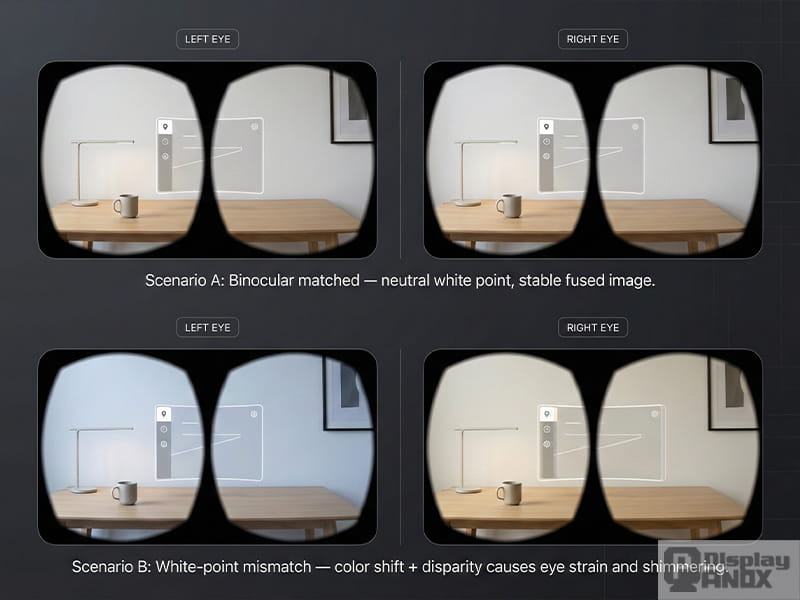
Figure: Binocular Matching vs Mismatch
The most critical metric for "presence" in XR is Color Consistency. In a near-eye system, your left and right eyes are viewing two independent displays. If the white point of the left Micro-OLED is even slightly cooler (bluer) than the right, the brain struggles to fuse the images, leading to eye strain and a "shimmering" sensation.
Achieving this consistency requires rigorous Binocular Matching. This goes beyond wide color gamut; it requires the manufacturer to calibrate each pair of displays to a Delta E ($Delta E$) of less than 2.0 across the entire luminance range. Achieving this at scale is incredibly difficult and is a primary differentiator between "prosumer" gear and entry-level headsets.
Case Study: Why Apple Vision Pro Settled for 92% DCI-P3
The release of the Apple Vision Pro provided a masterclass in prioritized engineering. While some competitors boasted "99% DCI-P3" or "Rec.2020 Ready," Apple targeted a calibrated 92% of the DCI-P3 color space. This was not a limitation, but a deliberate trade-off.
By targeting 92%, Apple ensured that the color gamut remained stable across a massive range of brightness levels. They prioritized Color Accuracy and Consistency over raw "range." The Vision Pro uses a dedicated R1 chip to handle display pipeline tasks, ensuring that the passthrough video and the virtual windows share the same color temperature and gamma curve. The result is a display that feels "correct" rather than just "vibrant." It proves that a slightly smaller, perfectly managed gamut is infinitely more immersive than a wide, unmanaged one.
If you need Micro-OLED modules for lens + color pipeline validation, view the product details here.
Conclusion: The New Hierarchy of Display Quality
As we look toward the future of Micro-OLED—including the transition to RGB Direct Patterning (which eliminates color filters for pure primaries)—we must shift our evaluative criteria. A "Wide Color Gamut" is a necessary starting point, but it is the "Floor," not the "Ceiling."
To truly judge a Micro-OLED system, we must ask:
-
How much of that gamut is maintained at peak HDR brightness?
-
Is the Delta E low enough to ensure professional-grade accuracy?
-
Does the Optical Engine preserve the color integrity at the periphery of the lens?
In the world of near-eye displays, the "Whole Story" is one of precision, management, and the seamless bridge between digital light and human perception.
Learn more: Why Are AR Glasses Chasing 3,000 Nits? Where Does the Brightness Come From?
| Panel model | Interface | Type | Size (inch) | Resolution | P.S |
| S032WEM01 | MIPI/RGB | Micro OLED | 0.32 | 800x600 | |
| PMOF039XGAM | RGB | Micro OLED | 0.39 | 1024x768 | Full Color/Monochrome |
| BO039M1920M | MIPI | Micro OLED | 0.39 | 1920x1080 | Highest PPI =5644 |
| EP047M800T | TTL | LCOS | 0.47 | 800x600 | |
| BO049FHPMO | SPI,MIPI | Micro OLED | 0.49 | 1920x1080 | |
| S050M1600M | MIPI | Micro OLED | 0.5 | 1600x1200 | |
| ECX331DB-6 | Mini LVDS | Micro OLED | 0.5 | 1024x768 | |
| S060LDM01 | MIPI | Micro OLED | 0.6 | 1920x1080 | |
| ECX335AF | Mini LVDS | Micro OLED | 0.71 | 1920x1080 | 200 nits brightness version |
| ECX335B | Mini LVDS | Micro OLED | 0.71 | 1920x1080 | 500 nits brightness version |
| ECX335SN | Mini LVDS | Micro OLED | 0.71 | 1920x1080 | 3000 nits brightness version |
| BO071M1920M | MIPI | Micro OLED | 0.71 | 1920x1080 | |
| S072WCM04 | MIPI | Micro OLED | 0.72 | 1920x1080 | |
| S103WAM01 | MIPI | Micro OLED | 1.03 | 2560x2560 |