



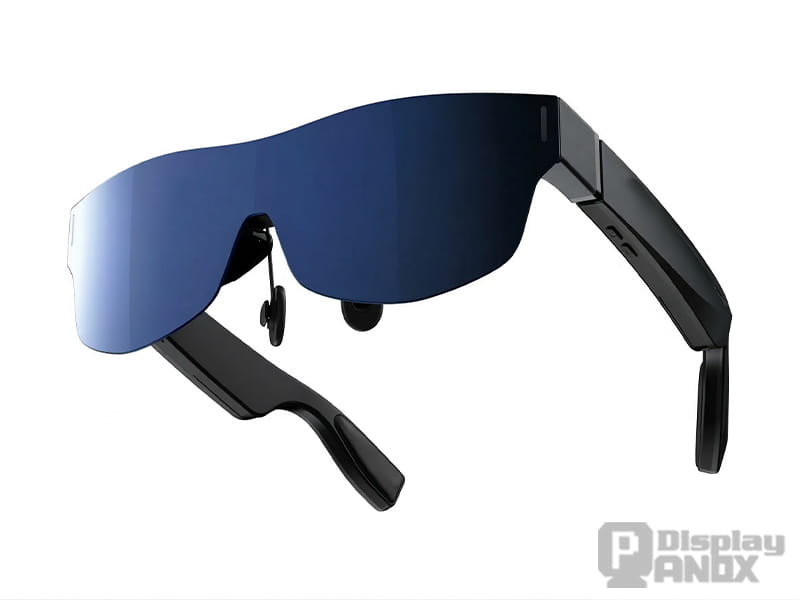
In 2026, AI glasses are no longer a fringe experiment. They are quickly moving into a real product category with fast-growing shipments, stronger brand participation, and much clearer segmentation between audio-first smart glasses, camera AI glasses, and display-equipped AR glasses. Counterpoint reported that global smart glasses shipments grew 139% year over year in the second half of 2025, with AI smart glasses accounting for 88% of shipments in that period. IDC also projected that the broader AR/VR headset and display-less smart glasses market would grow 39.2% in 2025 to 14.3 million units, driven largely by lightweight AI eyewear and new entrants racing to put AI on the face.
That explosive growth creates a more important question for product teams, OEM buyers, and device designers: what display technology should an AI glasses product actually use? In practice, display remains one of the hardest bottlenecks in the category. The screen engine must be compact, light, sharp enough for near-eye viewing, power-efficient enough for wearable use, and bright enough to survive real-world optics losses. That is why display strategy often decides whether an AI glasses product feels futuristic or simply unfinished.
Here is the key conclusion up front: Micro OLED is not the winner in every AI glasses scenario, but it is increasingly the most realistic mainstream choice for AI glasses that actually include a visual display, especially products prioritizing image quality, compact optical modules, readable text, immersive media, and practical commercialization today. Micro LED still leads in outdoor brightness potential, but Micro OLED currently offers the best balance of maturity, density, contrast, size, and manufacturability for many near-eye products shipping now.
If your product targets bright-use environments, prioritizing High Luminance can improve perceived image clarity.
1. AI Glasses Display Technologies in 2026: What Are the Main Options?
When people search for the best display for AI glasses, they usually compare five technical routes: Micro OLED, Micro LED, LCoS, DLP, and LBS. Each route solves the near-eye problem differently, and each comes with trade-offs in brightness, module size, optical efficiency, power draw, image quality, and commercialization readiness. Research reviews in near-eye displays continue to treat these as the major competing microdisplay paths for AR glasses.
Main display technologies at a glance
| Technology | Core strengths | Main weaknesses | Best-fit AI glasses scenarios |
|---|---|---|---|
| Micro OLED | Ultra-high PPI, deep blacks, high contrast, thin module, mature image quality | Brightness ceiling is lower than Micro LED for harsh outdoor AR, potential burn-in risk, cost still premium | Indoor AI glasses, media glasses, compact near-eye modules, display-first consumer products |
| Micro LED | Extremely high brightness, strong outdoor readability potential, long-term durability upside | Full-color mass production remains difficult and costly, supply chain is less mature | True outdoor AR, navigation-heavy glasses, future premium transparent AR |
| LCoS | Good optical efficiency in some systems, relatively mature, can work for low-power AR engines | Reflective architecture needs external illumination, color/contrast experience is less “OLED-like” | Functional AR, industrial or utility-style glasses |
| DLP | High brightness, fast modulation, good dynamic range | Optical engine can be bulkier, system power and complexity can rise | Specialized AR, industrial visualization, some enterprise systems |
| LBS | Can support compact architectures and see-through concepts | Speckle, image uniformity, and eye-safety/system complexity challenges | Niche AR engines and experimental designs |
For the market in front of us now, Micro OLED is winning more often where product teams need a premium visual experience in a compact consumer-ready form. Micro LED remains strategically important, but it is still more difficult to scale into affordable, lightweight, mass-market display glasses. That is why many products shipping today with an actual display still lean toward Micro OLED, while true see-through outdoor AR leaders continue exploring Micro LED.
2. Why Is Micro OLED Winning More Design Decisions?
The answer is simple: in AI glasses, the best technology is rarely the one with the most exciting lab headline. It is the one that survives the total product equation.
To succeed in real hardware, an AI glasses display has to fit inside a tiny optical path, remain readable at short viewing distance, preserve fine text and UI detail, keep weight under control, minimize heat, and avoid crushing battery life. Sony describes OLED microdisplays as achieving about 4,000 ppi thanks to silicon backplanes, and positions them specifically for ultra-compact, ultra-high-resolution applications that conventional LTPS OLED cannot meet. Sony’s newer AR-oriented ECX350F also targets thin, lightweight AR glasses while pushing pixel density to around 5,000 ppi and brightness up to 10,000 cd/m², showing how fast Micro OLED is evolving for near-eye use.
That matters because AI glasses are not judged like TVs or smartphones. On a phone, slightly lower pixel density may be acceptable. On a near-eye system, it can ruin immersion, text legibility, and perceived sharpness. On a wearable device, even a modest increase in optical engine size can hurt comfort, styling, and thermal design. This is where Micro OLED keeps earning its place: it delivers the kind of density and contrast that makes near-eye content feel refined without forcing a giant display engine.
3. The Core Advantages of Micro OLED for AI Glasses
3.1 Ultra-high pixel density means cleaner text and less screen-door effect
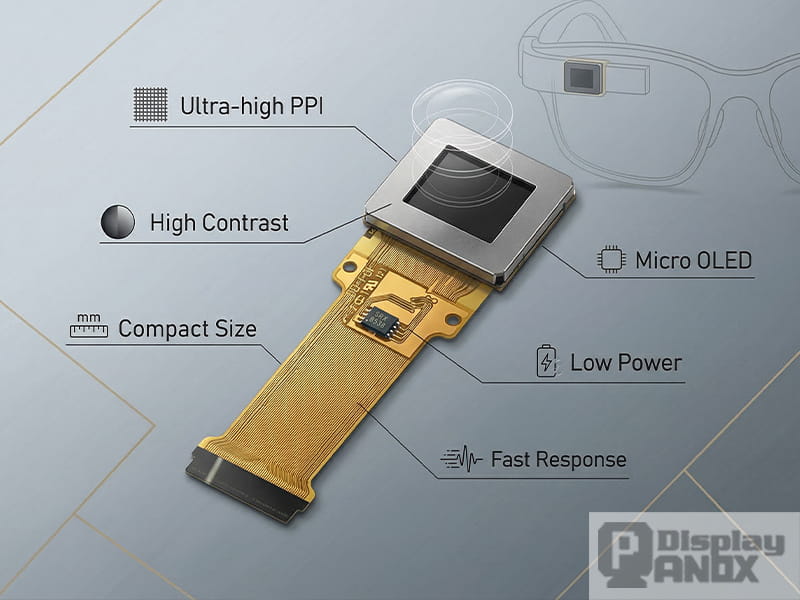
One of the biggest reasons buyers search for Micro OLED vs Micro LED in AI glasses is image sharpness. Micro OLED is fundamentally strong here. Sony’s official product information highlights around 4,000 ppi for OLED microdisplays, while its ECX350F reaches roughly 5,000 ppi in a compact 0.44-inch Full HD panel. High pixel density is critical in AI glasses because the display sits close to the eye and often has to render text, subtitles, translation overlays, notifications, maps, or UI prompts through magnifying optics.
In plain English, higher PPI means fewer visible pixel boundaries, smoother edges, and much better readability for small interface elements. That is especially important for AI assistants, where the visual layer often involves short bursts of information rather than passive video alone. If the user cannot read a message or translation overlay comfortably, the whole AI experience collapses.
3.2 Near-infinite contrast creates a more premium visual experience
Micro OLED is self-emissive, so it can deliver very deep blacks and extremely strong contrast. Sony lists a 100,000:1 contrast ratio and response speed of 0.01 ms or less for its OLED microdisplay platform. RayNeo’s current Micro OLED glasses also advertise contrast ratios as high as 200,000:1. This is one of the reasons Micro OLED often looks immediately more premium for media, interface overlays, and dark-scene rendering.
For AI glasses, contrast is not just a spec-sheet trophy. Good contrast improves text separation, perceived clarity, icon visibility, and color richness. It also helps visual content look less washed out when optical components already introduce losses.
For a more immersive viewing experience, High Contrast helps deliver deeper blacks and cleaner image separation.
3.3 Small module size helps make glasses lighter and more wearable
Glasses live or die by wearability. A bulky display engine is not just an engineering annoyance; it directly hurts adoption. Sony’s AR-targeted Micro OLED announcement explicitly ties the technology to thin, lightweight AR glasses. That is one of the biggest commercial reasons buyers keep choosing Micro OLED today: it gives product teams a realistic path to better styling and less front-heavy eyewear without sacrificing sharpness.
This is also why many successful display glasses on the market today use Micro OLED rather than waiting for perfect Micro LED economics. They need something that can ship now, fit now, and look acceptable on the face now.
3.4 Lower system burden can support better real-world battery life
Battery life in AI glasses is a brutal constraint. The display is only one part of the power budget, but it is a very important one. A 2025 power-consumption review specifically analyzed Micro LED, OLED, LCoS, LBS, and DLP for AR glasses, emphasizing that optical combiner losses make power efficiency one of the hardest problems in wearable AR. In many real-world consumer products, Micro OLED remains attractive because it pairs high visual quality with a relatively practical system path and mature integration.
This is also where the product type matters. For fully transparent outdoor AR, Micro LED may ultimately win on brightness-per-system. But for many current AI glasses focused on private displays, media viewing, notification layers, or indoor-first experiences, Micro OLED often lands in the sweet spot between usable brightness and manageable power.
3.5 Fast response helps reduce motion artifacts and discomfort
Slow response can amplify blur, lag perception, and visual discomfort. Sony states its OLED microdisplays can reach response times of 0.01 ms or less, which is one reason OLED-based microdisplays continue to be attractive for immersive near-eye experiences. Fast response is valuable not just for gaming and video, but also for head motion, cursor movement, and any UI that tracks changes quickly in the user’s field of view.
For AI glasses, that helps in navigation prompts, assistant overlays, live captions, and glanceable interface moments where the user needs fast, clean rendering rather than smeared transitions.
4. The Limits of Micro OLED: What Buyers Still Need to Watch
Micro OLED is strong, but it is not magic.
The first challenge is brightness. For true outdoor transparent AR, brightness requirements are severe because waveguides and combiners can lose more than 99% of light. A recent Nature review notes that AR displays need extremely high luminance for outdoor visibility, which is why Micro LED, with brightness potential above 10^6 nits, is often considered more viable than Micro OLED at around 10^3 nits for that specific use case. Even though new Micro OLED products are pushing much higher brightness than before, the brightness battle is still the biggest reason Micro LED remains strategically important.
The second challenge is image retention and burn-in. Like other OLED technologies, Micro OLED uses organic materials, so static UI elements can create lifetime and burn-in concerns over time if the design is poor. In practice, smart system design, UI motion, pixel compensation, brightness control, and usage patterns all matter. This is a manageable engineering issue, but buyers should not pretend it does not exist.
The third challenge is cost. Micro OLED is more mature than Micro LED in commercial near-eye products, but it is still not a low-end bill-of-materials choice. Premium silicon backplanes, high-density manufacturing, optics integration, yield management, and calibration all keep costs above mainstream commodity display levels. That said, the reason many teams still choose it is simple: it is often the most mature premium solution that can deliver flagship-grade visual quality in a glasses-friendly footprint right now.
5. Real Product Examples: What the Market Is Actually Doing
One important reality in 2026 is that “AI glasses” are not one hardware category. Some products are display-less audio or camera glasses. Others are true display glasses. Others are still concept-stage AR systems. That distinction matters when selecting a display roadmap.
Meta Orion
Meta’s Orion is one of the clearest examples that the long-term dream of true AR still points strongly toward Micro LED. Meta describes Orion as using Micro LED projectors and silicon carbide optics for roughly a 70-degree field of view. This is not a mass-market shipping consumer product yet, but it shows where the industry wants to go when outdoor-capable transparent AR is the priority.
RayNeo V3 and RayNeo X3 Pro
RayNeo’s product family shows the market split very clearly. The V series is positioned as AI camera glasses, not display-centric AR eyewear. By contrast, RayNeo’s display products split again: the Air series uses Micro OLED for immersive near-eye viewing, while the X3 Pro uses full-color Micro LED for transparent AR. RayNeo’s own materials list the Air 3s/Air 4 Pro with Micro OLED and the X3 Pro with full-color Micro LED. That is a perfect snapshot of today’s reality: Micro OLED is highly practical for display glasses now, while Micro LED targets more ambitious AR transparency and outdoor use.
Li Weike AI Glasses
Li Weike is equally revealing. Public reporting around the company’s 2025 product direction states that its AI glasses were intentionally display-less in order to prioritize lightweight all-day wear, with the company saying sub-40 g display-equipped AI glasses may come later as technology improves. In other words, many AI glasses brands have not rejected displays because they do not want them. They have rejected them because the display problem is still hard. That indirectly strengthens the case for Micro OLED: when brands do decide to add a display, they usually need the most compact, commercially ready premium option available.
Xiaomi AI Glasses and Xiaomi AR concept direction
Xiaomi’s 2025 AI Glasses followed the lightweight audio-plus-camera smart glasses route and did not center on an onboard visual display. But Xiaomi’s earlier Wireless AR Glass Discovery Edition concept used a pair of MicroOLED screens with a free-form optical module. Together, those two products show the same market logic: mainstream AI eyewear may begin without a display, while more advanced visual AR concepts still rely on microdisplay technologies such as Micro OLED.
6. Procurement Guide: How to Choose the Right Micro OLED Supplier
If you are sourcing a display for AI glasses, do not buy on resolution alone. The right Micro OLED module depends on your use case, optics route, and product priority.
Start with size. Smaller panels help reduce optical engine volume, but they also change optical complexity and perceived image design. Then check resolution and pixel density together, because a small panel with high PPI often matters more than a larger panel with a “nice-looking” resolution number.
Next, evaluate brightness in the context of your optical stack, not in isolation. A brightness figure that looks strong on paper may still feel inadequate after combiner losses. The interface also matters: MIPI, LVDS, timing requirements, driver support, and controller compatibility can all affect project complexity. Refresh rate, contrast, color coverage, and thermal behavior should be checked alongside optical efficiency, because AI glasses are a total-system product.
For supplier evaluation, look at five things:
compatibility with your optics path, stable quality control, realistic lead times, engineering support, customization flexibility, and willingness to support low- to mid-volume programs before scale-up. A good supplier for AI glasses is not just selling a panel. They need to help you reduce integration risk.
For teams developing AI glasses, Panox Display can support Micro OLED selection, display parameter matching, interface coordination, and small-batch customization discussions based on the product target, optical route, and project stage. That is especially useful when your device is still balancing industrial design, brightness targets, and power budget at the same time.
7. Conclusion: Why the Best Time to Enter Is Now
From 2026 to 2028, the AI glasses market will likely keep splitting into three lanes: lightweight display-less AI eyewear, Micro OLED-based display glasses that can ship at scale, and more advanced transparent AR products pushing toward Micro LED. The market data already shows the category accelerating, and the product landscape shows that visual experiences are gradually moving from concept to commercial reality.
So why is Micro OLED becoming the mainstream choice? Because it solves more of today’s real product problems than any other display technology in its class. It offers the image density, contrast, compactness, and commercial maturity that current AI glasses need right now. Micro LED may define the long-term AR endgame, but Micro OLED is the display technology helping many brands bridge the gap between prototype ambition and a product people can actually wear.
If you are developing AI glasses and need help selecting the right Micro OLED module, now is the right time to start sample evaluation, lock your key specs, and build around a display path that is commercially realistic instead of merely futuristic.
FAQs
What is the best display technology for AI glasses in 2026?
For display-equipped AI glasses shipping today, Micro OLED is often the most practical choice because it combines ultra-high pixel density, strong contrast, compact size, and better commercialization maturity. For outdoor transparent AR, Micro LED still has the edge in long-term brightness potential.
Why is Micro OLED better than LCD for AI glasses?
Micro OLED is self-emissive, so it delivers much deeper blacks, higher contrast, faster response, and much higher effective microdisplay density in a much smaller module. That makes it far better suited to near-eye display systems than conventional LCD routes.
Is Micro OLED the same as OLEDoS?
In most XR industry discussions, Micro OLED for near-eye use is commonly associated with OLED-on-silicon, or OLEDoS. The exact naming can vary by supplier and market context, but both point to high-density OLED microdisplay architectures built for compact near-eye systems.
Does Micro OLED have burn-in risk?
Yes, burn-in or image retention remains a known OLED-family issue, especially with static UI elements and aggressive brightness usage. Good software compensation, dynamic UI design, and sensible lifetime engineering can reduce the risk significantly.
Why are many AI glasses still launched without displays?
Because weight, battery life, optics volume, thermal limits, and cost are still difficult constraints. That is why many 2025-2026 AI glasses focus on audio and camera functions first. When brands decide to add a display, Micro OLED is often the easiest premium route to commercialize.
What specifications matter most when buying a Micro OLED for AI glasses?
The most important factors are panel size, resolution, pixel density, brightness after optical losses, contrast ratio, response speed, interface, thermal behavior, and supplier engineering support. In AI glasses, the best display is the one that fits the full system, not the one with the flashiest single spec.
Is Micro OLED already mainstream in AI glasses?
It is becoming mainstream among AI glasses and wearable display products that actually include a visual display module, especially for indoor-first and media-centric experiences. But the overall smart glasses market still includes many display-less AI products, and true outdoor transparent AR is still pushing hard toward Micro LED.
| Panel model | Interface | Type | Size (inch) | Resolution | P.S |
| S032WEM01 | MIPI/RGB | Micro OLED | 0.32 | 800x600 | |
| PMOF039XGAM | RGB | Micro OLED | 0.39 | 1024x768 | Full Color/Monochrome |
| BO039M1920M | MIPI | Micro OLED | 0.39 | 1920x1080 | Highest PPI =5644 |
| EP047M800T | TTL | LCOS | 0.47 | 800x600 | |
| BO049FHPMO | SPI,MIPI | Micro OLED | 0.49 | 1920x1080 | |
| S050M1600M | MIPI | Micro OLED | 0.5 | 1600x1200 | |
| ECX331DB-6 | Mini LVDS | Micro OLED | 0.5 | 1024x768 | |
| S060LDM01 | MIPI | Micro OLED | 0.6 | 1920x1080 | |
| ECX335AF | Mini LVDS | Micro OLED | 0.71 | 1920x1080 | 200 nits brightness version |
| ECX335B | Mini LVDS | Micro OLED | 0.71 | 1920x1080 | 500 nits brightness version |
| ECX335SN | Mini LVDS | Micro OLED | 0.71 | 1920x1080 | 3000 nits brightness version |
| BO071M1920M | MIPI | Micro OLED | 0.71 | 1920x1080 | |
| S072WCM04 | MIPI | Micro OLED | 0.72 | 1920x1080 | |
| S103WAM01 | MIPI | Micro OLED | 1.03 | 2560x2560 |