



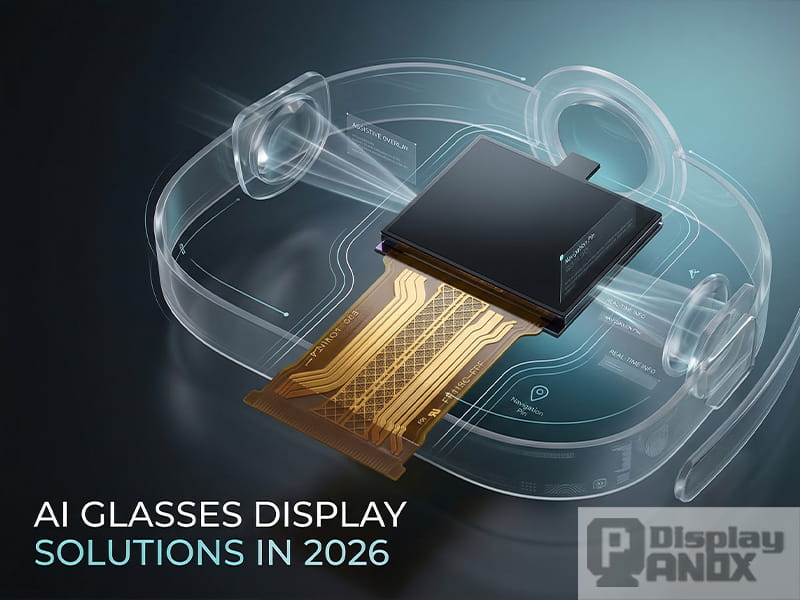
AI glasses are moving from voice-only interaction to visual AI experiences. In 2026, more smart glasses products are expected to support real-time translation, navigation, notifications, teleprompting, and lightweight AR functions. As these features become more common, display technology becomes a key part of product design.
For next-generation smart glasses, Micro OLED is one of the most practical display solutions. It combines ultra-high pixel density, strong contrast, fast response, and compact module size, making it highly suitable for near-eye viewing. For brands developing AI glasses, choosing the right display is no longer just a technical decision. It directly affects readability, comfort, product thickness, and overall user experience.
Beyond AI glasses, AR/VR devices also rely on advanced near-eye display technologies to deliver immersive visuals in a compact form factor.
1. Why Display Technology Matters for AI Glasses
The first generation of AI glasses focused on voice assistants, cameras, and audio interaction. But users now expect more visual support in daily scenarios, such as:
-
real-time translation
-
turn-by-turn navigation
-
message previews
-
AI prompts and summaries
-
teleprompting
-
lightweight visual AR
This shift means smart glasses need displays that are small, sharp, power-efficient, and comfortable for long use. That is why more developers are now paying attention to AI glasses display solutions instead of treating the display as a secondary component.
2. What Is Micro OLED?
Micro OLED, also called OLED microdisplay, is a display technology built on a silicon backplane. Compared with larger OLED panels used in phones, Micro OLED is designed for compact near-eye systems.
Its biggest advantage is that it can deliver very high resolution and pixel density in an extremely small size. This is especially important in smart glasses, where the image is viewed through optics at a very short distance from the eye. If the display is not sharp enough, text and UI elements can look rough, blurry, or uncomfortable to read.
3. Why Micro OLED Works Well for Smart Glasses
3.1 High Pixel Density for Clear Text and UI
AI glasses often display subtitles, prompts, icons, and navigation cues. These elements need to stay crisp and readable in a very small visual area. Micro OLED is strong in this scenario because it can deliver much higher pixel density than conventional display solutions used in larger consumer devices.
For smart glasses, this means:
-
clearer text
-
sharper interface elements
-
better visual detail
-
more premium viewing quality
3.2 High Contrast for Better Visual Experience
One of the biggest strengths of OLED technology is high contrast. In AI glasses, this helps captions, symbols, and interface layers stand out more clearly. It is especially useful for dark UI, floating prompts, and private viewing environments.
High contrast also helps create a cleaner and more premium visual effect, which is important for products positioned above entry-level smart glasses.
3.3 Fast Response for Dynamic Content
Modern AI glasses are not limited to static notifications. More products now support translation overlays, interactive menus, guided prompts, and media viewing. These functions require a display that responds quickly and remains visually stable.
Micro OLED is well suited for this because it supports smooth image updates and a more comfortable near-eye viewing experience.
3.4 Compact Size for Better Wearable Design
Smart glasses have very limited internal space. Designers need to balance cameras, speakers, batteries, wireless modules, sensors, and optics within a slim frame. A bulky display system makes the entire product harder to commercialize.
Micro OLED helps reduce this pressure because it offers high image quality in a compact module format. That gives product teams more flexibility when designing lighter and more wearable AI glasses.
4. Micro OLED vs MicroLED for AI Glasses
Micro OLED and MicroLED are both important display technologies for smart glasses, but they are not ideal for exactly the same applications.
Micro OLED is often better for:
-
private in-lens viewing
-
premium text clarity
-
video-capable smart glasses
-
compact optical engines
-
rich contrast and image quality
MicroLED is often better for:
-
transparent AR glasses
-
very high brightness outdoor use
-
waveguide-focused optical systems
-
lightweight visual overlays
So when people ask which is better, the better question is: which display technology fits the product goal? For many display-enabled AI glasses, Micro OLED remains one of the most practical choices because it balances image quality, compactness, and product maturity.
For projects that require better visibility in brighter environments, choosing a display with High Luminance can be a smart investment in product usability.
5. Best Use Cases for Micro OLED in AI Glasses
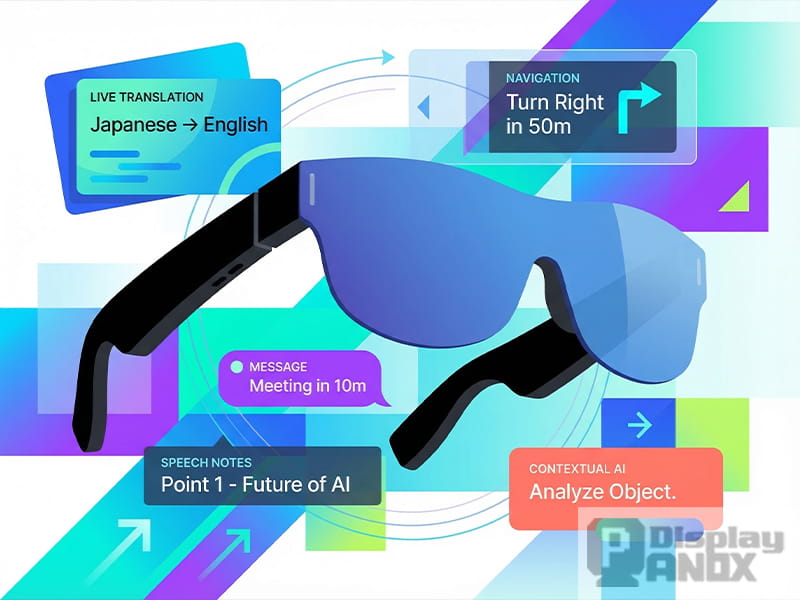
Micro OLED is especially suitable for smart glasses products that need clear visual information in a compact format.
5.1 Translation Glasses
Real-time translation depends on clear text rendering. Micro OLED helps subtitles remain sharp and easy to read.
5.2 Navigation Glasses
Directions, arrows, and location prompts need to stay visible without overwhelming the user. Micro OLED supports this kind of focused private display.
5.3 Teleprompting and Productivity
For business, livestreaming, training, and workflow assistance, smart glasses often need to show short lines of text clearly and comfortably. This is one of the most direct advantages of Micro OLED.
5.4 AI Glasses with Visual Assistance
As AI assistants become more visual, users increasingly expect to see names, summaries, reminders, or contextual prompts instead of hearing everything through audio alone. This makes Micro OLED more relevant in next-generation smart glasses development.
6. How to Choose a Micro OLED Display for Smart Glasses
When selecting a Micro OLED solution for AI glasses, product teams usually focus on:
-
display size
-
resolution
-
pixel density
-
brightness
-
contrast
-
refresh rate
-
power consumption
-
optical compatibility
-
module size
-
production readiness
A good display should not only look impressive on paper. It should also fit the optics, structure, thermal limits, and user experience target of the final product.
7. Final Thoughts
In 2026, AI glasses are moving beyond simple audio interaction. More products are adding visual interfaces to support translation, navigation, productivity, and contextual AI assistance. As a result, display technology is becoming one of the most important factors in smart glasses design.
Micro OLED stands out because it offers sharp near-eye image quality, high contrast, fast response, and compact integration potential. For brands building next-generation smart glasses, it remains one of the most practical display solutions for creating a more useful and more premium wearable experience.
If your project requires sharper near-eye imaging and a more premium user experience, exploring a reliable Micro OLED display option is a practical next step.
8. FAQ
8.1 Why is Micro OLED good for AI glasses?
Because it offers high pixel density, strong contrast, compact size, and good near-eye image quality, which are all important for smart glasses.
8.2 Is Micro OLED better than LCD for smart glasses?
In many near-eye applications, yes. Micro OLED is generally more suitable for compact smart glasses that need better contrast and sharper visual detail.
8.3 Is Micro OLED the same as MicroLED?
No. They are different technologies. Micro OLED is often preferred for compact, high-contrast near-eye viewing, while MicroLED is often preferred for very bright transparent AR systems.
8.4 What can Micro OLED be used for in smart glasses?
It can be used for translation subtitles, navigation, teleprompting, notifications, and other private visual AI functions.
8.5 What should buyers look for in a Micro OLED module?
Key factors include resolution, pixel density, brightness, contrast, refresh rate, power consumption, module size, and compatibility with the optical design.
| Panel model | Interface | Type | Size (inch) | Resolution | P.S |
| S032WEM01 | MIPI/RGB | Micro OLED | 0.32 | 800x600 | |
| PMOF039XGAM | RGB | Micro OLED | 0.39 | 1024x768 | Full Color/Monochrome |
| BO039M1920M | MIPI | Micro OLED | 0.39 | 1920x1080 | Highest PPI =5644 |
| EP047M800T | TTL | LCOS | 0.47 | 800x600 | |
| BO049FHPMO | SPI,MIPI | Micro OLED | 0.49 | 1920x1080 | |
| S050M1600M | MIPI | Micro OLED | 0.5 | 1600x1200 | |
| ECX331DB-6 | Mini LVDS | Micro OLED | 0.5 | 1024x768 | |
| S060LDM01 | MIPI | Micro OLED | 0.6 | 1920x1080 | |
| ECX335AF | Mini LVDS | Micro OLED | 0.71 | 1920x1080 | 200 nits brightness version |
| ECX335B | Mini LVDS | Micro OLED | 0.71 | 1920x1080 | 500 nits brightness version |
| ECX335SN | Mini LVDS | Micro OLED | 0.71 | 1920x1080 | 3000 nits brightness version |
| BO071M1920M | MIPI | Micro OLED | 0.71 | 1920x1080 | |
| S072WCM04 | MIPI | Micro OLED | 0.72 | 1920x1080 | |
| S103WAM01 | MIPI | Micro OLED | 1.03 | 2560x2560 |