



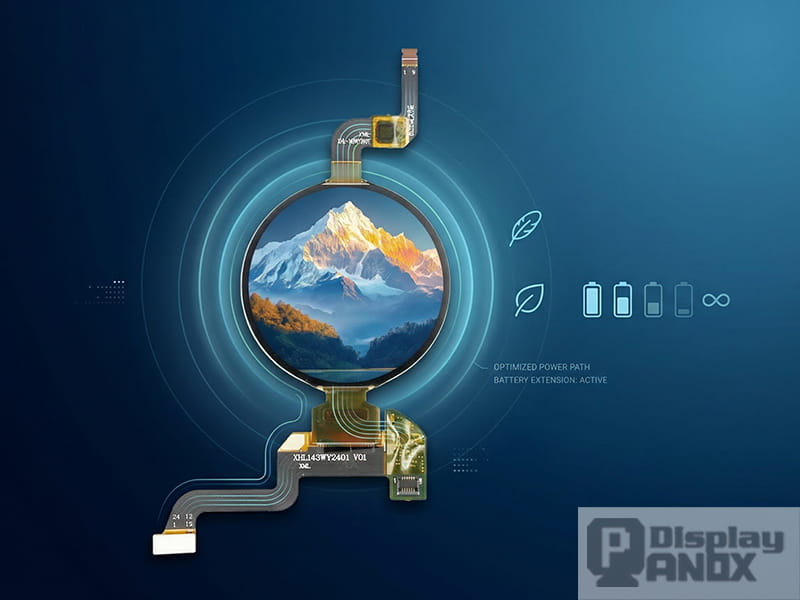
AMOLED is often associated with better battery life, but the real answer is more nuanced. Compared with LCD, AMOLED does not rely on a constant backlight. Each pixel emits its own light, which means black or very dark pixels can consume very little power, while bright content can increase power draw much more noticeably. That is why AMOLED battery performance depends heavily on brightness, UI design, content type, and refresh-rate management rather than on panel type alone.
In 2026, battery life remains one of the most searched concerns for smartphones, wearables, handheld devices, and portable electronics. For brands choosing a display solution, understanding how AMOLED behaves in real usage is essential. A well-optimized AMOLED product can deliver both premium visuals and strong runtime, but only when the panel, software, and usage scenario are aligned.
If your project requires vivid colors, true blacks, and a slimmer module structure, our AMOLED displays are worth a closer look.
Why AMOLED Power Consumption Is Different from LCD
The key difference is simple: LCD uses a backlight, while AMOLED lights each pixel individually. Because of this, AMOLED can reduce display power significantly when showing dark content. Samsung Display explicitly notes that, unlike LCD with an always-on backlight, OLED only emits light where needed, which helps reduce power consumption for dark images.
This also explains why AMOLED does not always consume less power than LCD in every situation. If the screen shows large white areas, high-brightness content, or full-screen outdoor UI, power use rises sharply. DisplayMate’s OLED measurements repeatedly show that full-screen white and higher brightness levels can push display power much higher than dark content does.
Does AMOLED Really Save Battery Life?
In many real-world cases, yes. AMOLED often helps save battery when the interface uses dark backgrounds, when brightness is controlled well, and when the device does not spend long periods showing bright full-screen content. Android’s official battery guidance specifically recommends dark theme on OLED phones because black pixels are turned off to display black.
But AMOLED is not a magic battery solution by itself. Battery life is still affected by processor efficiency, software tuning, radio activity, screen size, resolution, and thermal conditions. AMOLED gives product designers and engineers more flexibility to reduce screen-related power draw, but the result depends on how the product is actually built and used.
For portable devices where battery life matters, a display designed for low consumption can help improve overall user experience.
What Affects AMOLED Battery Life the Most?
Brightness Has the Biggest Impact
For most devices, brightness is one of the strongest factors in AMOLED power consumption. The more light the screen has to produce, the more power it needs. This becomes especially important outdoors, where high-brightness mode or peak luminance is often required for readability. DisplayMate’s OLED evaluations show that display power rises significantly with bright, high-APL content and maximum screen output.
For product planning, this means battery claims should always be considered together with brightness assumptions. A panel that looks efficient indoors may behave very differently in navigation, industrial handheld use, or gaming under strong ambient light.
Dark Mode Can Reduce Power Use
Dark mode is one of the most practical AMOLED battery-saving strategies. Samsung Display states that applying dark mode UI can reduce power consumption by about 25% in its laptop OLED example, and Android also highlights dark theme as a useful battery-saving setting for OLED devices.
However, the actual benefit depends on the interface. A truly dark UI with large black areas can save noticeably more power than a so-called dark theme that still uses many gray panels, bright cards, or white content windows.
White Backgrounds and High APL Increase Power Draw
Average Picture Level, or APL, matters a lot on AMOLED. The brighter the overall image across the display, the more energy the panel uses. This is why browsing white webpages, reading documents, using spreadsheets, and viewing bright dashboards can reduce the battery advantage AMOLED has over LCD.
This has a very practical implication for UI and product design. Battery optimization is not only a hardware decision. It is also a visual design decision.
Refresh Rate and LTPO Also Matter
High refresh rate improves smoothness, but it can also increase energy use if not managed carefully. Variable refresh-rate technologies such as LTPO help reduce panel power by lowering the refresh rate when content is static. Samsung Display says variable refresh can reduce panel-driving power by up to 22% in relevant scenarios.
That is why many battery-life discussions in 2026 are no longer just about AMOLED versus LCD. A better question is whether the AMOLED display can intelligently adapt its refresh behavior to actual usage.
AMOLED vs LCD for Battery Life: Which One Is Better?
AMOLED usually has the advantage when the device uses dark UI, selective highlights, and efficient refresh-rate control. It is especially strong in smartphones, smartwatches, premium wearables, and portable devices where black backgrounds and always-on display features are common.
LCD can narrow the gap when the device frequently shows bright white interfaces or stays at high brightness for extended periods. In those cases, AMOLED may still offer visual advantages such as true blacks and higher contrast, but the battery advantage may become smaller than users expect.
So the most accurate answer is this: AMOLED is often better for battery life, but only under the right content and power-management conditions.
How to Improve AMOLED Battery Performance in Real Products
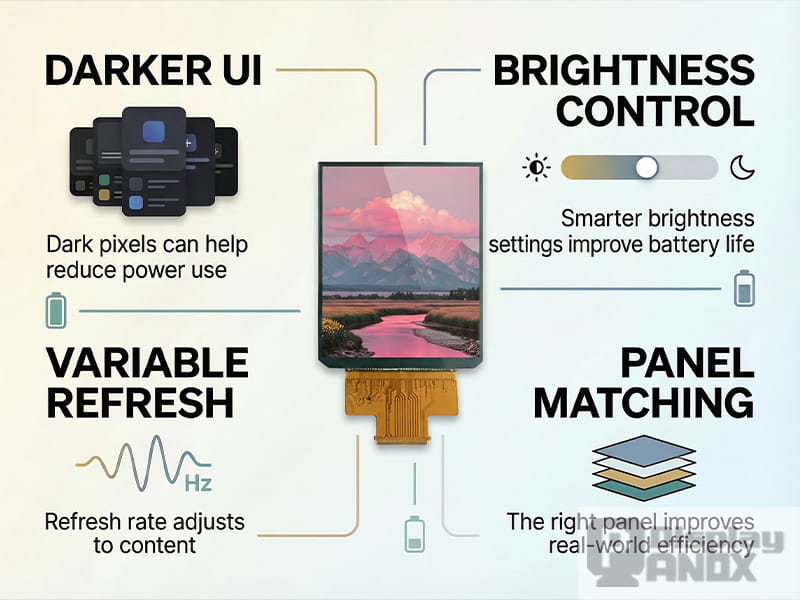
A darker UI structure is one of the easiest ways to improve AMOLED efficiency. Black or near-black backgrounds, restrained white surfaces, and more selective use of bright color blocks can all help reduce display power consumption while still maintaining a premium look.
Brightness strategy is equally important. Adaptive brightness, realistic default luminance, and sensible peak-brightness control can improve battery life more than many teams expect. Since brightness has such a strong effect on AMOLED power use, aggressive brightness behavior can quickly erase efficiency gains from dark pixels.
Refresh-rate optimization should also be part of the design process. If a product uses an AMOLED display, pairing it with variable refresh support can reduce unnecessary energy use during reading, always-on display, status monitoring, and other low-motion scenarios.
Finally, panel selection should match the product’s real use case. Brightness target, resolution, stack design, driver architecture, and expected UI style all influence real-world power behavior. For battery-sensitive applications, choosing the right AMOLED panel early can make later software and UX optimization much easier.
Why AMOLED Still Matters for Battery-Sensitive Devices
AMOLED remains a strong choice because it combines visual performance with power flexibility. It offers true black, high contrast, slim structure, and meaningful battery-saving potential in the right scenarios. With modern improvements in variable refresh and panel efficiency, AMOLED continues to be one of the most attractive display technologies for portable electronics in 2026.
For brands developing phones, wearables, handheld devices, or other portable products, the takeaway is clear: AMOLED battery life is real, but it is content-dependent. The best results come from combining the right panel with the right UI, brightness policy, and refresh-rate strategy.
Looking for a reliable AMOLED display solution for your next device? Explore our product range to find the right fit.
FAQs
Does AMOLED always use less power than LCD?
No. AMOLED usually performs better with dark content, but with bright white screens or sustained high brightness, its power use can rise significantly.
Does dark mode actually improve battery life on AMOLED?
Yes. On OLED-based screens, black pixels use very little power, so dark mode can help reduce battery consumption when the interface is truly dark.
Why does AMOLED battery drain faster outdoors?
Because higher brightness requires more energy. Outdoor readability often pushes the panel into much brighter operating conditions, which increases display power use.
Is LTPO AMOLED better for battery life?
In many cases, yes. LTPO helps lower refresh rate during static content, which can reduce unnecessary power consumption.
Is AMOLED a good choice for wearables?
Yes. AMOLED is often a strong fit for wearables because dark UI, selective lighting, and always-on display behavior can work well with its self-emissive structure.
What matters more for battery life: display type or software optimization?
Both matter, but software and UI design strongly influence how much real battery benefit AMOLED can deliver. A well-optimized AMOLED device usually performs much better than one that simply uses an AMOLED panel without power-aware design.