




When people compare flexible AMOLED vs rigid AMOLED, the conversation often gets reduced to one simple idea: flexible is “premium,” rigid is “standard.” That is not wrong, but it is also not the real engineering story.
The real difference starts much deeper in the panel stack. It is about substrate material, encapsulation method, mechanical stress management, module architecture, bezel strategy, yield, and long-term reliability targets. Both technologies are AMOLED. Both use active-matrix backplanes to drive self-emissive OLED pixels. Both can deliver high contrast, fast response, and true blacks. But from a product engineering standpoint, they solve different design problems.
If you are choosing between a flexible AMOLED display and a rigid AMOLED display for a phone, wearable, handheld device, automotive HMI, or other custom product, this is the comparison that actually matters.
What is the difference between flexible AMOLED and rigid AMOLED?
At the highest level, the core difference is simple:
-
Rigid AMOLED is built on a glass substrate and typically uses glass-based encapsulation.
-
Flexible AMOLED replaces rigid glass in the active display structure with polyimide (PI) and uses thin film encapsulation (TFE) so the panel can bend, curve, or fold.
That change sounds small, but it affects almost everything downstream:
-
mechanical behavior
-
panel thickness and weight
-
bezel compression options
-
drop resistance profile
-
process complexity
-
cost structure
-
reliability testing requirements
In other words, flexible AMOLED is not just rigid AMOLED with a bendable marketing label. It is a different engineering platform.
If you want to explore real AMOLED display modules for product development, you can browse our product page for more options.
The substrate is the real starting point
If you want to understand rigid AMOLED vs flexible AMOLED, start with the substrate.
Rigid AMOLED uses glass because glass is dimensionally stable, familiar to the display industry, and naturally strong as a barrier structure. Flexible AMOLED uses polyimide, a heat-resistant polymer material that can survive the display manufacturing process while allowing the final panel to bend. Samsung Display explicitly describes rigid OLED as glass-based and flexible OLED as PI-based.
This change matters because the substrate is not just a support layer. It affects:
-
how the TFT backplane is formed
-
how the OLED stack is protected
-
how thin the module can become
-
whether the panel can be curved, folded, or wrapped into a tighter industrial design
A rigid panel is optimized for flat, stable integration. A flexible panel is optimized for form-factor freedom.
Encapsulation is where flexible AMOLED becomes much more difficult
One of the biggest engineering differences between flexible AMOLED and rigid AMOLED is encapsulation.
OLED materials are highly sensitive to oxygen and moisture, so every OLED panel needs a barrier structure. In rigid OLED, a glass cover can be used as part of the sealing strategy. In flexible OLED, that rigid glass approach no longer works, so manufacturers use thin film encapsulation, typically a multilayer stack of alternating inorganic and organic layers designed to block moisture while still allowing flexibility. Samsung Display explains this directly in its TFE overview.
This is one of the reasons flexible AMOLED costs more and is harder to manufacture well:
-
the barrier must remain effective without becoming brittle
-
the stack must tolerate repeated bending stress
-
pinholes, cracks, and interface defects become more critical
-
process control is tighter than in a conventional rigid structure
So when buyers ask why flexible AMOLED pricing is usually higher, the answer is not just “because it bends.” It is because the barrier engineering is far more demanding.
Flexible AMOLED is usually built on carrier glass first
Here is another detail that many non-engineering articles skip: a flexible AMOLED panel is often not fabricated as a loose plastic sheet from the beginning.
In practical production, polyimide is first formed on carrier glass, then the TFT, OLED, and encapsulation layers are built, and later the panel is separated from that carrier through a laser lift-off or detachment process. Samsung Display and Corning both describe the role of carrier glass in flexible OLED manufacturing, and laser lift-off is widely recognized as a key step in flexible OLED production.
This matters because it shows why flexible AMOLED is not just a materials swap. It adds an entire process challenge:
-
carrier handling
-
PI formation quality
-
detachment uniformity
-
stress control after release
-
downstream yield protection
That extra complexity is part of the real engineering difference.
Why flexible AMOLED enables curved screens, foldables, and slimmer industrial design
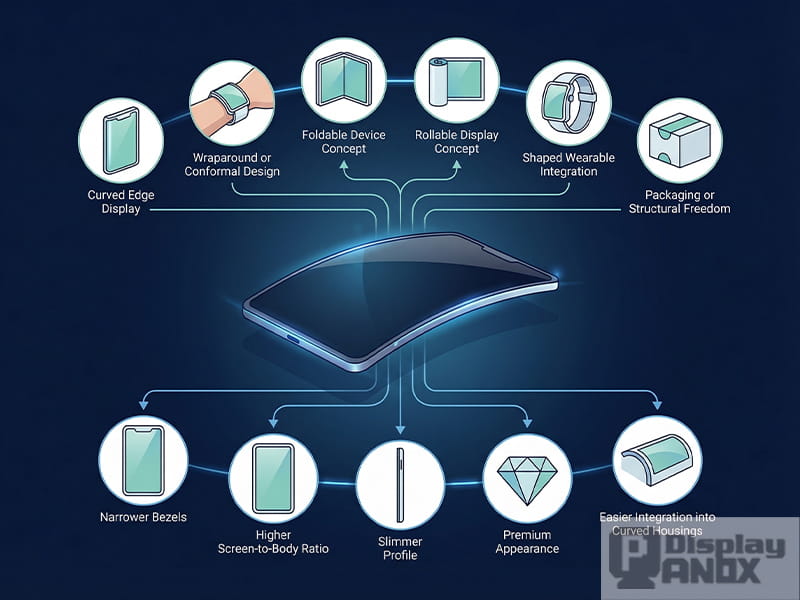
The obvious advantage of flexible AMOLED displays is form factor. Because the active display structure is not locked into a rigid glass-only architecture, flexible AMOLED makes possible:
-
curved-edge displays
-
wraparound or contour-fit modules
-
foldable phones
-
rollable concepts
-
compact wearables with shaped panels
-
aggressive internal packaging strategies
Samsung Display notes that flexible OLED can be made much thinner than glass-based structures and is used for curved, folded, and other advanced form factors.
For product teams, that means flexible AMOLED is often selected not because the image quality is automatically better, but because the mechanical freedom enables a better product architecture.
That can translate into:
-
narrower borders
-
better screen-to-body ratio
-
more premium industrial design
-
lower module thickness
-
easier integration into curved housings
Does flexible AMOLED have smaller bezels than rigid AMOLED?
In many real products, yes.
That is not only because the panel itself can bend. It is also because the electrical packaging strategy can change. Samsung Display explains that COF and especially COP packaging help move the driver arrangement behind the display structure, reducing bezel size. Flexible architectures are especially compatible with that compression strategy.
So if someone searches “why does flexible AMOLED have a narrower chin?”, the answer is:
-
the bendable structure helps routing
-
advanced packaging like COF/COP helps hide driver area
-
the module can be compressed more efficiently than many rigid designs
This is one reason flexible AMOLED became central to premium smartphone design.
Is flexible AMOLED more durable than rigid AMOLED?
This question needs a careful answer.
If by durability you mean impact behavior and resistance to cracking from rigid glass breakage, flexible AMOLED can offer an advantage because the active panel structure is not relying on the same rigid glass architecture. But if by durability you mean overall reliability under repeated bending, folding, thermal cycling, or interface fatigue, flexible AMOLED is actually much more demanding to engineer.
Research on flexible screen mechanics shows that stress rises quickly as bending radius decreases, and structural design choices strongly affect failure risk. Studies also show that water-drop-style folding geometry can reduce peak stress compared with a tighter U-shaped fold in small-radius designs.
So the honest engineering answer is:
-
Flexible AMOLED can be better for shaped or impact-sensitive products
-
Rigid AMOLED can be simpler to stabilize in flat products
-
Foldable or repeatedly bent flexible AMOLED requires far more reliability engineering than either of those statements suggests
In short, flexible is not automatically “more durable.” It is more mechanically adaptable, but also more mechanically challenging.
If you are evaluating options for your next product, you can explore our AMOLED display solutions for more reference.
Bend radius is not a marketing phrase. It is a design limit
In flexible AMOLED development, bend radius is one of the most important real-world parameters.
The smaller the bend radius, the greater the strain inside the stack. That strain must be controlled across multiple fragile functional layers, including the substrate, TFT region, OLED organic layers, encapsulation, adhesives, and cover structure. Research literature consistently shows that smaller radius means significantly higher stress and higher structural risk if the stack is not optimized.
That is why serious flexible AMOLED projects require more than a spec sheet. They require validation around:
-
target bend radius
-
bend direction
-
dynamic or static bending
-
folding cycle count
-
thermal and humidity exposure
-
adhesive and neutral-plane design
-
cover lens and touch-stack interaction
This is where many sourcing decisions are won or lost.
Is flexible AMOLED thinner and lighter than rigid AMOLED?
Generally, yes.
Because flexible AMOLED replaces rigid structural elements with PI and thin film barrier layers, it can reduce panel thickness and weight. Samsung Display states that flexible OLED can be made thinner than glass-based alternatives, and newer ultra-thin OLED structures in IT devices also show how replacing glass-heavy top structures can significantly reduce thickness and weight.
For device makers, even modest savings in thickness or mass can help with:
-
larger battery allocation
-
slimmer housings
-
more room for cameras, sensors, or thermal design
-
better ergonomics in wearables and mobile devices
This is one reason flexible AMOLED often wins in premium product categories even when flat display performance alone would not justify the added cost.
Which has lower power consumption: flexible AMOLED or rigid AMOLED?
There is no universal rule that flexible AMOLED inherently uses less power than rigid AMOLED.
OLED as a category can save power relative to LCD because it lights only the necessary pixels and benefits from dark content. Samsung Display notes that OLED power consumption drops when fewer pixels are lit, such as in dark mode.
But between flexible AMOLED vs rigid AMOLED, power depends more on:
-
brightness target
-
panel size and resolution
-
LTPS or oxide backplane behavior
-
refresh rate strategy
-
content mix
-
DDIC and compensation design
-
optical efficiency and stack optimization
So if a buyer asks, “Should I choose flexible AMOLED for better battery life?”, the safest engineering answer is:
Choose flexible AMOLED for form factor, thickness, and packaging advantages—not because flexibility alone guarantees lower power.
Why is flexible AMOLED more expensive?
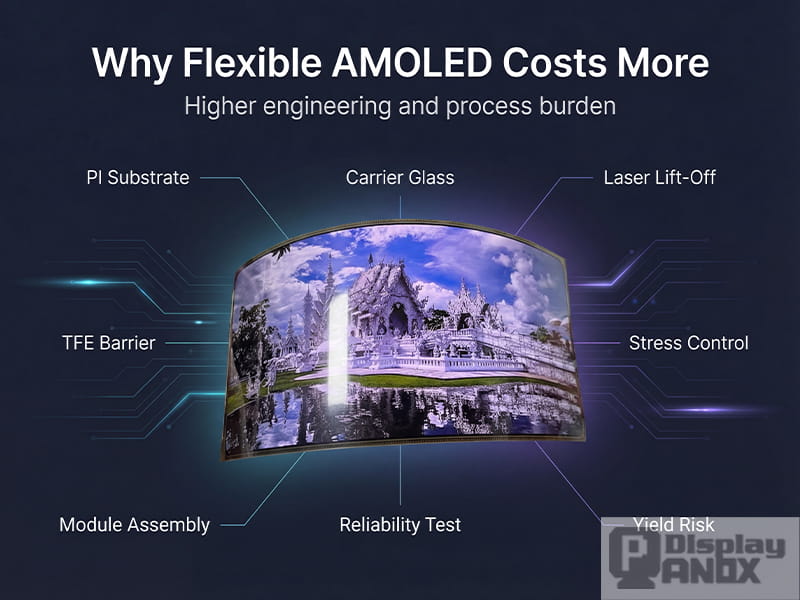
Because it usually carries more engineering and process burden.
Compared with rigid AMOLED, flexible AMOLED typically involves:
-
polyimide substrate formation
-
carrier glass handling
-
laser lift-off or detachment
-
thin film encapsulation instead of simpler glass sealing
-
tighter stress management
-
more complex module assembly
-
stricter mechanical reliability validation
-
yield loss risk from more demanding processing
Public technical sources from Samsung Display, BOE-related literature, and flexible-screen mechanics research all point in the same direction: flexible OLED manufacturing is materially more complex than rigid OLED manufacturing.
That is why flexible AMOLED is typically chosen when the product gains are meaningful enough to justify it.
When should you choose rigid AMOLED?
Rigid AMOLED is often the better choice when your product priorities are:
-
flat display integration
-
lower cost than flexible alternatives
-
simpler mechanical requirements
-
stable, conventional module design
-
premium image quality without needing curves or folds
-
lower program risk in straightforward form factors
For many handhelds, industrial devices, medical controls, and fixed-format interfaces, rigid AMOLED still makes excellent sense because it preserves OLED image advantages without adding unnecessary structural complexity. Samsung Display’s rigid OLED description makes clear that it remains a distinct and practical platform, not an obsolete one.
When should you choose flexible AMOLED?
Flexible AMOLED is usually the better path when you need:
-
curved or shaped displays
-
foldable or bendable product concepts
-
ultra-thin module construction
-
lighter display structures
-
narrow bezels or compressed bottom borders
-
advanced industrial design freedom
-
display integration into premium wearables or next-gen consumer devices
In these cases, rigid AMOLED may simply not support the product architecture you want. Flexible AMOLED is not just a better display. It is often the only display architecture that makes the industrial design possible.
Final takeaway
The debate around flexible AMOLED vs rigid AMOLED is often framed as a simple premium-versus-standard choice. In reality, the gap is much more technical.
Rigid AMOLED is defined by glass-based stability. Flexible AMOLED is defined by PI substrate, thin film encapsulation, carrier-glass processing, laser release, and mechanical stress control. Both can look excellent. Both can deliver true OLED advantages. But only one of them unlocks the next level of industrial design freedom—and that freedom comes with higher manufacturing complexity, tighter reliability demands, and higher cost.
If you are evaluating AMOLED for a new product, the smartest path is not to ask which one is more advanced in theory. It is to ask which one fits your thickness budget, bend requirement, bezel target, reliability profile, and program cost in the real world.
FAQs
Is flexible AMOLED better than rigid AMOLED?
Not universally. Flexible AMOLED is better for curved, foldable, ultra-thin, or narrow-bezel designs. Rigid AMOLED is often better for flat products that need OLED quality with lower complexity and lower cost.
What is the main engineering difference between flexible AMOLED and rigid AMOLED?
The main difference is the combination of substrate and encapsulation. Rigid AMOLED typically uses glass and glass-based sealing, while flexible AMOLED uses polyimide and thin film encapsulation.
Does flexible AMOLED always have lower power consumption?
No. Power consumption is driven more by content, brightness, refresh rate, panel design, and system tuning than by flexibility alone. OLED in general can save power on dark content, but flexible AMOLED does not automatically beat rigid AMOLED on power.
Is flexible AMOLED more durable?
It can be more tolerant of certain mechanical impacts and shaped integration, but it is also more demanding in repeated bending and folding applications. Durability depends on the use case and stack design, not on marketing labels.
Why is flexible AMOLED more expensive?
Because it usually requires PI processing, carrier glass, laser detachment, thin film encapsulation, more complex assembly, and stricter reliability control.
Can rigid AMOLED still be a good choice in 2026?
Absolutely. For many flat consumer, industrial, medical, and control-display products, rigid AMOLED remains a very practical solution with strong visual performance and lower program complexity.
If you are sourcing for a new project, you can browse our custom AMOLED display options here.