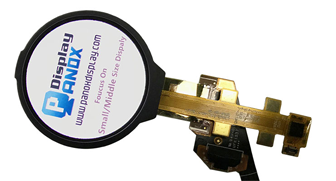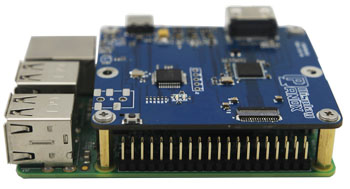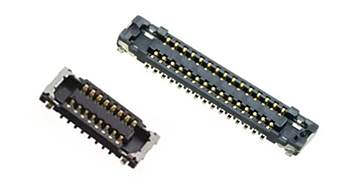







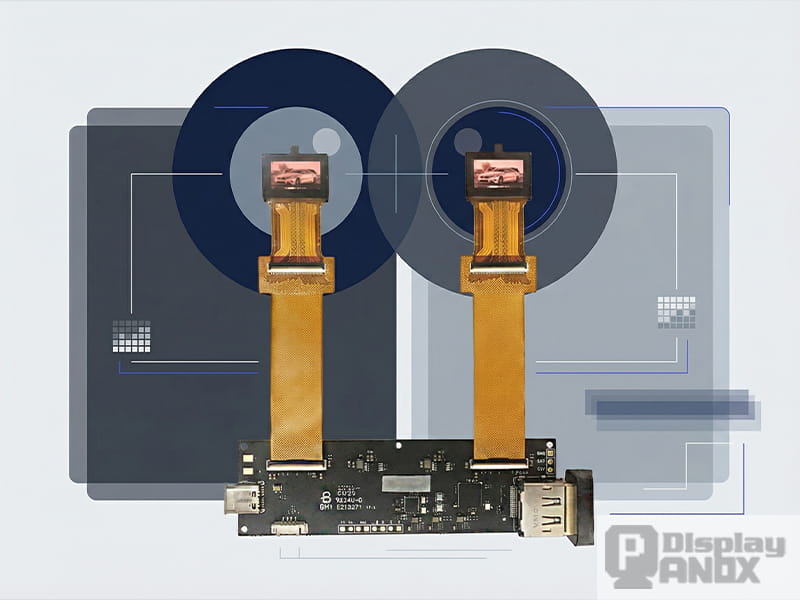
0.71 inch Micro OLED 1920x1080 LVDS 3000 nits
Micro OLED and Mini LED are two of the most talked-about display technologies in 2025 — but they are solving very different problems. Micro OLED is a self-emissive display built on a silicon wafer, delivering extraordinary pixel density in a tiny footprint, making it the dominant choice for AR/VR headsets and near-eye devices. Mini LED is a significant upgrade to traditional LCD backlighting, using thousands of tiny LEDs in local dimming zones to push brightness and contrast far beyond what standard LCD can achieve — ideal for TVs, monitors, and large-format displays in bright environments.
If you are choosing between them, the real question is not which technology is "better" — it is which one fits the application you are building or buying for.
How Do Micro OLED and Mini LED Work Differently?
The fundamental difference is how each technology creates light.
Micro OLED is entirely self-emissive. Each individual pixel is an organic light-emitting diode built directly onto a silicon wafer (which is why it is also called OLED-on-silicon, or OLEDoS). When a pixel needs to display black, it simply switches off — no light leaks, no compromise. The silicon backplane allows pixel pitches as small as 8–15 microns, which is why a Micro OLED panel smaller than 1.5 inches can achieve resolutions exceeding 3,000–5,000 PPI. The Apple Vision Pro and Samsung Galaxy XR both use 4K Micro OLED microdisplays per eye.
Mini LED is not a self-emissive technology — it is an evolution of LCD. A Mini LED display still uses liquid crystals and color filters to form images, but replaces the conventional backlight with an array of thousands of tiny LED chips (typically 100–200 microns in size). These chips are grouped into independent local dimming zones — premium models today reach 1,000 to 4,000+ zones per panel — allowing precise control of which areas of the screen are bright or dark. The result is contrast and HDR performance far superior to standard LED LCD, but still fundamentally limited by the fact that light must pass through liquid crystals rather than being generated at the pixel level.
| Feature | Micro OLED | Mini LED |
|---|---|---|
| Light Source | Self-emissive per pixel | LED backlight through LCD layer |
| True Black | Yes — pixels switch off | No — backlight leakage causes "blooming" |
| Typical Panel Size | 0.2" – 1.5" | 10" – 100"+ |
| Pixel Density | 2,000 – 5,400+ PPI | 200 – 600 PPI |
| Peak Brightness | 800 – 1,000 nits (improving) | 1,500 – 2,000+ nits |
| Burn-In Risk | Yes (organic materials) | No (inorganic LED backlight) |
| Primary Use Cases | AR/VR headsets, EVF, medical | TVs, monitors, laptops, signage |
Contrast and Black Levels: Where Micro OLED Has No Rival
In any self-emissive display, contrast is theoretically infinite — when a pixel is off, it contributes zero light, so the contrast ratio between a lit white pixel and a completely dark pixel is limitless.
Mini LED comes closer to this ideal than any LCD before it. With 1,000+ local dimming zones, modern Mini LED panels can achieve contrast ratios measured at 1,000,000:1 under ideal conditions. But "zones" are the key word — each zone controls a cluster of pixels, not individual ones. This means that a bright object on a dark background causes the surrounding zone to partially illuminate, creating a visible "halo" or blooming effect. High-end Mini LED panels have compressed this halo to within a few millimeters, and algorithmic compensation has improved significantly — but it cannot be fully eliminated as long as LCD remains the image-forming layer.
Micro OLED has no zones. Every pixel is its own light source, so contrast is genuine and per-pixel. This difference is especially significant in near-eye use cases: in a VR headset, imperfect blacks are immediately visible and immersion-breaking in a way that watching a TV across the room is not. This is a core reason why the premium VR market — Apple Vision Pro, Bigscreen Beyond, Pimax Crystal Super — has converged on Micro OLED rather than any LCD variant, including Mini LED.
Brightness: Where Mini LED Dominates
This is Mini LED's strongest card, and it is a genuine advantage.
Premium Mini LED TVs such as the LG G3 and Samsung Neo QLED routinely hit 2,000 nits peak brightness. Laptops with Mini LED panels achieve 1,000–1,600 nits, making them usable in direct sunlight where OLED screens wash out. The inorganic LED backlight can be driven hard without degradation concerns, since it is not organic material.
Micro OLED panels have historically peaked around 800–1,000 nits — enough for enclosed headset environments but inadequate for open outdoor AR use. The brightness ceiling exists because the color filter layer in conventional Micro OLED absorbs a significant portion of emitted light. Manufacturers including eMagin (now part of Samsung Display) have developed direct-patterned RGB Micro OLED processes that eliminate the color filter, achieving over 10,000 nits in laboratory conditions. Panox Display supplies high-luminance Micro OLED modules targeting this next generation of AR applications where outdoor visibility is required.
For any application where ambient light is controlled — VR headsets, surgical visualization, cockpit displays, camera viewfinders — Micro OLED's current brightness is more than sufficient. For applications in open, bright environments — outdoor signage, automotive head-up displays visible in daylight, laptop screens — Mini LED holds the advantage today.
Pixel Density and Sharpness: No Contest at Close Range
This is where the two technologies are not even competing on the same terms.
A flagship Mini LED TV at 4K resolution across a 65-inch panel achieves around 68 PPI. A high-end Mini LED laptop panel at 4K on 15 inches reaches approximately 293 PPI — impressive for a screen viewed at arm's length, where the human eye cannot resolve individual pixels beyond roughly 300 PPI at that distance.
Micro OLED operates in a completely different range. A 1.3-inch Micro OLED panel at 4K resolution hits approximately 3,800–5,400 PPI. At 2–3 centimeters from the eye — the typical distance in a VR headset with optics — this pixel density is what eliminates the "screen door effect": the visible grid of gaps between pixels that plagued early VR headsets using LCD or standard AMOLED panels. Users of Meta Quest 3 and similar Micro OLED headsets consistently report near-elimination of the screen door effect and significantly reduced eye strain compared to earlier LCD-based devices.
For near-eye applications, Mini LED's PPI is simply insufficient regardless of how good its other characteristics are. The physics of scale make Micro OLED the only practical technology for compact, high-quality microdisplays today.
Burn-In and Longevity: Mini LED's Structural Advantage
Mini LED does not burn in. Its inorganic LED backlight is not subject to the organic material degradation that affects all OLED technologies. A well-manufactured Mini LED display is rated for 60,000–100,000 hours of use — equivalent to 10–15 years of typical operation — with no risk of permanent image retention from static content.
Micro OLED, like all OLED technologies, uses organic light-emitting compounds that gradually lose brightness over time and can develop permanent burn-in from extended static content. For consumer applications — a VR headset used in sessions, a camera viewfinder, a medical monitor with varied content — this is a manageable limitation. Pixel shifting, brightness management, and usage pattern design all mitigate real-world burn-in risk significantly. For industrial applications requiring continuous 24/7 static display — monitoring dashboards, control room interfaces, permanent signage — Mini LED is the more appropriate choice.
Panox Display provides guidance on panel selection and firmware-level burn-in mitigation for Micro OLED deployments in commercial and industrial contexts.
Power Efficiency: Depends Entirely on Content
Both technologies can claim efficiency depending on context.
Micro OLED consumes power only for pixels that are illuminated. A display with predominantly dark content — a VR environment, a night scene, a dark UI — draws very little power. Meta Quest 3's dual Micro OLED panels draw approximately 30mW total display power, a key reason the headset remains lightweight and the battery achieves workable session lengths.
Mini LED's backlight remains on regardless of displayed content. Even with local dimming reducing backlight in dark zones, the overall power draw is higher than a Micro OLED display showing comparable content. For bright, predominantly white content — documents, spreadsheets, bright video — the difference narrows, and Mini LED may be comparably efficient.
For battery-powered near-eye devices, Micro OLED's efficiency advantage is practically significant. For mains-powered large displays, it is a secondary consideration.
What Applications Should Choose Micro OLED?
Micro OLED is the right choice when pixel density, contrast, compactness, and low power consumption matter most — and when the display will be viewed at very close range through optics:
- VR and MR headsets — Apple Vision Pro, Samsung Galaxy XR, Bigscreen Beyond, and virtually every premium headset in 2025 uses Micro OLED. DSCC forecasts OLED-on-silicon to capture the largest share of VR display shipments going forward.
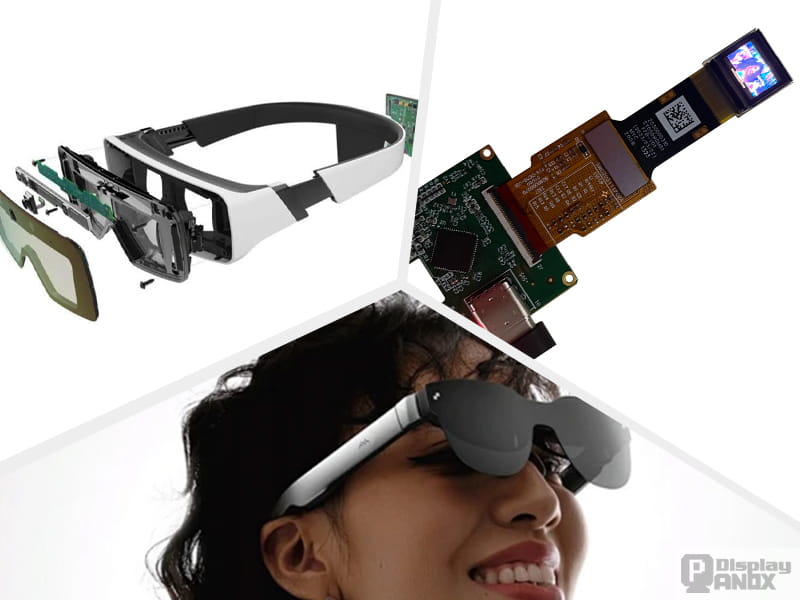
- AR glasses — High-luminance Micro OLED modules are the current mainstream solution for AR with video display capability, especially for indoor and enterprise use.
- Electronic viewfinders (EVF) — Professional cameras use Micro OLED for the viewfinder because the pixel density makes the image indistinguishable from optical viewing.
- Surgical and medical visualization — Near-eye displays in surgical loupes and diagnostic headsets benefit from Micro OLED's compact form and image accuracy.
- AI-powered smart glasses — Multiple manufacturers (including those using Panox Display's Micro OLED modules) are integrating compact Micro OLED displays into next-generation AI glasses for translation, navigation, and real-time information overlay.
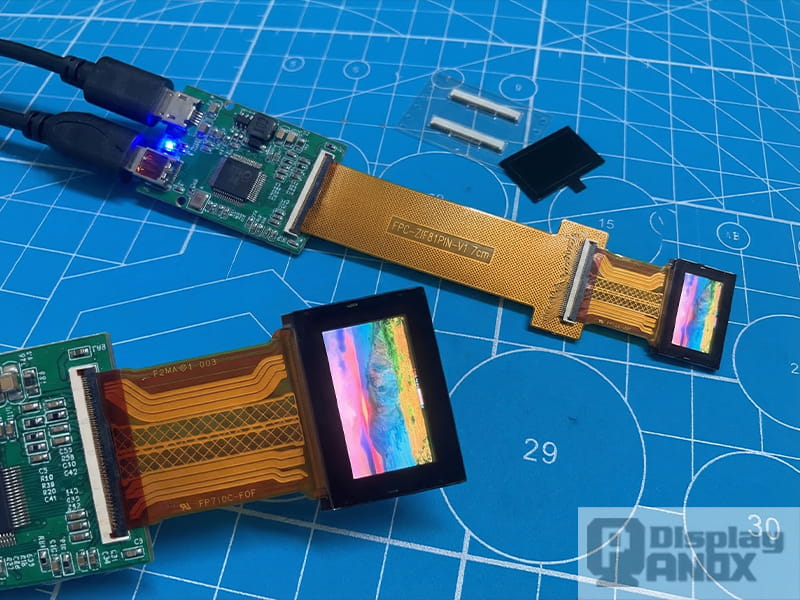
Panox Display supplies Micro OLED display modules in sizes from 0.2" to 1.3", supporting both standard optical waveguide configurations and custom OEM specifications for prototype and production volumes.
What Applications Should Choose Mini LED?
Mini LED is the right choice when brightness, large display area, longevity, and burn-in immunity are the priorities:
- Premium TVs and home cinema — Mini LED delivers the brightness required for HDR10+ and Dolby Vision content in well-lit living rooms where OLED would wash out.
- Professional monitors — Color-critical workflows where sustained brightness and no burn-in risk matter, such as video editing suites and graphic design studios.
- Gaming monitors — Mini LED offers burn-in-free extended use combined with high refresh rates and brightness that many competitive gamers prefer for bright-room setups.
- Laptops — Mini LED backlights in high-end laptops provide outdoor-readable brightness that OLED panels cannot match at comparable power budgets.
- Automotive and outdoor signage — Daylight-readable Mini LED panels are widely used in vehicle interior displays and outdoor digital signage where sustained high brightness is non-negotiable.
How Are the Two Technologies Evolving?
Micro OLED development is accelerating on two fronts. First, direct-patterned RGB Micro OLED (eliminating the color filter) is pushing brightness toward 5,000–10,000 nits, which would make Micro OLED viable for outdoor AR for the first time. Second, silicon wafer manufacturing is expanding — BOE showcased a 1.3-inch 4K Micro OLED panel exceeding 4,000 PPI, and Samsung Display's acquisition of eMagin signals major investment in expanding Micro OLED production capacity. The result will be lower costs and wider commercial availability.
Mini LED is improving through higher zone counts (moving from ~1,000 toward 4,000+ zones in consumer products), smarter dimming algorithms, and integration with Quantum Dot color enhancement layers (QD-Mini LED). These improvements continue to narrow the blooming and contrast gap with self-emissive displays, though the fundamental physics of LCD mean it can approach but never fully replicate per-pixel control.
The longer-term successor to both — Micro LED — remains years away from mainstream pricing. In the near term, Micro OLED and Mini LED will each continue to dominate their respective segments.
Panox Display Expert Views
"We see Micro OLED and Mini LED as technologies serving genuinely distinct markets, which is why framing them as direct competitors misses the point. Our clients building AR/VR devices, smart glasses, and near-eye instruments need what only Micro OLED can deliver: extreme pixel density, true blacks, and a compact form factor compatible with modern optics. At the same time, we recognize that Mini LED is the practical answer for large-format, high-brightness, and long-life applications where OLED's organic materials would be a liability. At Panox Display, our focus is on Micro OLED — because that is where the most demanding display engineering challenges are being solved right now, and where the next generation of spatial computing will be built." — Panox Display Senior Engineer
Conclusion
Micro OLED and Mini LED are not competing for the same customers. Micro OLED owns the near-eye display market — VR headsets, AR glasses, viewfinders, and medical devices — where its unmatched pixel density, true blacks, fast response, and compact silicon-based construction cannot be replicated by any backlit LCD technology. Mini LED owns the large-format, high-brightness market — TVs, monitors, automotive displays, and outdoor signage — where sustained luminance, burn-in immunity, and scale are the deciding factors.
For product teams and engineers evaluating display technology, the selection criterion is straightforward: if your display will be viewed through optics at close range, Micro OLED is the answer. If your display needs to be large, bright, and immune to static content degradation, Mini LED is the answer. Panox Display supports OEM customers across the Micro OLED spectrum, from early-stage prototype modules to customized production configurations.
FAQs
Q: Can Mini LED replace Micro OLED in VR headsets?
A: Not practically. Mini LED's pixel density is orders of magnitude lower than Micro OLED at equivalent panel sizes. A near-eye display needs thousands of PPI to eliminate the screen-door effect; no Mini LED panel achieves this at the small form factors required for headset optics.
Q: Is Micro OLED better than Mini LED for color accuracy?
A: Micro OLED delivers excellent color accuracy with wide color gamuts and per-pixel precision. Mini LED with Quantum Dot enhancement can achieve very wide color gamuts (98%+ DCI-P3) and high brightness, which some professional workflows favor. Both can be calibrated to professional standards; the choice depends on the application.
Q: Does Micro OLED have a burn-in problem?
A: Like all OLED technologies, Micro OLED can develop burn-in with prolonged static content. For typical near-eye applications with varied content, burn-in risk is well-managed with modern pixel-shift algorithms and display management firmware. For continuous 24/7 static display, Mini LED is the safer choice.
Q: Why is Micro OLED so expensive compared to Mini LED?
A: Micro OLED is fabricated on silicon wafers using semiconductor processes. A 12-inch silicon wafer yields approximately 100 panels at 1.3-inch diagonal — far fewer than a standard glass sheet produces for large-format displays. The precision required to achieve 5,000 PPI on microscopic panels is inherently costly. Prices are declining as production scales.
Q: Does Panox Display supply Micro OLED modules for custom AR/VR projects?
A: Yes. Panox Display offers Micro OLED display modules from 0.2" to 1.3" with options for optical waveguide integration, custom resolution configurations, and OEM controller board programming, supporting both development prototypes and volume production.
| Panel model | Interface | Type | Size (inch) | Resolution | P.S |
| S032WEM01 | MIPI/RGB | Micro OLED | 0.32 | 800x600 | |
| PMOF039XGAM | RGB | Micro OLED | 0.39 | 1024x768 | Full Color/Monochrome |
| BO039M1920M | MIPI | Micro OLED | 0.39 | 1920x1080 | Highest PPI =5644 |
| EP047M800T | TTL | LCOS | 0.47 | 800x600 | |
| BO049FHPMO | SPI,MIPI | Micro OLED | 0.49 | 1920x1080 | |
| S050M1600M | MIPI | Micro OLED | 0.5 | 1600x1200 | |
| ECX331DB-6 | Mini LVDS | Micro OLED | 0.5 | 1024x768 | |
| S060LDM01 | MIPI | Micro OLED | 0.6 | 1920x1080 | |
| ECX335AF | Mini LVDS | Micro OLED | 0.71 | 1920x1080 | 200 nits brightness version |
| ECX335B | Mini LVDS | Micro OLED | 0.71 | 1920x1080 | 500 nits brightness version |
| ECX335SN | Mini LVDS | Micro OLED | 0.71 | 1920x1080 | 3000 nits brightness version |
| BO071M1920M | MIPI | Micro OLED | 0.71 | 1920x1080 | |
| S072WCM04 | MIPI | Micro OLED | 0.72 | 1920x1080 | |
| S103WAM01 | MIPI | Micro OLED | 1.03 | 2560x2560 |