



A flexible OLED display is a next-generation screen technology built on bendable plastic substrates rather than traditional rigid glass, enabling it to curve, fold, or roll without losing image quality. Unlike conventional displays, every pixel in a flexible OLED screen generates its own light — delivering stunning contrast, vivid color, and an ultra-thin form factor that opens up entirely new possibilities in product design.
What Is a Flexible OLED Screen and How Does It Work?
A flexible OLED (Organic Light-Emitting Diode) display uses a polyimide plastic substrate instead of glass as its foundation. This material is both lightweight and mechanically resilient, allowing the panel to bend freely while maintaining full display functionality.
Each pixel in a flexible OLED screen consists of organic compounds layered between electrodes. When current passes through these layers — including the Hole Transport Layer (HTL), Emissive Layer (EML), and Electron Transport Layer (ETL) — each pixel emits its own light individually. This self-emissive design completely eliminates the need for a backlight, which is why flexible OLED panels can be made so thin and lightweight compared to LCD-based alternatives.
The result is a display capable of achieving true black levels, near-infinite contrast ratios, and wide viewing angles — all while conforming to curved, folded, or custom-shaped surfaces.
What Are the Different Types of Flexible OLED Displays?
Not all flexible OLED screens behave the same way. The technology has matured into several distinct form factors, each suited to different applications:
| Type | Description | Common Use Cases |
|---|---|---|
| Bendable / Curved | Fixed curve set during manufacturing; user cannot bend further | Automotive dashboards, edge-screen smartphones, curved monitors |
| Foldable | Can be folded by the end user; features a crease-resistant hinge area | Foldable smartphones, portable tablets |
| Rollable | Can be rolled into a compact cylinder when not in use | Rollable TVs, portable displays, next-gen laptops |
| Stretchable | Can be deformed in multiple axes; emerging technology | On-skin health sensors, experimental wearables |
Understanding which type fits your product requirements is the first step to choosing the right flexible OLED module.
What Makes Flexible OLED Screens Better Than Rigid Displays?
The advantages of flexible OLED over conventional LCD or rigid OLED panels are substantial:
True Black and Infinite Contrast: Because each pixel switches off completely, flexible OLED screens deliver contrast ratios of 1,000,000:1 — far exceeding the performance of any LCD backlit panel.
Thinner and Lighter Form Factor: Without a glass substrate or backlight assembly, flexible OLED panels are significantly thinner and lighter — a critical advantage for wearable devices, portable electronics, and automotive interiors where weight and space are at a premium.
Impact Resistance: Polyimide plastic substrates are inherently more shatter-resistant than glass, making flexible OLED screens better suited to devices that experience drops and vibration.
Design Freedom: Flexible OLED allows product designers to follow curved surfaces, create seamless cockpit layouts, wrap displays around objects, and achieve form factors previously impossible with rigid screens.
Energy Efficiency: Self-emissive pixels consume power only when lit, reducing overall energy use compared to always-on LCD backlights — an important factor for battery-powered wearable and mobile devices.
How Is a Flexible OLED Display Structured?
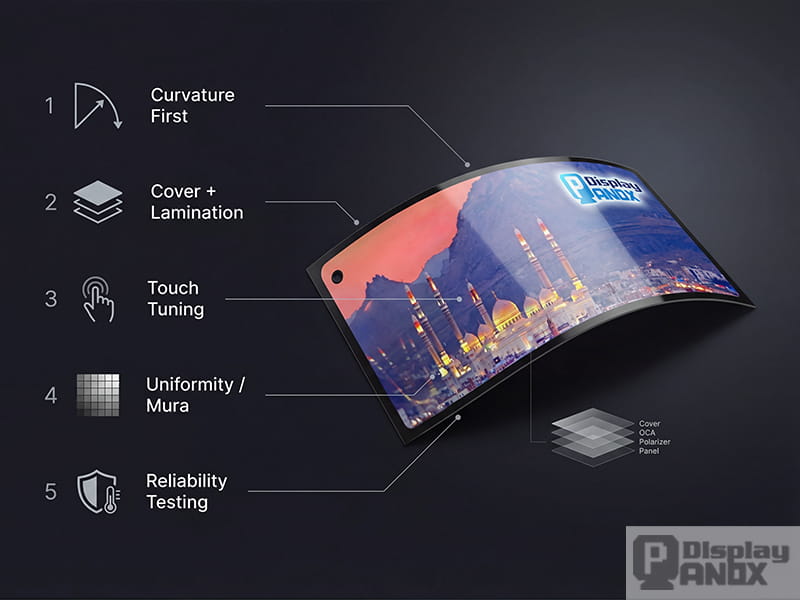
A flexible OLED screen is a precision multi-layer assembly. Each layer serves a specific purpose:
- Polyimide Substrate — The flexible foundation that replaces glass, providing mechanical resilience and thermal stability.
- TFT Backplane (Thin-Film Transistor) — Controls which pixels are activated and at what intensity. AMOLED panels use active-matrix TFTs for superior resolution and power efficiency.
- Organic Emissive Layers — The core functional layers where red, green, and blue light is generated per pixel.
- Encapsulation Layer — A critical moisture and oxygen barrier. Thin-film encapsulation is essential for maintaining display longevity on flexible substrates.
- Flexible Printed Circuit (FPC) — Connects the panel to the driver electronics; FPC tail length and bend direction can be customized for tight enclosures or specific wearable formats.
- Optional Touch Panel — Capacitive touch layers can be integrated directly into the flexible OLED module for interactive applications.
What Are the Main Applications for Flexible OLED Displays?
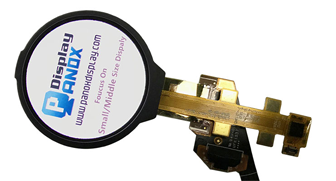
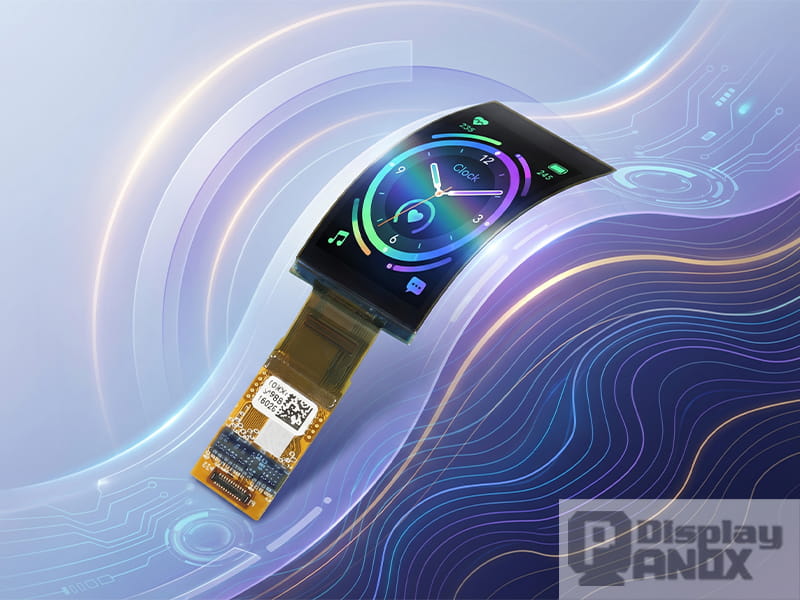 1.5 inch Flexible OLED For Wearable Smart Watch
The versatility of flexible OLED screens has driven adoption across a remarkably broad range of industries:
Consumer Electronics: Foldable smartphones, smartwatches, fitness trackers, VR/AR headsets, and laptops. Flexible OLED now appears in nearly half of all high-end smartphones and smartwatches globally.
Automotive: Curved instrument clusters, center infotainment screens, head-up displays, and seamless panoramic cockpit surfaces. Automotive usage of flexible OLED contributes close to 24% of total flexible OLED demand, with EV manufacturers in particular adopting curved OLED panels for premium interior design. Brands including BMW, Mercedes-Benz, and MINI have already deployed OLED displays in production vehicles.
Wearable and Medical Devices: Flexible OLED enables health monitors, diagnostic tools, and on-skin sensor displays that conform to the body. Recent research from Drexel University and Seoul National University demonstrated stretchable OLED devices capable of retaining over 83% of their light output after 100 repeated stretch cycles — pointing toward a future of reliable on-body display technology.
Industrial and IoT Devices: Rugged handheld equipment, flexible sensors, and compact interface panels for embedded systems benefit from OLED's wide operating temperature range and durability.
Digital Signage and Retail: Large-format flexible OLED panels — available from 42" up to 77" — enable immersive curved installations, frameless architectural displays, and eye-catching commercial signage.
Smart Home and Emerging Applications: Rollable TV concepts, furniture-integrated displays, and transparent OLED panels for next-generation interior design.
AMOLED vs. PMOLED: Which Flexible OLED Technology Is Right for You?
There are two primary driving technologies behind flexible OLED displays:
| Feature | AMOLED (Active Matrix) | PMOLED (Passive Matrix) |
|---|---|---|
| Resolution | High — suitable for HD and 4K | Lower — best for simple graphics |
| Refresh Rate | High — ideal for video and animation | Moderate |
| Power Efficiency | Excellent for complex content | Better for simple, static displays |
| Cost | Higher | Lower |
| Best For | Smartphones, automotive, premium wearables | Small wearables, industrial meters, basic UIs |
AMOLED holds roughly 70% of the flexible OLED market today, driven by foldable smartphone adoption and premium automotive applications. PMOLED maintains a role in cost-sensitive applications where lower resolution is acceptable.
What Should You Look for When Sourcing Flexible OLED Modules?
Selecting the right flexible OLED display for your product requires evaluating several technical and commercial factors:
Bending Radius: Typically 3–5 mm for consumer-grade displays. Industrial applications may require tighter radii down to 1 mm. Confirm this specification matches your enclosure design.
Interface Compatibility: Common interfaces include MIPI-DSI for smartphones and embedded devices, SPI/I²C for low-power wearables, and eDP for automotive cockpit applications. Ensure the module's interface aligns with your processor or microcontroller.
Encapsulation Quality: High-quality thin-film encapsulation is critical for long-term reliability, especially in humid or demanding environments. Poor encapsulation leads to premature display degradation.
Operating Temperature Range: Match the display's rated operating temperature to your deployment environment — particularly important for automotive and industrial applications.
Certifications: Look for IEC 62341 (OLED-specific), RoHS 3 compliance, CE marking, and IATF 16949 for automotive-grade modules.
Supplier Track Record: A reliable, experienced supplier will provide consistent panel quality, technical documentation, and responsive support for integration challenges.
How Does Panox Display Support Flexible OLED Projects?
Panox Display has been a trusted supplier of premium display modules since 2015, with a strong focus on sourcing panels from industry-leading manufacturers including AUO, BOE, and Innolux. Their flexible OLED offerings are designed to serve the full spectrum of development needs — from early-stage prototypes to high-volume production runs.
What sets Panox Display apart for flexible OLED projects:
- Curated Panel Selection: Premium-grade flexible OLED modules carefully sourced for color fidelity, brightness consistency, and long-term reliability.
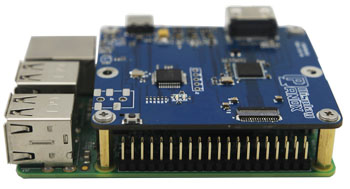
- Comprehensive Integration Support: Panox supplies not just display panels but also controller boards, PCBAs, touch panels, and interface accessories — reducing the integration burden for engineering teams.
- Custom and OEM Services: Panox offers OEM manufacturing and custom flexible OLED production tailored to specific form factors, interface requirements, and environmental ratings.
- Flexible MOQ: Startups and smaller development teams benefit from accessible minimum order quantities, lowering the barrier to innovation without forcing large upfront commitments.
- Technical Expertise: With years of experience in the display supply chain, Panox's team helps customers navigate substrate types, interface selection, encapsulation options, and certification requirements.
Whether you are building a next-generation wearable, a curved automotive interface, or a custom IoT device, Panox Display provides the components and expertise to bring your flexible OLED vision to production.
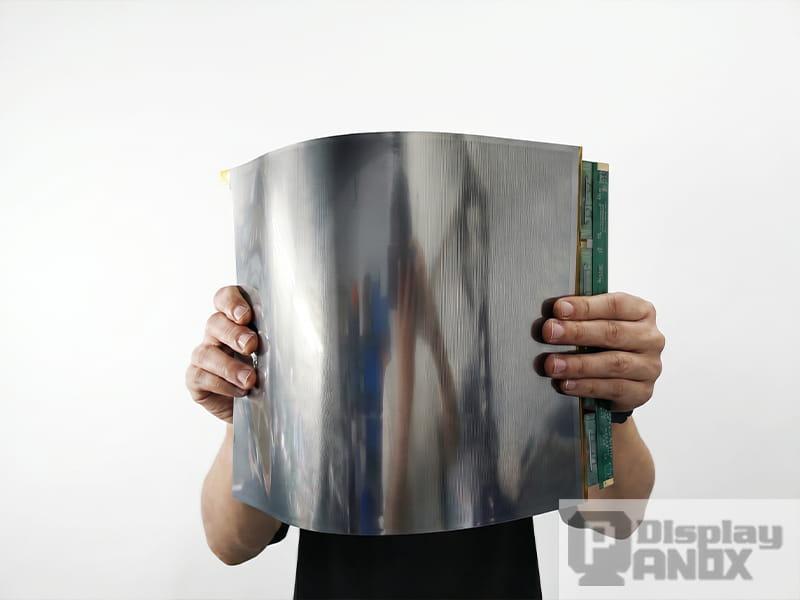
16.3 inch Flexible OLED
Panox Display Expert Views
"The flexible OLED display market is evolving at an extraordinary pace, and product teams need more than just a component supplier — they need a knowledgeable partner who can guide them from specification to final integration. At Panox Display, our focus is on providing premium-quality flexible OLED modules backed by deep technical support and flexible supply arrangements. From foldable consumer devices to demanding automotive-grade applications, we help developers access the right display solution for their exact use case, accelerating time-to-market without compromising on quality or reliability."
What Is the Current Market Outlook for Flexible OLED Displays?
The flexible OLED industry is expanding rapidly. The market was valued at approximately USD 16.4 billion in 2025 and is projected to reach USD 127.7 billion by 2035, growing at a compound annual growth rate of around 22.8%. This growth is driven by surging foldable smartphone adoption, expanding automotive display integration, and accelerating demand from wearable and health device sectors.
Key manufacturing advances are also reshaping the supply landscape. In early 2025, a South Korean research team introduced GLLO (Graphene Laser Lift Off), a new lift-off technique for flexible OLED production using graphene's ultraviolet-absorbing properties to achieve cleaner, residue-free panel fabrication. Manufacturers including BOE have also introduced crease-less foldable OLED architectures, reducing visible fold lines by over 40% — a significant step toward mainstream foldable device adoption.
As production scales and manufacturing costs continue to decline, flexible OLED technology is moving well beyond flagship smartphones into mid-range devices, industrial equipment, and specialized commercial applications.
Flexible OLED vs. Rigid OLED vs. TFT-LCD: A Quick Comparison
| Feature | Flexible OLED | Rigid OLED | TFT-LCD |
|---|---|---|---|
| Form Factor | Curved, foldable, rollable | Flat only | Flat only |
| Contrast Ratio | Infinite (true black) | Infinite (true black) | Limited by backlight |
| Thickness | Ultra-thin | Thin | Thicker (backlight required) |
| Impact Resistance | High (plastic substrate) | Lower (glass substrate) | Moderate |
| Power Efficiency | High | High | Lower |
| Design Freedom | Maximum | Limited | Limited |
| Cost | Higher | Moderate | Generally lower |
For products where design differentiation, weight, power efficiency, and form factor flexibility matter, flexible OLED is the clear front-runner. TFT-LCD remains a cost-effective option for standard flat-panel applications with less demanding visual requirements.
Conclusion
Flexible OLED display technology has moved well past the experimental stage — it is now the driving force behind foldable smartphones, premium automotive cockpits, advanced wearables, and the next generation of creative product design. The self-emissive pixel structure, polyimide substrate, and thin-film encapsulation work together to produce a display that is simultaneously thinner, lighter, more vivid, and more versatile than any competing technology.
Choosing the right flexible OLED screen requires matching the panel's form factor, interface, encapsulation quality, and certifications to your specific application. And sourcing from a proven, technically capable supplier like Panox Display ensures that your project has reliable access to premium-grade modules, OEM customization services, and the expert support needed to move from concept to production efficiently.
FAQs
Q: What is the difference between a flexible OLED and a foldable OLED display?
A: All foldable OLEDs are flexible, but not all flexible OLEDs are foldable. Flexible OLED is the broader category — it includes curved panels fixed during manufacturing, as well as user-bendable foldable and rollable formats. Foldable specifically refers to displays designed to be repeatedly folded by the end user.
Q: How long do flexible OLED displays last?
A: High-quality flexible OLED modules designed for commercial or industrial use are typically rated for up to 50,000 hours of continuous operation. Panel lifespan has improved by approximately 10% per year as encapsulation technology and organic material formulations have advanced.
Q: Can flexible OLED displays be used outdoors?
A: Flexible OLED panels offer excellent contrast and self-illumination, but standard variants can be affected by direct sunlight. High-brightness OLED modules with anti-reflective coatings are available for outdoor and semi-outdoor applications, particularly in automotive and industrial deployments.
Q: What interfaces do flexible OLED displays support?
A: Common interfaces include MIPI-DSI for high-speed mobile and embedded applications, SPI/I²C for compact wearable and IoT devices, and eDP for larger automotive or laptop display configurations. Your supplier can recommend the appropriate interface based on your host processor and resolution requirements.
Q: Does Panox Display offer custom flexible OLED modules?
A: Yes. Panox Display provides OEM manufacturing and custom flexible OLED production services, including custom panel sizes, interface configurations, touch panel integration, and environmental ratings. Flexible MOQ options make these services accessible to startups and smaller development teams as well as established OEMs.
Q: What certifications should I look for in a flexible OLED module?
A: For general applications, look for IEC 62341, RoHS 3 compliance, and CE marking. For automotive-grade deployments, IATF 16949 certification is the industry standard to require from your display supplier.
| Model | Size(inch) | Display Type | Resolution | Interface | Display Brand |
| 1.39 inch Round/Circular OLED Flexible For Wearable Smartwatch | 1.39 | AMOLED | 400(RGB)×400 | MIPI | Innolux |
| 1.5 inch Flexible OLED For Wearable Smart Watch | 1.5 | AMOLED | 120(RGB)×240 180PPI | SPI, MIPI | Innolux |
| 1.8 inch Flexible PMOLED For Wearable Bracelet | 1.8 | PMOLED | 160×32 | SPI | Futaba |
| 5.1 inch Flexible OLED On-Cell PACP For Cellphone | 5.1 | AMOLED | 720(RGB)×1520 330PPI | MIPI | BOE |
| 5.99 inch Flexible OLED On-Cell PACP For Cellphone | 5.99 inch | AMOLED | 1080(RGB)×2160 329PPI | MIPI | BOE |
| 5.99-Inch 1440x2880 Flexible AMOLED Display | BOE OLED for Huawei Smartphone | 5.99 | AM-OLED, OLED | 1440 x 2880 | MIPI | BOE&Huawei |
| 6.52 inch Flexible OLED 2520x840 Touch Panel | 6.52 | AM-OLED, OLED | 2520(RGB)×840 407 PPI | MIPI | CSOT |
| 6.67inch Flexible AMOLED 2K for Smartphone | 6.67 | OLED, AM-OLED | 1080x 2400 | MIPI | Tianma |
| 7.8 inch Flexible Full Color OLED 1920x1440 MIPI | 7.8 | AMOLED | 1440 x 1920 | MIPI | Royole |
| 8 inch Flexible/Foldable OLED | 8.01 | AMOLED | 2480x1860 | MIPI | CSOT |
| 13.3 inch 1536 x 2048 Flexible OLED Touch Screen | 13.3 | AM-OLED, OLED | 1536 (H) × 2048 (V) | eDP | LG |