



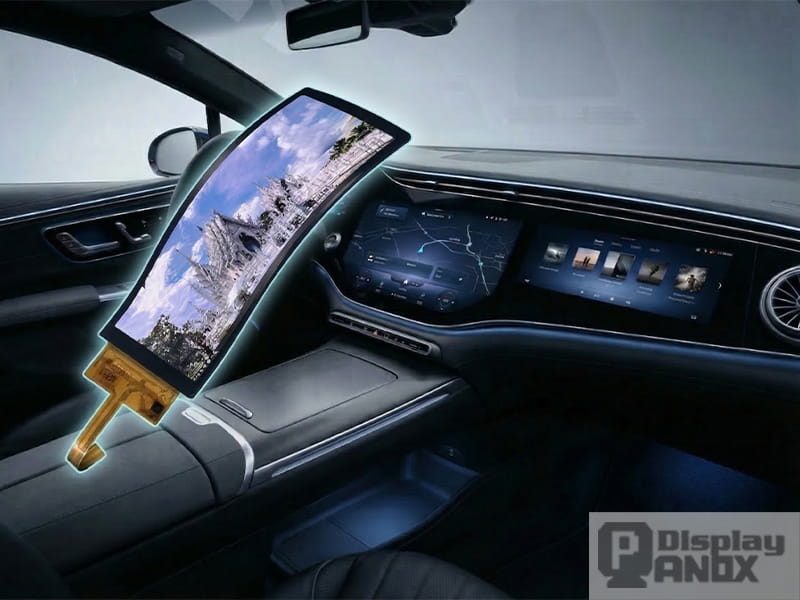
In 2026, the conversation around automotive displays is no longer just about screen size. It is about how the display shapes the entire cockpit experience—from curved center stacks and personalized clusters to hidden climate panels and immersive passenger entertainment. As software-defined vehicles become mainstream, the display is moving from a simple output component to a core interface layer for interaction, branding, and in-cabin intelligence. TrendForce expects total automotive panel supply to exceed 240 million units by 2026, with OLED reaching about 8.9% share, showing that OLED is no longer a niche experiment but a fast-rising category in vehicle HMI design.
Traditional TFT-LCD still dominates by volume, but it struggles when automakers want slimmer modules, deeper blacks, curved geometry, seamless dashboard integration, and premium visual differentiation. That is why Flexible OLED is gaining attention across smart cockpit roadmaps: it supports thin and bendable structures, higher perceived contrast, faster response, and cleaner industrial design language that fits the next wave of EV interiors. LG Display explicitly positions automotive P-OLED as thin, light, and bendable for curved vehicle surfaces, while Samsung Display is already showcasing flexible automotive cockpit concepts built around non-flat form factors.
The shift is also visible at the vehicle level. BMW has confirmed the rollout of its new Panoramic iDrive architecture across future models from late 2025, while the new BMW iX3 shown at CES 2026 combines panoramic information delivery with an OLED display element. MINI has already commercialized a round OLED center display, and Mercedes-Benz uses OLED in the central screen of the EQE SUV. In parallel, suppliers such as Continental, Samsung Display, and LG Display are pushing OLED deeper into hidden displays, seamless curved consoles, and next-generation cockpit packaging.
For automakers seeking slimmer and more integrated cockpit layouts, Flexible OLED is becoming a practical display option worth evaluating.
1. Why 2026 Is a Turning Point for Automotive Displays
Smart cockpits are evolving quickly because vehicles are becoming more digital, more connected, and more software-centric. Automakers now compete on cabin experience as much as on horsepower or range. A modern center display must do more than show navigation. It must manage media, climate, vehicle settings, ADAS feedback, camera feeds, personalization, and even entertainment for passengers. That shift naturally favors display technologies that look more premium and integrate more elegantly into the interior architecture.
At the same time, the design language of premium and new-energy vehicles is changing. Flat rectangular screens are no longer enough for brands that want panoramic dashboards, wraparound center stacks, concealed interfaces, or sculpted surfaces that blend into trim. This is exactly where Flexible OLED becomes strategically valuable: it gives cockpit designers more freedom without giving up visual quality.
2. Automotive Display Technology Comparison: TFT-LCD vs OLED vs Flexible OLED
Before discussing applications, it helps to separate three categories clearly.
2.1 TFT-LCD
TFT-LCD remains cost-effective, mature, and widely available. It is still the default choice for many mainstream vehicles, especially where flat module design and lower BOM pressure matter most. However, it depends on a backlight, which limits black level, can increase thickness, and makes deep curvature more difficult at the module level.
2.2 Rigid OLED
Rigid OLED improves contrast, response time, and visual impact compared with LCD. Because pixels are self-emissive, it delivers true blacks and stronger HDR perception. Samsung states OLED offers a contrast ratio of 1,000,000:1 or higher and faster response than LCD. Still, rigid OLED does not give the same form-factor freedom as plastic-substrate flexible structures.
2.3 Flexible OLED
Flexible OLED uses a bendable substrate, enabling curved, slim, and lightweight display modules that fit modern cockpit surfaces more naturally. LG Display highlights that automotive P-OLED applies Tandem OLED to a plastic substrate, making it thin, light, and bendable for curved integration. That is why Flexible OLED is increasingly viewed as the best match for premium center displays, hidden displays, and advanced cockpit layouts.
2.4 Key Comparison Table
| Technology | Brightness / Outdoor Readability | Contrast | Curved Design Capability | Thickness / Weight | Response Speed | Cost Position |
|---|---|---|---|---|---|---|
| TFT-LCD | Good, but depends heavily on backlight design | Moderate | Limited at module level | Thicker, heavier | Good | Lowest |
| Rigid OLED | Very good, strong sunlight performance possible | Very high | Limited compared with flexible | Thin | Fast | Mid to high |
| Flexible OLED | Very good, especially for premium cockpit tuning | Very high | Excellent | Thinnest and lightest class | Fastest class | Highest today |
This comparison reflects current industry positioning: LCD still wins on cost, but OLED wins on image quality, and Flexible OLED adds the industrial-design advantage that smart cockpit programs increasingly need. LG Display says its automotive P-OLED uses 60% less power and weighs 80% less than LCD, while Samsung highlights OLED’s high luminance, low reflectivity, and superior visibility outdoors.
3. Why Flexible OLED Fits Smart Cockpits Better Than Traditional LCD
The biggest reason is design freedom. A smart cockpit is no longer a collection of separate screens; it is becoming a continuous visual surface that spans instrument, center stack, passenger area, and hidden control zones. Flexible OLED makes it easier to follow dashboard curvature, reduce bezel visibility, and create a more integrated interior identity.
The second reason is premium image quality. In an automotive environment, perceived contrast matters more than spec-sheet marketing. Deep blacks make dark-mode interfaces cleaner. High contrast improves legibility for maps, status layers, and night driving UIs. Samsung emphasizes OLED’s high contrast and true black performance, while Mercedes-Benz specifically uses OLED in the EQE SUV’s center screen for display quality.
The third reason is packaging efficiency. Thin and lightweight modules help free up space inside the IP, improve integration with touch and decorative layers, and reduce mechanical constraints in curved assemblies. For EV and SDV interiors where every millimeter matters, that is a meaningful engineering benefit, not just a styling advantage.
4. Core Automotive Applications of Flexible OLED
4.1 Center Information Display: Curved Touch Interaction
The center display remains the most commercially important cockpit screen. This is where Flexible OLED can deliver the clearest value: curved touch surfaces, slimmer packaging, stronger premium feel, and a more seamless connection between display and dashboard geometry. Samsung Display’s CES 2026 digital cockpit concept featured an 18.1-inch “Flexible L” Center Information Display that connected with the dashboard and combined display aesthetics with intuitive climate and shortcut control.
4.2 Digital Instrument Cluster: Personalized UI and High Contrast
Clusters increasingly mix navigation, ADAS status, range, drive modes, and personalized layouts. OLED’s stronger contrast helps icons and warning layers stand out clearly, especially in dark UI themes. Faster response also helps when motion graphics, lane guidance, or animated driver-assistance visuals are involved.
4.3 Passenger Entertainment Display: More Immersive In-Car Content
Passenger displays are becoming more common in premium EVs and long-wheelbase models. OLED’s visual strengths—true black, saturated color, fast response—support a more immersive entertainment experience. This matters more as vehicles add streaming, gaming, and media-rich cabin experiences. BMW and MINI are both emphasizing richer display-led HMI concepts in recent cockpit rollouts.
4.4 HUD and Panoramic Information Systems
Not every HUD uses OLED directly, but the broader cockpit trend is clear: information is spreading beyond a single binnacle into windshield-spanning and multi-zone presentation systems. BMW has confirmed Panoramic Vision for production, showing how cockpit information is moving toward wider, more immersive delivery. As these layouts become more design-led, flexible display technologies gain relevance elsewhere in the cockpit stack.
4.5 Door Trim, Ambient Interfaces, and Smart Interaction Surfaces
As interiors become more software-defined, displays are moving into secondary zones such as doors, side trims, and multifunction surfaces. Flexible OLED is a strong candidate for these applications because it can conform to design surfaces more naturally than flat LCD. Samsung’s automotive roadmap and cockpit demos suggest that future mobility interfaces will extend beyond the classic instrument-and-center-screen layout.
4.6 Hidden Climate and Control Panels
One of the most interesting directions in automotive HMI is the hidden display: a screen that disappears visually when inactive and appears only when needed. Continental’s Invisible Biometrics Sensing Display shows how OLED can support this trend by hiding sensors behind the display surface while preserving a clean interior appearance. That same logic applies to climate control and contextual control zones.
5. Key Technical Requirements for Automotive Flexible OLED
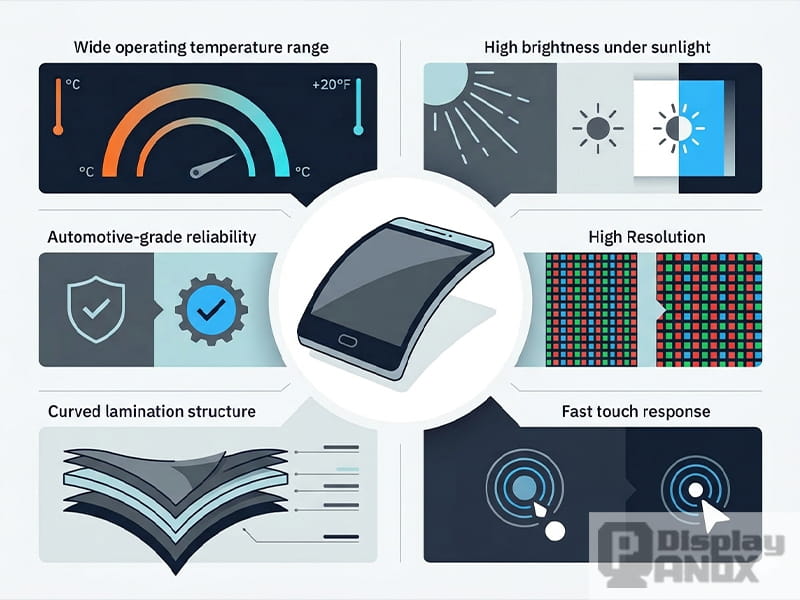
5.1 Wide Temperature Operation
Automotive displays must remain stable across harsh thermal conditions. In real projects, engineers typically target wide operating windows such as -40°C to 85°C for automotive-grade modules, especially in instrument panels and center stacks exposed to solar loading. In practice, that makes material stack design, encapsulation quality, touch bonding, and thermal management critical for Flexible OLED programs. This requirement aligns with the broader automotive-grade validation environment defined by major quality systems and OEM supplier expectations.
5.2 High Brightness and Sunlight Readability
For modern vehicle HMIs, sunlight readability is non-negotiable. Samsung states its OLED achieves over 1,500 nits in bright environments and shows around 21% higher outdoor visibility than existing displays in testing. For automotive buyers and engineers, this means Flexible OLED is no longer just a beautiful indoor display option—it is increasingly credible in bright cabin conditions too.
5.3 Automotive Reliability Standards
Automotive display sourcing is not just about panel specs. It is about process discipline, quality systems, traceability, change control, and validation readiness. IATF 16949 remains a foundational quality-management framework for automotive suppliers, and OEM-specific requirements continue to build on it. For any automotive display supplier, certification and process maturity are part of the product value.
5.4 Curved Lamination and Mechanical Integration
A curved display program succeeds or fails in integration, not just in panel selection. Engineers need to evaluate radius consistency, cover-lens fit, optical bonding, touch stack behavior, glare control, and long-term stress reliability. Flexible OLED makes curved packaging possible, but the real advantage appears only when the full module stack is engineered correctly. Supplier experience with plastic-substrate OLED and cockpit module integration is therefore essential.
5.5 Fast and Stable Touch Response
As smart cockpits use more animated UI, layered menus, and software-defined controls, users expect fluid interaction. OLED’s faster response characteristics support smoother perceived motion and cleaner visual transitions. In vehicle HMIs, that translates into a more modern experience for navigation, media, climate, and vehicle settings.
6. The Real Advantages of Flexible OLED in Automotive Interiors
6.1 Lighter and Thinner Design
Reducing display thickness helps with packaging freedom and overall cockpit elegance. LG Display states automotive P-OLED is significantly lighter than LCD, which is especially relevant in EV architecture where every subsystem is being optimized.
6.2 Premium Curved Surfaces
Consumers increasingly associate curved and seamless displays with luxury and technology leadership. Flexible OLED enables forms that look more native to the dashboard rather than “mounted on top” of it, which is one reason premium brands are leaning into more sculpted cockpit interfaces.
6.3 Lower Power Potential
Power efficiency matters in EVs, especially as display area grows. LG Display says its automotive P-OLED can use 60% less power than LCD in its referenced positioning, making OLED attractive where cabin electronics load is rising. Actual system consumption still depends on UI design and brightness strategy, but the technology direction is clear.
6.4 Faster Response for Dynamic UI
The software-defined vehicle uses more real-time graphics, motion transitions, and assistance overlays. OLED’s fast response behavior supports smoother visual feedback than LCD in motion-intensive interfaces.
6.5 Wider Color and Better Visual Impact
When a cockpit becomes part interface, part brand environment, color and contrast matter more. OLED makes premium interfaces feel more vivid and more intentional, which is important for navigation emphasis, ambient modes, and brand-specific HMI styling.
7. Industry Case Analysis
7.1 BMW: Panoramic Vision Plus OLED Signals the Next Cockpit Direction
BMW’s new Panoramic iDrive is one of the clearest signs of where the industry is going. It expands information presentation across the windshield area while integrating central OLED-based interaction into the cockpit. The 2026 iX3 demonstrates that future BMW interiors are being built around immersive, software-defined display architecture rather than isolated screens.
7.2 MINI: OLED Has Already Reached Production Interiors
MINI’s round OLED center display is important because it proves OLED is not limited to concept rhetoric. It also shows how OLED can help a brand create a unique HMI identity rather than just a bigger screen. For automotive product teams, that is a strong reminder that display choice affects both engineering and brand language.
7.3 Mercedes-Benz: Premium Central OLED Confirms Market Readiness
Mercedes-Benz uses OLED in the center display of the EQE SUV, reinforcing that OLED has already won acceptance in premium automotive applications where image quality and visual sophistication matter. Even where a vehicle architecture combines multiple display technologies, the move toward OLED in key interaction zones is telling.
7.4 Supplier Roadmaps Show Where 2026 and Beyond Are Headed
Samsung Display’s Flexible L cockpit concept, LG Display’s P-OLED and ATO portfolio, and Continental’s hidden OLED sensor integration all point in the same direction: the next cockpit is thinner, more curved, more contextual, and more display-native. That does not mean every 2026 vehicle will use Flexible OLED, but it does mean Flexible OLED is becoming a central technology in future cockpit planning. This is an inference based on multiple supplier and OEM roadmaps.
8. Procurement and Supply Chain Guide for Automotive Flexible OLED
8.1 What to Look for in a Supplier
For automotive display sourcing, panel specs alone are not enough. Buyers should evaluate automotive quality systems, module integration capability, touch and cover-lens customization, optical bonding know-how, validation support, and program-management discipline. A supplier that can only sell a panel, but cannot support the full module path, often becomes a bottleneck later in the project.
8.2 Why IATF 16949 Matters
IATF 16949 is one of the clearest markers that a supplier understands automotive process control. It does not guarantee success by itself, but it is a strong baseline for quality management, traceability, and continuous improvement in automotive programs.
8.3 Lead Time and MOQ Reality
Automotive OLED projects usually require longer development and validation cycles than consumer electronics because of environmental testing, reliability documentation, and OEM approval processes. MOQ, tooling, and lead time vary significantly depending on whether the program uses an existing module platform or a fully custom curved design. In other words, the fastest and safest path is often a semi-custom approach rather than a clean-sheet design. This is an industry inference based on the validation-heavy nature of automotive supply chains and supplier requirements.
8.4 From Sample to Mass Production
A typical program flow includes requirement definition, panel and module selection, mechanical and optical review, touch integration, prototype sampling, validation, pilot build, and SOP ramp. For Flexible OLED in particular, early alignment on curvature, brightness target, touch stack, cover material, and thermal conditions can save months later in the program.
8.5 Panox Display Automotive Display Solution Support
For brands developing next-generation cockpit products, Panox Display can support the evaluation process from display selection to project matching, including Flexible OLED direction assessment for center displays, passenger displays, hidden-display concepts, and other customized smart cockpit applications. The practical value is not only in sourcing a screen, but in reducing mismatch between industrial design intent and display engineering execution.
9. Conclusion: Flexible OLED Is Moving from Premium Option to Strategic Standard
From 2026 onward, automotive display competition will increasingly center on integration quality, cockpit aesthetics, and software-led user experience. TFT-LCD will remain important in cost-sensitive platforms, but it is becoming less suitable for the design ambitions of high-end smart cockpits. OLED improves image quality; Flexible OLED adds the structural freedom that modern interiors increasingly demand.
The market is not flipping overnight, but the direction is already visible. OEM display strategies, supplier roadmaps, and premium vehicle launches all suggest that curved, hidden, and immersive HMI systems will expand. In that environment, Flexible OLED is not just another display option. It is becoming one of the most important enabling technologies for next-generation automotive interiors.
If your team is evaluating a new automotive center display, passenger screen, hidden interface, or cockpit-wide display concept, now is the right time to review whether a Flexible OLED architecture can deliver better packaging, stronger visual impact, and a more future-ready HMI strategy.
If your project requires a slimmer, curved, and more premium in-car display solution, explore our Flexible OLED options for automotive applications.
FAQs
1. Is Flexible OLED better than LCD for automotive center displays?
For premium smart cockpit programs, Flexible OLED is often the better fit because it offers higher contrast, faster response, and much better curved-design flexibility. LCD still has a cost advantage and remains common in mainstream vehicles.
2. Why are automakers interested in Flexible OLED in 2026?
Because 2026 cockpit design is increasingly defined by curved surfaces, seamless integration, personalized UI, and premium in-cabin experience. Flexible OLED supports those requirements better than flat LCD architectures.
3. Can automotive OLED work in bright sunlight?
Yes. Recent OLED platforms have improved significantly in outdoor visibility. Samsung states its OLED exceeds 1,500 nits in bright environments and shows superior outdoor visibility compared with existing displays.
4. Is Flexible OLED already used in real vehicles?
Yes, OLED is already in production automotive interiors, including MINI’s round OLED center display and Mercedes-Benz’s EQE SUV central OLED screen. Broader flexible and hidden-display architectures are also being actively pushed by major suppliers.
5. What are the biggest engineering challenges for automotive Flexible OLED?
The biggest challenges are wide-temperature reliability, curved lamination, optical bonding, long-term mechanical stress management, sunlight readability, and automotive-grade validation.
6. What should buyers ask a Flexible OLED supplier before starting a project?
Ask about IATF 16949 quality systems, module integration capability, custom curvature support, touch and cover-lens options, validation resources, pilot-build experience, and mass-production readiness.
| Model | Size(inch) | Display Type | Resolution | Interface | Display Brand |
| 1.39 inch Round/Circular OLED Flexible For Wearable Smartwatch | 1.39 | AMOLED | 400(RGB)×400 | MIPI | Innolux |
| 1.5 inch Flexible OLED For Wearable Smart Watch | 1.5 | AMOLED | 120(RGB)×240 180PPI | SPI, MIPI | Innolux |
| 1.8 inch Flexible PMOLED For Wearable Bracelet | 1.8 | PMOLED | 160×32 | SPI | Futaba |
| 5.1 inch Flexible OLED On-Cell PACP For Cellphone | 5.1 | AMOLED | 720(RGB)×1520 330PPI | MIPI | BOE |
| 5.99 inch Flexible OLED On-Cell PACP For Cellphone | 5.99 inch | AMOLED | 1080(RGB)×2160 329PPI | MIPI | BOE |
| 5.99-Inch 1440x2880 Flexible AMOLED Display | BOE OLED for Huawei Smartphone | 5.99 | AM-OLED, OLED | 1440 x 2880 | MIPI | BOE&Huawei |
| 6.52 inch Flexible OLED 2520x840 Touch Panel | 6.52 | AM-OLED, OLED | 2520(RGB)×840 407 PPI | MIPI | CSOT |
| 6.67inch Flexible AMOLED 2K for Smartphone | 6.67 | OLED, AM-OLED | 1080x 2400 | MIPI | Tianma |
| 7.8 inch Flexible Full Color OLED 1920x1440 MIPI | 7.8 | AMOLED | 1440 x 1920 | MIPI | Royole |
| 8 inch Flexible/Foldable OLED | 8.01 | AMOLED | 2480x1860 | MIPI | CSOT |
| 13.3 inch 1536 x 2048 Flexible OLED Touch Screen | 13.3 | AM-OLED, OLED | 1536 (H) × 2048 (V) | eDP | LG |