



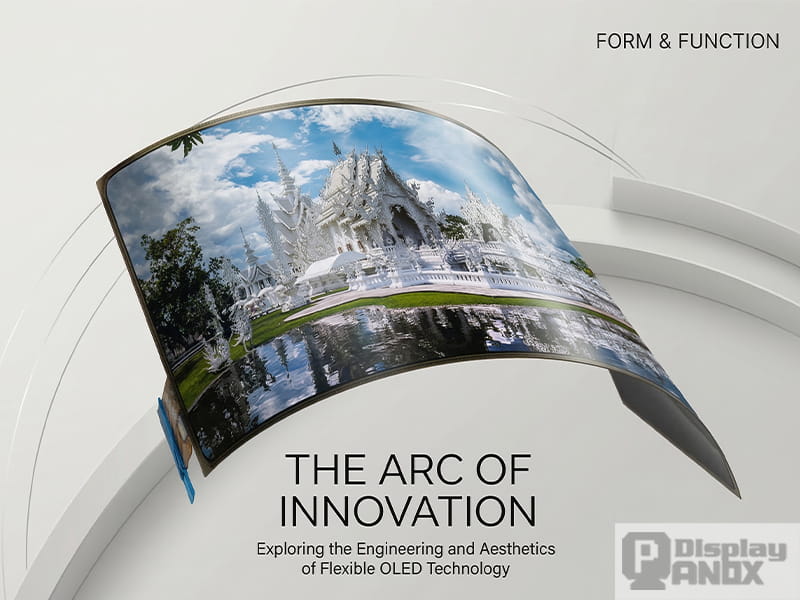
Flexible OLED is a display technology built on flexible substrates rather than rigid glass. Because OLED pixels emit their own light, the panel does not need a backlight, which makes it thinner, lighter, and easier to integrate into curved or foldable product designs. This is why Flexible OLED has become a key technology in smartphones, automotive displays, wearables, and other next-generation devices.
Unlike traditional flat displays, Flexible OLED allows the screen to become part of the product’s physical design. It is not only about bending a panel. It is about creating displays that better match modern devices, where thinness, adaptability, and premium visual quality matter just as much as resolution and brightness.
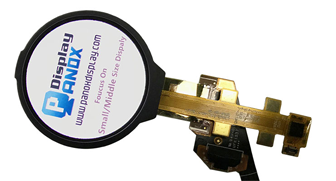
For projects that require a thinner and more adaptable display structure, Flexible OLED displays offer a strong solution.
How Flexible OLED Works
Flexible OLED uses a stack of functional layers, including a flexible substrate, a transistor backplane, organic emissive materials, electrodes, and protective encapsulation. Among these layers, the substrate and encapsulation system are especially important.
Flexible substrate
Instead of rigid glass, Flexible OLED usually uses polyimide as the base material. This allows the display to bend or curve while still supporting the manufacturing process and maintaining structural stability.
Thin-film encapsulation
OLED materials are sensitive to moisture and oxygen, so flexible panels need advanced barrier protection. Thin-film encapsulation helps protect the display while keeping the panel lightweight and bendable.
Stress management
In foldable or curved products, the display must be engineered to handle repeated mechanical stress. That is why Flexible OLED development depends not only on materials, but also on structural and durability design.
Learn more:The Future of Displays: How Flexible OLED Technology is Redefining the Screens We Use Every Day
Main Benefits of Flexible OLED
Flexible OLED has become important because it offers both performance and design freedom.
Thinner and lighter structure
Without a backlight and with less dependence on thick glass, Flexible OLED panels can be slimmer and lighter than many traditional display solutions.
More design flexibility
Flexible OLED supports curved, foldable, and even rollable product concepts. This gives brands more room to create compact yet immersive devices.
Premium visual performance
Like other OLED displays, Flexible OLED delivers deep blacks, strong contrast, vivid colors, and fast response times, making it suitable for high-end applications.
Better surface integration
Flexible OLED is especially useful in products with curved or unconventional shapes, such as automotive dashboards, smart wearables, and futuristic control surfaces.
Key Applications of Flexible OLED
Flexible OLED is already being used across several major industries.
Foldable consumer electronics
The best-known example is the foldable smartphone. Flexible OLED makes it possible for a device to open into a larger display area while staying compact when closed.
Automotive displays
In vehicles, Flexible OLED supports curved dashboards, integrated cockpit displays, and more refined interior designs. It helps combine premium visual quality with modern surface integration.
Wearables and healthcare
Smartwatches, fitness devices, and future health-monitoring systems benefit from thin, lightweight displays that can better match curved human surfaces.
Flexible OLED vs Traditional Displays
Compared with LCD, Flexible OLED offers a thinner structure and much greater form factor freedom. LCD still works well in many conventional products, but it is less suitable for curved or foldable applications because of its backlight-based structure.
Compared with rigid OLED, Flexible OLED uses a bendable substrate and is better suited to products where the display shape plays a major role in the user experience. Rigid OLED may still provide excellent image quality, but Flexible OLED opens the door to more advanced product design.
Challenges of Flexible OLED
Despite its advantages, Flexible OLED still comes with technical and commercial challenges.
Durability
Repeated folding, bending, and long-term stress can affect crease visibility, structural reliability, and overall user experience.
Manufacturing complexity
Flexible OLED requires advanced materials, precise processing, and strong yield control, which makes production more demanding than standard flat-panel manufacturing.
Cost
Because of its complexity, Flexible OLED is still more common in premium devices than in lower-cost mass-market products.
Future Trends of Flexible OLED
The future of Flexible OLED is moving toward better durability, wider application use, and more advanced forms such as rollable, slidable, and even stretchable displays. As the technology matures, it is likely to expand beyond consumer electronics into automotive, healthcare, industrial, and wearable systems more deeply.
In the long term, Flexible OLED is important not only because it improves image quality or thinness, but because it changes what a display can be. Instead of remaining a flat rectangular part, the screen becomes a more adaptive surface that can follow the form and function of the product.
Conclusion
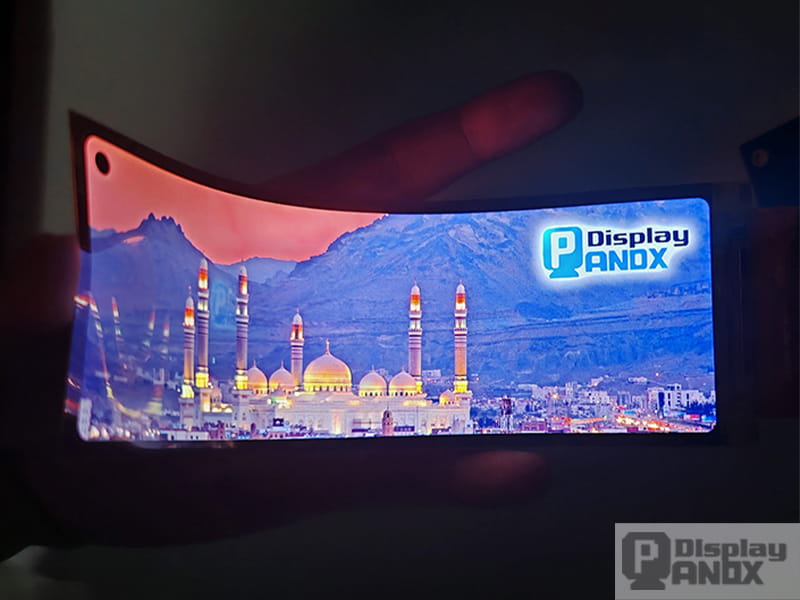
Flexible OLED is more than a display that bends. It is a key technology that combines OLED image quality with structural adaptability. By using flexible substrates, advanced encapsulation, and careful stress management, it enables thinner, lighter, and more innovative device designs.
As demand grows for foldable electronics, curved automotive interfaces, and wearable display systems, Flexible OLED will continue to play a major role in shaping the future of display technology.
If you are exploring display options for your next project, browse our Flexible OLED products for more details.
FAQ
What is Flexible OLED?
Flexible OLED is an OLED display built on a flexible substrate, allowing it to bend, curve, or fold while maintaining high image quality.
What are the main benefits of Flexible OLED?
Its main benefits include thin structure, light weight, design flexibility, strong contrast, and better integration into curved or foldable devices.
Where is Flexible OLED used?
It is commonly used in foldable smartphones, automotive displays, smartwatches, and other wearable or premium electronic products.
Is Flexible OLED better than LCD?
For curved, ultra-thin, and foldable applications, Flexible OLED has clear advantages. LCD remains widely used in conventional flat and cost-sensitive products.
What are the challenges of Flexible OLED?
The main challenges include durability, manufacturing complexity, encapsulation, and cost.
| Model | Size(inch) | Display Type | Resolution | Interface | Display Brand |
| 1.39 inch Round/Circular OLED Flexible For Wearable Smartwatch | 1.39 | AMOLED | 400(RGB)×400 | MIPI | Innolux |
| 1.5 inch Flexible OLED For Wearable Smart Watch | 1.5 | AMOLED | 120(RGB)×240 180PPI | SPI, MIPI | Innolux |
| 1.8 inch Flexible PMOLED For Wearable Bracelet | 1.8 | PMOLED | 160×32 | SPI | Futaba |
| 5.1 inch Flexible OLED On-Cell PACP For Cellphone | 5.1 | AMOLED | 720(RGB)×1520 330PPI | MIPI | BOE |
| 5.99 inch Flexible OLED On-Cell PACP For Cellphone | 5.99 inch | AMOLED | 1080(RGB)×2160 329PPI | MIPI | BOE |
| 5.99-Inch 1440x2880 Flexible AMOLED Display | BOE OLED for Huawei Smartphone | 5.99 | AM-OLED, OLED | 1440 x 2880 | MIPI | BOE&Huawei |
| 6.52 inch Flexible OLED 2520x840 Touch Panel | 6.52 | AM-OLED, OLED | 2520(RGB)×840 407 PPI | MIPI | CSOT |
| 6.67inch Flexible AMOLED 2K for Smartphone | 6.67 | OLED, AM-OLED | 1080x 2400 | MIPI | Tianma |
| 7.8 inch Flexible Full Color OLED 1920x1440 MIPI | 7.8 | AMOLED | 1440 x 1920 | MIPI | Royole |
| 8 inch Flexible/Foldable OLED | 8.01 | AMOLED | 2480x1860 | MIPI | CSOT |
| 13.3 inch 1536 x 2048 Flexible OLED Touch Screen | 13.3 | AM-OLED, OLED | 1536 (H) × 2048 (V) | eDP | LG |