



CES 2026 offered a strong preview of where the XR and smart glasses market is heading next. AI was everywhere on the show floor, but within the wearable space, the bigger story was how quickly the category is splitting into different product paths. AI glasses, AR glasses, accessibility-focused devices, and lightweight XR headsets are no longer moving in the same direction.
The market is becoming more crowded, but also more defined. New brands are entering, established players are expanding their portfolios, and the underlying technology choices are becoming easier to read. Some companies are focusing on audio-first or camera-first AI glasses, some are pushing lightweight AR experiences, and others are still moving toward higher-end visual hardware.
In that landscape, Micro OLED remains one of the most important display technologies in XR. It is not the default choice for every smart glasses product, but it continues to matter wherever image quality, compact optics, and immersive viewing are priorities.
What stood out at CES 2026
Looking back at the show from April, several clear directions emerged in the smart glasses market.
The first was stronger product design. AI glasses are already showing signs of visual sameness, and that makes design more important than before. Products with stronger aesthetics and more recognizable form language attracted noticeably more attention on the floor. Brands such as Even Realities and L’Atitude 52°N stood out for exactly this reason.
The second was the growing use of multi-chip architectures. Many products at CES 2026 adopted dual-chip or even more complex heterogeneous solutions to improve battery life, photography, AI processing, and system responsiveness. Combinations such as Qualcomm plus Bestechnic, or Bestechnic plus ISP, appeared repeatedly. Goertek even showed a reference design built around an MCU + ISP + NPU three-chip architecture.
The third was a clearer move toward vertical use cases. As the market becomes more saturated, startups are increasingly choosing narrower application areas instead of competing in the broad “general smart glasses” category. Sports, translation, accessibility, and professional assistance all received strong attention. There were also many exhibitors focused on solutions for users with visual or hearing impairments, a segment where overseas companies were particularly visible.
On the headset side, another pattern became clear: dual-4K Micro OLED headsets are becoming far more common. Beyond higher-resolution displays, a renewed focus on PCVR and lighter headset form factors also stood out. Companies such as Pimax and Play For Dream highlighted how the market is trying to balance immersive visual quality with smaller, lighter hardware.
Company roundup from CES 2026
.lumen
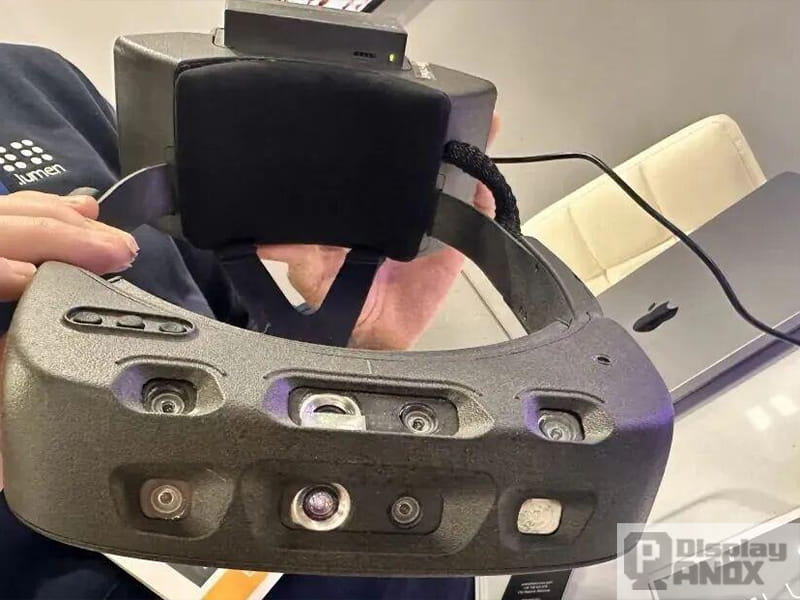
Romanian startup .lumen presented a navigation system for blind users in the form of smart glasses. Rather than relying mainly on voice prompts or conventional display-based guidance, the product miniaturizes autonomous driving technology into what the company describes as a pedestrian self-driving system.
The device integrates six high-resolution cameras, including stereo vision cameras, together with two infrared laser projectors. It can operate in difficult lighting conditions and even in darkness, while building 3D models of the surrounding environment at very high frequency. The system is designed to detect hanging obstacles, steps, bus stops, and hazardous ground conditions that a white cane may miss.
Its hardware is powerful, but also physically demanding. The device weighs around one kilogram and currently offers roughly two hours of battery life in its outdoor guidance mode. Even so, the product shows how smart eyewear can move beyond consumer convenience and become a scalable mobility tool for visually impaired users.
BirdiLens

BirdiLens, a new AR glasses brand under Dear Translator, targeted the golf segment. Its glasses use a binocular Micro LED solution, offered in both monochrome green and full-color versions. The product displays distance to the green, maps, putting force suggestions, and scoring information, while also including a virtual golf mini-game.
This was a good example of how more focused, sport-specific eyewear is becoming a practical strategy in a crowded market.
BUTTONS
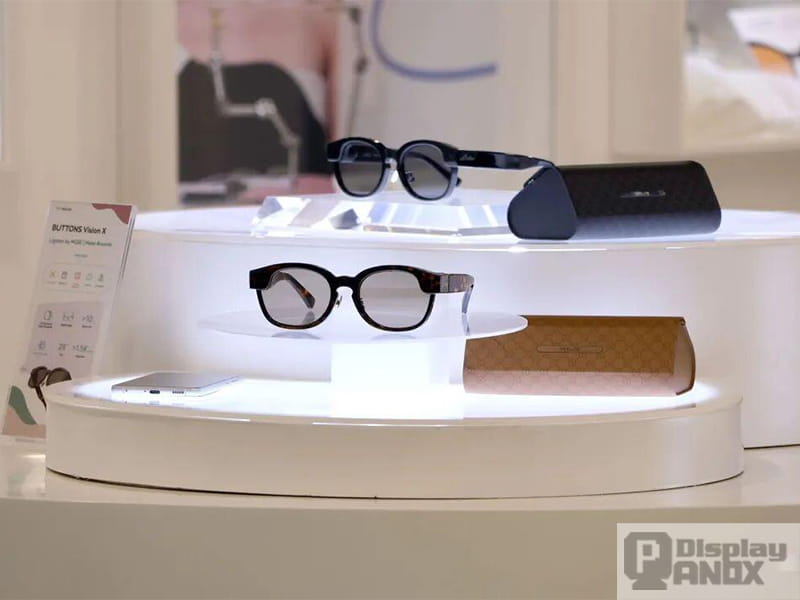
American technology brand BUTTONS showed an AR glasses product called BUTTONS VISION X. Public information suggests the product was developed in cooperation with Mokibo/Mojo-type supply-chain partners, using resin diffractive waveguide optics, binocular monochrome green Micro LED displays, and a 28-degree field of view.
One unusual design choice was the absence of speakers in the glasses themselves. Instead, a pair of TWS earbuds was built into the charging case. This approach potentially makes the glasses lighter while also improving audio quality.
Cearvol
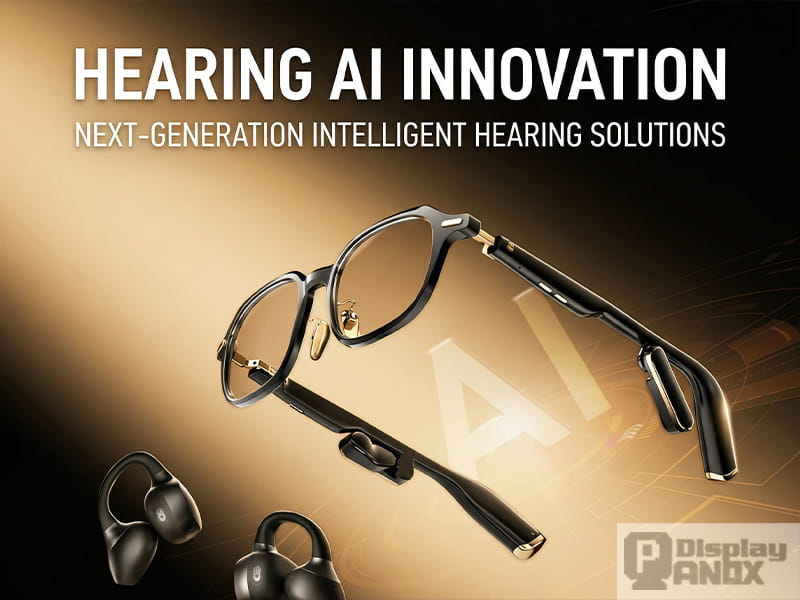
Cearvol, a hearing health brand under Conextion Technology, presented hearing-assistance glasses designed for older users. The product combines visual correction needs with audio support. Using an in-ear earphone structure, it offers hearing compensation and uses a three-microphone array to better focus on speech while reducing environmental noise.
Products like this show how smart glasses are increasingly expanding into hearing-care and accessibility-related categories rather than remaining limited to consumer AI interaction.
Cellid
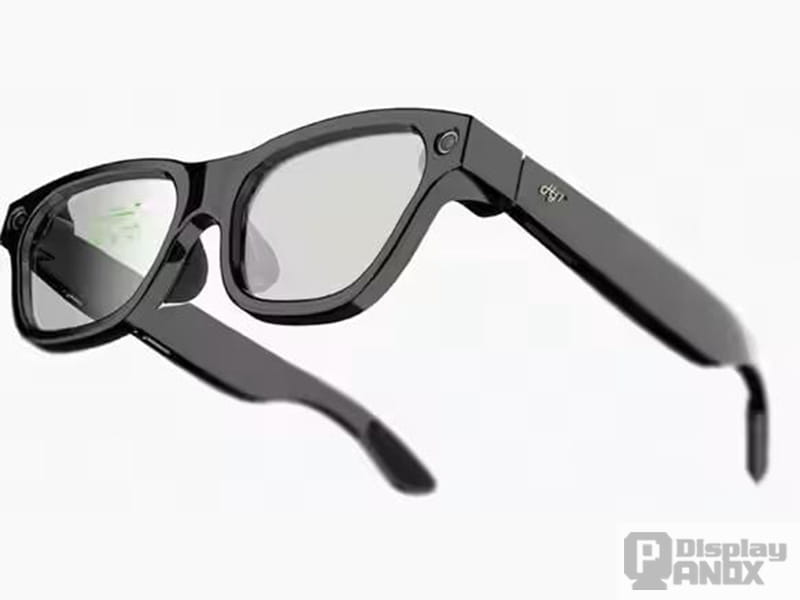
Japanese waveguide and spatial technology company Cellid showed both component technologies and cooperative smart glasses products. Beyond resin and glass waveguides, it presented multiple device implementations using its optics.
One example was the HJ1 AI smart glasses project, developed under Foxconn-related R&D efforts. The product uses a Micro LED display with up to 2,000 nits of eye brightness and waveguide optics compatible with prescription lenses. Other features include Cortex-A32 + M55 processing, eye tracking, a camera, and support for AI assistant functions, object recognition, and AR navigation.
Cellid also showed another AR glasses project developed with the Japanese company jig.jp. That product supports message notifications, brightness adjustment, transcription, and translation, with market launch plans reportedly targeting April.
Chengmu Technology
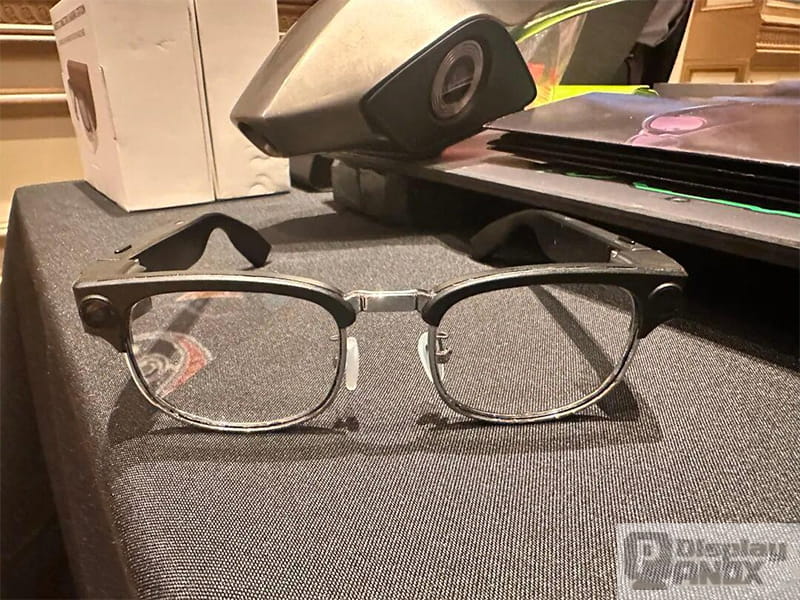
Chengmu Technology showed multiple AI glasses products, with silicon carbide waveguides drawing particular attention. One product, SYNCGLASSES X1, combined silicon carbide waveguides with a full-color Micro OLED optical solution.
According to available information, the product offers 480 × 640 resolution, a 30-degree field of view, and up to 1,000 nits of eye brightness. It uses a W517 chip, includes a 310mAh battery and a 32MP camera, supports ring-based interaction, and weighs 48 grams.
This was one of the clearest examples at CES 2026 of Micro OLED being used in smart glasses form factors, not just in larger immersive headsets.
Skyworth XR
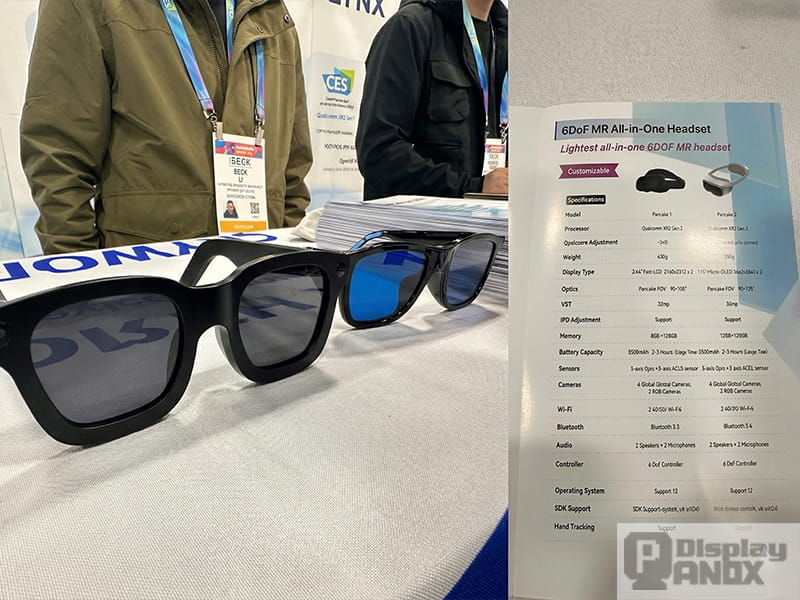
Skyworth XR showed multiple smart glasses and MR headset products. Its smart glasses lineup covered audio glasses, AI camera glasses, and AR glasses. The A6s, one of the highest-spec glasses in its booth, used an AR1 + Bestechnic 2800 chip combination together with a Micro LED display, 640 × 480 resolution, a 30-degree field of view, a 12MP camera, and around one hour of video recording endurance.
On the headset side, however, the display story became more relevant to the Micro OLED discussion. Skyworth’s high-end Pancake 2 used the Qualcomm XR2+ Gen 2 platform and two 4K-class Micro OLED displays, supported by grayscale and RGB cameras, all within a headset weighing only 350 grams.
Even Realities
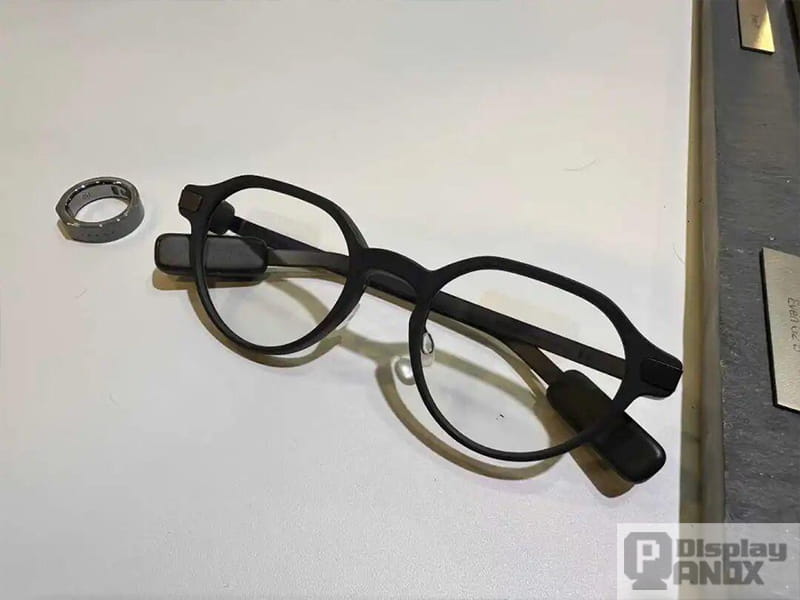
Even Realities, one of the most talked-about overseas AR glasses exhibitors, showed its latest Even G2 and a companion smart ring. The glasses use binocular monochrome green Micro LED optics but intentionally omit speakers and cameras, giving them a clean and elegant appearance.
The product also reaches IP65 protection, and the smart ring extends the experience with health-monitoring functions. Even Realities became one of the clearest examples of how design language itself has become a competitive factor in smart glasses.
Exumn
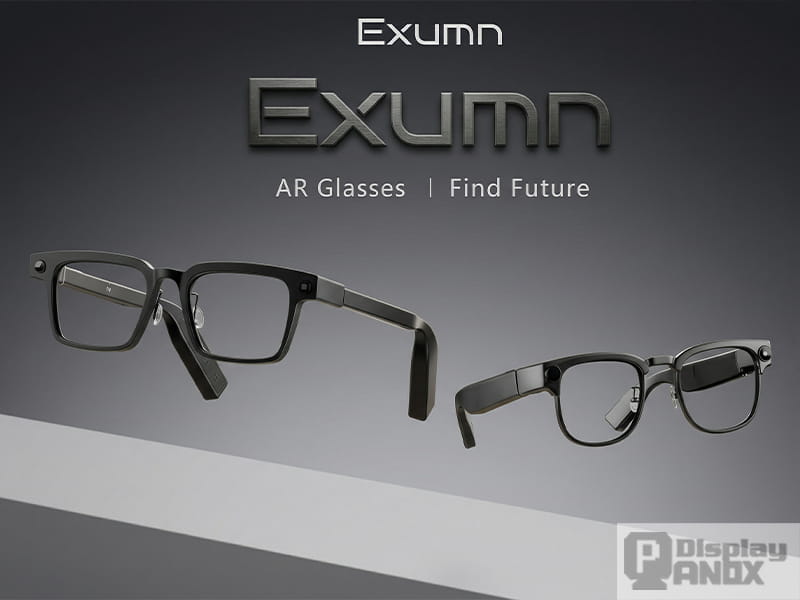
Shenzhen-based startup Exumn, which provides ODM/OEM services for smart glasses, showed a range of AR solutions. According to public information, one model used JBD’s Hummingbird II full-color Micro LED light engine together with a silicon carbide waveguide, while supporting photography and battery swapping in a 46-gram device.
Exumn’s presence also highlighted how many Chinese supply-chain and design-service companies are now deeply involved in shaping the smart glasses market, even when they are not always the best-known consumer brands.
Goertek
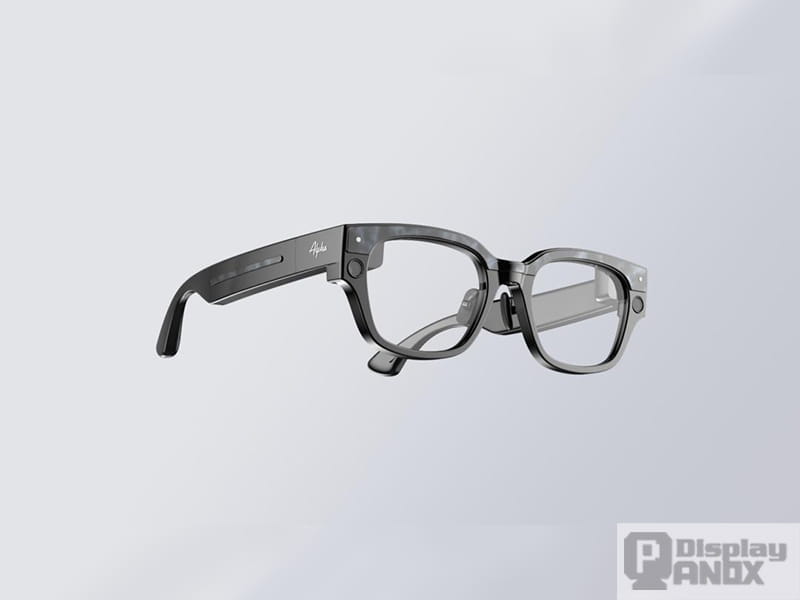
As one of the leading XR ODM and upstream technology companies, Goertek showed several new AR and VR reference designs at CES 2026.
Rubis was an AI smart glasses reference design using a first-of-its-kind MCU + ISP + NPU heterogeneous three-chip platform, paired with full-color etched waveguides and an ultra-compact full-color light engine. Spinel was a lightweight AI camera glasses concept weighing only 35 grams and supporting always-on AI visual perception. Rox Vision was a clip-on accessory product for standard eyewear, weighing just 13 grams while supporting visual capture, audio interaction, and AI processing.
Goertek also showed variable-focus liquid crystal lenses for XR devices, supporting diopter adjustment from -300 to +300, as well as a full-color resin waveguide module weighing only 4 grams.
GetD
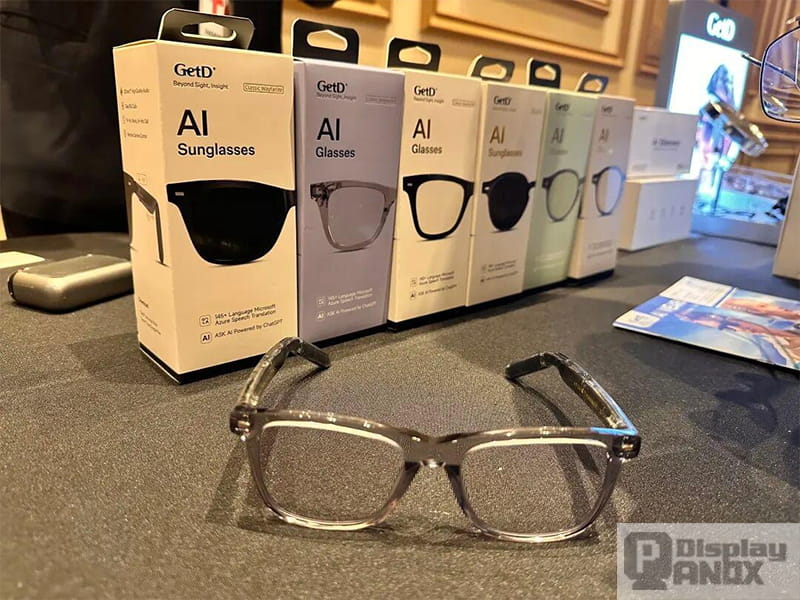
GetD presented multiple audio glasses products priced around the US$200 range. Its companion app integrates multiple large models including ChatGPT, Gemini, and DeepSeek, while supporting multilingual real-time translation. The glasses also include a six-axis gyroscope for functions such as nod-to-answer control, as well as features like step counting, fall detection, and neck health alerts.
The company reportedly shipped around 400,000 units last year, underscoring the scale potential of more affordable AI eyewear.
Amazfit
Amazfit showed a concept product called Amazfit Helio smart glasses, designed for runners. The core idea was to combine basic eye protection with minimal HUD-style data display so that key metrics could stay in view without requiring the user to look down at a watch.
The product can work together with Amazfit watches and display pace, heart rate, and navigation-related information. It also uses impact-resistant polycarbonate lenses, supports water and sweat resistance, and is being developed with endurance sufficient for a full marathon.
Infinix
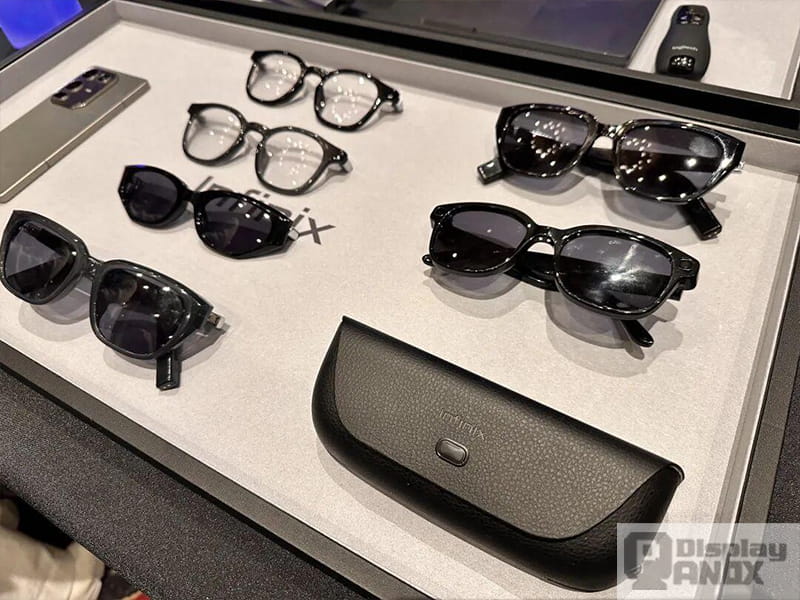
Infinix, the Transsion smartphone brand with a strong presence in Southeast Asia and Latin America, showed both Infinix AI Glasses and Infinix AI Glasses Pro.
The standard model was positioned more like audio glasses with interchangeable frame options, while the Pro model focused on AI-powered photography. It used a Bestechnic 2800 + ISP solution and an IMX681 camera sensor. The product supported Live Photo capture and used a charging case, while its projected launch was set for later in the year.
Innovega
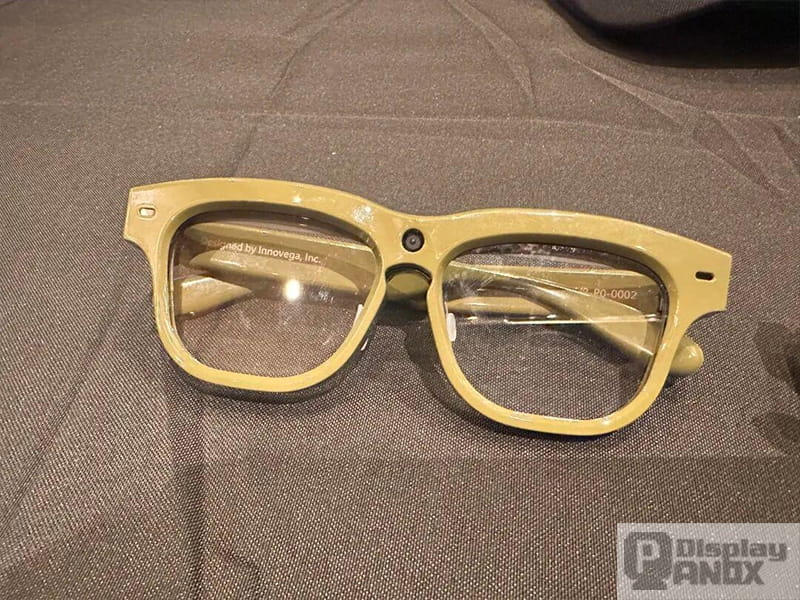
American AR company Innovega focused on eyewear solutions for visually impaired users. Unlike typical accessibility smart glasses that lean heavily on AI voice feedback, Innovega’s concept enlarges real-world imagery and projects it into disposable contact lenses with polarized filters.
Its target users include people affected by macular degeneration, diabetic retinopathy, and Stargardt disease. This made it one of the more technically distinctive accessibility-oriented exhibitors at CES 2026.
L’Atitude 52°N
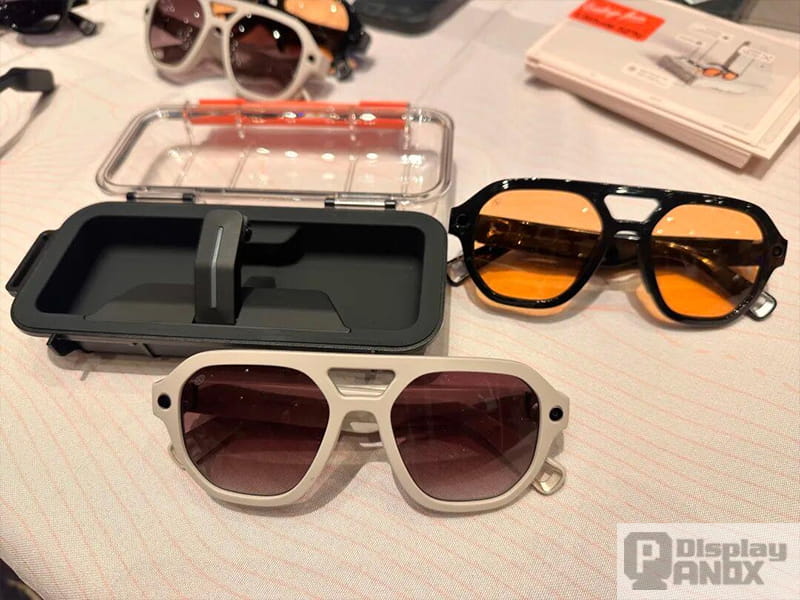
Berlin-based startup L’Atitude 52°N, with production and R&D tied to Shenzhen, showed an AI glasses product that had already gained attention on Kickstarter. The glasses target outdoor use and emphasize both design and practicality.
According to available information, the product uses a Bestechnic 2800 + ISP solution, a 107-degree ultra-wide-angle camera, Sony IMX681 sensor, dual speakers, and five noise-reduction microphones, while supporting AI assistant and real-time translation functions. It also offered multiple frame styles and a transparent charging case, along with an interesting walkie-talkie-style lanyard accessory based on Bluetooth mesh networking.
Lenovo
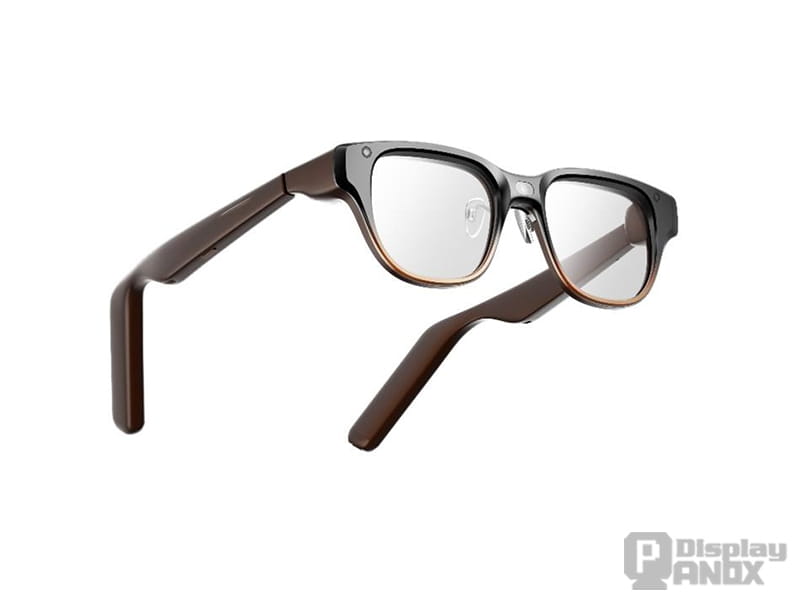
At CES 2026, Lenovo held a major Tech World event at the Las Vegas Sphere and introduced a broad AI portfolio including AI PCs, smartphones, personal AI agents, and wearables. Among them was a concept AI glasses product.
Compared with Lenovo’s earlier consumer AI glasses, this concept appeared different in positioning. The product was said to weigh 45 grams and provide up to eight hours of battery life, while supporting phone and PC connectivity, AI assistant interaction, real-time translation, image recognition, and cross-device notification summaries.
RayNeo
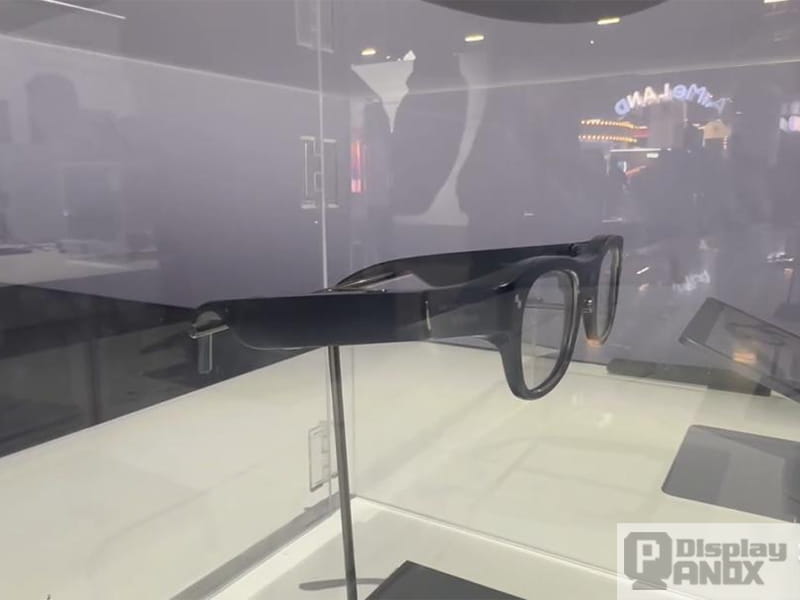
RayNeo, located in TCL’s large exhibition area, showed products across AI glasses, tethered AR, and full AR glasses categories, including RayNeo V3, RayNeo Air 4, and RayNeo X3 Pro. One especially notable concept was the RayNeo X3 Pro Project eSIM.
By integrating eSIM and 4G communication, the project aimed to reduce reliance on smartphones and move closer to true standalone AR glasses. It supported calling, AI conversation, real-time translation, and streaming, positioning itself as one of the earliest serious attempts at standalone consumer AR eyewear.
Razer
Strictly speaking, Razer is not a traditional XR company, but its Project Motoko looked very much like an AI wearable response to the smart glasses wave. Instead of glasses, it takes the form of wireless headphones with multiple microphones and first-person cameras positioned around eye level.
Razer’s idea is that earphones may be a more socially acceptable AI wearable form factor than unusual glasses, while still supporting object capture, voice interaction, and large-model integration across platforms such as OpenAI, Gemini, and Grok.
LLVision
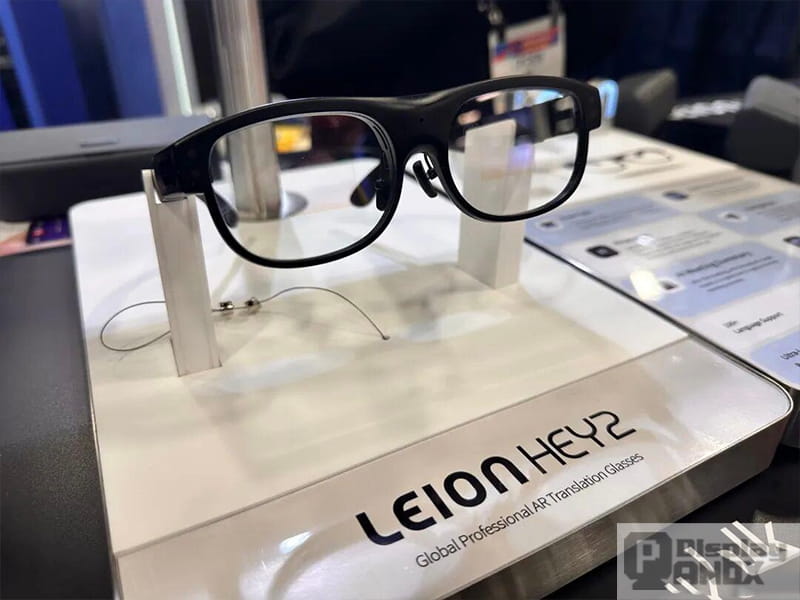
LLVision showed its consumer AR translation glasses Leion Hey2. The core selling points were real-time translation and transcription, with support for more than 100 languages, reported translation accuracy up to 98 percent, and latency below 500 milliseconds.
The product also included AI assistant features, meeting note generation, teleprompting, and navigation. The glasses weigh 49 grams and can reach up to eight hours of standalone battery life, extending to 96 hours with the charging case.
ASUS ROG
ROG, ASUS’s gaming brand, brought the ROG XREAL R1, a tethered AR glasses accessory co-developed with XREAL. The product is designed to work with gaming handhelds and PCs, and supports 240Hz refresh rate, a 57-degree field of view, and a very large virtual display equivalent.
This kind of product sits closer to display-first AR entertainment than to AI assistant glasses, showing how the market continues to split into very different use cases.
XGIMI
XGIMI was one of the new entrants into the AI glasses market. At CES 2026 it introduced its MemoMind sub-brand and launched two products: Memo One and Memo Air Display.
Memo One used binocular display technology and integrated speakers, while Memo Air Display aimed for extreme minimalism with monocular display, no built-in speaker, and weight of just 28.9 grams. The platform runs on a multi-LLM hybrid operating system designed to select the most suitable AI model for each task.
This was a reminder that many new players are not simply copying one smart glasses template. They are experimenting with different product layers and interaction styles.
Meta
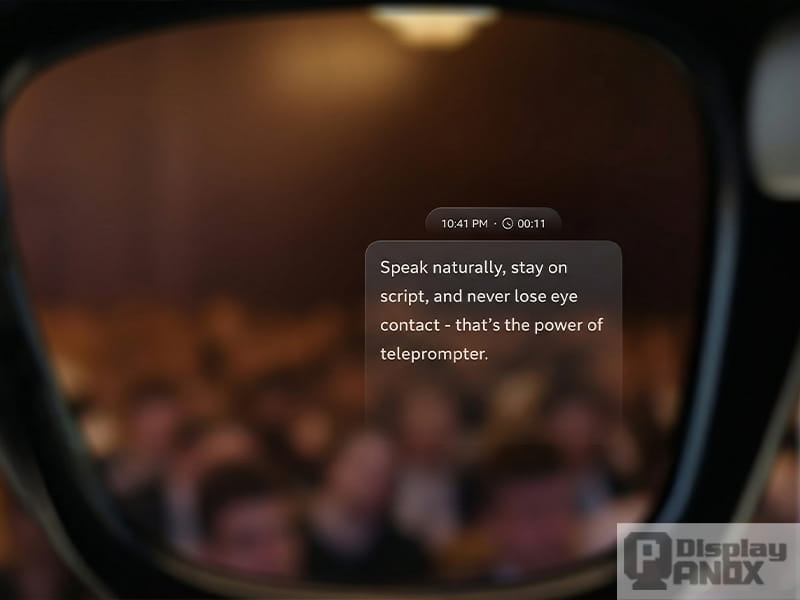
Meta remained the leading name in AI glasses, even without introducing a major new CES product. Its announcements still mattered. The company said demand for Meta Ray-Ban Display had been so strong that planned expansion into several international markets had to be delayed in order to fulfill US demand first.
Meta also pushed software updates, adding teleprompting features, EMG handwriting input through early access, and broader pedestrian navigation coverage. Even without a new show-floor hardware reveal, Meta continued to shape the competitive tone of the category.
MetaVu
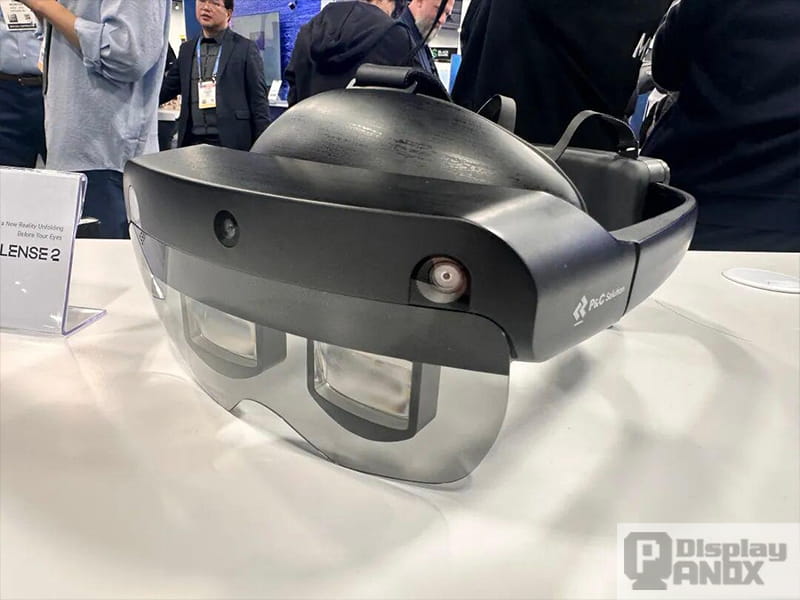
Korean AR/MR developer MetaVu showed an industrial AR headset and also indicated it is developing lightweight AI glasses expected to arrive around 2027.
Mokibo / Mojie Technology
Mojie Technology focused on AR core technology and precision mass manufacturing. At CES 2026 it showed AR prototypes, 12-inch resin wafers, and fully laminated resin waveguides.
Its two AR prototypes both won CES 2026 innovation awards. One used a monocular monochrome green Micro LED engine with resin diffractive waveguides and weighed only 25 grams. The other adopted a binocular full-color approach based on single-panel full-color Micro LED and high-index resin waveguides, while supporting photography and weighing only 38 grams.
Pimax
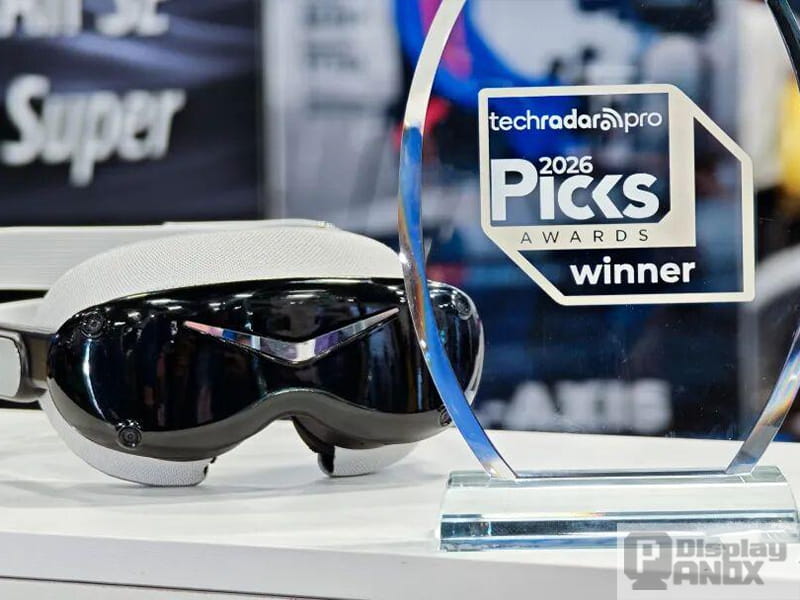
Pimax brought four VR headsets to CES 2026, including Crystal Light, Crystal Super micro-OLED & QLED, Dream Air, and Dream Air SE. Among them, Dream Air became one of the show’s most eye-catching headset products.
Dream Air uses 4K Micro OLED panels per eye, supports HDR, eye tracking, and 90Hz refresh rate, and reaches a 102-degree field of view. Its lightweight and compact design keeps the headset body below 180 grams, excluding the head strap. It was one of the clearest examples of how Micro OLED continues to define the premium lightweight PCVR direction.
Rokid
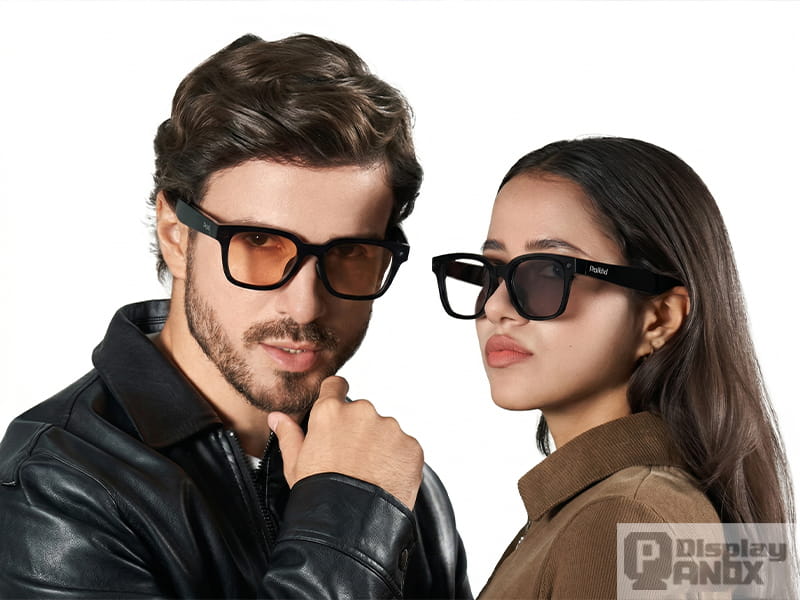
In addition to its already announced Rokid AI Glasses, Rokid also showed Rokid AI Glasses Style, a no-display AI glasses product. The device uses a Qualcomm AR1 + NXP RT600 dual-chip architecture, includes a 12MP camera, weighs only 38.5 grams, and supports models such as ChatGPT and DeepSeek, along with voice navigation and AI translation.
Its overseas pre-order pricing started at US$299, reinforcing the idea that non-display AI eyewear is becoming an important parallel branch of the market.
Sharge
After launching Loomos L1 and S1 late last year, Sharge showed Loomos L1 at CES 2026. Loomos L1 is an AI camera glasses product with improved styling, a dual-chip architecture, battery swapping support, and a Sony IMX681 sensor.
Loomos S1, by contrast, is an AR glasses product using an LCoS + holographic waveguide solution, weighing just 29 grams. Together they show how one brand can span both AI capture glasses and display-enabled AR products under one operating system.
Shokz
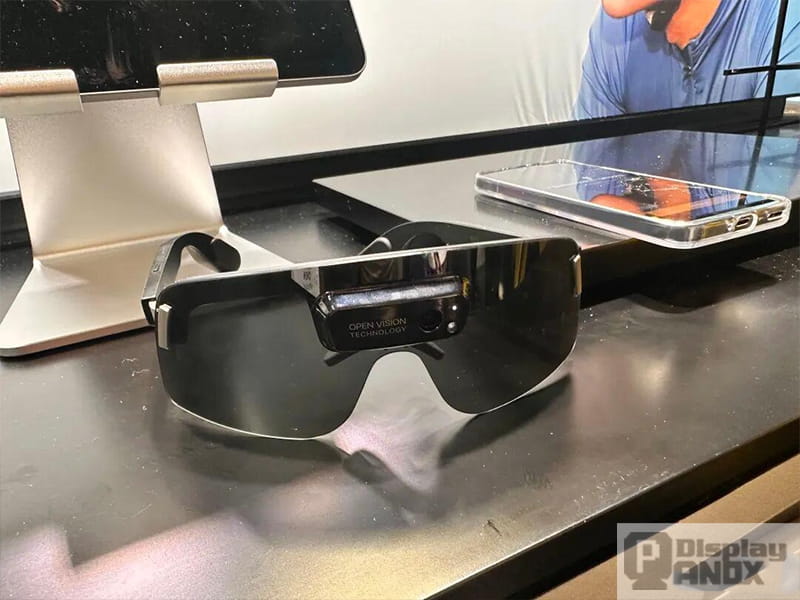
Known for bone-conduction audio, Shokz also showed two smart glasses products. One was an AI sports glasses product with a camera, 2K video support, and a full-color display for navigation and sports data. The other targeted visually impaired users, combining open-ear audio, a single camera, and AI assistant features such as text reading, 3D spatial search, and obstacle avoidance.
Shiftall
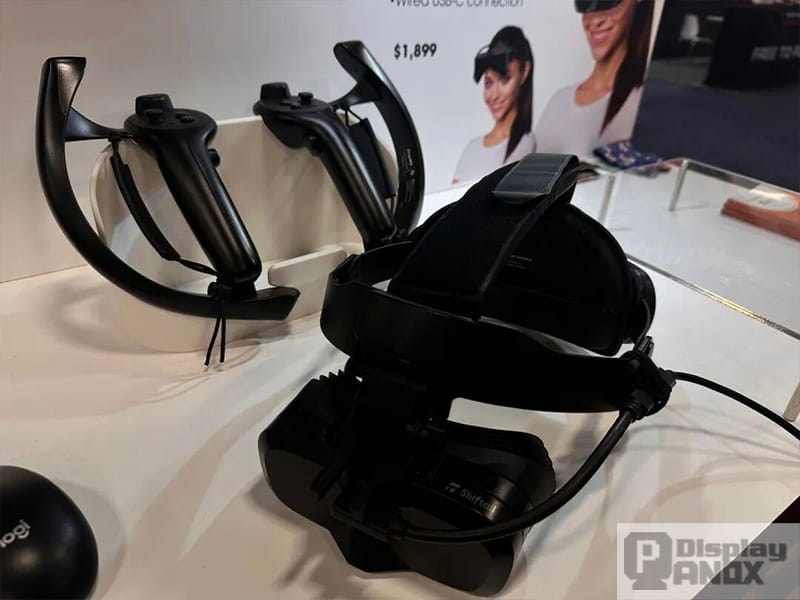
Ahead of CES, Panasonic announced its withdrawal from the MeganeX headset business, leaving Shiftall to continue development and service for the series. At the show, Shiftall presented MeganeX 8K Mark II, a lightweight PCVR headset using 4K Micro OLED displays per eye, HDR, and 90Hz refresh rate.
The product weighs only 179 grams and supports electric IPD adjustment as well as focus mechanisms that do not require removing glasses. It was another strong example of Micro OLED’s role in premium compact XR headsets.
TOZO
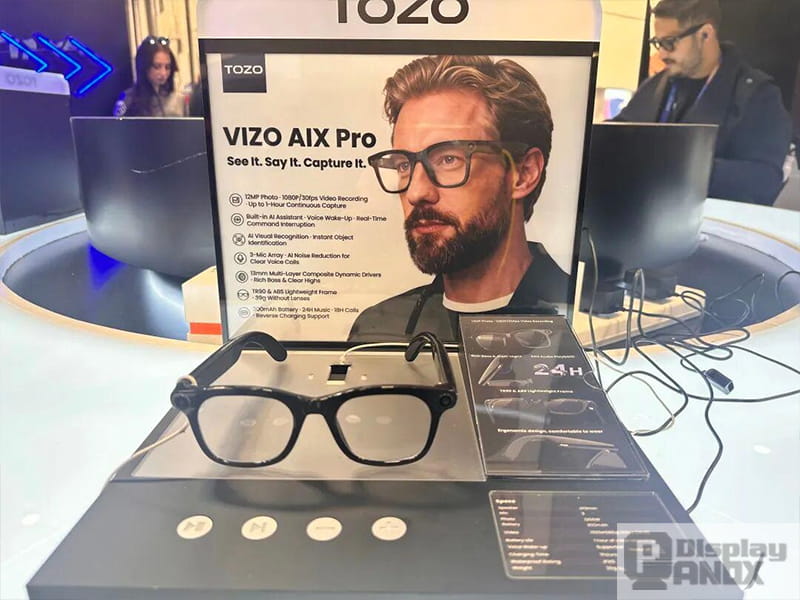
Originally known for its TWS earphones, TOZO has moved into AI and AR glasses as well. At CES 2026 it showed several smart glasses products.
VIZO Z1 was a video glasses product using a Micro OLED + Birdbath optical combination, with dual 1920 × 1080 displays. VIZO AIX Pro was an AI camera glasses product with 12MP photo capture, 1080P/30fps video, lightweight construction, long endurance, reverse charging, voice wake-up, and AI object recognition. VIZO SoundFit focused more on AI audio functionality.
TOZO’s portfolio demonstrated how brands from adjacent consumer electronics markets are now entering XR through multiple product types at once.
VITURE
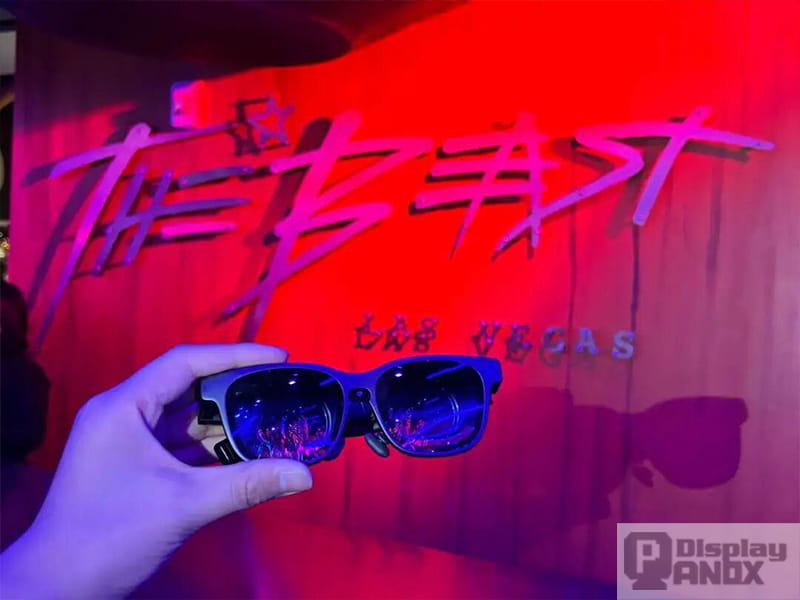
VITURE appeared together with brands such as NVIDIA, INAIR, and Jackery to show XR + AI applications across healthcare, spatial interaction, and outdoor scenarios. Its VITURE Beast was positioned as a display-centric AR glasses product, offering a 58-degree field of view, a very large virtual screen equivalent, 120Hz refresh rate, 1,250-nit brightness, and electrochromic dimming.
The product also supported 3DoF fixed screen functions and multiple virtual screen layouts through its SpaceWalker platform.
Vuzix
Vuzix showed a broad mix of AI glasses, AR glasses, OEM solutions, and optical modules. One especially notable exhibit was a reference design developed with Quanta, combining Qualcomm AR1, full-color binocular display, Vuzix waveguides, and Avegant LCoS light engines.
The company also showed Vuzix Ultralite Pro, another full-color waveguide reference design supporting AI conversation, photography, and 3D display.
Weiguang Technology
Weiguang Technology introduced its Xuanjing M6 series, a modular smart glasses system built around an AI camera glasses base product and magnetic waveguide display modules. The M6 Air base form weighs just 36.8 grams and uses a Sony IMX681 12MP sensor.
When display functionality is needed, magnetic display modules based on JBD Micro LED waveguides can be added for reading, navigation, teleprompting, and translation scenarios. This modular approach may prove attractive for brands trying to cover both AI and AR functions within one product family.
EmdoorVR
EmdoorVR, one of the major Chinese ODM/OEM players in smart glasses, showed a wide array of products covering audio glasses, camera glasses, and AR glasses. One AR concept, EM-SW5010, adopted a binocular full-color Micro LED solution with 580 × 300 resolution, a Qualcomm AR1 + Bestechnic 2800 chipset combination, a 12MP camera, and a 248mAh battery.
INMO
INMO showed both INMO GO3 and INMO AIR3, with GO3 making its overseas debut. GO3 focuses on real-time translation and supports as many as 261 languages, while also offering a clip-on accessory for two-way translation.
INMO AIR3 uses array waveguides together with a Micro OLED optical combination, provides 1080P resolution, and includes an interaction ring while supporting Android app installation.
Dreame
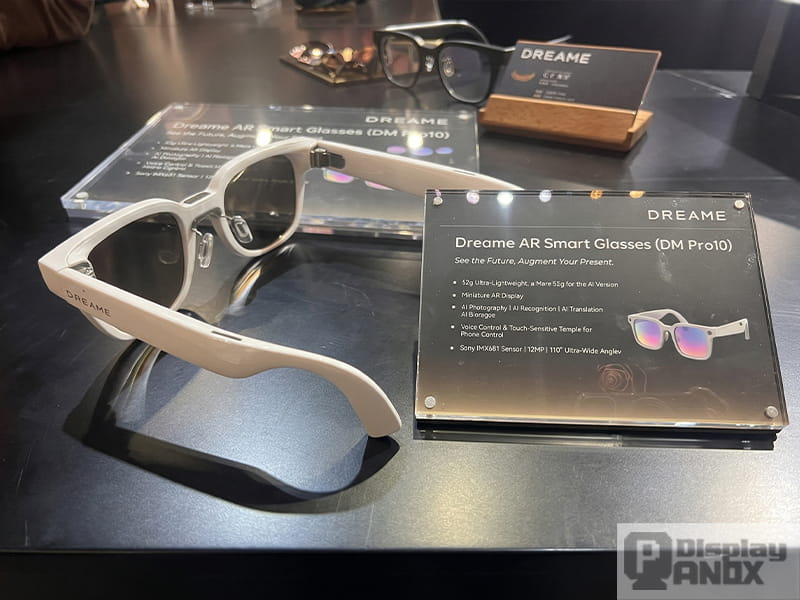
Dreame arrived at CES with a broad smart home ecosystem, but its smart glasses project also drew attention. The product, codenamed DM Pro 10 and based on Weiguang Technology’s solution, is fundamentally an AI glasses product weighing 35 grams. Users can also add a magnetic diffractive waveguide display module, bringing total weight to 52 grams.
The product uses a Sony IMX681 12MP sensor, a 110-degree ultra-wide-angle camera, and supports AI photography, recognition, and translation interaction.
What all of this means for Micro OLED
CES 2026 made one thing very clear: the XR market is no longer moving in one straight line.
AI glasses without displays are growing quickly. Lightweight AR glasses based on Micro LED and waveguide optics remain highly active. Accessibility products are expanding into more specialized real-world use cases. But at the same time, Micro OLED continues to secure an important position in the market, especially in premium XR hardware.
Its role was especially visible in compact PCVR headsets, immersive viewing devices, and a smaller number of smart glasses products that want stronger display performance in a limited form factor. At this stage, Micro OLED is not replacing every display route in smart glasses, but it is becoming more firmly established where visual quality, contrast, resolution, and compact immersion matter most.
That is why, even in April 2026, Micro OLED remains one of the most important technologies to watch in the XR industry. CES 2026 did not point to one single winner for all wearable devices. Instead, it showed a market becoming more layered, more specialized, and more competitive. In that environment, Micro OLED is not fading out. It is finding its clearest role.
If you are evaluating display solutions for next-generation XR hardware, our Micro OLED products offer a strong balance of image quality and integration flexibility.
| Panel model | Interface | Type | Size (inch) | Resolution | P.S |
| S032WEM01 | MIPI/RGB | Micro OLED | 0.32 | 800x600 | |
| PMOF039XGAM | RGB | Micro OLED | 0.39 | 1024x768 | Full Color/Monochrome |
| BO039M1920M | MIPI | Micro OLED | 0.39 | 1920x1080 | Highest PPI =5644 |
| EP047M800T | TTL | LCOS | 0.47 | 800x600 | |
| BO049FHPMO | SPI,MIPI | Micro OLED | 0.49 | 1920x1080 | |
| S050M1600M | MIPI | Micro OLED | 0.5 | 1600x1200 | |
| ECX331DB-6 | Mini LVDS | Micro OLED | 0.5 | 1024x768 | |
| S060LDM01 | MIPI | Micro OLED | 0.6 | 1920x1080 | |
| ECX335AF | Mini LVDS | Micro OLED | 0.71 | 1920x1080 | 200 nits brightness version |
| ECX335B | Mini LVDS | Micro OLED | 0.71 | 1920x1080 | 500 nits brightness version |
| ECX335SN | Mini LVDS | Micro OLED | 0.71 | 1920x1080 | 3000 nits brightness version |
| BO071M1920M | MIPI | Micro OLED | 0.71 | 1920x1080 | |
| S072WCM04 | MIPI | Micro OLED | 0.72 | 1920x1080 | |
| S103WAM01 | MIPI | Micro OLED | 1.03 | 2560x2560 |