



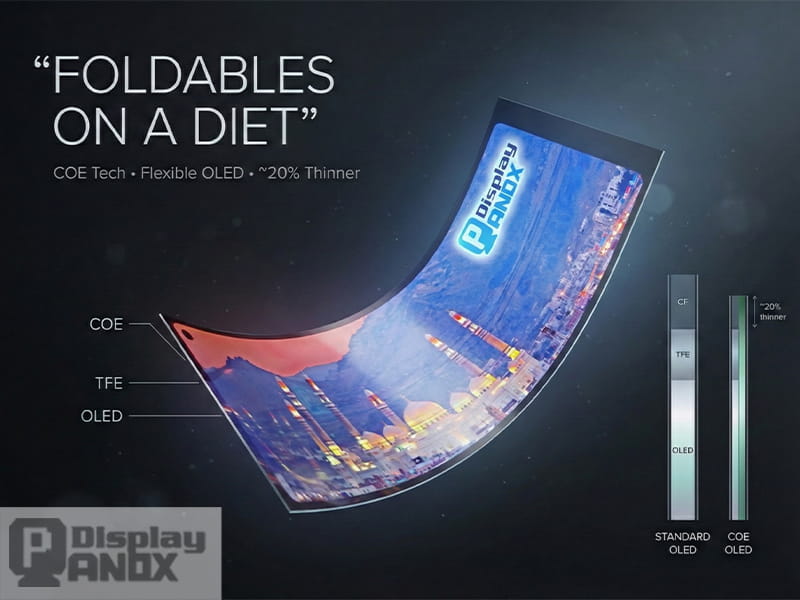
The evolution of foldable smartphones has been a race against physics. While early iterations were criticized for their bulk and noticeable creases, the latest generation of devices has achieved a sleeker, more refined profile that rivals traditional flagship phones. While improved hinge mechanisms often steal the spotlight, a silent revolution is happening within the display stack itself. This breakthrough is known as COE (Color on Encapsulation) technology, an innovation that is fundamentally changing how flexible OLED are manufactured.
By eliminating traditional optical layers, COE allows manufacturers to shave off critical millimeters and significantly boost efficiency. For tech enthusiasts and industry watchers, understanding COE is key to understanding why modern foldables are finally becoming pocket-friendly in both form and function.
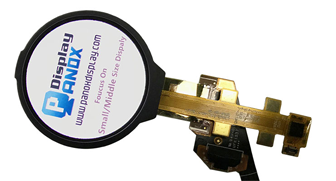
Explore our Flexible OLED modules designed for ultra-thin, bendable form factors in next-gen devices.
The "Chunky" Culprit: Why Traditional OLEDs Needed a Diet
To appreciate the innovation of COE, we must first understand the limitation of conventional OLED displays. For years, the industry standard involved placing a circular polarizer (C-Pol) on top of the display panel. While OLEDs are self-emissive, the metallic electrodes within the panel reflect ambient light, which can make the screen look grey and washed out under the sun. The circular polarizer solved this by blocking reflected light and ensuring deep, inky blacks.
However, this solution came with a significant penalty. The polarizer is a physical plastic sheet that adds thickness—typically between 50 to 100 micrometers. In the world of flexible displays, where every micron counts toward the bending radius, this added bulk creates mechanical stress. Furthermore, polarizers are optically inefficient; they can block more than 50% of the light emitted by the OLED pixels, forcing the device to pump more power just to achieve acceptable brightness levels.
Enter COE: Replacing Plastic with Precision Printing
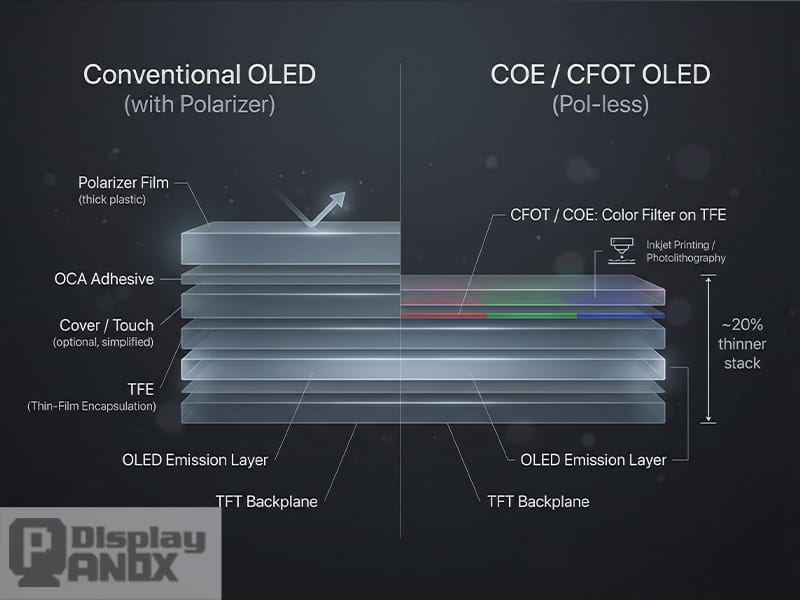
Color on Encapsulation (COE), also referred to by some manufacturers as "Pol-less" technology or CFOT (Color Filter on Thin-film encapsulation), completely removes the need for a separate polarizer sheet. Instead of gluing a thick plastic layer on top of the screen, manufacturers use high-precision inkjet printing or photolithography to deposit color filters directly onto the Thin-Film Encapsulation (TFE) layer of the OLED panel.
How the Optical Magic Works
The COE structure mimics the anti-reflection properties of a polarizer but achieves it through a different physical mechanism. By aligning red, green, and blue color filters precisely over the corresponding sub-pixels, the structure absorbs ambient light reflections between the pixels while allowing the light generated by the OLED to pass through with much less obstruction.
This transition from a separate adhesive-backed layer to a chemically bonded, micron-thin coating is what allows for the dramatic reduction in the display's cross-section. It transforms the display from a "sandwich" of separate components into a single, integrated unit.
The 20% Thinner Metric: Breakdown by the Numbers
The headline benefit of COE is the physical slimming of the device. By removing the polarizer and the associated optical clear adhesive (OCA), manufacturers can reduce the thickness of the OLED module by approximately 20%. While this might sound minor on paper, in a foldable device where the screen must double over itself, this reduction is exponential in its impact.
improved Folding Mechanics
A thinner screen stack is inherently more flexible. According to mechanical engineering principles, the stress placed on a material during folding decreases as the material becomes thinner. The COE structure allows for a smaller folding radius (1.4R or lower) without damaging the panel. This reduction in stress is directly responsible for the minimized creases we see in modern devices, as the panel is under less tension when folded flat.
The Efficiency Bonus: Brighter Screens, Longer Battery
Perhaps even more critical than the thickness reduction is the optical advantage. Because the dark, light-absorbing polarizer is removed, light transmittance is increased by 20% to 30%.
This creates a win-win scenario for the user:
-
Higher Peak Brightness: At the same power level, a COE display is significantly brighter and more legible outdoors.
-
Lower Power Consumption: To achieve standard brightness (e.g., 500 nits), the display requires roughly 25% less power. Since the display is the biggest battery drain on a large foldable, this directly translates to hours of extra usage time.
Learn more: The Era of the Flexible OLED Display: How Bending Screens Are Reshaping Technology
Future Implications: The Standard for Premium Displays
The adoption of COE is not just a trend; it is becoming the baseline requirement for premium foldable devices. Leading manufacturers like Samsung Display (with their Eco² OLED brand) and BOE have already integrated variations of this technology into their mass-production lines. As the technology matures, we can expect it to trickle down to standard rigid OLEDs and even laptops, where efficiency and thinness are equally prized.
Ultimately, COE represents the best kind of technological advancement: one that improves aesthetics, durability, and performance simultaneously. As foldables continue their march toward mainstream dominance, it is this "diet" of shedding unnecessary layers that will allow them to finally fit seamlessly into our lives.
Start your next lightweight product with a reliable Flexible OLED module from our collection.
| Model | Size(inch) | Display Type | Resolution | Interface |
| 1.39 inch Round/Circular OLED Flexible For Wearable Smartwatch | 1.39 | AMOLED | 400(RGB)×400 | MIPI |
| 1.5 inch Flexible OLED For Wearable Smart Watch | 1.5 | AMOLED | 120(RGB)×240 180PPI | SPI, MIPI |
| 1.8 inch Flexible PMOLED For Wearable Bracelet | 1.8 | PMOLED | 160×32 | SPI |
| 5.1 inch Flexible OLED On-Cell PACP For Cellphone | 5.1 | AMOLED | 720(RGB)×1520 330PPI | MIPI |
| 5.99 inch Flexible OLED On-Cell PACP For Cellphone | 5.99 inch | AMOLED | 1080(RGB)×2160 329PPI | MIPI |
| 5.99-Inch 1440x2880 Flexible AMOLED Display | BOE OLED for Huawei Smartphone | 5.99 | AM-OLED, OLED | 1440 x 2880 | MIPI |
| 6.52 inch Flexible OLED 2520x840 Touch Panel | 6.52 | AM-OLED, OLED | 2520(RGB)×840 407 PPI | MIPI |
| 6.67inch Flexible AMOLED 2K for Smartphone | 6.67 | OLED, AM-OLED | 1080x 2400 | MIPI |
| 7.8 inch Flexible Full Color OLED 1920x1440 MIPI | 7.8 | AMOLED | 1440 x 1920 | MIPI |
| 8 inch Flexible/Foldable OLED | 8.01 | AMOLED | 2480x1860 | MIPI |
| 13.3 inch 1536 x 2048 Flexible OLED Touch Screen | 13.3 | AM-OLED, OLED | 1536 (H) × 2048 (V) | eDP |