




In recent years, the display industry has undergone a seismic shift, moving rapidly from rigid, glass-based panels to adaptable, form-fitting interfaces. At the heart of this revolution is the flexible OLED display. With its unique ability to bend, fold, and even stretch, this technology is breaking the physical limitations of traditional screens. From the latest breakthroughs by the Chinese Academy of Sciences in high-performance polymer light-emitting diodes (PLEDs) to LG Display’s prototype capable of 53% stretchability, the momentum behind flexible electronics is undeniable. These advancements are not just novelties; they are laying the foundation for a future where displays are ubiquitous, seamlessly integrating into consumer electronics, commercial spaces, and intelligent interaction systems.
Learn more: Technological Breakthrough! Flexible OLED Luminous Efficiency Surges by 370%
The Engineering Behind a Flexible OLED Screen
Creating a flexible OLED screen is far more complex than simply bending a standard display. It requires a complete reimagining of the manufacturing process, often described as constructing a multi-layered "rainbow cake" where every single layer must possess flexibility. To achieve a screen that can withstand thousands of folds without compromising visual quality or durability, engineers must coordinate innovations across substrate materials, electronic components, and encapsulation technologies.
The Foundation: Flexible Substrates and "Island-Bridge" Design
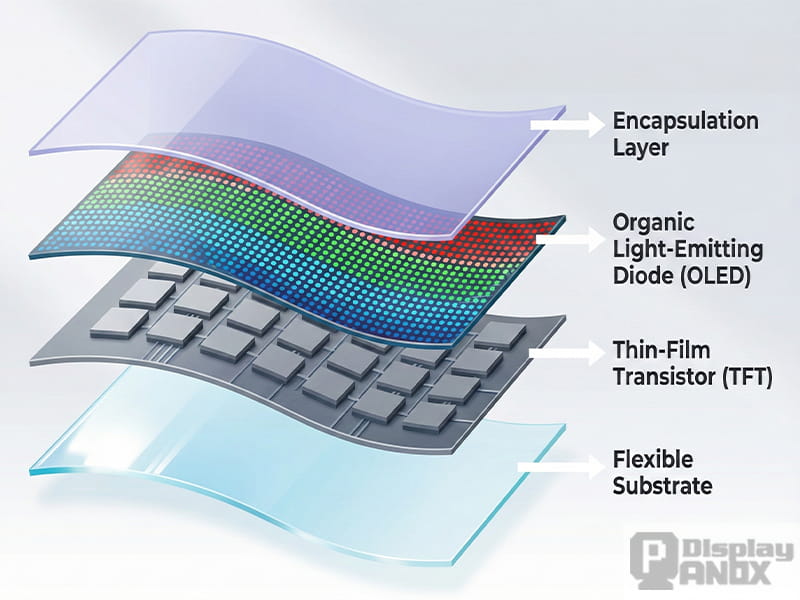
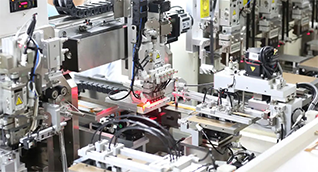
Flexible Display Manufacturing Diagram
The process begins with the substrate. Unlike traditional screens that use rigid glass, flexible displays rely on advanced polymer materials like polyimide or polyester. These materials can be as thin as 0.1 millimeters, offering high thermal stability and the resilience to endure high-temperature manufacturing processes and repeated folding.
Above the substrate lies the core of the display: the Thin-Film Transistors (TFT) and the Organic Light-Emitting Diodes (OLED). These components function like a high-performance team. Oxide semiconductors act as rapid couriers, ensuring fast current flow for clear, smooth visuals; organic semiconductors provide the "magic" of self-illumination, eliminating the need for bulky backlights; and conductive metals serve as the highway for electrical current. To prevent damage during bending, manufacturers often utilize an "island-bridge" structural design. In this layout, rigid components sit on "islands" connected by elastic "bridges," forming a flexible network that releases stress and maintains the screen's integrity during deformation.
Encapsulation: The Shield
The final critical step is encapsulation. Because organic components are highly sensitive to oxygen and moisture, they require robust protection. Researchers have developed multi-layer composite encapsulation and even self-healing coatings. These technologies ensure that the flexible OLED display remains lightweight and pliable while offering industrial-grade protection against environmental factors, significantly extending the product's lifespan.
Market Growth and Diverse Applications
The global appetite for flexible technology is exploding. Industry statistics indicate that shipments of flexible AMOLED panels reached approximately 631 million units in 2024, accounting for 42% of the smartphone market. Projections suggest that by 2031, the market size for flexible displays will exceed $173 billion, growing at a compound annual rate of 34.3%. This growth is driving innovation across four key sectors:
1. Smart Terminals and Consumer Electronics
The most visible application of the flexible OLED screen is in smartphones and laptops. Manufacturers are pushing the boundaries of form factors, moving beyond simple curves to complex folding and rolling mechanisms. For instance, Huawei has pioneered the tri-fold concept, with devices capable of transforming from a portable size into an 18-inch workspace, bridging the gap between mobile and desktop computing. Similarly, developments in rollable technology by companies like Samsung allow screens to expand from standard phone sizes to larger tablet formats (up to 12.4 inches). These next-generation devices offer superior resolution and durability compared to early foldable models.
2. Automotive and Transportation
In the automotive sector, the flexible OLED display is redefining the digital cockpit. Luxury manufacturers are replacing flat instrument clusters with immersive, curved interfaces. The Mercedes-Benz VISION EQXX concept, for example, features a massive 47.5-inch seamless flexible screen that spans the entire dashboard. Manufacturers like BMW and Audi are also integrating flexible OLEDs for instrument clusters and entertainment systems to enable dynamic, personalized interaction. Since 2020, major panel makers like BOE have been mass-producing automotive-grade flexible screens for electric vehicle brands like Nio and Xpeng, offering better energy efficiency and design freedom compared to traditional LCDs.
3. Wearable Technology and Healthcare
Flexible screens are making wearables more ergonomic and functional. By wrapping around the wrist or body, these displays allow for larger information areas on compact devices. Innovations such as the curved-screen fitness bands developed by Huami and BOE allow users to view comprehensive health data at a glance. In the medical field, the technology is evolving from simple readouts to clinical-grade diagnostic tools. From health patches that track heart rate and blood oxygen to portable ultrasound devices equipped with clear, low-energy flexible OLEDs, these screens are making healthcare more accessible and mobile.
4. Public Spaces and Commercial Display
The public sector is utilizing the flexible OLED display as a new canvas for communication. Superior to early LCDs in brightness and bendability, these screens are appearing in bus stops, shopping windows, and exhibitions. Their ability to conform to curved walls and pillars allows for immersive advertising experiences. notably, the 2024 Paris Olympics utilized flexible transparent displays for event broadcasting and interactive guidance, showcasing the technology's versatility in large-scale environments.
Related:View more Flexible Display Screen
The Future: Intrinsic Flexibility and "Skin-Like" Electronics
While current flexible screens rely on mechanical structures (like hinges) to fold, the future lies in "intrinsic flexibility." This concept involves developing materials that are stretchable at the molecular level, eliminating the need for external folding mechanisms. This evolution addresses current challenges such as creasing, fragility, and resolution loss during stretching.
Researchers are making significant headwinds in this area. In 2022, a team led by Bao Zhenan at Stanford University developed an intrinsically flexible OLED composed of light-emitting polymer fibers and a polyurethane matrix. This device achieved a brightness of 7,450 cd/m² and could stretch up to 100% of its length, mimicking the properties of human skin. Similarly, researchers at the Chinese Academy of Sciences have introduced micro-crystalline elastomers into polymer matrices to create high-performance, stretchable PLEDs.
Although intrinsic flexibility is currently in the material verification stage, it promises to revolutionize the industry. By integrating sensors and AI algorithms directly into these "skin-like" screens, we are moving toward true "human-computer symbiosis." Future devices will not just be tools we hold; they will be adaptable interfaces that conform to our bodies and environments, reshaping their content and form in real-time. As the industry overcomes challenges in self-healing substrates and elastic electrodes, the flexible OLED screen will complete its transition from a "rigid" past to a limitless, adaptable future.