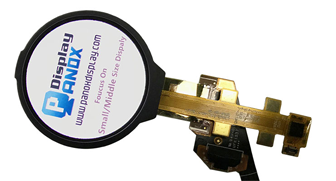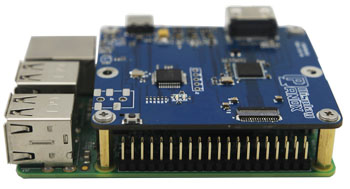




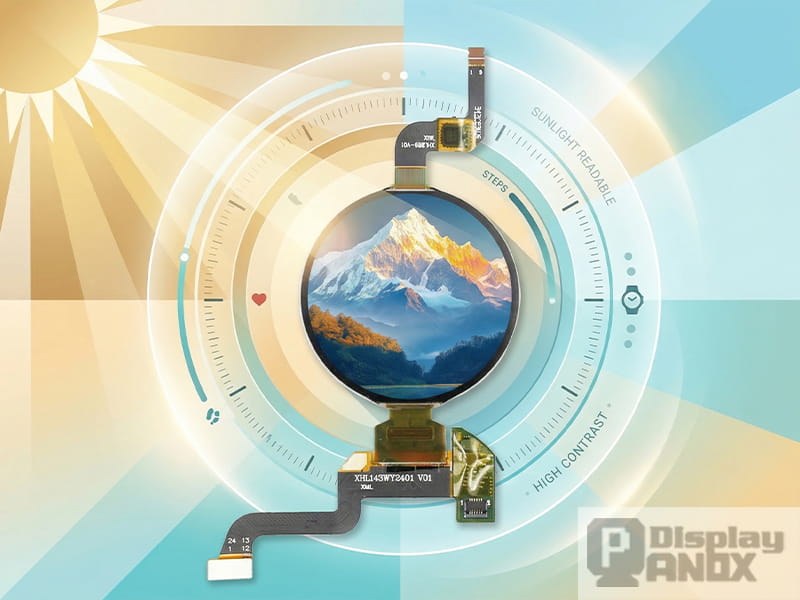
Smartwatches and wearable devices are no longer judged only by tracking accuracy or battery life. Display quality now plays a major role in how users experience health data, notifications, workout stats, navigation, and always-on watch faces throughout the day. That is exactly why AMOLED continues to dominate the premium wearable segment in 2026: it delivers the contrast, color depth, flexibility, and visual polish that modern wearables need, while newer LTPO-based implementations help reduce the traditional battery trade-offs.
For brands developing a smartwatch, fitness wearable, medical wearable, or compact smart device, AMOLED is not just a display upgrade. It is often a product-positioning decision. A better screen can make health metrics easier to read, improve outdoor usability, support slimmer industrial design, and create the premium first impression that buyers now expect from wearable tech.
Developing a new Smart Watch product? Check our display solutions designed for compact wearable devices.
Why AMOLED is ideal for smartwatches and wearable devices
The biggest reason AMOLED works so well in wearables is simple: each pixel emits its own light. That allows the display to show true blacks, extremely high contrast, and vivid colors without relying on a full backlight. On a small watch face, this matters even more than it does on a phone, because tiny text, icons, rings, and health metrics need to stay crisp at a glance. Samsung Display explicitly positions OLED as a strong fit for wearables because it remains clear outdoors and avoids the light leakage associated with black backgrounds on other display types.
AMOLED also supports the visual language that wearable brands want today: deep black UI, edge-to-edge layouts, elegant curved forms, and premium-looking watch faces. Since flexible OLED has already been mass-produced for wearable devices for years, it gives product teams more freedom in shape, curvature, and bezel control than legacy display approaches.
AMOLED vs LCD for wearables: what users notice first
When people compare smartwatch screens in real life, they usually do not start with engineering terms. They notice whether the display looks sharp indoors, whether it stays readable in sunlight, whether black backgrounds look truly black, and whether the watch face feels premium. On those points, AMOLED usually wins.
Compared with LCD, AMOLED offers stronger perceived contrast, richer color, and a cleaner look for always-on watch faces, notification cards, and health dashboards. That is especially useful for premium smartwatches, sports watches with colorful training metrics, and wearable interfaces that rely on dark themes. LCD can still be practical in some battery-focused or low-cost devices, but it usually cannot match AMOLED in visual depth or industrial-design flexibility.
Does AMOLED drain battery on a smartwatch?
This is one of the most searched questions around wearable displays, and the honest answer is: it depends on how the device is designed.
AMOLED can be power-efficient on dark interfaces because black pixels are effectively off. But smartwatch battery life is influenced by far more than panel type alone. Always-on display behavior, refresh rate management, GPS, sensors, brightness, processor architecture, and software optimization all matter. Google’s Wear OS documentation repeatedly emphasizes that always-on behavior has a direct battery impact, which is why power-aware ambient modes and low-pixel-illumination design are so important on watches.
This is where LTPO AMOLED becomes especially valuable. Apple’s recent watch specifications and announcements show how LTPO-based OLED enables always-on operation while lowering refresh rate and improving efficiency. Apple Watch models have long used Always-On Retina LTPO OLED displays, and newer generations push brightness higher while enabling very low refresh behavior for watch-face visibility without the same battery penalty older OLED systems would face.
Real products also show how far wearable AMOLED efficiency has improved. Garmin’s Instinct 3 AMOLED lists up to 18 days in smartwatch mode with wrist gesture, or up to 7 days with always-on display enabled, while OnePlus Watch 2 promotes up to 100 hours of battery life with a 1.43-inch AMOLED display and always-on capability. That does not mean every AMOLED watch lasts that long, but it clearly shows that AMOLED and strong battery life are no longer mutually exclusive in 2026.
Explore our display solutions for products that demand Low consumption without sacrificing visual quality.
Why always-on display matters for smartwatch UX
Always-on display is one of the clearest reasons AMOLED became the preferred choice for smartwatches. Users do not want to exaggerate wrist movement just to check time, training pace, or a timer during exercise. A wearable should feel glanceable.
That sounds simple, but it creates real technical demands. The display must stay visible, keep power consumption under control, and avoid excessive pixel activation. Wear OS quality guidance specifically limits how much of the screen should remain illuminated in always-on watch faces, underscoring how closely battery and display design are linked in wearables. Apple’s watch lineup also shows how OLED, LTPO, and low minimum brightness work together to make always-on viewing practical in daily use.
Outdoor visibility and brightness: can AMOLED work well in sunlight?
Yes, and this is another area where wearable AMOLED has improved significantly.
Older assumptions that AMOLED is only for indoor beauty no longer reflect the current market. Premium smartwatch specs now regularly highlight high brightness for outdoor use. Apple Watch Series 11 lists up to 2000 nits peak brightness with 1 nit minimum brightness, supporting both sunlight readability and dim nighttime viewing. Samsung Display also directly markets OLED for wearables as clear even in glaring outdoor conditions.
For sports watches and outdoor wearables, brightness alone is not the whole story. Contrast, black depth, UI layout, and anti-reflective cover materials all contribute to readability. But modern AMOLED has reached a point where it is no longer just a fashion-forward choice for lifestyle wearables. It is also a practical option for fitness, navigation, and all-day smartwatch use.
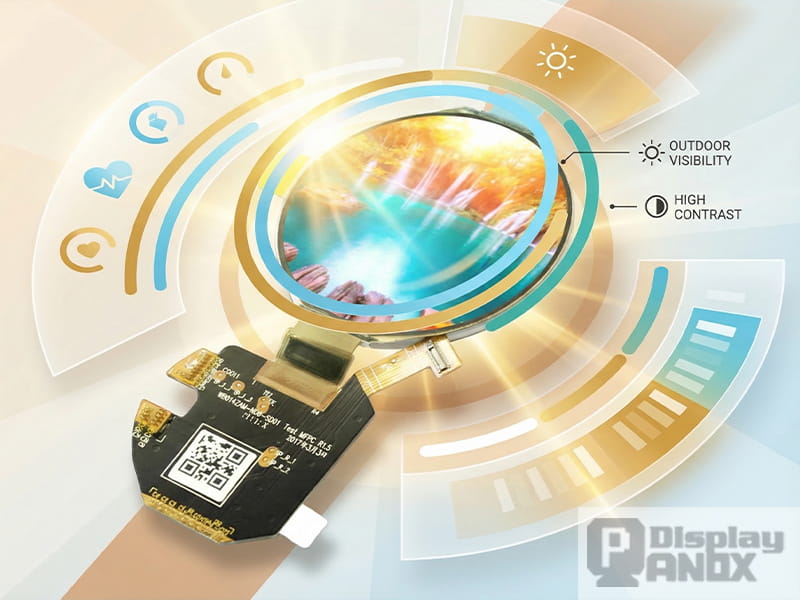
For outdoor-focused wearables, explore our Sunlight Readable display solutions.
Why wearable brands choose AMOLED for premium product design
AMOLED helps wearable brands in two ways at once: user experience and industrial design.
On the user-experience side, it enables polished visuals for heart-rate dashboards, sleep analysis, blood oxygen data, workout zones, navigation cues, and app notifications. On the product-design side, it supports slimmer modules, better edge control, more refined shapes, and a more premium front-of-device appearance. Flexible OLED development for wearables has been part of the industry for years, and concept work such as Samsung Display’s “Cling Band” continues to show how OLED can support new wearable form factors beyond conventional rigid watch faces.
This is especially relevant for brands building custom wearables, including smart rings with companion displays, medical wearables, compact health monitors, sports wearables, and next-generation wrist devices. If the product needs a compact, high-contrast, premium display with design flexibility, AMOLED is usually the first technology considered.
AMOLED for health wearables, fitness bands, and smartwatches
Wearables are increasingly used for health and wellness, not just notifications. That makes display clarity more important than ever. Users need to read heart rate, sleep stages, recovery status, oxygen saturation trends, training load, and alerts quickly, sometimes while moving.
A high-contrast AMOLED screen helps make that information easier to scan. It also supports more modern visual hierarchy, where important health data can stand out without cluttering the interface. As smartwatch shipments returned to growth in 2025, the category continued to expand around health tracking, premium design, and stronger user engagement, all of which support the ongoing demand for better wearable displays.
Is AMOLED still the best display choice for wearable devices in 2026?
For most premium smartwatches and advanced wearable products, yes.
AMOLED remains the leading choice because it balances the factors that matter most in wearables: high contrast, attractive visuals, compact integration, always-on readiness, and design flexibility. The battery story is no longer as simple as “AMOLED uses more power,” because LTPO, improved software, dual-chip architectures, and smarter ambient modes have changed the equation. In 2026, the better question is not whether AMOLED belongs in wearables. It is how well the display, power system, and UI are engineered around it.
For brands sourcing display solutions, that makes AMOLED particularly attractive for smartwatch projects, premium fitness wearables, health-monitoring devices, and custom-shaped wearable products where both visual impact and form-factor optimization matter.
Conclusion
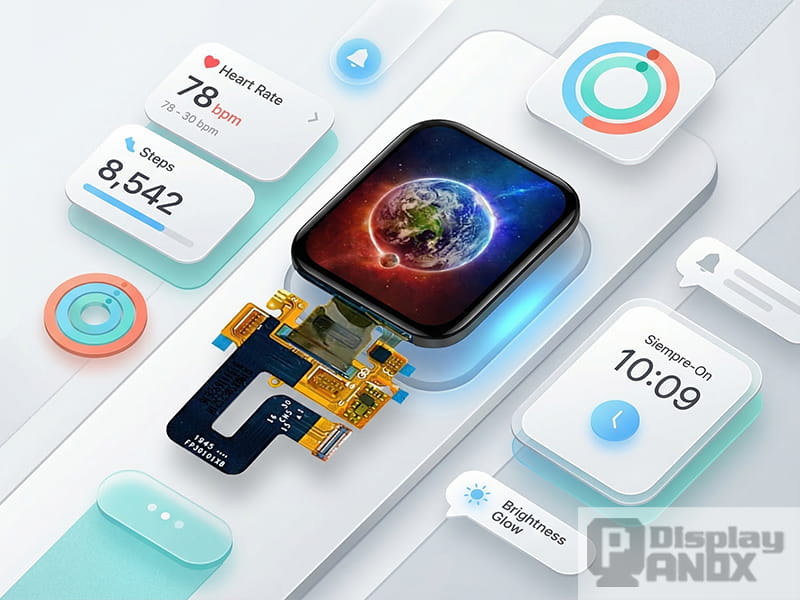
AMOLED has become the reference display technology for smartwatches and wearables because it solves multiple product challenges at once. It makes interfaces look better, improves perceived quality, enables always-on experiences, supports modern industrial design, and now works with increasingly efficient power-management systems.
For any company developing a wearable product in 2026, AMOLED is not just a trend-driven option. It is a practical, scalable, and market-proven display choice for devices that need to feel modern the moment a user raises their wrist.
Looking for a brighter and more premium wearable screen? Explore our AMOLED solutions for next-generation devices.
Learn more:AMOLED Power Consumption & Battery Life: What Really Affects Battery Performance?
FAQs
Is AMOLED better than LCD for a smartwatch?
In most premium smartwatch applications, yes. AMOLED typically offers better contrast, deeper blacks, more vivid color, and a more premium appearance, while LCD may still be used in some lower-cost or battery-priority designs.
Does AMOLED reduce smartwatch battery life?
Not necessarily. Battery life depends on always-on settings, refresh-rate control, chipset design, sensors, brightness, and software optimization. Modern LTPO AMOLED smartwatches are far more efficient than earlier generations.
Why is AMOLED good for always-on display?
Because OLED can selectively illuminate pixels and work with low-refresh ambient modes, it is well suited for glanceable always-on watch faces while helping manage battery usage.
Is AMOLED readable outdoors on wearable devices?
Yes. Modern wearable AMOLED panels now reach high brightness levels, and premium smartwatch makers increasingly emphasize outdoor readability in their product specs and marketing.
Can AMOLED be used in custom wearable designs?
Yes. Flexible OLED has already been used in wearable development and is well suited for curved, compact, or premium industrial designs where traditional flat display approaches are more limiting.
Is AMOLED suitable for health and fitness wearables?
Yes. High contrast, clear text rendering, and premium visual output make AMOLED especially useful for displaying workout data, recovery metrics, sleep tracking, and health dashboards on small screens.