



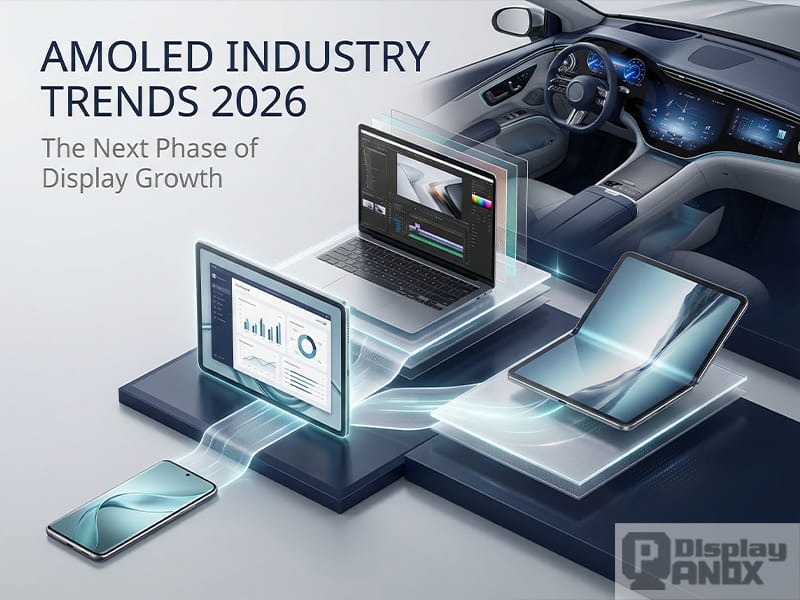
AMOLED is no longer just a premium smartphone feature. In 2026, it is becoming a broader display strategy that spans phones, foldables, laptops, tablets, automotive cockpits, wearables, and even new manufacturing routes for medium-sized panels. The market is entering a more mature phase, where the key question is no longer whether AMOLED will grow, but where it will create the most value and which technologies will define the next wave of adoption.
For brands, product teams, and display buyers, the 2026 AMOLED story is more nuanced than simple shipment growth. Smartphone AMOLED volumes are facing short-term pressure from memory pricing and broader macroeconomic uncertainty, yet investment in AMOLED capacity, efficiency, durability, and new form factors continues to accelerate. That combination matters: it shows AMOLED is evolving from a category advantage into a platform technology for multiple device classes.
Learn more about our AMOLED screen products for advanced display integration.
1. AMOLED remains the display technology to watch, even as smartphone growth becomes more selective
The smartphone market is still the largest anchor for AMOLED, but 2026 is shaping up to be a year of more selective growth rather than unlimited expansion. Omdia forecasts global smartphone AMOLED shipments at 810 million units in 2026, down slightly from 817 million in 2025, which would mark the first year-on-year decline after three years of growth. That does not suggest AMOLED is weakening structurally. Instead, it shows that the display market is becoming more sensitive to component pricing, inventory discipline, and regional demand shifts.
This is an important distinction for SEO discussions around AMOLED. A modest shipment pause does not reduce the importance of AMOLED in the smartphone value chain. In reality, AMOLED continues to define the experience expectations of modern mobile devices: deep blacks, excellent contrast, vibrant color, thinner modules, support for curved and foldable industrial design, and more efficient pixel-level light control compared with backlit technologies. Samsung Display’s OLED technology pages continue to emphasize power savings on dark UI and pixel-level emission as a core advantage, which remains highly relevant as brands try to balance premium visuals with battery life.
In practical terms, 2026 is less about “AMOLED replacing everything overnight” and more about AMOLED becoming the default expectation across a wider span of upper-midrange and premium devices. Even when overall handset output softens, brands still treat AMOLED as a competitive lever for differentiation in image quality, thinness, refresh rate, and industrial design. That is why AMOLED continues to attract investment even in a more cautious shipment environment.
2. The biggest AMOLED story in 2026 is expansion beyond smartphones
If one trend defines AMOLED in 2026, it is the move into medium-sized IT displays. Laptops, tablets, and portable productivity devices are becoming a far more serious battleground for AMOLED suppliers. Samsung Display has been building its 8.6-generation IT OLED line in Korea, with production scheduled to begin in 2026, and the company has highlighted the much larger 2290 x 2620 mm mother glass format as a major production-efficiency step for the category.
That matters because medium-sized AMOLED has historically been constrained by cost, capacity, and manufacturing efficiency. Larger-generation lines improve substrate utilization and help panel makers scale OLED into laptops and tablets more effectively. In other words, AMOLED in 2026 is increasingly about supply-chain readiness for the next device wave, not only about mobile phone replacement cycles.
The rise of AI PCs also strengthens this direction. Display makers are now talking about AMOLED not just in terms of beauty, but in terms of total device performance. Samsung Display and Intel announced SmartPower HDR in January 2026, claiming up to 22% lower OLED emissive power consumption in HDR mode on laptops. That is a highly relevant signal: laptop AMOLED is no longer being sold only as a premium visual upgrade, but as a smarter power-performance component for mobile computing.
3. Tandem OLED is turning AMOLED into a better fit for laptops, tablets, and premium productivity devices
Another major AMOLED trend in 2026 is the rise of tandem OLED architectures. Tandem OLED stacks multiple emissive layers to improve brightness, lifespan, and efficiency, which directly addresses some of the concerns that have historically limited OLED in long-use devices such as laptops and tablets. LG Display describes Tandem OLED as improving lifespan and brightness while reducing power consumption compared with conventional OLED structures.
LG Display’s Tandem ATO positioning for laptops is especially telling. The company says this architecture can reduce power consumption by up to 40% versus regular OLED in laptop use cases, while its tablet materials make the same 40% reduction claim at equivalent brightness. It has also described its tandem laptop OLED as capable of double the lifespan and triple the brightness of conventional single-layer OLED, pointing to a clear strategy of making OLED more practical for sustained productivity use.
This is one of the clearest indicators of where AMOLED is heading in 2026. The conversation is moving away from “AMOLED looks better” toward “AMOLED can now serve more demanding device classes.” For manufacturers, that means OLED is becoming easier to justify in premium notebooks, tablets, portable creative tools, and future hybrid devices where battery life, brightness, and durability all matter at once.
4. Foldable AMOLED is still a growth engine, but the real focus is better durability and less visible creasing
Foldables remain one of AMOLED’s most visible showcase categories in 2026, but the story is becoming more engineering-led. Instead of simply chasing novelty, panel makers are focusing on hinge radius, crease reduction, durability, and practical user experience. Samsung Display’s Flex OLED materials highlight extremely tight curvature, while its 2025 foldable panel announcement said its durability standard had been raised from 200,000 to 500,000 folds.
These improvements matter because foldables are one of the clearest examples of where AMOLED has a structural advantage over LCD. Flexible substrates, thinner stacks, and self-emissive pixels make AMOLED inherently better suited to foldable, curved, and unconventional form factors. BOE also continues to emphasize flexible and foldable OLED development, and reported shipping nearly one million flexible and foldable OLED modules in one of its recent announcements.
The foldable segment may not define total AMOLED volume on its own, but it remains strategically important. It pushes the industry forward in materials, encapsulation, thinness, and mechanical durability. Many of those improvements later influence mainstream AMOLED products as well. That is why foldable AMOLED still matters in 2026 even when the broader mobile market is cautious.
Learn more: The Ultimate AMOLED Display Price Guide & Cost Factors
5. Automotive AMOLED is moving from niche premium feature to long-term growth market

Automotive is becoming one of the most important non-smartphone opportunities for AMOLED. As vehicle interiors turn into large digital surfaces, the strengths of OLED and AMOLED become easier to monetize: high contrast, true black, premium appearance, curved formats, ultra-thin construction, and improved design freedom for cockpits and passenger displays. Samsung Display launched DRIVE as a dedicated automotive OLED brand in 2025, explicitly positioning automotive OLED as a next-generation growth engine.
BOE’s automotive display platform also reflects the scale of this opportunity. The company promotes a product range from 2-inch to 48-inch automotive displays, including center stack, cluster, rear-view mirror, entertainment, and HUD-related applications, with emphasis on high contrast, narrow borders, and high reliability. That portfolio language is important because it shows the market is no longer treating automotive displays as a one-screen problem. It is a system market, and AMOLED fits naturally into the premium end of that system.
Market researchers are also signaling shipment growth. Omdia said automotive OLED shipments were expected to rise 11.8% in 2025 to about 3.05 million units, and a later summary reported expectations of almost 6 million units in 2026. While adoption rates vary by vehicle tier and region, the direction is clear: AMOLED is becoming a more realistic option for instrument clusters, center information displays, passenger entertainment, and brand-defining cockpit designs.
6. 2026 AMOLED Market Outlook
AMOLED is still expected to grow in value in 2026, even though smartphone shipments may soften slightly. Omdia forecasts global smartphone AMOLED shipments at 810 million units in 2026, down from 817 million in 2025, while total AMOLED display revenue is still projected to reach US$56 billion, up 5% year over year. At the same time, growth is shifting toward larger and more diversified applications: Omdia expects OLED tablet panel shipments to rise 39% YoY to 15 million units in 2026, and total tablet panel shipments to reach 301.5 million units. In automotive, OLED shipments are expected to grow from about 3 million units in 2025 to nearly 6 million units in 2026, showing that AMOLED is expanding beyond smartphones into a broader range of premium products.
For Chinese manufacturers, these numbers point to a clearer opportunity in 2026: the market is becoming less dependent on one single category and more driven by tablets, laptops, automotive displays, and other custom projects. That shift favors suppliers with stronger OEM flexibility, stable production, and better integration support. It also matches the direction of new capacity investment, as Samsung Display’s 8.6-generation IT OLED line is scheduled for mass production in 2026 and is designed for output of up to 10 million laptop panels per year, reinforcing the wider move toward medium-sized AMOLED applications.
7. AMOLED competition in 2026 is shifting from panel quality alone to manufacturing route and cost structure
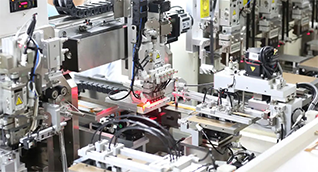
A major change in 2026 is that AMOLED competition is no longer only about who can make the best-looking panel. It is increasingly about who can produce OLED more efficiently, at larger sizes, with better yields, lower material waste, and more scalable architectures. That is why process innovation is such a big part of the current AMOLED narrative.
TCL CSOT has been especially vocal about inkjet printing OLED. The company announced mass production of IJP OLED in late 2024 and continues to promote the process as a route to better scalability and product diversity. Its CES and SID-related materials highlight regular RGB pixel arrangement, 50% to 60% light-emitting area rate, and notebook-oriented printed OLED development. In parallel, Visionox has been promoting its ViP AMOLED technology across watches, smartphones, and laptops, describing it as part of an “AMOLED+ era” with better color and performance expectations.
For buyers and brands, this matters because process innovation can eventually change pricing, availability, form factors, and product segmentation. In simple terms, the 2026 AMOLED market is not only about display quality. It is also about which manufacturing approach can make high-performance AMOLED more accessible across more categories.
8. Power efficiency is now one of the most important AMOLED keywords
For years, AMOLED marketing focused heavily on contrast ratio, color saturation, and premium design. In 2026, power efficiency is becoming just as important. This shift is visible across smartphones, laptops, tablets, and even automotive discussions. Samsung Display continues to stress the advantage of pixel-level control and dark-mode-related savings, while newer laptop-focused solutions such as SmartPower HDR frame AMOLED as an active contributor to overall device efficiency.
This change is especially meaningful for IT devices. The old criticism that OLED is less suitable for productivity hardware because of power draw is being addressed through tandem structures, improved materials, variable refresh technologies, and power-optimized driving. LG Display’s tandem messaging and Samsung’s SmartPower HDR announcement both point in the same direction: AMOLED is being engineered for longer-duty computing, not just short-form media consumption.
9. What AMOLED means for brands in 2026
For brands, sourcing teams, and product marketers, AMOLED in 2026 should be understood as a strategic option with multiple layers of value. In smartphones, it remains a core differentiator. In laptops and tablets, it is entering a scale-up phase driven by 8.6-generation production and tandem architectures. In foldables, it remains the enabling technology for future form factors. In automotive, it is becoming part of the premium cockpit roadmap.
At the same time, the market is becoming more complex. Shipment growth may not be linear. Costs still matter. Process choices will matter more. Power efficiency and durability will influence adoption as much as color and contrast. That is exactly why AMOLED remains such an important keyword in 2026: it sits at the center of where display technology, product design, and user experience are all moving.
Conclusion
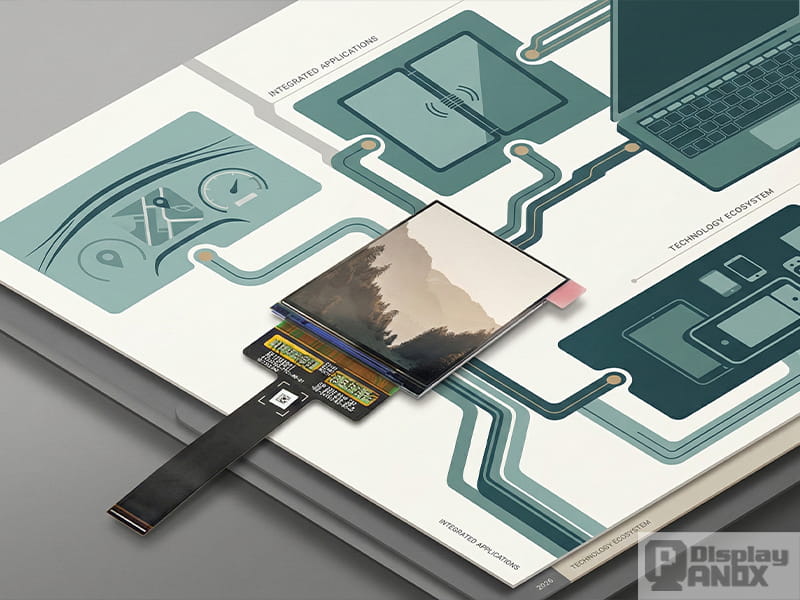
The AMOLED industry in 2026 is entering a more advanced stage of competition. Smartphones still matter, but the real momentum is coming from medium-sized OLED, tandem structures, power-efficiency improvements, foldable durability, automotive expansion, and new manufacturing routes such as inkjet printing and ViP AMOLED. The market may look more selective in the short term, but the long-term direction is clear: AMOLED is becoming a foundational display technology for the next generation of connected devices.
For anyone building products around display innovation, 2026 is not a year to ask whether AMOLED still matters. It is the year to decide which kind of AMOLED roadmap matters most: flexible AMOLED, tandem AMOLED, laptop AMOLED, automotive AMOLED, or next-generation AMOLED manufacturing.
FAQ
What is AMOLED and why is it important in 2026?
AMOLED stands for Active-Matrix Organic Light-Emitting Diode. It is important in 2026 because it is expanding well beyond smartphones into laptops, tablets, foldables, wearables, and automotive displays, supported by new production lines, tandem architectures, and efficiency-focused technologies.
Is AMOLED still growing if smartphone AMOLED shipments are softening?
Yes. Omdia expects smartphone AMOLED shipments to dip slightly in 2026, but that does not cancel AMOLED’s broader growth story. Investment is still accelerating in IT OLED, automotive OLED, foldable OLED, and new manufacturing approaches, which means AMOLED’s role in the wider display market is still expanding.
Why is AMOLED becoming more common in laptops and tablets?
AMOLED is becoming more viable in laptops and tablets because manufacturers are improving production efficiency and solving practical concerns around power use and lifespan. Samsung Display’s 8.6-generation IT OLED production and LG Display’s tandem OLED approach are two strong examples of that shift.
What is Tandem OLED and why does it matter for AMOLED?
Tandem OLED uses multiple emissive layers to improve brightness, efficiency, and lifespan. It matters because it makes AMOLED more suitable for laptops, tablets, and other devices that need longer operating life and more consistent performance over time.
Is AMOLED better than LCD in 2026?
In many premium use cases, yes. AMOLED still offers stronger contrast, true blacks, thinner structures, and greater design flexibility. However, the more relevant question in 2026 is not only whether AMOLED looks better than LCD, but whether AMOLED can now meet the efficiency, durability, and cost targets required for more product categories. That is where much of today’s innovation is focused.
What are the main AMOLED technology trends in 2026?
The biggest AMOLED trends in 2026 include 8.6-generation IT OLED production, tandem OLED, power-saving laptop OLED technologies, stronger foldable durability, automotive OLED branding and expansion, and alternative manufacturing routes such as inkjet printing OLED and ViP AMOLED.
Is flexible AMOLED still important in 2026?
Absolutely. Flexible AMOLED remains essential for foldable smartphones, curved displays, and thinner device designs. It is still one of the clearest structural advantages AMOLED has over LCD, and suppliers continue to improve curvature, reliability, and folding endurance.
What should buyers look for when sourcing AMOLED displays in 2026?
Buyers should evaluate more than visual quality. Key factors now include power efficiency, lifespan, panel architecture, production route, scalability, form-factor support, and long-term supply consistency. In 2026, choosing the right AMOLED solution is increasingly about matching the right AMOLED technology to the right application.
Find more AMOLED products for flexible, slim, and high-contrast display designs.