



Choosing between an AMOLED gaming monitor and an LCD gaming monitor is no longer a simple “premium vs budget” decision. In 2026, both categories have matured. OLED-class gaming displays now offer 240Hz, 360Hz, and even higher-refresh options in mainstream enthusiast sizes, while LCD gaming displays continue to push brightness, price efficiency, and long-session practicality. For gamers, the real question is not which technology is universally better, but which one is better for the way you actually play.
1. What “AMOLED vs LCD” really means for gaming monitors
AMOLED stands for Active Matrix Organic Light Emitting Diode. In practice, when people search for “AMOLED gaming monitor,” they are usually comparing OLED-class self-emissive displays against LCD monitors, including Fast IPS, VA, TN, and Mini LED LCD models. The core difference is simple: AMOLED/OLED pixels generate their own light, while LCD panels rely on a backlight. That single architectural difference shapes almost everything gamers care about, from black levels and HDR to motion performance and burn-in risk.
For gaming, that means AMOLED and OLED monitors tend to excel in cinematic image quality, near-instant pixel response, and dark-scene immersion. LCD monitors, meanwhile, often win on sustained brightness, price range, text clarity consistency, and lower long-term concern around static desktop elements.
2. AMOLED vs LCD for gaming: the biggest real-world difference
If you notice black levels first, AMOLED will usually impress you more. Because each pixel can switch off individually, blacks look truly black rather than dark gray, and contrast feels much more dramatic in horror games, space scenes, stealth games, and HDR-heavy titles. VESA’s DisplayHDR True Black standard was created specifically for emissive displays because of this kind of deep-black performance.
If you notice screen brightness, daytime visibility, and overall value first, LCD still makes a strong case. A high-quality IPS or Mini LED LCD gaming display can stay punchy in brighter rooms and often costs less at a given size and resolution. Mini LED LCD models can also deliver very strong HDR highlights, sometimes well above 1500 nits, even if they still cannot match OLED’s per-pixel black control.
3. AMOLED gaming monitors and motion clarity
For pure pixel response, AMOLED gaming monitors are still the class leader. Current premium OLED models from major brands commonly advertise 0.03ms GTG response times, while strong LCD gaming monitors still tend to sit around 1ms GTG on spec sheets. In practice, that helps OLED reduce smearing, overshoot tuning issues, and transition blur, especially in fast camera pans and high-speed shooters.
That does not automatically mean every AMOLED gaming display is the best esports choice. LCD, especially Fast IPS and Fast TN, still competes aggressively at ultra-high refresh rates and motion-clarity-focused designs. ASUS offers a 360Hz Fast IPS option, and ZOWIE continues to push Fast TN esports monitors into the 400Hz and 540Hz range. NVIDIA’s 2026 G-SYNC Pulsar launch also shows that motion clarity innovation is still moving quickly on the LCD side. So if your priority is pure competitive tracking clarity at the highest frame rates, LCD is far from obsolete.
4. HDR, dark scenes, and single-player immersion
This is where AMOLED usually creates the strongest emotional upgrade. Because OLED-class displays combine pixel-level light control with extremely fast transitions, HDR games can look more dimensional and more convincing, particularly in titles with high-contrast lighting, neon effects, shadow detail, and night environments. That is why many of the top-rated gaming monitors in 2026 are now OLED-based.
LCD can still be excellent for HDR, but the experience depends heavily on the backlight system. A standard edge-lit or basic IPS gaming monitor will not match AMOLED in black depth. A Mini LED LCD gaming display can come much closer and may even beat OLED in highlight intensity, but haloing, black crush, or blooming can still appear depending on the dimming implementation and viewing conditions.
5. Bright-room gaming: where LCD keeps winning
If you mostly game in a bright room, near a window, or with overhead lighting, LCD often remains the safer choice. Many OLED monitors still deliver outstanding HDR peaks, but their full-screen brightness and bright-room black handling can be less forgiving than LCD. RTINGS notes that OLED monitors are generally better suited to darker environments, and some QD-OLED panels can show raised blacks in bright rooms.
That matters more than many buyers expect. A gaming display that looks spectacular at night may feel less convincing in a sunlit office-bedroom setup. By contrast, IPS and Mini LED LCD monitors tend to hold up better against glare and ambient light, which can make them a better everyday gaming display for mixed daytime use.
6. Burn-in, desktop use, and long-session practicality
This is still the biggest caution point for AMOLED gaming monitors. Burn-in is real. Multiple manufacturers now build in protection systems such as pixel shifting, logo dimming, panel refresh cycles, proximity-based dimming, and thermal control, and several brands now include burn-in coverage in their warranties. Even so, static UI elements, desktop toolbars, HUD-heavy games, and long hours of unchanged content remain more of a concern on OLED than on LCD.
For gamers who also work, browse, edit documents, or keep the same windows open all day, LCD is easier to live with. It also tends to offer more predictable text rendering and fewer worries around subpixel-layout quirks. OLED monitor text clarity has improved, but subpixel fringing remains a known discussion point depending on panel type, OS rendering, and viewing distance.
7. Price and value: AMOLED gaming is better, but not always smarter
AMOLED gaming monitors have become much more accessible, but LCD still dominates value. A budget or mid-range LCD gaming display can deliver 1440p, 180Hz to 240Hz, VRR, and solid response times at a far lower entry price than premium OLED. Even Mini LED is starting to push deeper into aggressive price brackets, which makes LCD more competitive than many “OLED-only” conversations suggest.
So the smart buying logic is not “AMOLED is best, therefore buy AMOLED.” The smarter logic is this: if your budget is fixed, ask what trade-off matters least. If you can stretch for OLED and mostly play immersive games, the upgrade is easy to justify. If you want maximum performance per dollar, bright-room flexibility, and fewer long-term maintenance concerns, LCD still delivers better value in many setups.
8. Which gaming display should you choose?
Choose an AMOLED gaming monitor if you want the best contrast, the cleanest motion response, stronger perceived HDR depth, and a more premium gaming display experience overall. It is especially compelling for story-driven games, RPGs, racing games, horror games, and players who game mostly in controlled lighting.
Choose an LCD gaming monitor if you want stronger daytime usability, lower cost, safer long-hour desktop behavior, or the widest range of refresh-rate and panel-price combinations. It is also a very sensible choice for competitive players who want high refresh without paying OLED prices, and for mixed-use setups where gaming is only part of the day.
If you want the shortest verdict possible, here it is: AMOLED is usually the better-looking gaming display, while LCD is usually the more forgiving and cost-efficient gaming display. In 2026, the best choice is not about hype. It is about whether you want maximum visual impact or maximum flexibility.
The best gaming display strategy often depends on whether your priority is AMOLED/OLED immersion, LCD versatility, or High refresh rate responsiveness.
9. Final verdict: AMOLED vs LCD for gaming monitors
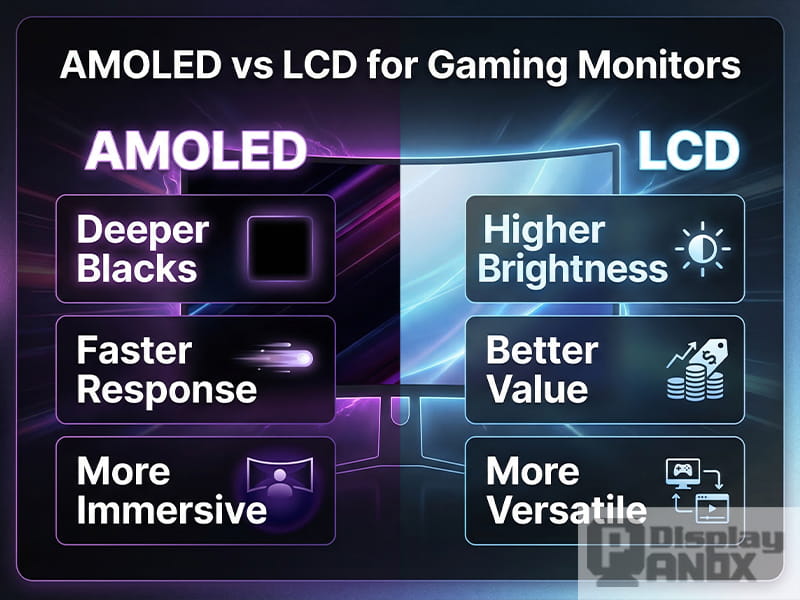
For most enthusiasts, AMOLED gaming monitors now represent the premium target. The combination of near-instant response, deep blacks, and high-end HDR makes them hard to ignore. That is why so many of the most talked-about 2026 gaming displays sit in the OLED family.
But LCD is not the old compromise people sometimes assume. Fast IPS, Mini LED, and high-refresh TN still cover major needs that OLED does not solve as cleanly: affordability, long-term static use, bright-room visibility, and esports-oriented variety. If your goal is the best all-around match for real life rather than the most dramatic spec sheet, LCD is still a serious answer.
Whether you are evaluating AMOLED/OLED for immersive contrast or LCD for practical value, choosing the right panel is key to building a better gaming display.
FAQs
1. Is AMOLED better than LCD for gaming monitors?
Usually yes for picture quality and response time, but not always for value or daily practicality. AMOLED/OLED gaming monitors generally offer deeper blacks, stronger contrast, and faster pixel transitions, while LCD gaming monitors often cost less and are easier to use for long mixed desktop sessions.
2. Is AMOLED the same as OLED in gaming monitor discussions?
Not exactly, but in search intent they often overlap. AMOLED is a type of OLED technology using an active-matrix backplane, and many buyers use “AMOLED gaming monitor” as a broad shorthand for OLED-class gaming displays.
3. Are LCD gaming monitors still worth buying in 2026?
Absolutely. LCD gaming displays still make sense for competitive gaming, brighter rooms, lower budgets, and mixed work-and-play setups. Fast IPS, Mini LED, and high-refresh TN all remain relevant depending on your priorities.
4. Do AMOLED gaming monitors have burn-in risk?
Yes. Burn-in risk has been reduced with panel protection features and warranty support from several brands, but it has not disappeared. If you use the monitor for many hours of static content, LCD remains the safer choice.
5. Which is better for esports: AMOLED or LCD?
It depends on what you mean by “better.” AMOLED offers cleaner pixel response and excellent motion handling, but LCD still has strong high-refresh esports options, especially in Fast IPS and Fast TN categories. If you prioritize pure tournament-style refresh rates and proven esports ergonomics, LCD still deserves a close look.
6. Which is better for HDR gaming: AMOLED or LCD?
AMOLED is usually better for perceived HDR depth because of its pixel-level lighting and true blacks. Mini LED LCD can sometimes deliver brighter highlights, but it may also introduce blooming or dimming-related compromises.
7. Should I buy an AMOLED gaming monitor for both work and gaming?
Only if you are comfortable managing burn-in precautions and your workflow is not dominated by static UI all day. For heavy productivity plus gaming, LCD is often the lower-risk and lower-stress option.
8. What is the best gaming display choice for most buyers?
For most buyers, the best gaming display is the one that matches room lighting, budget, game type, and daily usage pattern. If gaming immersion is the top goal, AMOLED is a great choice. If you want a balanced, lower-risk setup for gaming plus everything else, LCD is still the more practical answer.
Learn more:AMOLED vs LCD: A Complete Comparison Guide for Phones, Tablets, and Everyday Use in 2026