



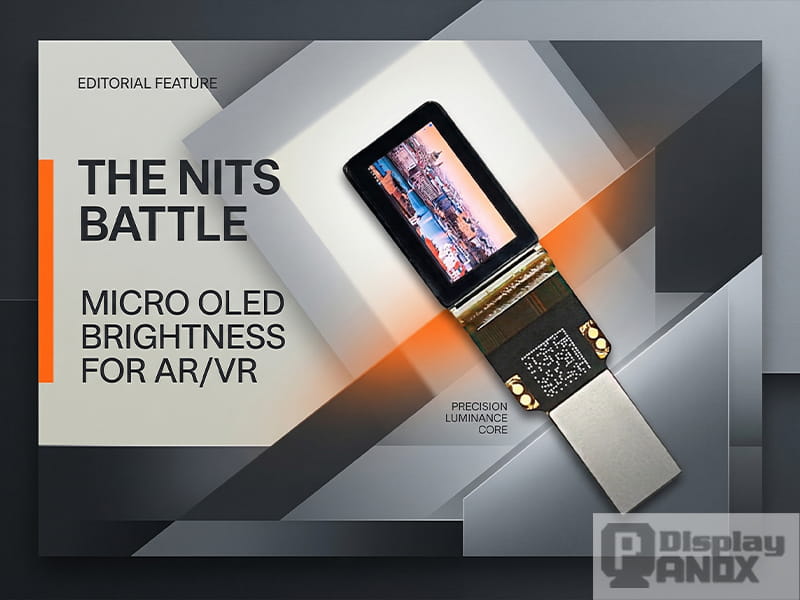
When people compare near-eye displays, brightness is often the first number they notice. But in AR/VR, brightness is not just a spec-sheet competition. It directly affects readability, contrast perception, comfort, optical design, thermal load, and battery life.
That is why the real question is not “Is higher always better?” but rather: How bright does a Micro OLED actually need to be for the intended AR/VR use case?
For many projects, especially those focused on indoor AR, mixed-light environments, compact optics, or power-conscious wearable designs, the 1000–3000 nits range can be more relevant than extreme peak numbers. Modern OLED microdisplays span a wide luminance range in the market: Sony’s current lineup includes models around 1,000 nits, 3,500 nits, 5,000 nits, 6,500 nits, and up to 10,000 nits, depending on panel size and application target. Sony also positions OLED microdisplays for AR/VR, camera EVFs, FPV, medical, and other compact high-resolution systems.
Why brightness matters so much in AR/VR
In a conventional display, the screen replaces the background. In AR, it does not. The virtual image has to remain visible while competing with the real world behind it. That means brightness has to overcome not only ambient light, but also optical losses inside the viewing system. Lumus notes that AR glasses must handle both strong real-world illumination and losses through the lens path, while Oxford Instruments similarly explains that perceived image quality depends on display brightness, combiner efficiency, and lens transparency together.
This is why a Micro OLED panel’s rated nits do not translate one-to-one into what the user finally perceives. The light still has to travel through optics, waveguides, couplers, or other elements before it reaches the eye. In practice, system brightness is always lower than panel brightness, and the efficiency of the optical stack can matter as much as the panel itself.
For VR, the environment is controlled, so panel brightness requirements are usually easier to manage. For transparent AR glasses, the challenge is harder because the digital image must remain legible without overpowering comfort, efficiency, or wearability. Sony’s own positioning reflects this split: some OLED microdisplays are aimed at AR headsets, some at VR headsets, and others at EVF-style applications where brightness needs differ by scenario.
What 1000, 2000, and 3000 nits actually mean
1000 nits: workable for controlled environments
A 1000-nit Micro OLED is not “low” by default. In compact near-eye systems, it can still be useful for applications where ambient light is predictable, the optics are efficient, and the content does not need to fight harsh daylight all day. Sony still offers 1,000-nit OLED microdisplay options in its lineup, which shows that this brightness class remains relevant for certain products rather than being obsolete.
In practical terms, 1000 nits can make sense for:
-
indoor smart glasses
-
EVF-style viewing systems
-
FPV and industrial eyepieces in managed lighting
-
medical or professional near-eye displays used primarily indoors
The strength of this range is not raw punch. It is balance. A design centered around 1000 nits can often prioritize image stability, compactness, and lower system stress instead of chasing maximum output.
2000 nits: a flexible middle ground
Around 2000 nits, Micro OLED becomes more versatile. This level can give designers more headroom for mixed-light conditions, brighter user interfaces, and optics that are not extremely efficient. It also gives more margin for maintaining perceived contrast once real optical losses are taken into account. Since AR brightness is shaped by the whole optical chain, this middle band is often where product teams start to feel they have useful design flexibility without moving into an aggressively high-power system.
This is often a strong range for:
-
indoor/outdoor transitional AR use
-
enterprise smart glasses
-
engineering or maintenance overlays
-
compact consumer XR concepts where battery life still matters
3000 nits: strong for many real products, not just “entry level”
A 3000-nit Micro OLED sits in a strategically interesting zone. It is well above the lower end of current OLED microdisplay offerings, yet still below the highest-brightness AR-focused panels now entering the market. That makes it especially attractive for products that need a better brightness reserve than 1000 nits, but do not want the added pressure that can come with chasing 5000–10000 nits-class output. Current commercial OLED microdisplay offerings show that the market spans from 1,000 nits to 10,000 nits, so 3000 nits belongs in a meaningful middle tier rather than at the bottom.
For many AR/VR projects, 3000 nits can be a smart target because it can support:
-
brighter overlays in mixed indoor lighting
-
more comfortable visibility margin in see-through optics
-
better perceived vividness for UI elements
-
system-level balance across image quality, power, and thermals
In other words, 3000 nits is often not about “winning the brightness race.” It is about reaching a level that is commercially usable and system-friendly.
Is 3000 nits enough for AR glasses?
The honest answer is: often yes, but not for every optical architecture or outdoor scenario.
Lumus says indoor AR may need only a few hundred to around a thousand nits to the eye, while outdoor readability can demand several thousand nits to the eye. That distinction matters, because the panel must start brighter than the final eye-delivered image due to losses in the optical path.
That means whether 3000 nits at the panel is enough depends on factors such as:
-
waveguide or combiner efficiency
-
lens transparency
-
field of view targets
-
ambient light conditions
-
UI color choices and contrast strategy
-
thermal and battery constraints
A well-optimized AR system may achieve good usability from a 1000–3000 nits Micro OLED panel if the optical engine is efficient and the target environment is realistic. But a daylight-first consumer AR glasses design with tougher visibility goals may need more brightness margin or a different system strategy. DigiLens, for example, explicitly markets brightness and efficiency as major waveguide differentiators, and highlights waveguides aimed at both gaming/entertainment use and indoor/outdoor enterprise use.
So the better framing is not “Is 3000 nits universally enough?” It is “Is 3000 nits enough for your optical stack and your use case?”
Why higher brightness is not always the best answer
Brightness sounds simple, but pushing it higher affects the rest of the system.
Sony’s recent ECX350F announcement shows how difficult high brightness becomes when pixels get very small: the company specifically highlights a new OLED structure, microlenses, and semiconductor process improvements to reach 10,000 cd/m² in a compact Full HD 0.44-inch panel for AR glasses. In other words, extreme brightness is not free. It usually requires more advanced process choices and tighter engineering.
At the product level, more brightness can mean:
-
higher power draw
-
more thermal pressure
-
tougher optical management
-
stricter battery-life tradeoffs
-
more demanding integration targets
That is why the best Micro OLED for AR/VR is not automatically the brightest one. In many real products, the winning design is the one that delivers enough brightness while preserving contrast, efficiency, compactness, and comfort.
Brightness vs. contrast, response time, and optical efficiency
Brightness gets attention, but it does not work alone.
Sony lists 100,000:1 contrast and 0.01 ms or less response time as core OLED microdisplay strengths. Those characteristics matter because a bright panel with weak contrast can still look washed out, while a panel with strong contrast can preserve image separation and apparent clarity more effectively in near-eye viewing.
Likewise, optical efficiency can completely change the outcome. Lumus frames AR as a brightness-efficiency problem, and DigiLens repeatedly promotes brightness and efficiency together rather than brightness alone. Oxford Instruments also points out that combiner efficiency and lens transparency materially affect the final visual result.
That is why buyers should never evaluate Micro OLED brightness in isolation. A well-balanced system with:
-
solid panel brightness
-
fast response
-
efficient optics
-
acceptable thermal behavior
can outperform a nominally brighter system that wastes too much light or becomes too power-hungry.
When the 1000–3000 nits range makes the most sense
The 1000–3000 nits range is often especially attractive when the design goal is not headline-chasing brightness, but a practical AR/VR product.
This range tends to fit best when the project values:
-
compact near-eye integration
-
indoor or mixed-light usability
-
power-conscious wearable design
-
strong image quality without overbuilding the light engine
-
commercial feasibility for enterprise, industrial, medical, EVF, and selected consumer XR devices
That alignment is consistent with the broader OLED microdisplay market, where current products still span lower and mid brightness levels for different applications even as the highest-end AR panels push further upward.
For many teams, this is exactly the sweet spot: bright enough to be meaningful, controlled enough to stay efficient.
How to choose the right Micro OLED brightness for your project
If you are selecting a Micro OLED for AR/VR, start with the application, not the biggest number.
Ask:
-
Will the device be used mostly indoors, outdoors, or both?
-
Is it immersive VR, see-through AR, or an EVF-like viewing experience?
-
How efficient is the optical path?
-
How important are battery life and thermal limits?
-
Is the UI content text-heavy, contrast-heavy, or mostly simple icons?
-
Are you optimizing for consumer comfort, enterprise utility, or premium peak performance?
A 3000-nit Micro OLED can be the right answer when you need a display that is clearly stronger than entry-level brightness, yet still realistic for compact, efficient, and manufacturable AR/VR hardware. For many projects, that is not a compromise. It is a well-judged product decision.
Final thoughts
In AR/VR, brightness is a system question, not just a panel question.
A 1000-nit Micro OLED can still work well in controlled or efficiency-focused designs. A 2000-nit Micro OLED offers more headroom for real-world variation. A 3000-nit Micro OLED can be a very practical target for many near-eye products that need stronger visibility without the added burden of ultra-high-brightness architectures.
So how bright does Micro OLED need to be for AR/VR?
For many real devices, especially those balancing image quality, optical efficiency, thermal limits, and wearable comfort, the answer is not “as bright as possible.” The answer is often: bright enough to work beautifully in the intended system.
If you are evaluating a Micro OLED for AR/VR, focusing on the 1000–3000 nits range may be one of the smartest ways to match performance with real product goals.
FAQs
What is a good brightness level for Micro OLED in AR/VR?
There is no single universal answer. For many indoor or controlled-light applications, 1000–3000 nits can be a useful range. For more demanding transparent AR use, the required brightness depends heavily on optical efficiency and ambient light.
Is 1000 nits enough for Micro OLED?
It can be enough for some indoor AR, EVF, FPV, medical, or professional near-eye systems, especially when the optics are efficient and the environment is controlled. Sony still offers 1,000-nit OLED microdisplay products, which suggests the range remains relevant in the market.
Is 3000 nits good for AR glasses?
Yes, 3000 nits can be a strong and practical level for many AR glasses concepts, especially when paired with an efficient optical engine and realistic use-case targets. It may not suit every outdoor-first design, but it is often a solid system-level choice.
Why does AR usually need more brightness than VR?
Because AR content must remain visible on top of the real world, while VR replaces the real-world background entirely. AR therefore has to fight ambient light and optical losses at the same time.
Is panel brightness the same as brightness at the eye?
No. The panel’s rated nits are only the starting point. The final brightness seen by the user depends on the whole optical path, including combiner efficiency, lens transparency, and waveguide losses.
Does higher Micro OLED brightness always mean a better display?
Not always. Contrast, response time, optical efficiency, power consumption, and thermal behavior all matter. Sony’s OLED microdisplay platform emphasizes high contrast and fast response alongside luminance, which shows that overall display quality is multi-dimensional.
Are 5000- to 10000-nit Micro OLED panels already on the market?
Yes. Sony’s current lineup includes OLED microdisplay products rated at 5,000, 6,500, and 10,000 cd/m², showing that very high brightness is already available in some AR/VR-focused configurations.
What should buyers compare besides nits?
Compare contrast, response time, resolution, optical efficiency, lens or waveguide design, thermal limits, and power budget. In AR/VR, those factors often determine real usability just as much as brightness does.
| Panel model | Interface | Type | Size (inch) | Resolution | P.S |
| S032WEM01 | MIPI/RGB | Micro OLED | 0.32 | 800x600 | |
| PMOF039XGAM | RGB | Micro OLED | 0.39 | 1024x768 | Full Color/Monochrome |
| BO039M1920M | MIPI | Micro OLED | 0.39 | 1920x1080 | Highest PPI =5644 |
| EP047M800T | TTL | LCOS | 0.47 | 800x600 | |
| BO049FHPMO | SPI,MIPI | Micro OLED | 0.49 | 1920x1080 | |
| S050M1600M | MIPI | Micro OLED | 0.5 | 1600x1200 | |
| ECX331DB-6 | Mini LVDS | Micro OLED | 0.5 | 1024x768 | |
| S060LDM01 | MIPI | Micro OLED | 0.6 | 1920x1080 | |
| ECX335AF | Mini LVDS | Micro OLED | 0.71 | 1920x1080 | 200 nits brightness version |
| ECX335B | Mini LVDS | Micro OLED | 0.71 | 1920x1080 | 500 nits brightness version |
| ECX335SN | Mini LVDS | Micro OLED | 0.71 | 1920x1080 | 3000 nits brightness version |
| BO071M1920M | MIPI | Micro OLED | 0.71 | 1920x1080 | |
| S072WCM04 | MIPI | Micro OLED | 0.72 | 1920x1080 | |
| S103WAM01 | MIPI | Micro OLED | 1.03 | 2560x2560 |