



Virtual reality has reached a point where display quality is no longer a secondary spec. It directly shapes immersion, comfort, readability, motion clarity, and even headset design. For buyers, developers, and hardware teams evaluating next-generation VR hardware, one question is becoming increasingly important: Micro OLED vs traditional OLED in VR—what actually performs better?
The short answer is that both are self-emissive technologies and both can produce deep blacks, strong contrast, and fast response. But in real VR use, they do not solve the same problems in the same way. Traditional OLED helped define early premium VR. Micro OLED is increasingly becoming the display choice for smaller, sharper, more premium near-eye systems because it pushes pixel density and optical integration much further.
If your goal is to understand which display is better for modern VR headsets, this guide breaks down the differences in image sharpness, screen door effect, brightness behavior, headset weight, optics compatibility, and practical product positioning in 2026.
If your next product is focused on immersive VR performance, a high-quality display module is one of the most important factors in delivering a sharper and more convincing visual experience.
What Is the Difference Between Micro OLED and Traditional OLED in VR?
Traditional OLED in VR usually refers to larger OLED panels built on conventional backplanes such as LTPS and used in headsets like the original HTC Vive and PlayStation VR2. These panels can still deliver excellent blacks, vivid color, and low-latency response, which is why OLED remained attractive for immersive gaming headsets for years. Sony’s PS VR2 uses OLED panels at 2000 × 2040 per eye and 90Hz to 120Hz refresh rates, while the original HTC Vive used dual AMOLED displays at 1080 × 1200 per eye and 90Hz.
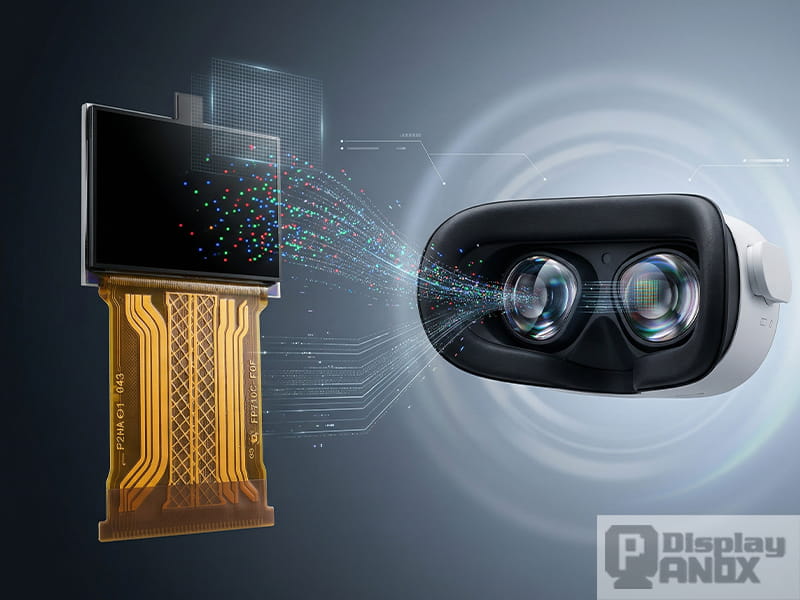
Micro OLED, also called OLED microdisplay or OLED-on-silicon, is built on a silicon backplane instead of the larger-panel architecture used by typical OLED displays. That change is not just a manufacturing detail. It is the reason Micro OLED can achieve extremely high pixel density in a very small display size, making it especially suitable for compact near-eye optics. Sony states that its OLED microdisplays reach about 4,000 ppi and are increasingly adopted where ultra-compact, ultra-high-resolution performance cannot be met by LTPS OLED.
In simple terms, traditional OLED made VR look better than LCD in many early headsets. Micro OLED is helping premium VR look dramatically sharper while also enabling smaller optical engines and lighter headset designs. Apple Vision Pro and Bigscreen Beyond are two of the clearest signals of this shift, both using Micro OLED-based display systems in high-end headset designs.
Why Micro OLED Matters More in Modern VR Headsets
The biggest reason is pixel density. In a VR headset, the screen sits extremely close to the eye and is magnified through optics. That means panel limitations become easy to see. If pixel density is not high enough, users notice aliasing, jagged edges, text softness, and the classic screen door effect. Micro OLED is much better positioned to reduce these issues because it can pack far more pixels into a much smaller area than traditional OLED. Sony explicitly highlights this as one of the main reasons OLED microdisplays are increasingly used for AR and VR.
This has direct user-facing benefits. Menus look cleaner, small UI text becomes more legible, distant objects hold together better, and scenes feel less like they are being viewed through a visible pixel grid. That is one reason premium VR brands continue to move toward Micro OLED for image-focused products. Bigscreen Beyond, for example, uses OLED microdisplays at 2560 × 2560 per eye in a very compact headset format.
Micro OLED also fits the broader 2026 trend toward slimmer optics and lighter headsets. Smaller displays pair naturally with compact optical stacks, especially pancake optics, which are now widely associated with premium mixed reality and high-end VR design. That combination matters because visual quality in VR is not just about panel specs. It is also about how much bulk, weight, and optical compromise a headset needs in order to deliver that image.
Image Sharpness and Resolution: Which Technology Looks Better in VR?
When people ask which display is better for VR, what they usually mean is: which one looks sharper?
In most premium near-eye scenarios, Micro OLED wins this comparison. The reason is not simply resolution on paper. It is resolution combined with extremely high pixel density. Apple lists Vision Pro’s Micro OLED system at 23 million pixels with 7.5-micron pixel pitch, while Sony describes OLED microdisplays as reaching around 4,000 ppi. That kind of density is exactly what near-eye displays need when the user is staring through magnifying optics.
Traditional OLED can still look very good, especially in gaming-focused headsets with solid optics and strong rendering pipelines. PS VR2 is a strong example, delivering OLED visuals at 2000 × 2040 per eye with up to 120Hz refresh. But compared with Micro OLED-based systems, larger traditional OLED panels generally do not reach the same pixel density, which makes them more vulnerable to visible pixel structure and lower text clarity in close-view VR scenes.
For reading interfaces, productivity-style spatial apps, simulation dashboards, or premium cinematic VR, Micro OLED has the stronger performance story. For many users, that difference is immediately visible the moment they look at fine text or distant detail.
Contrast, Black Levels, and Color: Is Traditional OLED Still Competitive?
Yes. This is where traditional OLED remains highly competitive.
Both Micro OLED and traditional OLED are self-emissive technologies, so both can switch individual pixels off completely and produce excellent black levels. Sony describes OLED microdisplays as offering high contrast ratio, wide color gamut, and fast response, with native contrast cited at 100,000:1 and response speed at 0.01 ms or less. Traditional OLED panels in VR also benefit from the same self-emissive foundation, which is why OLED has long been favored for dark scenes, space environments, horror titles, and high-contrast gaming.
This means the comparison is not really “good blacks versus bad blacks.” It is more nuanced. Traditional OLED still offers the core OLED strengths that VR users love: true blacks, rich perceived contrast, vivid imagery, and fast pixel response. Micro OLED keeps those strengths while adding a major gain in pixel density and miniaturization.
So if your main question is purely about contrast and black depth, traditional OLED is not obsolete. But if you care about contrast plus finer pixel structure plus compact optical integration, Micro OLED is the more forward-looking solution for premium VR.
Brightness in VR: Is Micro OLED Always Better?
Brightness is where the conversation gets more interesting.
Many people assume higher brightness always means a better VR display. In reality, usable brightness in a headset depends on the full optical path, including lens efficiency, panel drive strategy, persistence behavior, and thermal limits. Sony states that high luminance is an important part of expanding OLED microdisplay use in AR and VR, and its recent high-luminance technology is designed to improve light emission efficiency by 2.2 times versus its conventional product.
Recent industry development also shows how fast Micro OLED is evolving on this front. Samsung Display said in 2025 that it would showcase an RGB OLED-on-silicon microdisplay for XR, and third-party reporting around those 2025 demonstrations described 5,000 PPI-class panels and significant brightness gains for next-generation headsets.
That said, traditional OLED can still be very effective in VR, especially in gaming headsets designed around larger panels and different optical tradeoffs. So the real takeaway is this: Micro OLED is no longer just the sharper technology. It is also becoming increasingly competitive on brightness and efficiency, which strengthens its position in premium VR and mixed reality design.
For demanding near-eye applications, panels with High Luminance can help improve visual clarity and support a brighter, more impactful viewing experience.
Screen Door Effect and Visual Comfort: Which One Feels More Immersive?
If you care about visual immersion, this is one of the most important sections in the entire comparison.
The screen door effect is caused by visible spacing or structure between pixels when a display is viewed up close through magnifying optics. It breaks immersion and makes the image feel less natural. Because Micro OLED can achieve much higher pixel density than traditional OLED, it is far better suited to minimizing this problem in VR.
This improvement affects more than just image beauty. It impacts comfort. Cleaner pixel structure means less distraction, less visual roughness around edges, and better readability in UI-heavy environments. In headsets built for premium visual fidelity, these details matter a lot. Recent hands-on reporting on Micro OLED VR headsets has highlighted exactly these strengths, including better contrast, sharper perceived image quality, and reduced visible screen door effect.
Traditional OLED can still provide a compelling, immersive image, particularly in gaming where motion, HDR feel, and contrast dominate the experience. But for users who are sensitive to pixel structure, lens magnification artifacts, or soft text, Micro OLED is usually the stronger choice.
Headset Size, Weight, and Optics: Why Micro OLED Has a Design Advantage
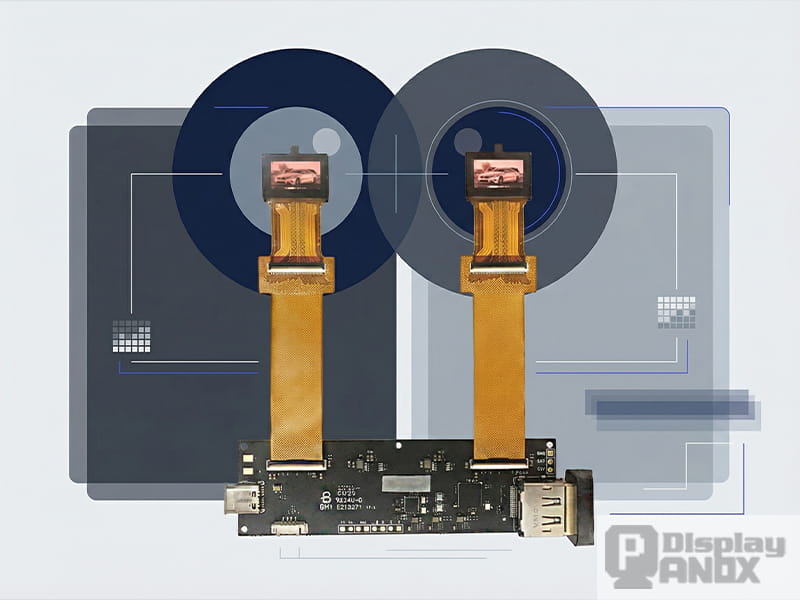
One of the biggest advantages of Micro OLED is not visible in a spec table. It shows up in the physical product.
Because Micro OLED panels are tiny and extremely dense, they can be used in more compact optical systems. This helps manufacturers build smaller and lighter headsets without giving up image quality. That is one reason modern premium devices increasingly connect Micro OLED with compact pancake-style optical architectures. Bigscreen Beyond and Apple Vision Pro are strong market examples of this direction.
Traditional OLED VR headsets have usually relied on larger display panels. That can still work well, but it often leads to bulkier optical layouts and fewer options for aggressive miniaturization. In other words, traditional OLED can still deliver strong VR image quality, but Micro OLED usually gives engineers more freedom when the target is a lighter, more compact, more premium headset.
For the end user, this design advantage matters. Lower front-heavy weight, smaller form factor, and better balance can improve long-session comfort just as much as raw panel quality does.
Refresh Rate and Motion Performance in VR
Refresh rate alone does not decide motion quality, but it still matters a lot in VR.
Traditional OLED headsets have proven they can deliver strong motion performance. The original HTC Vive ran at 90Hz, and PS VR2 supports 90Hz and 120Hz. Those are meaningful refresh targets for immersive VR gaming.
Micro OLED is also highly capable here. Apple Vision Pro supports refresh rates up to 120Hz, and Sony lists OLED microdisplay response at 0.01 ms or less. That combination of fast response and improving refresh performance is important because it helps support motion clarity, low persistence strategies, and reduced blur in premium near-eye systems.
So this is not a category where traditional OLED automatically loses. But Micro OLED is clearly no longer behind in the motion conversation, especially as premium XR systems target both high sharpness and smoother viewing.
Cost and Commercial Reality: Why Traditional OLED Still Exists in VR
If Micro OLED is so strong, why does traditional OLED remain relevant?
The answer is cost, product positioning, and design goals. Traditional OLED remains attractive for some VR products because it can still deliver excellent contrast, strong refresh rates, and proven gaming performance without requiring the same level of optical miniaturization or ultra-high pixel density. For some products, especially when price sensitivity is higher, this still makes sense.
Micro OLED, meanwhile, is typically associated with more premium positioning. It is especially attractive when a headset is targeting thinner industrial design, better text clarity, premium viewing quality, and next-generation optics. That is why it is increasingly linked with flagship or enthusiast-grade hardware rather than purely mass-market cost-first devices.
For buyers and product teams, this means the better question is not simply “Which is superior?” It is “Which display architecture matches the headset class we want to build?”
Which Display Technology Is Better for VR in 2026?
For premium VR and mixed reality, Micro OLED is increasingly the better answer.
It offers the core OLED strengths people already value—deep blacks, strong contrast, vivid image quality, and fast response—while adding the two things that modern VR needs most: much higher pixel density and better compatibility with compact optical design. That combination helps reduce screen door effect, improves text and fine-detail clarity, supports lighter headset architectures, and aligns well with the direction of high-end spatial computing hardware.
Traditional OLED is still absolutely relevant in VR. It remains a strong technology for immersive gaming experiences and can still deliver beautiful visuals. But when the target is premium near-eye performance, compact form factor, and sharper visual fidelity, Micro OLED has the stronger long-term position.
That is exactly why so many conversations around the best VR display technology in 2026 now center on Micro OLED.
Final Thoughts
The future of VR is not just about more pixels. It is about better pixels in the right optical system.
Traditional OLED helped bring true blacks and immersive contrast to VR. Micro OLED builds on that foundation and pushes the format further for the kinds of headsets users increasingly want: smaller, sharper, lighter, and more premium. For brands, developers, and buyers evaluating the next step in VR hardware, Micro OLED is no longer a niche display option. It is one of the most important display technologies shaping high-end VR today.
If your project is focused on near-eye image quality, compact headset design, and premium visual immersion, Micro OLED deserves serious attention.
FAQs
1. Is Micro OLED better than traditional OLED for VR?
For most premium VR use cases, yes. Micro OLED usually performs better where pixel density, text clarity, reduced screen door effect, and compact headset design matter most. Traditional OLED still performs well in contrast and immersive gaming visuals, but Micro OLED is generally better suited to next-generation premium near-eye VR.
2. Why does Micro OLED look sharper in VR?
Because it is built on a silicon backplane and can achieve much higher pixel density in a much smaller display area. That makes the pixel structure less visible when viewed through magnifying optics, which improves detail, readability, and overall immersion.
3. Does traditional OLED still make sense for VR headsets?
Yes. Traditional OLED still makes sense for VR headsets that prioritize strong contrast, proven gaming performance, and a different cost-performance balance. It is not outdated—it is just less ideal than Micro OLED for the newest premium compact headset designs.
4. Is Micro OLED good for pancake optics in VR?
Yes. Micro OLED is especially well matched to compact optical architectures, including pancake-style systems, because the displays are very small and very dense. This helps support lighter and slimmer headset designs without giving up image sharpness.
5. What is the biggest advantage of Micro OLED in VR?
The biggest advantage is the combination of OLED-level contrast with ultra-high pixel density. In practice, that means sharper visuals, cleaner text, less visible pixel structure, and better fit for premium lightweight VR hardware.
6. Is Micro OLED the future of VR displays?
For premium near-eye VR and mixed reality, it is one of the strongest display directions today. Market adoption in high-end devices and ongoing improvements in brightness, efficiency, and panel performance all point to a very strong future for Micro OLED in VR.
| Panel model | Interface | Type | Size (inch) | Resolution | P.S |
| S032WEM01 | MIPI/RGB | Micro OLED | 0.32 | 800x600 | |
| PMOF039XGAM | RGB | Micro OLED | 0.39 | 1024x768 | Full Color/Monochrome |
| BO039M1920M | MIPI | Micro OLED | 0.39 | 1920x1080 | Highest PPI =5644 |
| EP047M800T | TTL | LCOS | 0.47 | 800x600 | |
| BO049FHPMO | SPI,MIPI | Micro OLED | 0.49 | 1920x1080 | |
| S050M1600M | MIPI | Micro OLED | 0.5 | 1600x1200 | |
| ECX331DB-6 | Mini LVDS | Micro OLED | 0.5 | 1024x768 | |
| S060LDM01 | MIPI | Micro OLED | 0.6 | 1920x1080 | |
| ECX335AF | Mini LVDS | Micro OLED | 0.71 | 1920x1080 | 200 nits brightness version |
| ECX335B | Mini LVDS | Micro OLED | 0.71 | 1920x1080 | 500 nits brightness version |
| ECX335SN | Mini LVDS | Micro OLED | 0.71 | 1920x1080 | 3000 nits brightness version |
| BO071M1920M | MIPI | Micro OLED | 0.71 | 1920x1080 | |
| S072WCM04 | MIPI | Micro OLED | 0.72 | 1920x1080 | |
| S103WAM01 | MIPI | Micro OLED | 1.03 | 2560x2560 |