



Tandem OLED is becoming one of the most important display keywords in 2026, and for good reason. As brands push for thinner devices, higher sustained brightness, better HDR, and longer panel life, conventional single-stack OLED is no longer the only answer. By stacking multiple emissive layers inside one panel, Tandem OLED helps solve several of OLED’s long-standing tradeoffs at once: brightness, efficiency, and durability.
This is no longer just a lab concept or a niche automotive solution. Apple’s iPad Pro lineup uses tandem OLED for its Ultra Retina XDR display, LG Display has moved Tandem OLED into laptop mass production, and Samsung Display is now branding its latest multi-layer QD-OLED architecture as Penta Tandem for premium monitors and TVs. That makes Tandem OLED one of the clearest display trends to watch across tablets, laptops, automotive screens, monitors, and other high-end applications in 2026.
What Is Tandem OLED?
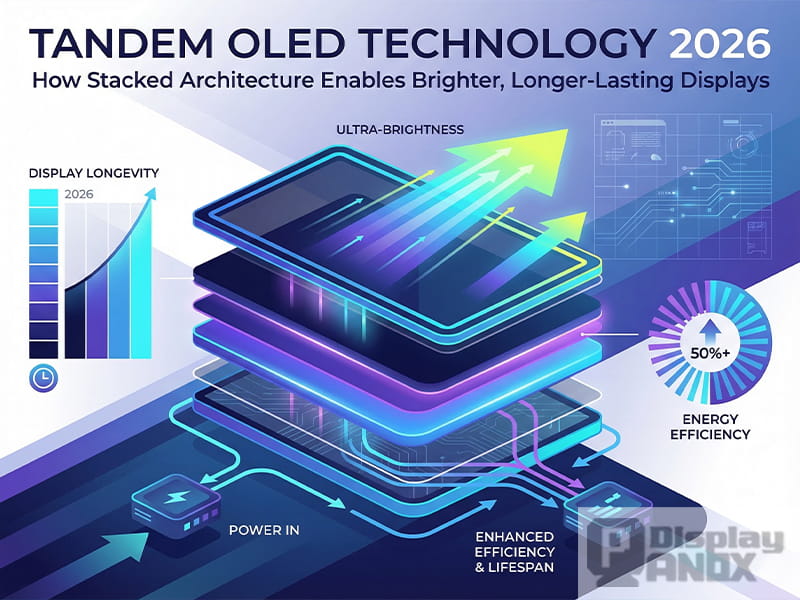
Tandem OLED is a stacked OLED architecture that places two or more light-emitting units vertically within a single display structure instead of relying on a single emissive stack. LG Display describes Tandem OLED as stacking two RGB emissive layers in one panel, while Apple explains its iPad Pro implementation as a Tandem OLED design using two OLED panels to achieve very high brightness on a large display.
In simple terms, a Tandem OLED panel spreads the light-generation workload across multiple layers. That means each layer can operate with less stress to reach the same target brightness, or the combined structure can deliver much higher luminance than a traditional OLED panel. This is the core reason Tandem OLED is now strongly associated with keywords such as brighter OLED display, longer OLED lifespan, high efficiency OLED, and OLED for high-brightness devices.
Why Is Tandem OLED Important in 2026?
In 2026, the display market is under pressure from several directions at once. Tablet and laptop buyers want OLED image quality without worrying about panel aging during long daily use. Automotive platforms need stable performance under strong ambient light and severe temperatures. Premium monitors and TVs are chasing higher peak brightness, higher pixel density, and stronger HDR certification. Tandem OLED directly addresses all three.
Apple’s iPad Pro helped bring tandem OLED into mainstream awareness by pairing the technology with 1,000 nits of full-screen brightness, 1,600 nits peak HDR brightness, and a 2,000,000:1 contrast ratio. At the same time, LG Display positioned Tandem OLED for laptops by emphasizing longer life, higher brightness, and reduced power draw, while Samsung Display pushed multi-layer OLED further in QD-OLED for premium TVs and monitors in 2026.
How Does Stacked OLED Architecture Work?
The logic behind stacked OLED architecture is straightforward: more emissive units share the job. In a conventional OLED panel, one emissive stack has to generate the full required luminance. In a Tandem OLED design, two or more stacks contribute to total light output, which improves luminous efficiency and lowers the electrical and thermal burden on any single layer. Samsung Display states this directly in its 2026 Penta Tandem release, noting that adding organic material layers improves luminous efficiency, making it possible to reach higher brightness at the same power level or maintain brightness with lower power consumption.
That is why Tandem OLED is frequently discussed together with lower current density, better durability, and longer operational lifetime. When each emissive unit is pushed less aggressively, degradation can be reduced compared with a single-stack design targeting the same brightness. This is one of the biggest reasons Tandem OLED is gaining traction in devices that stay on for long periods, such as tablets, notebooks, and automotive displays.
Tandem OLED vs Traditional OLED: What Is the Real Difference?
The real-world difference is not just “more layers.” It is a different performance balance.
A traditional OLED panel is often easier and cheaper to manufacture, and it already delivers excellent contrast, fast response, and thin form factors. But once the application demands very high brightness, long operating hours, and stronger lifetime performance, the weaknesses of single-stack OLED become harder to ignore. That is where Tandem OLED gains value.
Compared with conventional OLED, LG Display says Tandem OLED improves lifespan and brightness while reducing power consumption. For laptop applications, LG Display’s first mass-produced Tandem OLED panel was promoted as offering double the lifespan, triple the brightness, and up to 40% lower power consumption than conventional single-layer OLED.
For buyers, that means the Tandem OLED vs OLED conversation is really about use case. If the target product needs premium HDR, better sustained luminance, longer-life performance, and lower power at a given brightness level, Tandem OLED becomes much more attractive than standard OLED.
Why Is Tandem OLED Better for Tablets and Laptops?
This is one of the hottest search angles around Tandem OLED right now, especially after Apple’s iPad Pro and LG Display’s laptop push.
Tablet and laptop panels are used for longer sessions than many smartphone displays. They also need higher full-screen brightness for productivity, creative work, and HDR viewing. Apple’s iPad Pro is a strong example: its Ultra Retina XDR display uses Tandem OLED to deliver 1,000 nits full-screen brightness and 1,600 nits peak HDR brightness, while Apple also emphasizes color accuracy, wide color support, and high contrast.
LG Display took the same logic into the notebook category. In 2024 it announced mass production of the industry’s first Tandem OLED for laptops, highlighting double lifespan, triple brightness, and up to 40% lower power consumption. In practice, this matters because laptop buyers want OLED image quality without sacrificing battery life or long-term reliability.
That is why queries like Tandem OLED laptop, Tandem OLED iPad Pro, and Tandem OLED vs OLED for productivity are likely to stay relevant through 2026. The technology is especially compelling anywhere OLED is expected to work hard for many hours a day.
Why Is Tandem OLED a Strong Fit for Automotive Displays?
Automotive OLED is one of the clearest long-term use cases for Tandem OLED because vehicles are brutal environments for displays. The panel must remain visible in strong ambient light, survive wide temperature swings, and operate reliably for years. LG Display specifically says Tandem OLED maintains stable performance even under extreme temperatures and strong ambient light, and its automotive materials describe operation in harsh conditions ranging from -40°C to 85°C.
That makes Tandem OLED attractive for digital cockpits, center information displays, passenger entertainment, pillar-to-pillar layouts, and other premium in-vehicle interfaces. Faster response, strong contrast, flexibility in shape, and better durability all matter in this environment, but the big differentiator is that Tandem OLED helps OLED adapt to automotive-grade performance expectations more effectively than a basic single-stack structure.
Can Tandem OLED Also Improve Monitors and TVs?
Yes, and 2026 is making that increasingly visible.
Samsung Display’s QD-OLED Penta Tandem branding is a major signal. In February 2026, Samsung Display said its five-layer organic light-emitting structure improves luminous efficiency by 1.3 times and extends lifespan by 2 times versus its previous four-layer QD-OLED structure. It also linked the architecture to higher brightness and premium monitor performance, including 1,300 nits peak brightness for monitors and 4,500 nits for TVs under specified test conditions.
This matters because monitor and TV buyers are increasingly comparing OLED not just on black levels, but on sustained HDR performance, gaming brightness, certification levels, and panel longevity. In other words, the industry is no longer asking only whether OLED looks good. It is asking how OLED can stay bright, efficient, and durable enough for more demanding premium segments. Multi-layer OLED structures are becoming one of the main answers.
Does Tandem OLED Reduce Burn-In Risk?
It is more accurate to say Tandem OLED can help improve OLED durability and lifetime rather than claiming it completely eliminates burn-in. Because the emissive workload is shared across multiple layers, the architecture can reduce stress on each layer and help maintain performance longer. That is one reason manufacturers position Tandem OLED as a longer-life solution for devices with heavier usage patterns.
However, Tandem OLED is still OLED. Image retention and differential aging do not disappear simply because the structure is stacked. Final burn-in behavior still depends on materials, compensation algorithms, brightness management, UI design, and user behavior. For buyers and product teams, the practical takeaway is that Tandem OLED is a meaningful improvement in durability, but it should not be marketed as a magical cure-all.
Why Is Tandem OLED More Expensive?
The performance advantages come with manufacturing complexity. A Tandem OLED panel needs a more advanced stack design, tighter process control, more demanding materials optimization, and stronger integration expertise. Samsung Display explicitly notes that multi-layer organic light-emitting structure is not just about adding layers; it requires deep expertise in material selection and thickness optimization.
That is why Tandem OLED is currently concentrated in premium products and high-value applications. But if 2024 and 2025 were the years of breakout commercialization, 2026 looks more like the year the market begins treating Tandem OLED as a serious platform direction rather than a specialty upgrade. Apple, LG Display, and Samsung Display have all reinforced that shift from different parts of the market.
What Does Tandem OLED Mean for Display Buyers in 2026?
For OEMs, product managers, and sourcing teams, Tandem OLED should be viewed less as a buzzword and more as a selection filter.
If your product prioritizes extreme thinness at the lowest possible cost, a conventional OLED or even LCD option may still make more sense. But if your project requires higher brightness, better power efficiency at a given luminance, longer service life, or more confidence in long-duration use, Tandem OLED deserves serious attention. That is especially true for premium tablets, laptops, automotive HMIs, and next-generation monitors.
In practical sourcing terms, the key questions are no longer just panel size and resolution. Buyers should also ask about stack structure, target brightness, full-screen luminance behavior, lifetime strategy, thermal constraints, and whether the application truly benefits from a stacked OLED architecture. In 2026, that is where better display decisions are being made.
Final Thoughts
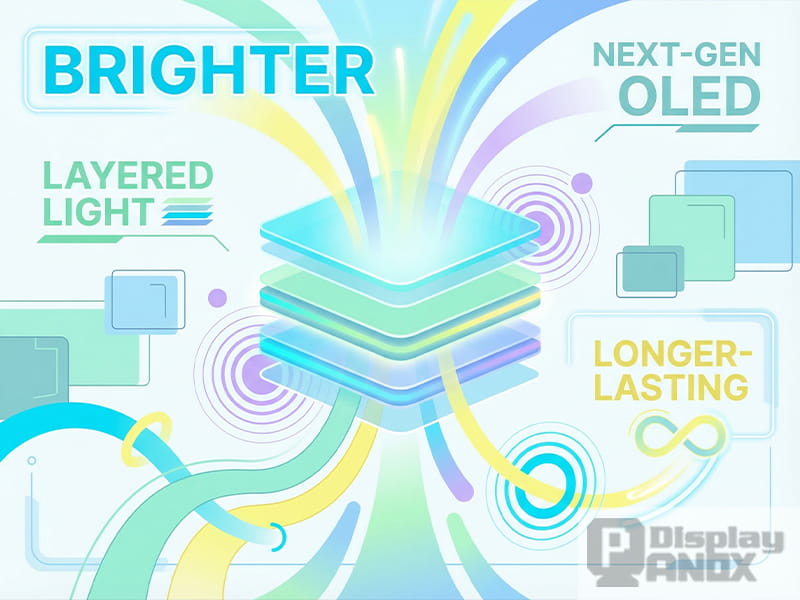
Tandem OLED technology matters in 2026 because it helps OLED move into more demanding roles without giving up its core strengths. By stacking emissive layers, manufacturers can push brightness higher, improve efficiency, and extend display life in ways that conventional single-stack OLED struggles to match. That is why Tandem OLED is now showing up in premium tablets, high-performance laptops, advanced automotive displays, and next-generation QD-OLED monitors and TVs.
For brands building premium products, Tandem OLED is not just a specification detail. It is increasingly a strategic display choice. And as the market keeps demanding brighter, longer-lasting, and more power-efficient screens, stacked OLED architecture is likely to become even more central to the next wave of high-end display design.
Learn more:Tandem OLED Technology Overview
FAQs
What is Tandem OLED technology?
Tandem OLED is a stacked OLED architecture that uses two or more emissive layers in one panel to improve brightness, efficiency, and lifetime compared with traditional single-stack OLED.
Is Tandem OLED better than normal OLED?
For applications that need higher brightness, longer life, and lower power at the same brightness level, Tandem OLED is generally better than normal OLED. For cost-sensitive products, conventional OLED may still be the better fit.
Why does Tandem OLED last longer?
Because the light-generation workload is distributed across multiple emissive layers, each layer can operate under less stress, which helps improve durability and operational lifetime.
Does Tandem OLED use less power?
It can. Manufacturers including LG Display and Samsung Display say multi-layer OLED structures can either achieve higher brightness at the same power level or maintain the same brightness with lower power consumption.
Which products use Tandem OLED in 2026?
Notable examples include Apple’s iPad Pro with Ultra Retina XDR, LG Display’s Tandem OLED laptop panels, and Samsung Display’s QD-OLED Penta Tandem technology for premium monitors and TVs.
Is Tandem OLED only for tablets?
No. In 2026, Tandem OLED is relevant to tablets, laptops, automotive displays, premium monitors, and TVs. It is especially valuable in products that need high brightness and long service life.
Is Tandem OLED good for automotive displays?
Yes. Tandem OLED is well suited to automotive use because it helps improve brightness, durability, and stability under strong ambient light and harsh temperatures.
Does Tandem OLED eliminate burn-in?
No. It can improve durability and help reduce stress on the OLED materials, but it does not completely eliminate burn-in risk. Final performance still depends on materials, driving methods, and usage conditions.
Looking for the right OLED display for your application? Explore our solutions here.