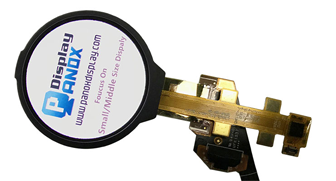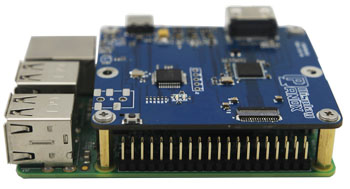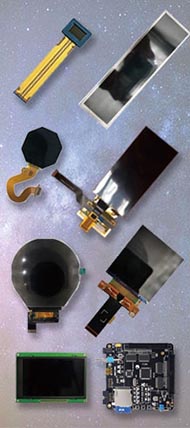





OLEDoS means OLED on silicon. It is another name for silicon-substrate OLED, also known as Micro OLED. In essence, OLEDoS is a type of microdisplay that combines integrated circuit technology with OLED display technology by using a single-crystal silicon wafer as the backplane.
1.Definition and Core Concept
An OLEDoS microdisplay is a very small, high-resolution screen in which the driving circuits are integrated directly onto a silicon substrate, and an organic light-emitting diode (OLED) layer is deposited on top. It delivers clear, vivid images in an extremely compact form factor.
You can think of an OLEDoS microdisplay as a “compressed” display: with the light-emitting layer at the core, more than a dozen functional layers made of different materials are stacked into a single organic emitting film. This film is only about one-tenth the thickness of a human hair. As a result, OLEDoS offers high integration, low power consumption, small size and light weight.
Compared with everyday displays such as smartphone and TV screens, an OLEDoS microdisplay is:
Smaller and lighter
More power-efficient
Capable of much higher pixel density
These characteristics make OLEDoS a core component in near-eye display systems.
2.Technology Characteristics
OLEDoS leverages the combination of:
Single-crystal silicon for the backplane and driving circuits
OLED as the light-emitting element
This architecture allows OLEDoS to achieve:
Full-color display
High resolution, up to and above 1920 × 1080 and 4K levels
Average brightness exceeding 1000 nits in near-eye AR applications
High contrast and fast response times
Because the driving electronics are integrated on the silicon substrate, OLEDoS microdisplays can offer compact designs with high reliability and low power consumption.
3. Key Advantages
Compared with traditional display technologies such as LCD, OLEDoS provides several advantages:
High pixel density and fine image detail
High brightness and contrast, suitable for bright and complex environments
Thin, lightweight modules that support comfortable wearable designs
Low power consumption, helping extend device battery life
High refresh rates and rapid response
Good performance across wide temperature ranges and under vibration or shock
These strengths make OLEDoS well-suited for both consumer and professional applications, including use in extreme operating conditions.
4. Main Application Scenarios
4.1 AR/VR and Metaverse Devices
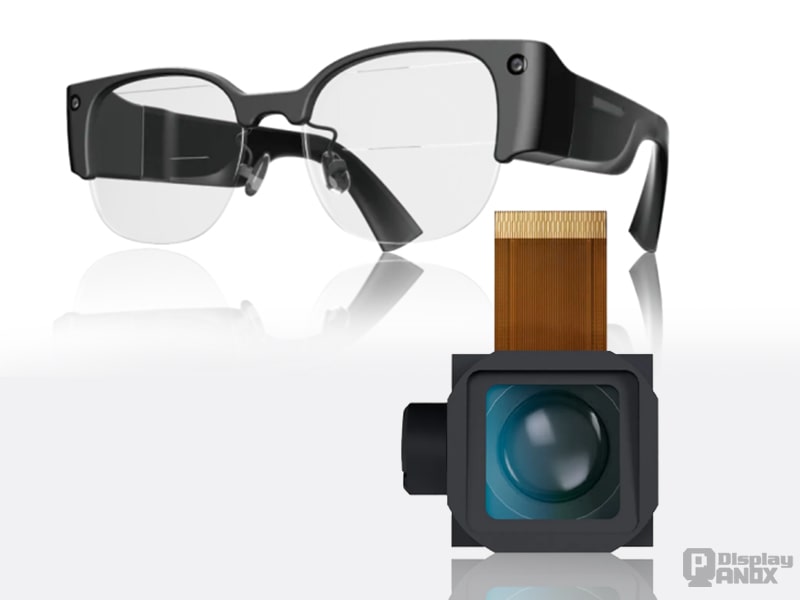
In AR glasses and VR headsets, OLEDoS microdisplays are used as the primary near-eye screens. A microdisplay roughly the size of half a thumbnail can, when integrated into AR eyewear, bring a full virtual world into the user’s field of view.
With resolutions of 1920 × 1080 and above, average brightness over 1000 nits and high contrast, OLEDoS meets users’ expectations for high-definition and immersive visuals. Its thinness and low weight help AR and VR devices achieve lightweight designs and improve comfort during extended use. Low power consumption further supports longer battery life.
For gaming and entertainment, AR glasses and VR headsets powered by OLEDoS can seamlessly blend virtual and real content, enabling highly immersive experiences.
4.2 Automotive Head-Up Display (HUD)
In consumer electronics, automotive head-up displays are one of the key application areas for OLEDoS. Originally developed for fighter jets, HUD systems allow critical information to be projected into the pilot’s forward view, eliminating the need to look down at instruments.
In vehicles, HUD systems using OLEDoS microdisplays can,
Provide clearer, more dynamic projected images
Support intelligent driving visualization
Project speed, mileage and other driving data onto the windshield
This enhances driver focus and improves driving safety by keeping key information within the line of sight.
4.3 Digital Camera Electronic Viewfinders (EVF)
OLEDoS microdisplays are widely used in electronic viewfinders of digital cameras. Compared with traditional LCD viewfinders, OLEDoS-based EVFs offer:
Higher contrast
Better color reproduction at low brightness
Smaller size and lower power consumption
For photographers, this means clearer, more accurate framing and image preview in a compact and efficient viewfinder.
4.4 Industrial and Medical Equipment
In industrial and medical fields, OLEDoS microdisplays can be integrated into various vision and imaging systems:
In industry, OLEDoS combined with infrared detectors can form infrared thermal imaging instruments, providing clear thermal images for inspection and monitoring.
In medicine, OLEDoS used in endoscopic systems helps doctors more accurately locate lesions and improve diagnostic precision.
Head-mounted or integrated medical imaging equipment using OLEDoS can provide higher-quality visualization to support accurate diagnosis.
4.5 Night Vision and Observation Equipment
Thanks to low power consumption, wide operating temperature range, strong vibration resistance, high refresh rate and high resolution, OLEDoS microdisplays also perform well in extreme environments. They can be used in:
Infrared night-vision goggles
Electronic sights and aiming devices
Other observation and targeting systems
In these scenarios, OLEDoS helps users observe and identify targets more clearly in low-light or harsh conditions.
5. About Hong Kong Panox Electronics Co., Ltd.
Hong Kong Panox Electronics Co., Ltd. is a national high-tech enterprise focused on providing microdisplay products and complete solutions. The company specializes in advanced OLEDoS chip design and high-brightness OLEDoS device development.
Its core products are OLEDoS microdisplays and modules. Panox has developed a product range spanning:
Sizes from 0.2 inches to 1.2 inches
Resolutions from 640 × 480 up to 3840 × 2160
Color brightness up to 6000 nits
These OLEDoS microdisplay products are widely used in night-vision observation, helmet-mounted displays, digital sights, AR/VR, EVF, FPV and other scenarios. Panox also provides customized OLEDoS-based solutions for industrial, education, medical and security applications.