






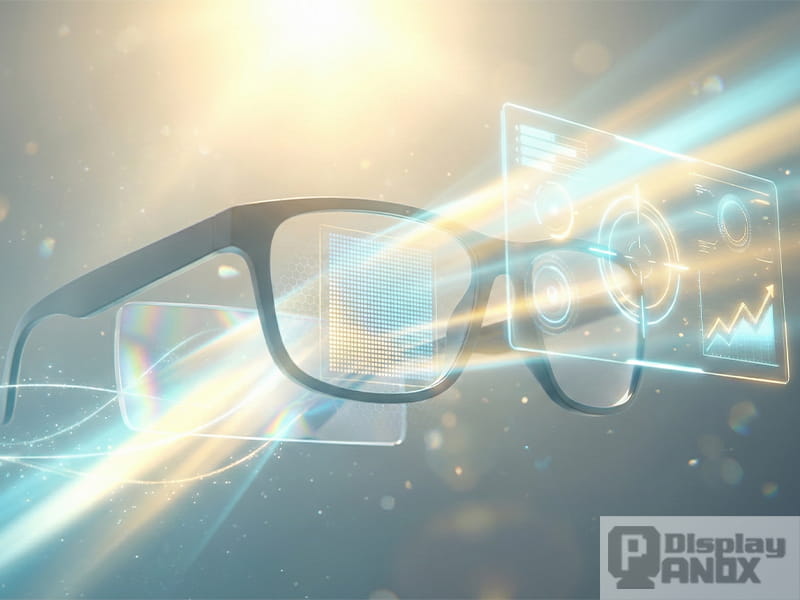
In the rapidly evolving world of Augmented Reality (AR), hardware specifications are often reduced to a numbers game. However, when manufacturers and optical engineers emphasize the need for 3,000 nits, it is not merely a marketing vanity metric. It is a fundamental requirement for survival in the real world.
Unlike Virtual Reality (VR), which operates in the controlled darkness of an enclosed headset, AR glasses must compete with the most powerful light source in our solar system: the sun. For AR to transition from an indoor novelty to a functional, all-day wearable device, display brightness is the single most critical factor. This article explores why 3,000 nits has become the industry’s new gold standard and how modern MicroOLED technology achieves this luminance while maintaining exceptional color fidelity.
Looking for a AR-ready microdisplay? Browse our AR display selection.
The Physics of Visibility: The Battle Against Ambient Light
To understand the obsession with brightness, we must first understand the environment in which AR glasses operate. The human eye perceives brightness logarithmically, and the contrast between the digital overlay and the physical world determines whether an image is legible or invisible.
The Contrast Ratio Challenge
In a typical indoor office environment, ambient light measures between 300 and 500 nits. In this setting, an AR display delivering 500 nits to the eye appears crisp and vibrant. However, the moment a user steps outside, the physics change drastically.
-
Overcast Day: Ambient brightness jumps to 2,000–5,000 nits.
-
Sunny Day: Direct sunlight can exceed 10,000 to 50,000 nits.
If an AR display cannot generate enough luminance to compete with this background, the projected image becomes "ghosted"—semi-transparent and washed out. To maintain a contrast ratio that allows for reading text or viewing complex UI elements, the display brightness does not need to match the sun, but it must be significant enough to stand out against it. 3,000 nits is widely regarded as the "sweet spot" for high-end consumer AR. It provides sufficient luminance to ensure visibility in bright outdoor conditions without inducing the excessive heat and power consumption associated with higher, industrial-grade targets.
The Optical Tax: Why the Source Must Be Brighter
When we discuss "3,000 nits" in the context of AR, it is crucial to distinguish between Source Brightness (what the MicroOLED panel emits) and Eye Brightness (what the user actually sees). The journey light travels from the panel to the retina is fraught with inefficiency, often referred to as the "optical tax."
The Waveguide Bottleneck
Most modern, lightweight AR glasses utilize optical waveguides (diffractive or geometric) to keep the form factor slim. While aesthetically pleasing, waveguides are notoriously inefficient. It is not uncommon for a waveguide system to have an optical efficiency of less than 10%, and in some diffractive systems, less than 1%.
This creates a massive math problem for engineers. To deliver 3,000 nits to the human eye through a system with low efficiency, the source display must be exponentially brighter. This is why standard smartphone OLED panels are useless for AR; the optics would dim them into invisibility. The industry demands a display technology that is compact, pixel-dense, and incredibly luminous.
Where Does the Brightness Come From? The MicroOLED Solution
Historically, achieving high brightness meant using LCoS (Liquid Crystal on Silicon) or waiting for MicroLED. However, MicroOLED (Organic Light Emitting Diode on Silicon) has emerged as the superior solution for high-quality AR, offering a perfect balance of brightness, contrast, and color gamut.
But how does an organic material, traditionally known for lower brightness than inorganic LEDs, hit these intense targets? The answer lies in two breakthrough technologies: Tandem Structures and Micro-Lens Arrays (MLA).
1. Tandem OLED Structure: Stacking for Power
Traditional OLEDs use a single layer of organic material to emit light. To increase brightness, you must increase the current, which generates heat and degrades the organic material rapidly.
The Tandem OLED structure solves this by vertically stacking multiple emissive layers (e.g., two or three layers of RGB emitters) connected by charge generation layers. This effectively doubles or triples the brightness for the same current density.
-
Efficiency: It allows the display to run brighter without overdriving the pixels.
-
Longevity: Because the electrical stress is distributed across multiple layers, the lifespan of the MicroOLED is significantly extended, even at high brightness levels like 3,000 nits.
2. Micro-Lens Array (MLA): directing the Light
Generating light is only half the battle; directing it is the other. In standard OLED displays, a significant portion of the light generated is trapped within the panel layers due to internal reflection. It bounces around inside the screen and never reaches the optical combiner.
Micro-Lens Array (MLA) technology applies billions of microscopic lenses directly over the pixels. These lenses collimate the light, focusing beams that would otherwise be lost directly toward the output path.
-
Boosted Luminance: MLA can increase optical extraction efficiency by 20% to 50% without consuming extra power.
- Power Savings: By wasting less light, the display can achieve the target 3,000 nits while running cooler, which is essential for a device worn on the face.
Beyond Brightness: The Quality Advantage of MicroOLED
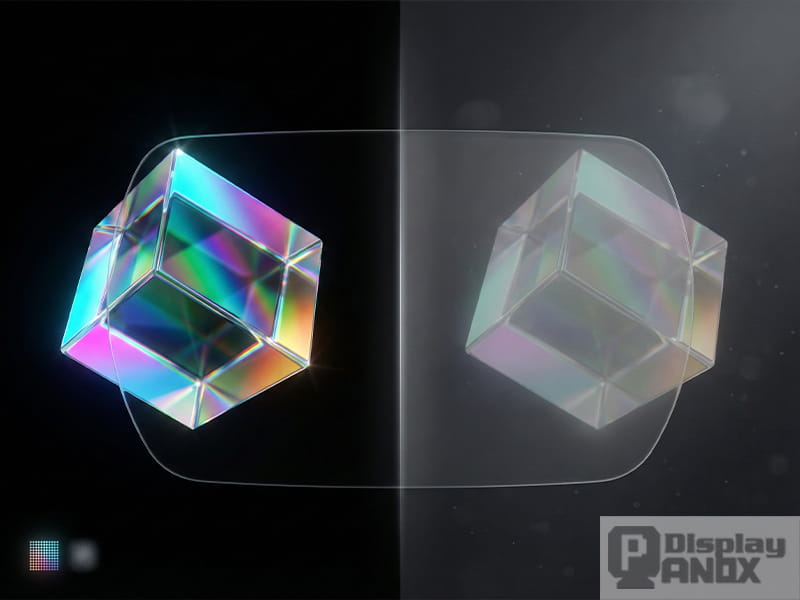
MicroOLED Quality Advantage: True Blacks & Rich Color Volume
While brightness is the headline feature, it is not the only metric that matters. If brightness were the only goal, simplistic monochromatic green displays would suffice. The market, however, demands full-color, cinematic experiences.
This is where MicroOLED asserting its dominance over competing technologies at the 3,000-nit benchmark. Unlike LCoS, which requires an always-on backlight that turns "black" into "dark gray," MicroOLED is self-emissive. This means:
-
Infinite Contrast: When a pixel is off, it is truly black. This high contrast makes the 3,000 nits of brightness perceive even brighter and sharper against the transparent background of AR glasses.
- Rich Color Volume: MicroOLED maintains exceptional color accuracy (DCI-P3 gamut coverage) even at high luminance levels, ensuring that virtual objects look realistic rather than washed out.
If you want true blacks and rich color at high brightness, Micro OLED is a strong solution.
Conclusion
The chase for 3,000 nits is not a trend; it is a technical prerequisite for the mass adoption of Augmented Reality. It represents the threshold where digital information can seamlessly coexist with the bright physical world.
Through the integration of Tandem stacking architectures and Micro-Lens Arrays, MicroOLED technology has successfully bridged the gap. It now offers the high luminance required to overcome optical inefficiencies while delivering the superior image quality that users expect. For AR glasses manufacturers, choosing a display module that hits this brightness target is no longer optional—it is the definition of a viable product.
For outdoor use, brightness is not a luxury—it’s a requirement
| Panel model | Interface | Type | Size (inch) | Resolution | P.S |
| S032WEM01 | MIPI/RGB | Micro OLED | 0.32 | 800x600 | |
| PMOF039XGAM | RGB | Micro OLED | 0.39 | 1024x768 | Full Color/Monochrome |
| BO039M1920M | MIPI | Micro OLED | 0.39 | 1920x1080 | Highest PPI =5644 |
| EP047M800T | TTL | LCOS | 0.47 | 800x600 | |
| BO049FHPMO | SPI,MIPI | Micro OLED | 0.49 | 1920x1080 | |
| S050M1600M | MIPI | Micro OLED | 0.5 | 1600x1200 | |
| ECX331DB-6 | Mini LVDS | Micro OLED | 0.5 | 1024x768 | |
| S060LDM01 | MIPI | Micro OLED | 0.6 | 1920x1080 | |
| ECX335AF | Mini LVDS | Micro OLED | 0.71 | 1920x1080 | 200 nits brightness version |
| ECX335B | Mini LVDS | Micro OLED | 0.71 | 1920x1080 | 500 nits brightness version |
| ECX335SN | Mini LVDS | Micro OLED | 0.71 | 1920x1080 | 3000 nits brightness version |
| BO071M1920M | MIPI | Micro OLED | 0.71 | 1920x1080 | |
| S072WCM04 | MIPI | Micro OLED | 0.72 | 1920x1080 | |
| S103WAM01 | MIPI | Micro OLED | 1.03 | 2560x2560 |