



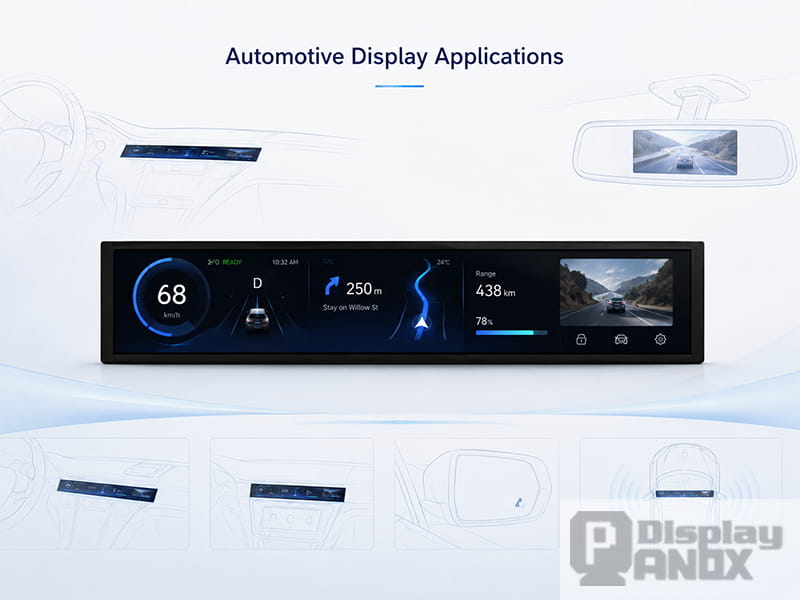
Automotive display applications have expanded far beyond the traditional dashboard screen. In modern vehicles, display panels are used for driving information, navigation, entertainment, camera monitoring, climate control, passenger interaction, commercial vehicle systems, and smart cockpit design. As vehicles become more digital, the automotive display is becoming one of the main interfaces between the vehicle system and the user.
This is why the application scenario matters so much. A center console display, a digital instrument cluster, a rearview mirror screen, a long strip dashboard display, and an industrial vehicle HMI may all belong to the automotive display category, yet they do not share the same requirements. One project may need high resolution and touch interaction. Another may need sunlight readability, wide temperature operation, a special aspect ratio, or a controller board for easier system integration.
Industry sources also show that in-vehicle screens are becoming larger, brighter, higher-resolution, and more diverse in form. Analog Devices notes that demand for larger, brighter, curved, higher-resolution and higher-contrast automotive displays continues to grow, while TFT-LCD remains the dominant flat-panel display technology in automotive applications.
1. Center Console Display
The center console display is one of the most common automotive display applications. It is usually used for navigation, multimedia, vehicle settings, air conditioning, camera view, phone connection, energy information and other interactive functions.
For this application, the screen is often touched directly and viewed by both driver and passenger. That means the display panel should offer good resolution, wide viewing angle, stable brightness, reliable touch performance and a clean integration structure.
A center console automotive display usually needs:
| Requirement | Why It Matters |
|---|---|
| High resolution | Makes maps, menus and vehicle settings easier to read |
| PCAP touch support | Enables direct interaction with vehicle functions |
| Wide viewing angle | Keeps the UI readable from driver and passenger positions |
| Stable brightness | Supports both daylight and night operation |
| Reliable interface | Helps connect with vehicle systems or controller boards |
| Wide temperature operation | Improves stability in real cabin conditions |
Panox Display’s 10.1-inch LCD for automobile console applications is a relevant example for this use case. It uses a 1920×1200 resolution, integrated PCAP touch panel and LVDS interface, with a wide operating temperature range of -30°C to 85°C.
This type of panel is suitable when the project needs a larger HMI screen for navigation, console control, embedded vehicle systems or industrial vehicle terminals.
2. Digital Instrument Cluster
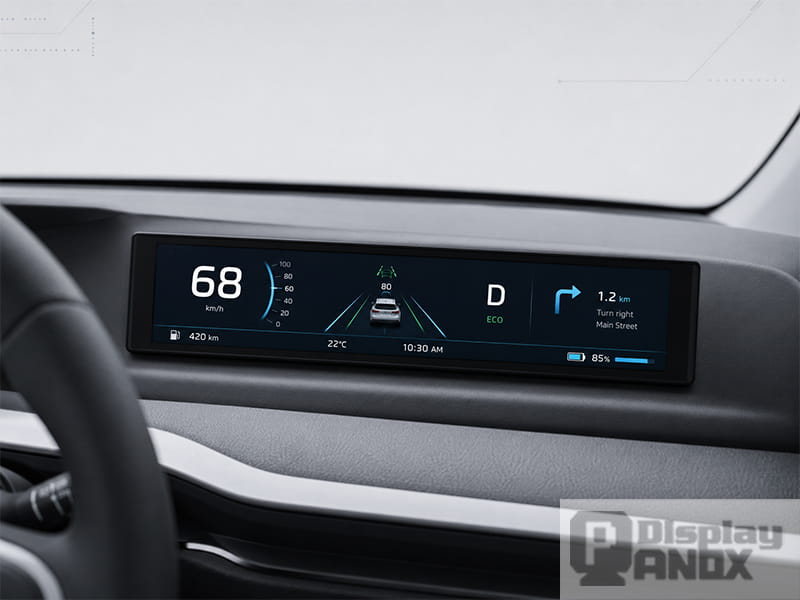
6.8 inch long strip LCD IPS TFT
A digital instrument cluster replaces or supplements traditional mechanical gauges. It shows speed, RPM, fuel or battery level, warning lights, driving mode, ADAS alerts, navigation hints and other driving-related data.
Compared with a center console display, an instrument cluster has stronger safety and readability requirements. The driver needs to understand the information quickly without unnecessary visual search. NHTSA’s visual-manual driver distraction guidelines recommend that in-vehicle devices be designed so tasks can be completed with glances away from the road of two seconds or less, with a cumulative glance time of 12 seconds or less.
For digital clusters, display quality is not only about looking modern. It affects how fast the driver can read critical information. The screen should support clear contrast, suitable brightness, stable refresh behavior and a UI layout that keeps essential data easy to identify.
Common digital cluster display requirements include:
| Display Factor | Practical Role |
|---|---|
| Brightness and contrast | Improves visibility in daytime and night driving |
| Low reflection | Reduces glare from cabin light or sunlight |
| Fast response | Helps keep motion and alerts clear |
| High reliability | Supports long-term vehicle use |
| Stable color and viewing angle | Keeps symbols and warning information consistent |
For mainstream applications, TFT-LCD remains a practical choice because of its mature supply chain, cost control and broad size availability. OLED and micro-LED are also receiving attention in premium cockpit designs because of their contrast, thinness and design flexibility.
3. Rearview Mirror Display and Camera Monitor System
Rearview mirror displays and camera monitor systems are important application areas for automotive display panels. They can be used for reversing cameras, rearview mirror replacement, side camera displays, blind-spot monitoring and surround-view systems.
This application needs a different type of performance. The display does not mainly show menus. It shows visual information from cameras, and the driver may rely on that information while parking, reversing or changing lanes.
A rearview or camera monitor display should focus on:
| Requirement | Reason |
|---|---|
| High brightness | Helps camera images remain visible in strong ambient light |
| Good contrast | Makes vehicles, pedestrians and obstacles easier to identify |
| Stable image quality | Reduces visual uncertainty during driving or parking |
| Suitable aspect ratio | Fits mirror-style or panoramic camera layouts |
| Low latency system design | Keeps the displayed image close to real-time behavior |
Long strip LCDs are especially useful here because rearview mirror displays and panoramic camera layouts often need a wide, narrow screen shape. Panox Display lists long strip LCDs under its Vehicle category, including 6.8-inch, 8.8-inch and 14-inch options for vehicle-related display projects.
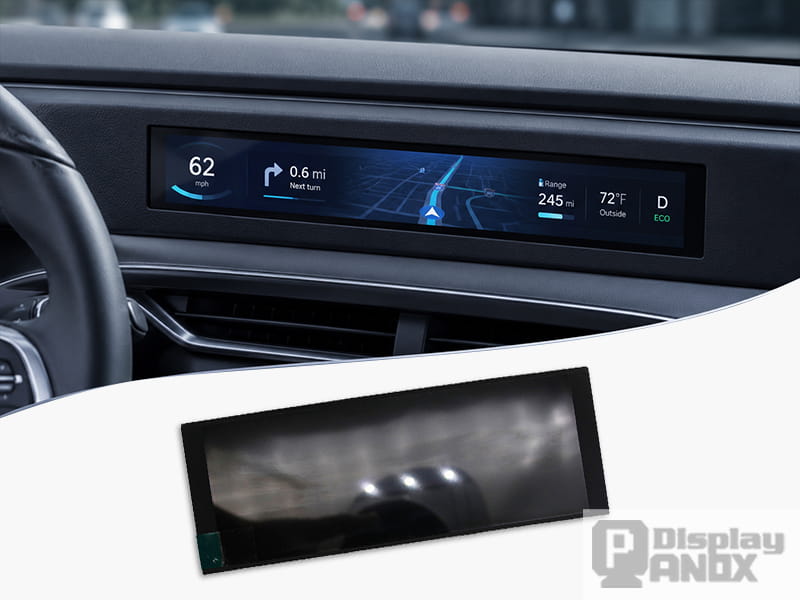
For example, the 6.8-inch long strip LCD uses a 480×1280 resolution, MIPI interface and IPS TFT-LCD structure. Its listed applications include rearview mirror, industrial device, security and dynamic information displays.
4. Long Strip Dashboard Display
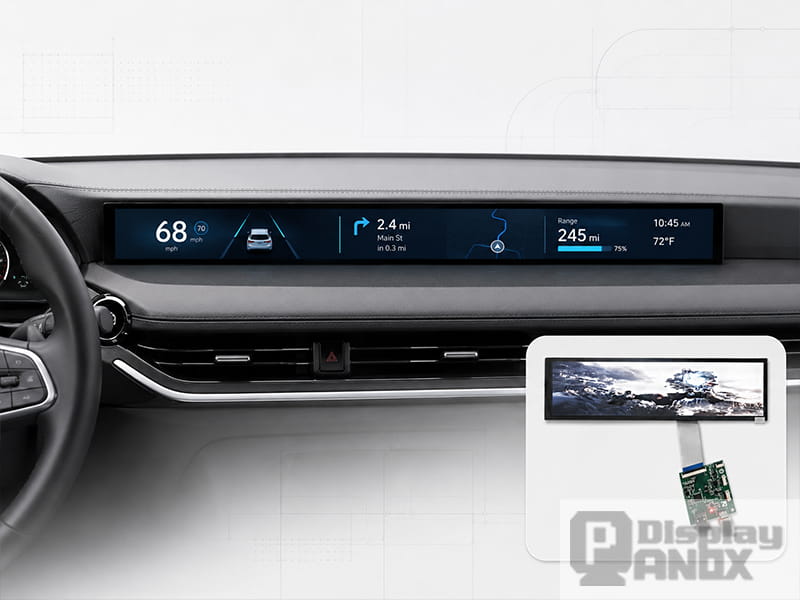
8.8 inch Long Strip LCD Aida64 HDMI Board
Long strip displays are becoming more common in vehicle HMI design because they can show continuous information without occupying too much vertical space. They can be placed in dashboard extensions, narrow information bars, auxiliary control panels, rearview mirror screens or custom cockpit modules.
The value of a long strip automotive display is its format. It can show speed, route guidance, temperature, battery status, ADAS icons, media information or system alerts in a compact horizontal layout.
Typical long strip automotive display applications include:
| Application | Suitable Content |
|---|---|
| Dashboard information bar | Speed, range, route hints, alerts |
| Rearview mirror display | Camera feed, blind-spot view, reversing image |
| Passenger-side status display | Trip data, media, climate, seat status |
| Commercial vehicle information screen | Route, fleet data, system status |
| Custom cockpit module | Brand-specific HMI or special dashboard layout |
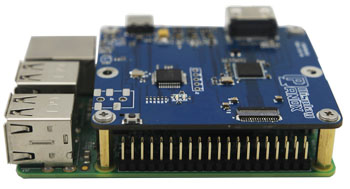
Panox Display’s 8.8-inch long strip LCD uses 1920×480 resolution and MIPI interface. The product category information notes its use in vehicle and car applications, and Panox can also provide HDMI-to-MIPI DSI controller board support for this type of stretched bar LCD.
For larger panoramic layouts, Panox Display’s 14-inch long strip LCD offers 3840×1100 resolution, 283 PPI and LVDS/HDMI interface support. It is listed under Long Strip/Stretched and Vehicle-related categories.
5. Passenger Display and Rear-Seat Entertainment
Passenger displays and rear-seat entertainment screens are becoming more important as vehicles become smart living spaces. These displays may be used for media playback, navigation sharing, seat control, climate adjustment, gaming, online services or multi-user cockpit interaction.
Compared with driver-focused screens, passenger displays place more emphasis on entertainment quality, screen size, color performance, touch interaction and content separation. In premium smart cockpits, automakers may use larger screens, curved displays or even multi-display systems to create a more immersive interior experience.
TrendForce has reported that passenger-side displays, rear-seat entertainment displays and rear armrest screens are becoming an important growth category in the automotive display market.
For this type of application, OLED and advanced LCD solutions both have their place. OLED can provide high contrast, thin structure and premium visual quality, while TFT-LCD remains attractive for stable cost, mature supply and high brightness options. The final choice depends on project budget, visual positioning, lifetime requirements and cabin integration design.
6. Head-Up Display and AR-HUD
A head-up display, or HUD, projects driving information into the driver’s forward field of view. Typical HUD content includes speed, navigation arrows, warning information, lane guidance and ADAS alerts. More advanced AR-HUD systems can visually align information with the road scene.
HUD is different from a traditional display panel because it involves optics, projection, windshield or combiner design, image generation and brightness control. Still, it belongs to the wider automotive display ecosystem because it is another way for the vehicle to present information.
Kelley Blue Book describes HUD as a technology that projects an image onto the windshield or a panel below the driver’s line of sight, helping provide information without requiring the driver to look away from the road.
From an application perspective, HUD and direct-view cockpit displays often work together. The HUD can carry high-priority driving prompts, while the cluster or center display shows deeper vehicle data, map details, menus or entertainment functions.
7. Industrial and Commercial Vehicle HMI
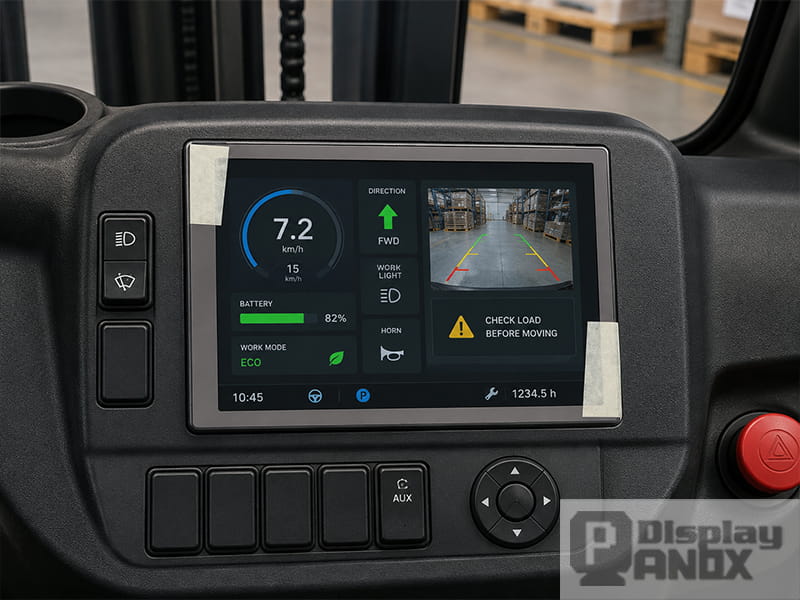
Automotive display applications are not limited to passenger cars. Industrial vehicles, commercial vehicles, buses, trucks, construction equipment, agricultural machinery and special-purpose vehicles also need reliable displays.
These projects often care less about luxury cockpit styling and more about durability, readability and system integration. A screen may be used outdoors, near vibration sources, inside dusty environments or in cabins exposed to strong temperature changes.
For industrial and commercial vehicle HMI, common requirements include:
| Requirement | Application Meaning |
|---|---|
| High brightness | Better readability under sunlight or outdoor conditions |
| Wide temperature range | More stable operation in harsh environments |
| Strong mechanical integration | Better resistance to vibration and installation stress |
| Simple interface matching | Easier connection to embedded systems |
| Long backlight lifetime | Supports long operating cycles |
| Anti-reflection treatment | Improves practical visibility |
Panox Display’s 6.5-inch industrial LCD is a good example for compact vehicle-mounted and industrial HMI use. It provides 640×480 resolution, 800 nits brightness, LVDS interface, anti-reflection treatment, WLED backlight and a -30°C to 80°C operating temperature range.
This kind of automotive display panel may be used in industrial vehicle terminals, monitoring systems, control panels, outdoor equipment, testing devices and custom embedded vehicle systems.
8. Public Transport and Vehicle Information Screens
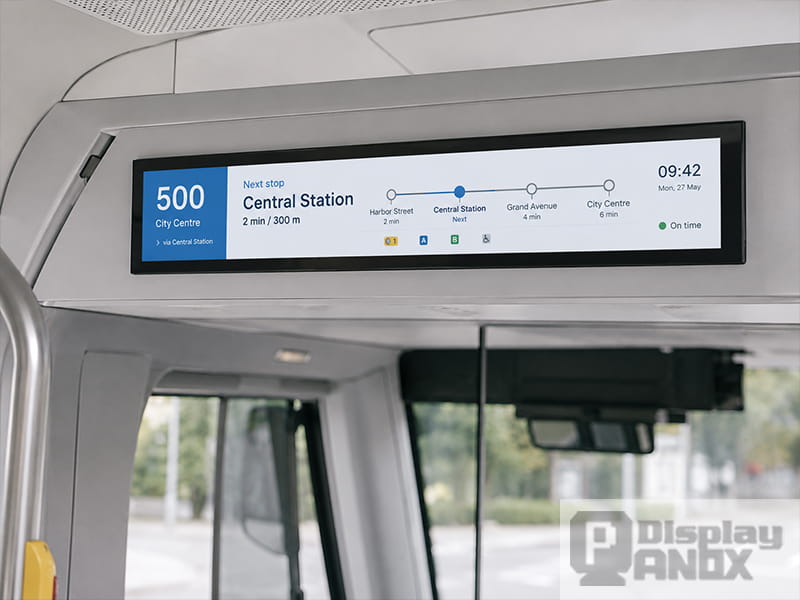
Automotive displays are also used in public transport and vehicle-mounted information systems. Buses, trains, shuttles, taxis and commercial fleets may use display panels for route information, passenger notices, advertising, fleet status, schedule updates or driver information.
For these applications, the screen may need to operate for long hours and remain readable under changing lighting conditions. Long strip displays are often suitable because they can show route names, station information, warning messages or status data in a narrow horizontal area.
In these projects, engineers often focus on:
| Factor | Why It Matters |
|---|---|
| Continuous operation | Public transport screens may run for long periods |
| Brightness | Passengers need to read information in mixed lighting |
| Wide temperature support | Vehicles may operate in different climates |
| Interface flexibility | Integration may involve HDMI, LVDS, MIPI or custom boards |
| Mechanical fit | Screens often need to fit into narrow interior spaces |
A long strip LCD with an HDMI board can be useful when developers need easier testing or faster integration. Panox Display’s 14-inch long strip LCD, for example, is available with HDMI controller board support for development and project matching.
9. EV and Smart Cockpit Energy Interface
Electric vehicles have created new information needs inside the cockpit. The display may need to show battery percentage, charging status, remaining range, energy flow, driving efficiency, regenerative braking, thermal status and charging station navigation.
This makes automotive display design more important for EV user experience. Range anxiety, charging planning and energy consumption are not only technical data. They are daily user concerns. A clear display can help drivers understand the vehicle’s energy state more confidently.
For EV-related display applications, useful panel features include:
| Feature | Value |
|---|---|
| High resolution | Shows maps, range estimates and charging data clearly |
| High brightness | Supports cabin readability in daylight |
| Touch support | Allows interactive navigation and charging settings |
| Wide temperature operation | Supports battery-related vehicle environments |
| Good contrast | Helps energy graphs and warnings stand out |
| Stable interface | Connects reliably with vehicle control systems |
This is where larger center displays, long strip information bars and passenger-side screens may work together. The center display can manage navigation and charging data, while a narrow auxiliary screen can show range, efficiency or driving mode in a more glanceable format.
10. Custom Vehicle Display Projects
Many automotive display applications do not fit standard categories. Some projects need a display for a special vehicle, prototype cockpit, test platform, smart mirror, fleet terminal, charging system, vehicle diagnostic device or embedded control system.
For these projects, display selection should begin with the actual use case rather than a fixed product size. Engineers should define where the screen will be installed, who will view it, what information it will show, how it will connect to the system and what environmental conditions it must survive.
Key questions include:
| Question | Why It Helps |
|---|---|
| Is the display for driver-critical information or secondary content? | Determines readability and safety priority |
| Will it be used in sunlight? | Affects brightness, coating and contrast requirements |
| Is touch required? | Affects cover glass, PCAP and bonding design |
| What host interface is available? | Determines LVDS, MIPI, HDMI, eDP or RGB matching |
| Is the installation space narrow or standard? | Determines aspect ratio and mechanical structure |
| Will the vehicle face extreme temperature? | Determines operating temperature and material stack |
| Is this a prototype or mass-production project? | Affects controller board and customization strategy |
For early-stage development, a controller board can make testing much easier. For production, the final solution may require customized cover glass, touch panel, FPC direction, interface adaptation, optical bonding or mechanical design support.
11. Matching Automotive Display Applications with Panel Types
Different applications usually point to different display choices. The table below gives a practical matching reference:
| Application | Suitable Display Direction |
|---|---|
| Center console display | 10.1-inch or larger TFT-LCD/OLED with touch support |
| Digital instrument cluster | High-contrast TFT-LCD, LTPS LCD or OLED |
| Rearview mirror display | Long strip LCD with wide format and strong readability |
| Camera monitor system | Bright display with good contrast and stable image quality |
| Passenger display | Larger LCD/OLED with high resolution and multimedia quality |
| Rear-seat entertainment | Larger display with good color and interface compatibility |
| Commercial vehicle HMI | High-brightness, wide-temperature industrial LCD |
| Public transport display | Long strip LCD or stretched display with long operation stability |
| EV information screen | Center display or auxiliary display with clear energy data layout |
| Custom cockpit module | Special aspect ratio LCD/OLED with controller board support |
This is also why the phrase automotive display covers a wide range of products. It can refer to a high-resolution center display, a narrow dashboard information bar, a compact industrial LCD, a rearview camera screen or a premium OLED cockpit panel. The best panel depends on the application.
12. Panox Display Solutions for Automotive Display Applications
6.8 inch long strip LCD IPS TFT
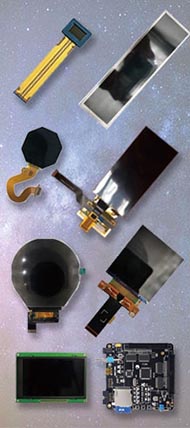
Panox Display provides LCD/OLED display panels, long strip LCD modules, industrial LCDs, touch panel options and controller board support for vehicle and embedded display projects. The Vehicle category includes display solutions for vehicle-mounted applications, rearview mirror screens and console displays.
For center console and larger vehicle HMI applications, the 10.1-inch 1920×1200 LCD with PCAP touch and LVDS interface can support navigation, vehicle control and smart cockpit interface designs.
For compact industrial vehicle HMI, the 6.5-inch industrial LCD with 800 nits brightness and -30°C to 80°C operating range is suitable for projects where readability and reliability are more important than decorative cockpit styling.
For long strip vehicle display layouts, Panox Display offers 6.8-inch, 8.8-inch and 14-inch long strip LCD options. These panels are suitable for rearview mirror screens, dashboard information bars, vehicle sub-displays, custom cockpit layouts and other narrow-format display projects.
Conclusion
Automotive display applications now cover almost every part of the modern vehicle experience. Displays are used in center consoles, digital clusters, HUD systems, rearview mirrors, camera monitor systems, passenger screens, rear-seat entertainment, EV energy interfaces, industrial vehicle terminals and public transport information systems.
The key is to match the display panel to the application. A center console display needs touch interaction and high-resolution UI support. A long strip LCD needs the right aspect ratio and a clear information layout. An industrial vehicle display needs brightness, temperature stability and reliability. A passenger display may focus more on entertainment and visual quality.
Panox Display supports automotive display projects with TFT-LCD panels, long strip LCD modules, high-brightness industrial displays, touch options and controller board solutions. For vehicle HMI, smart cockpit, industrial vehicle or custom embedded projects, selecting the right automotive display early can reduce integration risk and improve the final user experience.
Learn more: Why Are Automotive Displays Important in Modern Vehicles?
FAQs:
1. What are the main automotive display applications?
Automotive displays are used in center consoles, digital instrument clusters, rearview mirror screens, camera monitor systems, passenger displays, rear-seat entertainment, HUD systems, industrial vehicle HMIs and public transport information screens.
2. What display is suitable for a car center console?
A center console display usually needs high resolution, touch support, wide viewing angle, stable brightness and a reliable interface. TFT-LCD with PCAP touch is a practical choice for many mainstream vehicle HMI projects.
3. Why are long strip LCDs used in vehicles?
Long strip LCDs fit narrow dashboard spaces, rearview mirror layouts and custom cockpit information bars. They can show speed, navigation, range, camera feeds or system status without taking much vertical space.
4. Are high-brightness displays important for automotive applications?
Yes. High brightness helps vehicle displays remain readable in daylight, outdoor conditions and cabins with strong ambient light. It is especially important for dashboard, industrial vehicle and camera monitor applications.
5. Can industrial LCDs be used in vehicle projects?
Yes. Industrial LCDs can be suitable for commercial vehicles, outdoor equipment, control terminals and embedded vehicle systems, especially when wide temperature operation, long lifetime and readability are required.
6. Does Panox Display provide controller board support?
Yes. Panox Display can support controller board solutions such as HDMI, MIPI, LVDS, RGB, eDP or Type-C depending on the panel and project requirements. This is useful for prototyping, testing and custom vehicle display integration.