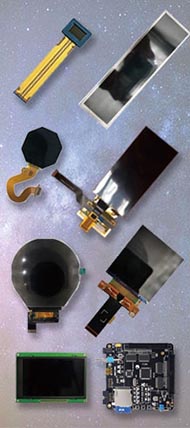







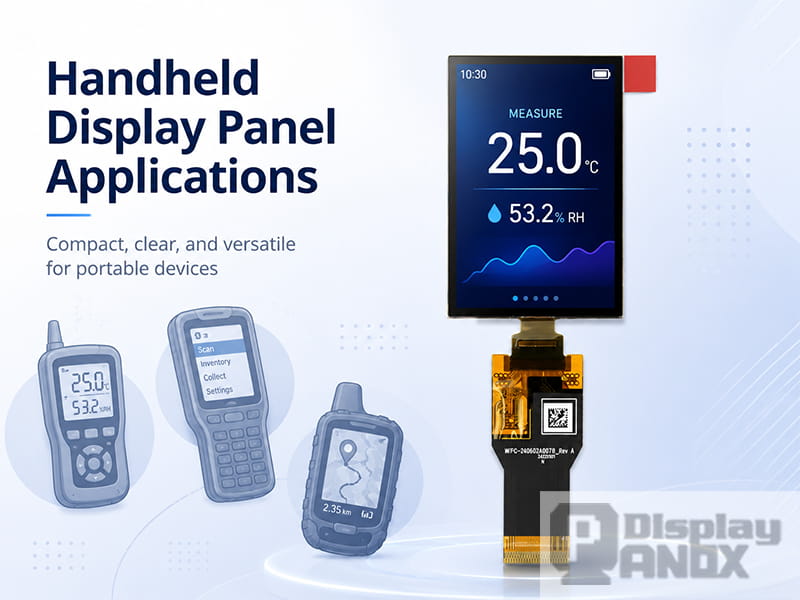
Handheld products ask a lot from a small screen. The display has to fit into a compact enclosure, remain readable at close viewing distance, support the right interface, manage power carefully, and survive the real environment where the device will be used. A display for a compact instrument will not be selected in the same way as a display for a portable game console or a high-resolution smart controller.
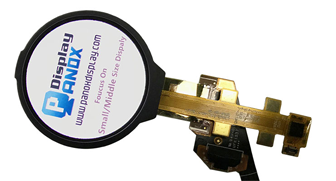
That is why a For Handheld display panel should be considered from the application side, not only from the size or resolution side. Panox Display’s For Handheld category describes handheld devices as pocket-sized or portable computing products that often need a small display screen, touch input, low power consumption, and readability under sunlight. The category also includes display options across AMOLED and TFT-LCD technologies, with interfaces such as SPI, RGB, MCU, MIPI, and eDP depending on the model.
This article looks at typical handheld display panel applications and explains how different display types fit different product directions, including compact instruments, industrial control terminals, smart home controllers, medical and inspection devices, portable GPS products, mobile-style terminals, and handheld gaming devices.
Application Requirements Come Before Display Size
A 2.4-inch AMOLED, a 3-inch square TFT-LCD, and a 7-inch AMOLED can all be used in handheld products, but they serve very different design goals. The application decides how much information must be shown, how often the screen updates, whether touch is required, how bright the display should be, and how much power the device can afford.
For outdoor or semi-outdoor products, readability becomes one of the first questions. NIST research on daylight display readability explains that display performance under daylight and sunlight needs to consider reflection, contrast, and measurement methods that can simulate hand-held display utilization. This is important because real-world visibility depends on more than luminance alone.
For battery-powered products, the interface and display technology also matter. A review of display technologies notes that the display is one of the components with a high percentage of energy consumption in portable electronics, and OLED technology can be efficient for small display sizes because its power behavior is linked to the pixels being lit. OLED power is also content-dependent: research on OLED-based mobile devices explains that the power consumption of OLED displays depends highly on the displayed content, especially pixel intensity and color composition.
In other words, the right display for a handheld application is the one that matches the product’s actual working condition: lighting, UI style, interface platform, touch method, enclosure space, battery target, and expected use environment.
Portable Instruments and Compact Measurement Devices
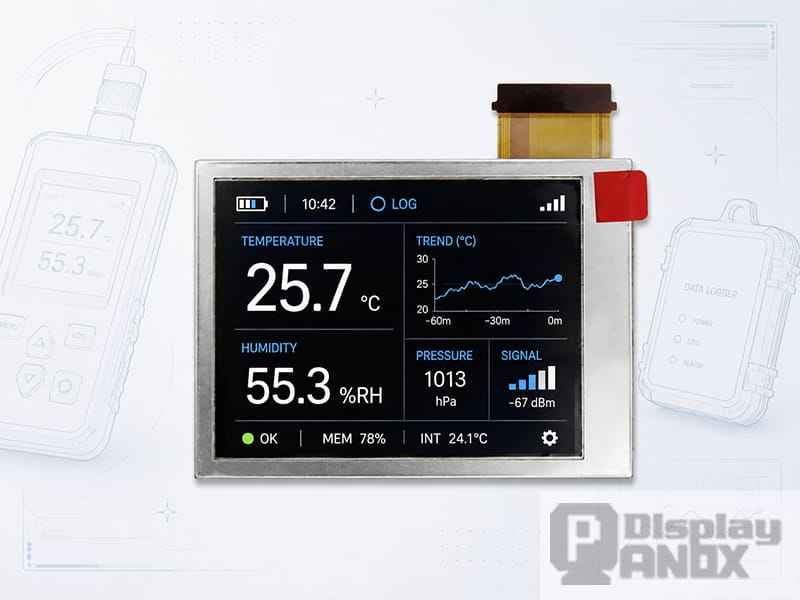
Portable instruments usually need a screen that is clear, compact, and easy to integrate with an embedded system. These products may show status values, menus, battery information, signal levels, warnings, or measurement data. The display does not always need to be large, but it should make key information easy to read at a glance.
For this type of application, compact AMOLED panels can be useful because they offer high contrast, vivid color, and a thin structure. A dark UI with bright text or color-coded status indicators often works well on OLED, especially when the screen area is small and the interface is not dominated by a white background.
The 2.4-inch Color OLED 450 × 600 is a good example for compact handheld and instrument-style products. Panox lists this AMOLED panel with 450 × 600 resolution, 800 cd/m² typical luminance, SPI / MCU / MIPI interface options, 312 PPI, 16.7M colors, 100000:1 contrast ratio, and usage directions including handheld, security, industrial device, and instrument.
The 2.6-inch AMOLED RGB MCU Interface can also fit compact instruments and embedded handheld devices. Its page lists SPI and RGB interface support, MCU compatibility, low-temperature operation down to -40°C, and application directions such as industrial control, medical equipment, monitor, instrument, and handset.
For portable instruments, these smaller OLED panels are most suitable when the UI is focused and controlled: a few data fields, icons, alarms, status bars, or guided steps. They are less suitable when the product needs to show dense charts, large forms, long text, or multi-window layouts. In those cases, a larger TFT-LCD or AMOLED panel may create a better user experience.
Industrial Handheld Terminals and Control Interfaces
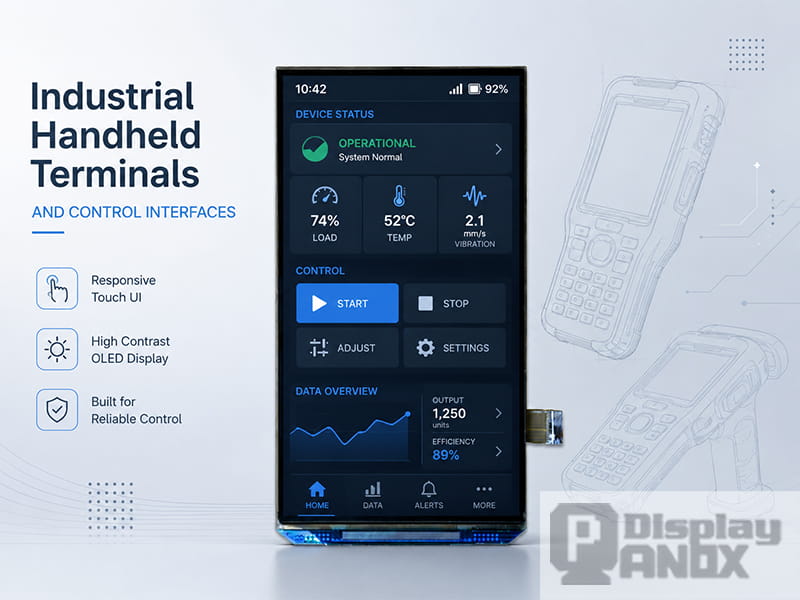
Industrial handheld devices often need a balanced display: enough size for readable menus, enough brightness for changing lighting, and stable integration with the processor or controller board. The display may be used for configuration, inspection, machine status, device calibration, or simple workflow guidance.
The 4.3-inch TFT-LCD 480 × 272 RGB Interface is a practical option for this type of product when the application needs a mature LCD format and a familiar RGB interface. Panox describes this module as a 4.3-inch a-Si TFT-LCD with WLED backlight, 480 × 272 resolution, 40-pin FPC, 500 cd/m² typical brightness, anti-glare treatment, and application directions including portable navigator, car display, and handheld device.
A TFT-LCD like this is often a sensible choice when the interface is mostly menu-based and the system already supports RGB output. It can be used in handheld control terminals, inspection tools, field service devices, portable configuration panels, and product prototypes that require an easier path to development. If touch is needed, an external PCAP touch panel and cover glass can be customized as part of the front structure.
For industrial handheld terminals with more premium visual requirements, the 4.3-inch AMOLED 540 × 960 provides a different direction. Panox describes this AMOLED as thinner and lighter than LCD, with high contrast, wide color gamut, MIPI interface, 540 × 960 resolution, and wide operating temperature down to -40°C.
The choice between these two 4.3-inch directions depends on the product positioning. A TFT-LCD may be more practical for a stable industrial interface with a familiar supply and development path. A 4.3-inch AMOLED can support a slimmer, more modern handheld design where visual quality and product feel are part of the selling point.
Smart Home Controllers and Square UI Products
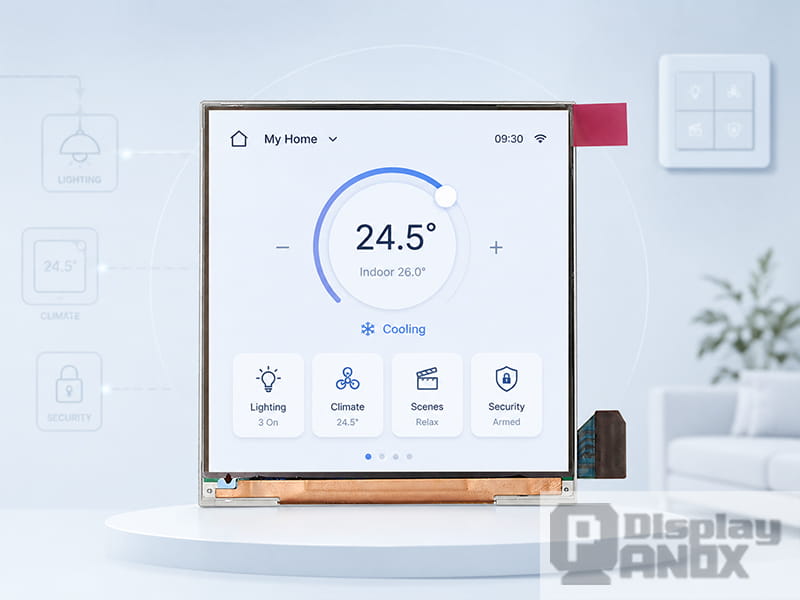
Some handheld or portable control products need a screen that does not feel like a phone display. A square screen can be useful for smart home panels, compact control terminals, dashboard-style interfaces, or products where the UI is built around icons, circular controls, tiles, and symmetrical layouts.
The 3-inch / 3.1-inch square TFT-LCD 720 × 720 MIPI is suitable for this kind of application. Panox describes this display as a 720 × 720 square TFT-LCD with WLED backlight, 2-lane MIPI interface, 328 PPI, 450 cd/m² typical luminance, 60 Hz refresh rate, 1:1 aspect ratio, and optional HDMI controller board support. The page also mentions use cases such as gaming, mobile phone, VR, vehicle, smart homes, and industrial devices.
A square display gives designers more freedom than a narrow portrait or landscape panel. It can support radial menus, centered status indicators, thermostat-like controls, compact dashboards, or icon grids without wasting much screen area. For handheld products that need to look distinctive, this format can help the product avoid the “small phone screen” feeling.
The MIPI interface also makes sense for higher-resolution compact displays. MIPI DSI-2 is described by MIPI Alliance as a high-bandwidth link between host processors and displays, with advantages including low power, low EMI, scalability, and support for mobile, portable gaming, smartwatches, VR headsets, laptops, tablets, and automotive use cases.
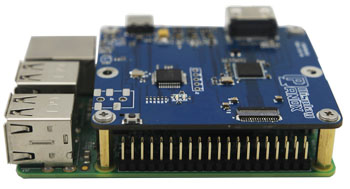
For early development, the availability of an HDMI controller board can also be useful. It allows the team to test UI layouts, viewing quality, and screen behavior before the final embedded board is fully ready.
Medical, Health, and Field Inspection Devices
Medical and health-related handheld devices often need clear information hierarchy. A small screen may show readings, trend indicators, alert states, icons, and guided operating steps. Field inspection devices have similar needs: the display should make the most important information visible quickly, even when the user is moving, wearing gloves, or working under variable light.
The 2.6-inch AMOLED is relevant when the product needs a compact full-color screen with embedded interfaces and wide-temperature capability. Panox lists it for industrial application, medical equipment, and handset use, with SPI / RGB signal support and -40°C to 60°C operating temperature.
The 3.92-inch AMOLED PCAP 1080 × 1240 MIPI can be considered when the product requires a more advanced front panel. Panox describes it as a high-resolution AMOLED with integrated on-cell capacitive touchscreen, 1080 × 1240 resolution, 600 cd/m² typical luminance, MIPI / eDP interface, 60 Hz refresh rate, 100000:1 contrast ratio, and readable-under-sun outdoor visibility.
For applications such as portable diagnostic equipment, inspection terminals, compact imaging devices, or professional handheld tools, integrated touch can simplify the front structure and improve interaction. On-cell touch also helps when the product needs a thinner stack and a cleaner front design. However, for medical and professional devices, the final choice should still be validated with the real UI, expected lighting condition, cover glass, cleaning method, and reliability requirements.
Portable GPS, Navigation, and Vehicle-Adjacent Handheld Devices
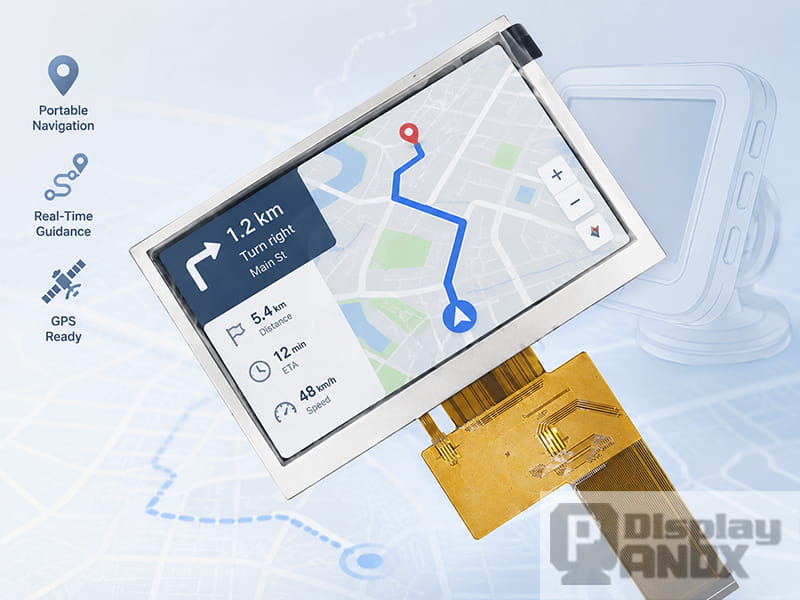
Navigation and field-route devices need a display that can show maps, icons, position markers, menus, and system prompts. These screens may be used indoors, inside vehicles, or under strong ambient light. They also need a balance between screen size, brightness, interface compatibility, and battery life.
The 4.3-inch TFT-LCD 480 × 272 RGB Interface is a familiar direction for portable navigation-style products. Panox specifically lists portable navigator, car display, and handheld device under its usage directions, with 500 cd/m² typical luminance, anti-glare treatment, WLED backlight, and RGB interface.
For a higher-end navigation or portable terminal, the 7-inch AMOLED 1080 × 1920 MIPI offers a larger visual area and stronger image quality. Panox describes this 7-inch AMOLED with Full HD resolution, 315 PPI, 800 cd/m² luminance, 100000:1 contrast ratio, 1.07 billion colors, MIPI 4-lane signal, on-cell touch, and usage directions including mobile phone, portable GPS, and handheld game console.
A 7-inch handheld display is better suited when the user needs more visual context. That may include map viewing, route guidance, image preview, real-time data panels, or multi-section UI layouts. The trade-off is mechanical: a larger display affects enclosure size, drop protection, battery capacity, connector placement, and grip comfort.
Handheld Gaming and Entertainment Devices
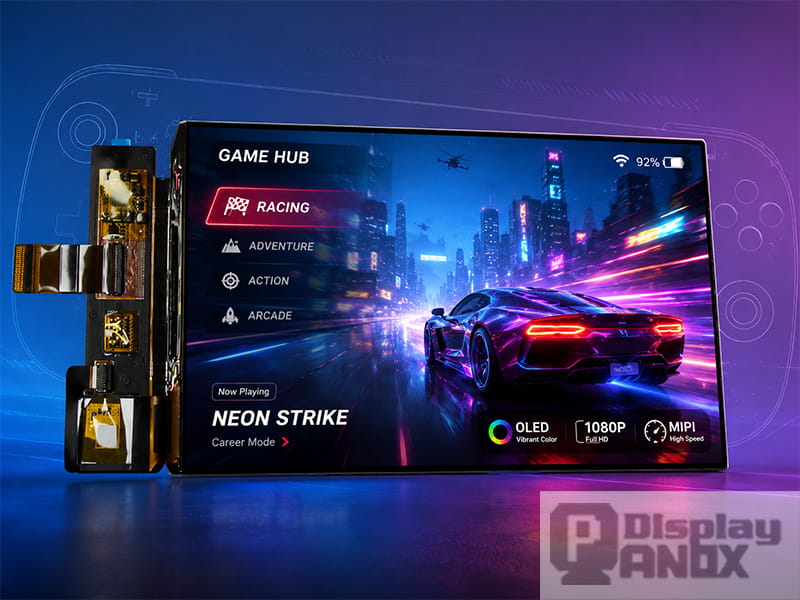
Handheld gaming products place heavier demands on the display than basic control terminals. The screen may need higher resolution, fast response, vivid color, wide viewing angle, and a UI that feels smooth during animation or video content. A larger panel also gives the user a more immersive experience, especially when the product includes game controls on both sides of the screen.
The 7-inch AMOLED is the strongest fit among the selected Panox handheld display options for this direction. Its Full HD resolution, 315 PPI, 800 cd/m² luminance, 165 Hz refresh rate, 100000:1 contrast ratio, MIPI 4-lane interface, and on-cell touch support make it suitable for large portable entertainment and handheld game console designs.
The 3-inch square TFT-LCD 720 × 720 can also be useful for compact gaming-style products or small interactive devices where the UI is built around a square visual area. Its 720 × 720 resolution, 328 PPI, and 60 Hz refresh rate make it more capable than many low-resolution small displays, while the square form factor creates a distinctive design language.
For handheld gaming and entertainment devices, interface bandwidth matters. MIPI DSI-2 supports high-resolution and high-frame-rate display modes, while also addressing low power, EMI, cost, and complexity for mobile and gaming applications.
Premium Mobile-Style Handheld Devices
Some handheld products are not phones, but they need a phone-like visual experience. Examples include smart terminals, compact controllers, portable media products, advanced communication tools, and high-end inspection devices. In this category, the display becomes part of the product identity.
The 3.92-inch AMOLED PCAP is especially suitable when the product needs high resolution, integrated touch, and a compact premium front panel. Its 1080 × 1240 resolution, on-cell capacitive touch, MIPI interface, high contrast, and thin OLED structure make it useful for devices where image quality and interaction are both important.
The 4.3-inch AMOLED 540 × 960 fits products that need a larger portrait screen with a mobile-style aspect ratio. Panox positions it for handheld and cellphone-related use, with a thin and lightweight OLED structure, MIPI interface, 540 × 960 resolution, high contrast, wide color gamut, and wide-temperature operation.
In this type of product, the display does more than show information. It influences how premium the device feels, how quickly users trust the interface, and how naturally they interact with the product. A higher-resolution AMOLED panel can support smoother icons, better text rendering, cleaner UI transitions, and stronger contrast between content layers.
Matching Panox Display Panels to Handheld Applications
The table below summarizes how the selected Panox Display options can support different handheld application directions.
| Application direction | Suitable Panox display option | Why it fits |
|---|---|---|
| Compact instrument, security device, industrial handheld indicator | 2.4-inch AMOLED, 450 × 600, SPI / MCU / MIPI | High pixel density, 800 cd/m² luminance, high contrast, compact portrait format, and multiple embedded interface options make it practical for small data-driven devices. |
| Portable instrument, medical equipment, industrial control, handset-style device | 2.6-inch AMOLED, 240 × 320, SPI / RGB / MCU | Compact OLED module with embedded interface support, wide-temperature performance, and application directions including industrial control, medical equipment, monitor, instrument, and handset. |
| Smart home controller, square dashboard, compact industrial UI, small interactive product | 3-inch / 3.1-inch TFT-LCD, 720 × 720, MIPI | Square 1:1 format, 328 PPI, WLED backlight, 450 cd/m² luminance, and optional HDMI controller board support make it suitable for distinctive control interfaces. |
| Premium touch terminal, high-resolution portable device, compact smart controller | 3.92-inch AMOLED PCAP, 1080 × 1240, MIPI / eDP | Integrated on-cell capacitive touch, high resolution, 600 cd/m² luminance, high contrast, thin structure, and readable-under-sun feature support advanced handheld designs. |
| Portable navigator, handheld controller, vehicle-adjacent display, mature embedded device | 4.3-inch TFT-LCD, 480 × 272, RGB | Familiar 4.3-inch LCD format with RGB interface, 500 cd/m² luminance, anti-glare treatment, WLED backlight, and handheld / navigator usage directions. |
| Mobile-style handheld product, digital device, slim portable terminal | 4.3-inch AMOLED, 540 × 960, MIPI | Thin and lightweight OLED structure, high contrast, wide color gamut, portrait resolution, MIPI interface, and wide-temperature operation suit refined handheld products. |
| Handheld game console, portable GPS, large smart terminal, media-rich device | 7-inch AMOLED, 1080 × 1920, MIPI | Large Full HD AMOLED panel with 315 PPI, 800 cd/m² luminance, 165 Hz refresh rate, on-cell touch, high contrast, and usage directions including portable GPS and handheld game console. |
This table is not meant to force one display into one fixed use case. In real projects, the same display may work for several product types. The better approach is to define the application first, then choose the display that supports the required UI density, lighting condition, interface, power target, and mechanical structure.
How to Choose a Display by Application
For a compact instrument, start with the information density. If the screen only needs to show a few values, icons, or short menus, a 2.4-inch or 2.6-inch AMOLED may be enough. If the device needs charts, image previews, multi-language text, or a touch-driven interface, a larger and higher-resolution panel will usually feel more comfortable.
For an industrial handheld terminal, check the interface and mechanical layout early. A 4.3-inch TFT-LCD with RGB interface may simplify development if the host platform already supports RGB output. A MIPI AMOLED may be better when the project needs higher resolution, thinner structure, or a more modern UI.
For smart home and control products, think about the shape of the interface. A square display can make sense when the UI is centered around tiles, circular controls, icons, or dashboard-style layouts. A rectangular portrait AMOLED may be better when the interface follows a mobile app-like structure.
For portable GPS, gaming, or media-rich handheld devices, screen size and resolution become more important. A larger AMOLED can give users more visual context, stronger contrast, and a more immersive experience. It also demands more attention to enclosure strength, touch structure, heat, battery capacity, and processor capability.
For touch-based products, select the display, touch panel, cover glass, and enclosure together. Panox’s For Handheld category notes customized touch panel and controller board support, including cover glass / touch panel services and controller boards with inputs such as HDMI, Type-C video, MIPI, RGB, LVDS, and eDP.
Conclusion
Handheld display panel applications are broad, but the selection logic is always connected to the real product environment. A portable instrument needs clarity and compact integration. An industrial terminal needs stable readability and interface compatibility. A smart controller may need a distinctive square UI. A medical or inspection device needs clear information hierarchy. A handheld gaming or GPS device may need a larger screen, stronger contrast, and smooth visual performance.
Panox Display’s For Handheld display panel options cover several of these application directions, including compact 2.4-inch and 2.6-inch AMOLED modules, a 3-inch square TFT-LCD, a 3.92-inch AMOLED PCAP touch display, mature 4.3-inch TFT-LCD, slim 4.3-inch AMOLED, and a larger 7-inch AMOLED for advanced portable products.
The most reliable way to choose a display is to start with the application, then confirm the display technology, interface, brightness, touch structure, power behavior, mechanical fit, controller board requirement, and long-term supply plan. A good handheld display panel should not only look impressive in a sample test. It should make the final product easier to use, easier to integrate, and easier to trust in real working conditions.
Learn more: Why Is the Right Handheld Display Panel Important for Portable Device Design?
FAQs:
What are the most common applications of handheld display panels?
Handheld display panels are commonly used in portable instruments, industrial handheld terminals, smart home controllers, medical and health-related equipment, inspection devices, portable GPS products, mobile-style terminals, and handheld gaming devices.
Which display is suitable for compact handheld instruments?
Compact instruments often work well with small AMOLED displays such as 2.4-inch or 2.6-inch panels, especially when the UI focuses on status values, icons, alarms, and short menus. These panels can offer high contrast, compact size, and embedded interface options.
Which display is suitable for a smart home controller?
A square TFT-LCD such as a 3-inch / 3.1-inch 720 × 720 MIPI display can be a strong choice for smart home controllers because it supports balanced UI layouts, icons, circular controls, and dashboard-style interfaces.
Which display is suitable for handheld GPS or navigation devices?
A 4.3-inch TFT-LCD can fit mature portable navigation products, while a 7-inch AMOLED is better for larger, premium portable GPS or smart terminal designs that need more screen area and higher visual quality.
When should a handheld product use AMOLED?
AMOLED is suitable when the product needs high contrast, vivid color, thin structure, fast response, premium visual quality, or a dark UI that can benefit from OLED’s self-emissive pixels. The final power result should still be checked with real UI content.
When should a handheld product use TFT-LCD?
TFT-LCD is suitable when the project needs a mature display format, predictable backlight behavior, familiar interface options, and stable integration. It is often practical for embedded control, industrial handheld terminals, navigation products, and square UI devices.