



A display is no longer just a place to show information. In many modern products, it has become part of the product structure, part of the user experience, and sometimes even part of the brand identity. That is one reason long strip LCD and OLED displays are gaining more attention across vehicles, PC sub-displays, retail shelves, smart home devices, industrial equipment and custom embedded systems.
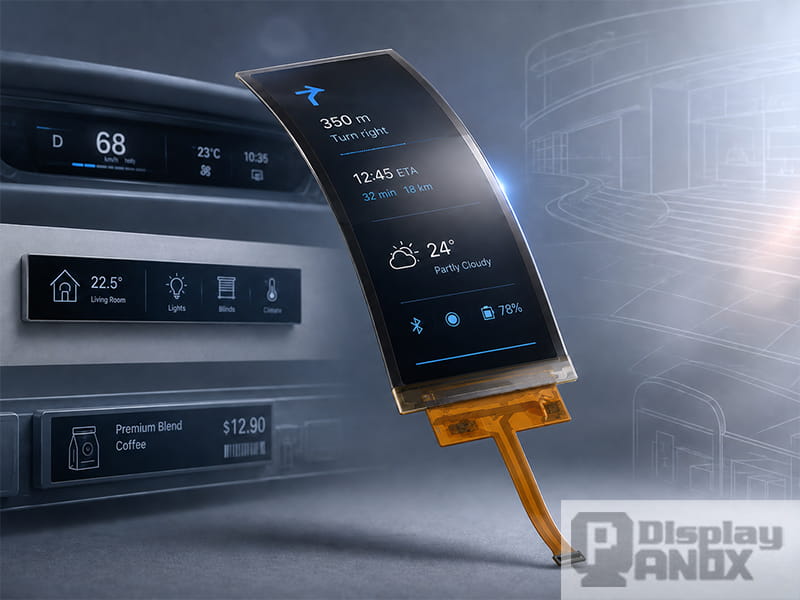
The reason is practical. Many products do not have a large rectangular area waiting for a traditional 16:9 screen. They have narrow dashboard gaps, shelf edges, handles, control bars, rack panels, mirror housings, handheld bodies and curved surfaces. A long strip display uses these spaces more naturally.
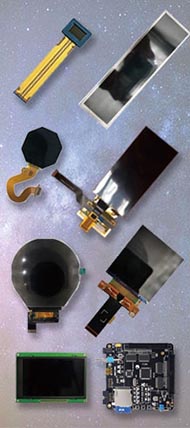
Panox Display’s long-strip display category includes multiple stretched-format modules, such as 2.99-inch 268 × 800 IPS LCD, 6.52-inch 2520 × 840 flexible OLED, 6.8-inch 480 × 1280 IPS TFT-LCD, 7.84-inch 1280 × 400 TFT-LCD, 8.8-inch 1920 × 480 TFT-LCD and 14-inch 3840 × 1100 TFT-LCD panels. These sizes show how long strip displays can cover compact handheld devices, PC monitoring screens, automotive interfaces, flexible curved concepts and high-resolution touch-bar-style applications.
Why product shape matters more than screen tradition
For years, many interfaces were designed around available display formats. The product had to make room for the screen. Today, the situation is changing. Industrial designers and engineers often want the screen to fit the product, not dominate it.
A long strip LCD or OLED panel works well because it follows linear product geometry. A vehicle dashboard is horizontal. A shelf edge is horizontal. A scan pen is narrow. A smart appliance control area is usually vertical or slim. A PC sub-display sits best along the case, desk or monitor edge. In these situations, a stretched display feels intentional instead of forced.
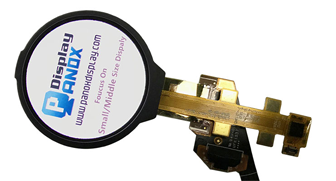
This is also where long strip displays differ from other custom-shaped panels. A Round Display fits circular interfaces such as watches, knobs, gauges and compact controllers. Panox’s circular display category lists round LCD and OLED panels for smartwatches, medical devices, automotive displays, smart homes and other products. A long strip display solves a different design problem: it is built for linear information and narrow installation spaces.
Why long strip displays improve space efficiency
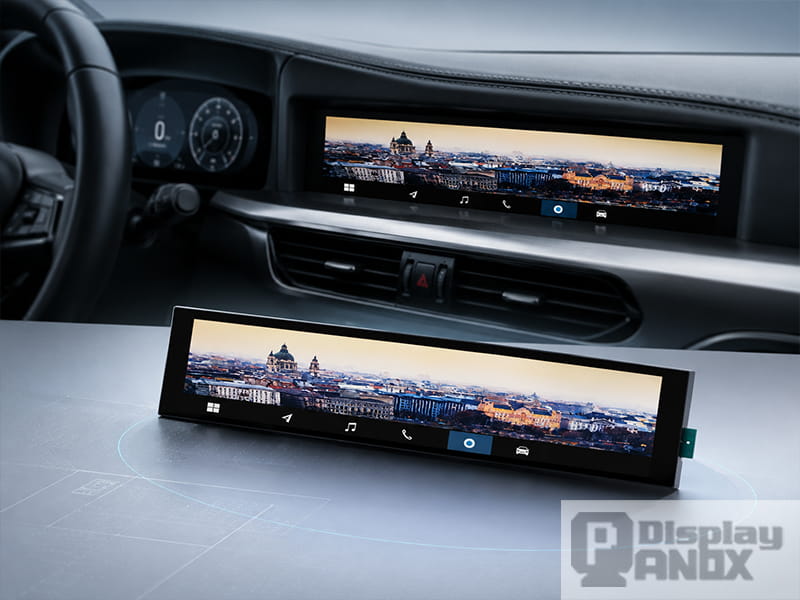
6.8 inch long strip LCD IPS TFT
In embedded product design, usable space is often more valuable than screen size. A product may have enough room for information, but not enough room for a normal display. A long strip panel turns a narrow area into an active interface without changing the whole product layout.
This is important in automotive interiors. A dashboard already has long horizontal surfaces, but adding a standard rectangular screen can interrupt the interior design. A long strip LCD can sit inside a dashboard band and display navigation prompts, range, speed, climate information or warning messages. Panox’s 6.8-inch long strip LCD uses a 480 × 1280 resolution, MIPI 40-pin interface, 202 PPI and IPS TFT-LCD structure, and its listed applications include AIDA64 display, rearview mirror, smart home, industrial device, security and dynamic information displays.
Space efficiency is also valuable in compact tools. Panox’s 2.99-inch long strip LCD is designed for dictionary pens and scan pens, with 268 × 800 resolution, 282 PPI and integrated on-cell touch. Its active area is listed as 24.12 × 72 mm, with a 26.52 × 78.75 × 1.65 mm outline. This kind of screen format helps a narrow handheld device show menus, recognition results, language information or operating status without becoming bulky.
Why linear information is easier to understand on a linear screen
Some information naturally belongs in a line. Route progress, temperature bars, CPU load, battery status, fan speed, price labels, next-stop reminders, progress steps and warning messages are not always improved by putting them on a large rectangular screen. A slim display can make the information feel more focused.
This matters in interface design. A long strip display encourages the designer to divide information into clear zones. Each zone can show one task: speed, range, direction, temperature, CPU, GPU, RAM, fan speed, network status or a short alert. When the content is organized this way, users can scan it quickly.
Automotive interface research supports the idea that layout affects readability. A study on dashboard layout and driver performance found that dashboard usability is related to eye movement characteristics such as fixation duration, fixation times and pupil diameter. The same study also found that search time, reading time and reading accuracy influence dashboard interaction. For long strip vehicle displays, the lesson is simple: a narrow screen should reduce visual effort, not become a dense strip of tiny information.
Why LCD remains a strong choice
LCD is still widely used because it is mature, available in many sizes, cost-effective and suitable for long operating hours. In automotive display technology, Analog Devices notes that TFT LCDs currently dominate flat panel display technology in the automotive industry because of their maturity and cost advantages.
For long strip displays, LCD is often the safest first choice when the project needs stable supply, controlled cost, moderate to high brightness, and familiar driving solutions. Retail shelf-edge displays, industrial status bars, PC sub-displays and dashboard auxiliary screens can all benefit from LCD’s practical balance.
The 7.84-inch long strip LCD is a good example. Panox lists it as a TFT-LCD with 1280 × 400 resolution, 171 PPI, MIPI interface, 350 cd/m² typical luminance and an active area of 190.08 × 59.4 mm. Its application examples include PC sub-screen, vehicle, car and stretched bar LCD, and the page also mentions testing with an HDMI-to-MIPI DSI controller board.
Why OLED is attractive for curved and premium interfaces
OLED has a different strength. Because it is emissive, it can deliver deep black, high contrast, fast response and a thinner structure. A review in Light: Science & Applications describes LCD and OLED as two dominant flat panel display technologies, and notes that OLED has gained momentum because of its dark state, thin profile and freeform potential, while also pointing out practical concerns such as burn-in and lifetime.
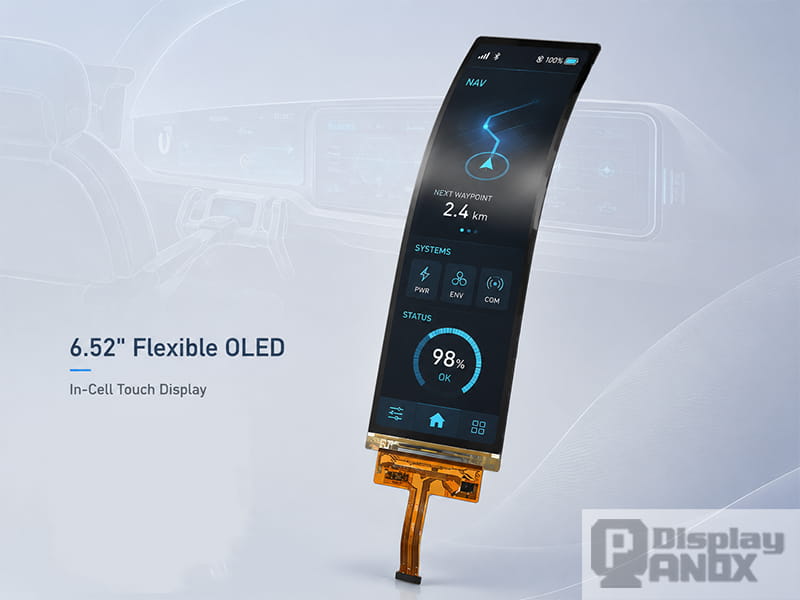
This makes OLED especially interesting for long strip products where the display should feel premium or follow a curved surface. Panox’s 6.52-inch flexible OLED module supports 2520 × 840 resolution, a 3:1 aspect ratio, 407 PPI, MIPI interface, 430 cd/m² luminance and a listed active area of 52.4 × 157.2 mm. The product page describes it as suitable for curved or wraparound screen projects and shows support for HDMI controller board and test kit demonstration.
OLED is not automatically the right answer for every project. Static content, long duty cycles and high-brightness environments need careful evaluation. Analog Devices notes that OLED can suffer from image retention after displaying static images for a long time, and that OLED lifetime is shorter than LCD in its technology comparison. Still, when the product needs a thin, curved, high-contrast display surface, flexible OLED can offer a design freedom that traditional rigid LCD cannot easily match.
Why long strip displays make PC sub-displays feel more useful
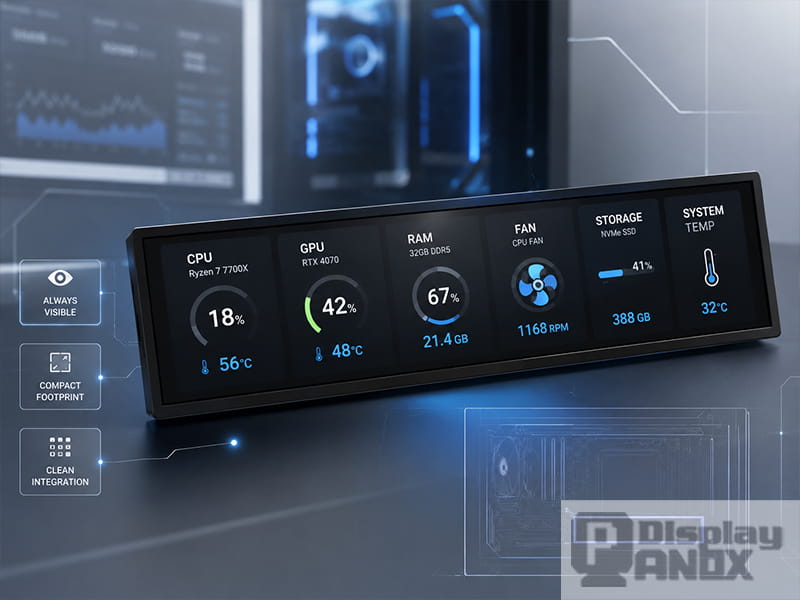
A PC sub-display is a small thing, but it can change the whole desktop experience. Instead of hiding system information inside software windows, a long strip LCD can keep performance data visible at all times. This is why 7.84-inch and 8.8-inch stretched LCDs are popular in AIDA64-style monitoring setups.
Panox’s 8.8-inch long strip LCD uses a 1920 × 480 resolution and a 1:4 active display format. The product page says it is used as a secondary LCD for PC, vehicle and car applications, and also notes that PC gamers use it with AIDA64 to display temperatures, FPS, frequency and memory utilization. Panox also provides HDMI-to-MIPI DSI controller board support for this stretched bar LCD.
The reason this format works is visual rhythm. CPU, GPU, RAM, fan speed, storage and network status can sit side by side in separate blocks. The user does not need a large secondary monitor just to check a few live values. A slim bar display does the job with less desk space and a cleaner setup.
Why interface compatibility matters
A display panel is only useful when it can be driven reliably. This is why interface choice is one of the main reasons engineers select certain long strip modules over others.
Many small and medium long strip LCD/OLED panels use MIPI because it supports compact embedded design. MIPI describes DSI as a high-speed serial interface between a host processor and a display module, with high performance, low power, low EMI and reduced pin count. MIPI also lists use cases such as embedded displays, smart watches, VR/AR head-mounted devices and automotive dashboard displays.
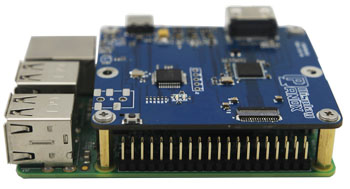
For PC, Raspberry Pi, mini PC or media-player use, raw MIPI may not be convenient. This is where a controller board becomes important. Panox’s long strip category states that customized controller/driver boards can support VGA, HDMI, DVI, DP, Type-C video input, MIPI, RGB, LVDS and eDP, depending on the project. In real development, this can be the difference between a panel that looks good on a datasheet and a panel that can actually be integrated into a working product.
Why retail and signage benefit from narrow displays
In retail, the most valuable display position is often close to the product. Shelf edges, aisle headers and product strips are narrow by nature, so long strip displays fit them well.
Digital signage research gives this format a strong reason to exist. ITU describes digital signage as an innovative medium for targeted information, entertainment, merchandising and advertising, and notes that falling display manufacturing costs and retail growth have supported the spread of high-definition display networks.
A field study in the Journal of Retailing and Consumer Services examined how customers process in-store digital display ads. It found that screen location, content type and shopping-goal relevance affect how customers respond to digital signage. The article also explains that digital signage can be used for product advertising, information presentation, navigation and entertainment, and can support real-time adapted price offers when linked with other systems.
This explains why long strip LCD/OLED screens are useful in shelf-edge displays. The format puts information where the decision happens: price, promotion, stock status, product comparison, QR code or short video content can sit directly beside the product.
Why measurement and specifications should be taken seriously
A stretched display is easy to recognize by shape, but shape alone does not define performance. Brightness, contrast, viewing angle, response, lifetime, interface, active area, outline size, touch structure and thermal behavior all need to be verified.
The Society for Information Display’s International Committee for Display Metrology publishes the Information Display Measurements Standard. SID states that ICDM focuses on the IDMS, which includes about 140 display measurements covering every area of displays, and that the standard provides procedures to quantify electronic display characteristics and qualities.
For sourcing long strip panels, this matters because display numbers can be misunderstood when test conditions are unclear. A 350 cd/m² indoor LCD, a 550 cd/m² automotive auxiliary display and a flexible OLED with different luminance behavior should not be compared only by diagonal size. The environment decides what matters: dashboard readability, shelf lighting, PC desk brightness, handheld viewing distance or industrial operating temperature.
Why customization often decides the final success
Many long strip display projects fail or slow down because the panel is chosen too late. The screen may fit visually, but the FPC direction, connector location, touch panel, cover glass, driver board, mounting space or UI resolution may not fit the product.
This is why customization is not just an add-on service. For long strip displays, it is often part of the core engineering process. Cover glass affects optical performance and mechanical appearance. Touch structure affects thickness and user interaction. Controller boards affect development speed. Connectors and FPC routing affect enclosure design. UI layout affects whether the narrow screen feels clean or cramped.
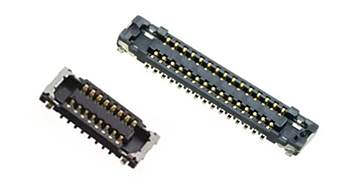
Panox’s long strip category highlights customized service around connectors, cover glass/touch panels and controller/driver boards, and notes that controller boards can support common video input options such as HDMI, DP, Type-C, MIPI, RGB, LVDS and eDP. For developers and product teams, this kind of support is valuable because a display project is rarely just a panel purchase. It is a small system.
Why long strip LCD/OLED displays are worth considering early
A long strip display should be considered early in the product design process because it influences the mechanical structure, UI design, electronics, thermal layout and user experience. Waiting until the enclosure is almost finished can force compromises.
When the screen is planned early, the designer can reserve the right window size, align the active area with the UI, route the FPC cleanly, choose the right interface and decide whether touch or cover glass is needed. The final product usually looks more integrated and feels more intentional.
For many projects, LCD is the practical starting point. It works well for cost-sensitive products, long operating time, stable supply and clear indoor or semi-outdoor readability. OLED is better when the product needs a thin, high-contrast or flexible visual surface. Both technologies have a place. The important thing is to choose based on application conditions, not just visual preference.
Why Panox Display’s long strip range is useful for development
Panox Display’s long strip range covers several product directions. The 2.99-inch long strip LCD fits compact handheld devices such as dictionary pens and scan pens. The 6.8-inch IPS TFT-LCD works for dynamic information displays, rearview mirror concepts, smart home products and industrial devices. The 7.84-inch and 8.8-inch LCDs are suitable for PC sub-displays and AIDA64-style dashboards. The 6.52-inch flexible OLED gives designers a curved, high-resolution OLED option for wraparound or premium interfaces. The 14-inch bar-type TFT-LCD supports higher-resolution touch-bar-style and aviation-style applications.
This variety matters because “long strip display” is not one product. A scan pen display, a PC monitoring bar, a dashboard information strip and a flexible OLED interface all have different priorities. The best choice depends on active area, resolution, brightness, interface, viewing angle, touch requirement, cover glass and development method.
Conclusion
Long strip LCD and OLED displays are becoming essential because modern products need screens that fit real spaces. A narrow display can turn unused product surfaces into useful interfaces. It can make linear information easier to read, reduce layout waste, support cleaner industrial design and create more flexible user experiences.
LCD remains the reliable choice for many long-duty and cost-sensitive applications. OLED brings contrast, thinness and flexibility for premium or curved designs. MIPI, HDMI, Type-C, LVDS and eDP controller support make these panels more practical for different development paths.
The best reason to choose a long strip display is not simply that it looks different. The reason is that the shape can make the product work better. When the display follows the product structure and the information flow, the interface feels less like an added screen and more like a natural part of the device.
Learn more: Where Long Strip LCD and OLED Displays Are Used: Key Applications and Design Considerations
FAQs:
Why choose a long strip display instead of a normal rectangular display?
A long strip display fits narrow spaces more naturally, such as dashboards, shelf edges, scan pens, PC cases, control bars and appliance panels. It is useful when the product needs linear information without adding a large screen.
Why are long strip LCDs commonly used?
Long strip LCDs are mature, cost-effective and available in practical sizes and brightness levels. They are suitable for PC sub-displays, vehicle auxiliary screens, industrial equipment, smart home devices and retail signage.
Why use flexible OLED for a long strip display?
Flexible OLED is useful when the product needs a thin, high-contrast or curved display surface. It works well for premium interfaces, wraparound dashboards, curved control panels and future-looking product designs.
Why is MIPI common in long strip LCD/OLED modules?
MIPI DSI supports high-speed data transmission, low power, low EMI and reduced pin count, which makes it suitable for compact embedded display modules. For PC or Raspberry Pi projects, an HDMI-to-MIPI or Type-C controller board may be easier to use.
Why should the UI be designed specifically for long strip displays?
A long strip screen has a narrow active area, so normal desktop or 16:9 layouts usually do not work well. The UI should be divided into clear zones with large numbers, short labels and simple icons.
Why should engineers check active area and outline size separately?
Active area is the part that displays content. Outline size includes the surrounding structure, bezel, PCB, FPC and other mechanical parts. Both are important for enclosure design, cover glass matching and final assembly.