






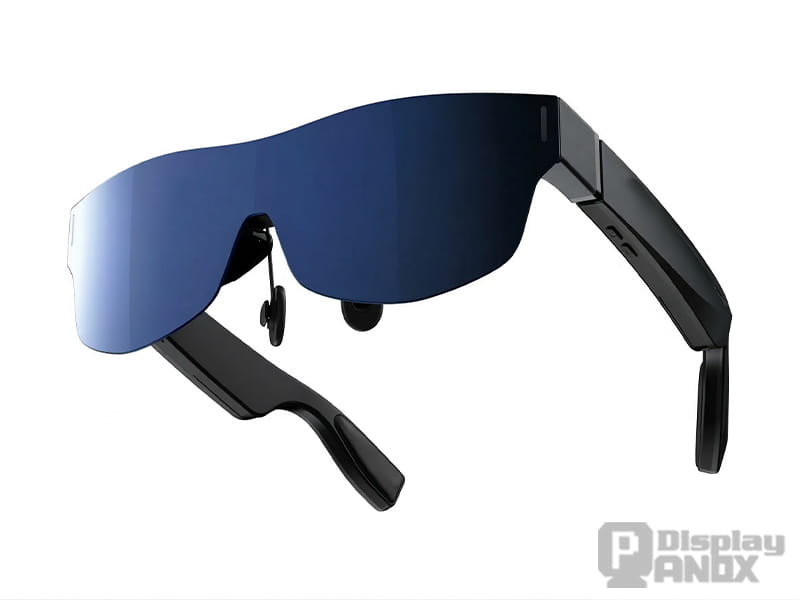
When you wear an AR headset, you might notice something peculiar. The lens looks like a transparent piece of plastic, yet as soon as you power on the device, a digital image appears right before your eyes. How is this possible?
The answer lies in the lens itself: it's built with a technology called waveguide optics, which plays a crucial role in enabling the fusion of the virtual world with reality. But waveguides alone aren't enough — the display technology behind the visuals is just as important, and this is where Micro OLED comes into play.
The Role of Waveguide Optics in AR Glasses
Waveguide optics are designed to bend light within the lens. Here's how it works: a projector inside the AR device generates the image, and the light passes through the waveguide. The light is then reflected within the waveguide, bouncing back and forth, until it exits the other side, entering the user’s eyes. This process allows the display to appear in the wearer’s field of vision while still maintaining transparency, so the real world remains visible.
One of the most popular waveguide technologies is Surface Relief Grating (SRG), which offers several advantages, but it is not without its challenges. The primary benefit of SRG is its thinness, which enables a wide field of view, a critical feature for AR glasses. Thin lenses also make the glasses lighter and more comfortable for extended wear. However, SRG's optical efficiency tends to be lower than that of other waveguide types, meaning it requires more energy to deliver the same brightness level, placing additional strain on the battery.
The Technology Behind SRG Waveguides
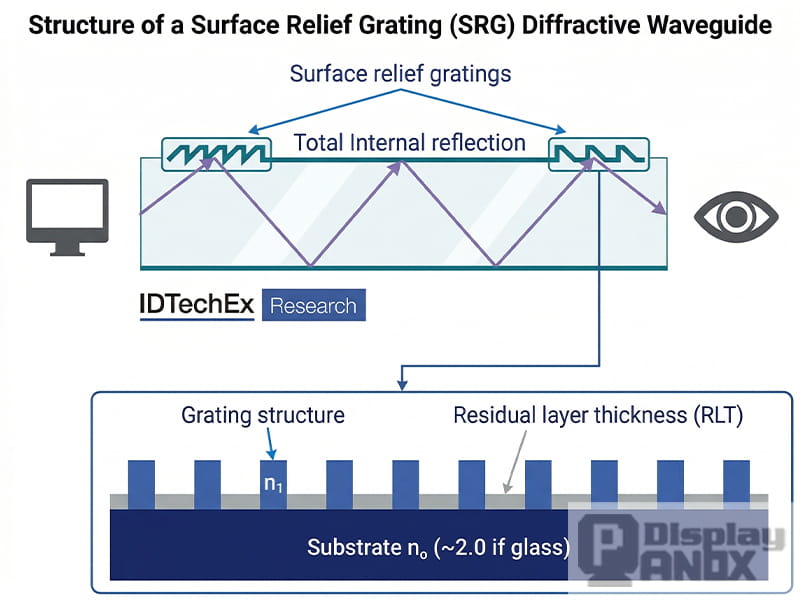
In SRG waveguides, the surface is etched with tiny grooves that redirect light. This technique is quite similar to the way light is manipulated in a typical diffraction grating. When light hits the etched grooves, it bends and reflects multiple times inside the waveguide, eventually being directed into the user’s eyes.
The reason SRG waveguides are so popular is their simplicity and cost-effectiveness. However, there are other types of waveguides, such as reflective waveguides, which can achieve better optical efficiency but at the cost of increased complexity and power consumption.
Micro OLED: A Crucial Component for AR Displays
While waveguide technology ensures that the virtual image is projected correctly into the user’s eyes, the Micro OLED display is what creates the vivid, high-quality visuals. Micro OLED technology has emerged as a game changer in the field of AR displays due to its small size, high pixel density, and superior contrast ratios.
Unlike traditional displays, Micro OLED integrates directly into the optical system of the AR device. Its small form factor allows it to be easily embedded within the frame of AR glasses, ensuring that the display remains compact and lightweight. Moreover, Micro OLED provides deep blacks and high contrast ratios, making it ideal for AR applications where clarity and sharpness are crucial.
Why Micro OLED is Perfect for AR Applications
For AR glasses to function effectively, the display must be able to produce high brightness levels while also being energy-efficient. Micro OLED excels in this regard, offering high luminance with low power consumption. This makes it an ideal choice for AR applications, where long battery life is essential without compromising on visual quality.
Moreover, Micro OLED is known for its wide color gamut and fast response times, making it suitable for dynamic AR environments where images and videos must be rendered quickly and accurately. Whether it's for immersive gaming, real-time data overlays, or hands-free navigation, Micro OLED displays are capable of delivering exceptional visual experiences.
Challenges and Opportunities in the AR and Micro OLED Market
As the AR market continues to evolve, the demand for high-quality, efficient display technologies like Micro OLED will only increase. Industry analysts predict that by 2036, AR smart glasses will reach annual sales of 35 million units, with waveguide technologies such as SRG and reflective waveguides capturing over 70% of the market share.
For companies looking to capitalize on the AR revolution, investing in Micro OLED technology offers a significant opportunity to differentiate products in a competitive market. With its ability to deliver stunning visuals with minimal power consumption, Micro OLED is set to become a cornerstone of future AR innovations.
Conclusion
Waveguide optics, especially SRG technology, are at the heart of AR smart glasses, enabling the seamless integration of virtual and real-world environments. However, to deliver vibrant, clear, and efficient AR experiences, Micro OLED displays are essential. As the AR industry grows, Micro OLED will play a critical role in shaping the future of smart glasses, providing users with more immersive and practical AR experiences.
For companies and consumers alike, now is the perfect time to explore how Micro OLED technology can enhance AR applications and push the boundaries of what's possible in augmented reality.
| Panel model | Interface | Type | Size (inch) | Resolution | P.S |
| S032WEM01 | MIPI/RGB | Micro OLED | 0.32 | 800x600 | |
| PMOF039XGAM | RGB | Micro OLED | 0.39 | 1024x768 | Full Color/Monochrome |
| BO039M1920M | MIPI | Micro OLED | 0.39 | 1920x1080 | Highest PPI =5644 |
| EP047M800T | TTL | LCOS | 0.47 | 800x600 | |
| BO049FHPMO | SPI,MIPI | Micro OLED | 0.49 | 1920x1080 | |
| S050M1600M | MIPI | Micro OLED | 0.5 | 1600x1200 | |
| ECX331DB-6 | Mini LVDS | Micro OLED | 0.5 | 1024x768 | |
| S060LDM01 | MIPI | Micro OLED | 0.6 | 1920x1080 | |
| ECX335AF | Mini LVDS | Micro OLED | 0.71 | 1920x1080 | 200 nits brightness version |
| ECX335B | Mini LVDS | Micro OLED | 0.71 | 1920x1080 | 500 nits brightness version |
| ECX335SN | Mini LVDS | Micro OLED | 0.71 | 1920x1080 | 3000 nits brightness version |
| BO071M1920M | MIPI | Micro OLED | 0.71 | 1920x1080 | |
| S072WCM04 | MIPI | Micro OLED | 0.72 | 1920x1080 | |
| S103WAM01 | MIPI | Micro OLED | 1.03 | 2560x2560 |