



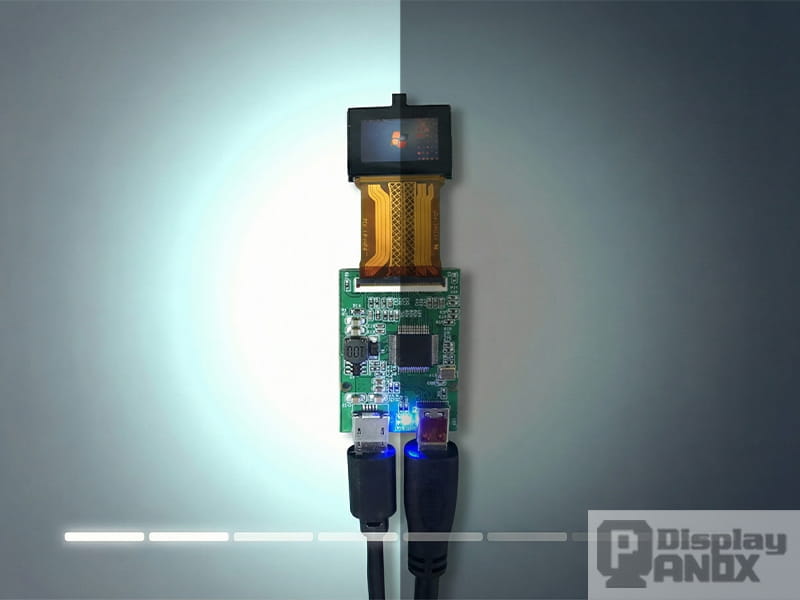
Micro OLED, also called OLEDoS or OLED-on-Silicon, has become one of the most important display technologies for premium AR and VR devices because it combines ultra-high pixel density, fast response, deep black levels, and strong visual immersion in a very small form factor. Sony describes OLED microdisplays as a fit for AR and VR headsets because they pair high resolution with high contrast, wide color gamut, fast response, and high luminance.
When people ask about the lifetime of Micro OLED, the real answer is not a single number. In engineering terms, lifetime depends on luminance, usage pattern, thermal management, materials, and how aggressively the panel is driven. In practical AR/VR discussions, a well-designed Micro OLED system is often discussed in the tens of thousands of hours range, but that headline number only makes sense when you also define brightness and the lifetime standard being used.
Learn more: What is OLEDoS ?
What Is the Typical Lifetime of Micro OLED?
For high-end Micro OLED used in near-eye systems, the most realistic industry framing is that usable lifetime is often discussed around 30,000 to 100,000 hours, but the lower or higher end of that range depends heavily on initial brightness, optical efficiency, and content behavior. Older eMagin microdisplay data showed about 10,000 hours of predicted usable life at very high full-on luminance in a demanding operating scenario, while broader OLED industry references and newer engineering expectations for optimized OLED structures can extend far beyond that under lower-luminance conditions. That is why quoting one universal Micro OLED lifetime without a brightness condition is misleading.
For AR and VR products, this matters even more because headset displays are rarely judged by raw panel life alone. The display may still be functional long after peak luminance has fallen, and in many real products, the battery, optics, thermal design, or other electronics may age out before the display becomes the first failed component. That is one reason Micro OLED lifetime questions should always be answered as a system-level issue, not just a panel-level specification.
Lifetime Usually Means T50, Not “Time Until the Screen Dies”
The most important thing buyers often miss is that display lifetime usually refers to T50. T50 means the time required for luminance to fall to 50% of its initial value. It does not mean the display suddenly stops working at that point. The panel still operates, but brightness headroom is reduced, and color shift may become more noticeable over time.
This is especially relevant for Micro OLED in AR headsets. If a panel starts with very high brightness to overcome optical losses, it may still remain usable for a long time even after measurable luminance decay. So when a supplier says “50,000 hours,” the first follow-up question should be: at what starting luminance, under what content pattern, and under which lifetime definition?
Why Brightness Has Such a Big Impact on Micro OLED Lifetime
Brightness is one of the biggest variables in OLED aging. Sony explicitly states that higher luminance is a central requirement for expanding OLED microdisplay use in AR glasses, and also notes that high-luminance technology is expected to help achieve longer lifetime and lower power consumption by improving light emission efficiency. In other words, if you can get more light out of the device more efficiently, you do not have to drive the OLED as hard to reach the same visual result.
This is why brightness and lifetime are always linked. In OLED research, lifetime is commonly modeled against starting luminance, and published data shows that increasing initial luminance sharply reduces operating life. The same Nature review discussing OLED lifetime notes that blue OLED lifetime improves dramatically when measured or estimated at lower luminance, which reflects the broader OLED rule that more aggressive brightness targets usually cost lifetime.
For AR/VR, this trade-off is even more sensitive because the panel may need to compensate for optical losses in pancake optics, waveguides, or other near-eye architectures. If a headset designer forces the panel to run at very high brightness for long periods, especially in high-APL scenes or bright outdoor-oriented modes, lifetime pressure rises quickly. That does not make Micro OLED unsuitable for AR/VR, but it does mean efficient optics and careful luminance budgeting are critical.
Why Micro OLED Can Be More Durable Than Many People Expect
Micro OLED still uses organic emissive materials, so it is not immune to aging. But its structure offers some meaningful advantages. Sony explains that OLED microdisplays use monocrystalline silicon wafers as the backplane, enabling extremely high pixel density around 4,000 ppi. That silicon-based architecture is one reason Micro OLED is so attractive for compact near-eye systems.
A silicon backplane can also help with stability and heat handling compared with more conventional OLED substrates. Multiple Micro OLED technical explainers and reviews note that silicon backplanes support dense integration, stable electrical performance, and better thermal behavior than glass-based approaches, which is one reason OLEDoS is so strong in AR/VR. While exact thermal benefit depends on module design, the engineering direction is clear: better heat flow and more precise pixel driving help reduce stress on the OLED stack.
Another advantage is efficiency at very small pixel scale. Because Micro OLED is designed for ultra-high-resolution near-eye applications, system designers can achieve excellent image detail without relying on a large direct-view panel area. That does not automatically guarantee longer life, but it does create opportunities for better control over power, brightness distribution, and optical efficiency when the headset is designed well.
Blue OLED Aging Is Still the Hard Part
One reason lifetime discussions remain complicated is that blue OLED materials are still the most difficult part of the stack. The Nature review on display technologies notes that blue OLED has historically had much shorter lifetime than red and green, although major progress has been made through better materials and device structure. This is a core reason color balance and luminance maintenance matter so much in long-term OLED performance.
In practice, this means Micro OLED lifetime is not just about whether the screen remains on. It is also about whether white balance, brightness consistency, and color quality remain acceptable after thousands of hours. For AR/VR devices where visual comfort is critical, this is a more useful way to think about lifetime than a simple “works vs. broken” definition.
Does Micro OLED Burn In?
Yes, Micro OLED can experience burn-in or uneven wear, because it is still OLED. Burn-in is fundamentally uneven pixel aging caused by static content staying in the same place for long periods. This is not unique to Micro OLED, but AR interfaces can create a specific risk because navigation bars, status indicators, and HUD-style overlays may remain persistent in the user’s field of view.
That said, burn-in risk should be discussed realistically. In a well-designed headset, the combination of varied content, smart UI behavior, brightness control, and panel protection features can reduce the practical risk substantially. Official OLED-care guidance from Samsung and ASUS shows that tools such as pixel shift, static-element dimming, and panel refresh are widely used to reduce uneven wear. These are not magic fixes, but they are established mitigation methods.
The Biggest Factors That Determine Micro OLED Lifetime
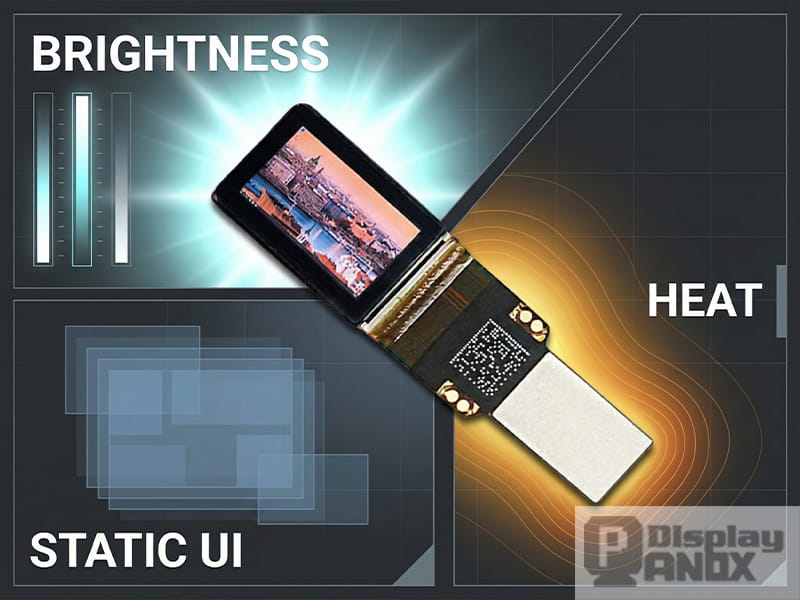
Brightness level
Higher brightness generally shortens OLED lifetime because the device is driven harder. This is one of the most consistent findings across OLED engineering literature and manufacturer guidance. For Micro OLED in AR/VR, brightness target selection is one of the most important lifetime decisions in the whole product architecture.
Static UI and image persistence
Persistent icons, fixed menus, and long-lived overlay elements can cause uneven aging. This matters more in AR than in cinematic VR because AR products may keep the same interface elements visible for much longer sessions. OLED protection mechanisms such as pixel shift and dimming of static logos exist precisely because this risk is real.
Thermal management
Heat accelerates OLED degradation. In compact head-mounted devices, display, driver electronics, optics, and battery layout all contribute to thermal load. Better thermal paths, better optical efficiency, and lower required current all help preserve lifetime. This is one reason silicon-backplane Micro OLED remains attractive for premium near-eye systems.
Optical efficiency of the headset
If the optical path wastes too much light, the display must compensate by running brighter. Sony’s high-luminance approach is explicitly focused on improving light extraction efficiency so the display can reach required performance more effectively. This is a strong reminder that AR/VR display lifetime is not only about the panel itself, but also about the optical engine wrapped around it.
Material stack and architecture
Single-stack, tandem, direct-patterned RGB, white OLED plus color filter, and other structural choices affect both brightness efficiency and aging behavior. Industry development efforts from companies such as Sony, Kopin, and eMagin have repeatedly linked higher efficiency architectures with better lifetime potential.
So How Long Does Micro OLED Last in Real AR/VR Use?
For most premium AR/VR use cases, it is reasonable to say that Micro OLED lifetime is generally long enough for serious commercial products, and often long enough that the display is not the first practical limit in the device. A cautious engineering summary is that tens of thousands of hours is a realistic discussion range, while the exact result depends on how hard the panel is driven and how efficiently the rest of the optical system is designed.
If a headset is tuned for balanced indoor or mixed-use operation, uses efficient optics, controls static UI intelligently, and manages heat well, Micro OLED lifetime can be very strong for consumer and professional products. If the same panel is pushed toward extreme brightness for long sessions, lifetime will drop faster. That is why the best question is not “What is the lifetime of Micro OLED?” but “What is the lifetime of this Micro OLED under this exact AR/VR operating condition?”
That is also why many developers continue to consider Micro OLED for premium near-eye display designs.
How to Extend Micro OLED Lifetime
For product teams, the best strategy is to reduce unnecessary stress rather than chase headline brightness. Improve optical efficiency, tune average picture level, optimize thermal design, avoid overly static UI, and use panel-protection features such as pixel shifting and refresh cycles where appropriate. Those steps align with both OLED engineering practice and official OLED-care guidance.
For end users, the practical advice is simpler: avoid running maximum brightness all the time, do not leave static interface elements on screen unnecessarily, keep automatic protection features enabled, and treat “lifetime” as gradual luminance aging rather than sudden failure. That mindset is much closer to how Micro OLED actually behaves in the field.
Why Micro OLED Still Matters in 2026
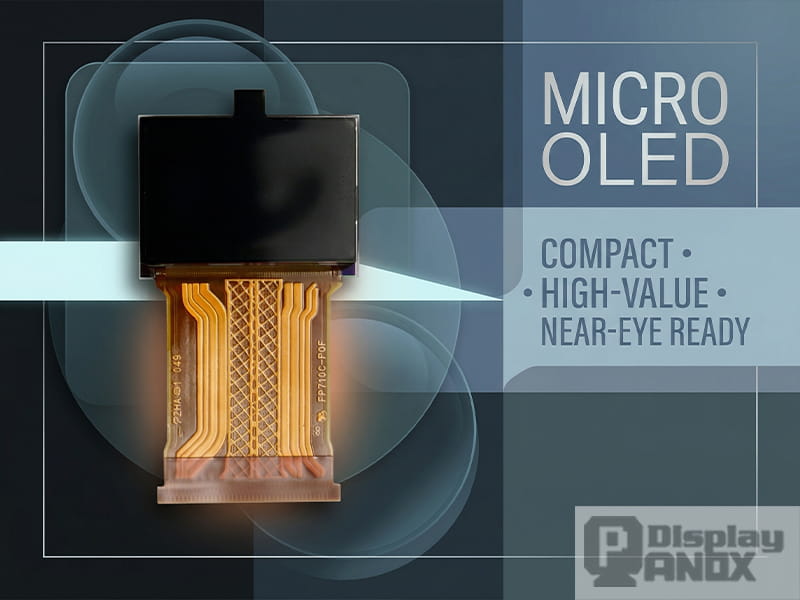
Even with lifetime trade-offs, Micro OLED remains one of the most compelling near-eye display choices in 2026 because it delivers the image quality, compactness, contrast, and response speed that AR/VR products need. Sony continues to position OLED microdisplays for AR and VR, and recent OLEDoS industry reviews still frame the technology as a central platform for XR. In other words, lifetime is an engineering variable to manage, not a reason the technology stops being relevant.
If your goal is to evaluate a Micro OLED for AR/VR, lifetime should be assessed together with brightness target, optical efficiency, thermal path, and UI behavior. That is where good display decisions are made, and that is where strong products separate themselves from spec-sheet marketing.
Looking for a reliable supplier for Micro OLED? Explore our available product options and contact us for more details.
FAQs
How long does a Micro OLED display last?
A practical industry answer is usually tens of thousands of hours, often discussed around 30,000 to 100,000 hours depending on luminance, usage pattern, and lifetime definition. The exact number is highly condition-dependent.
What does T50 mean for Micro OLED?
T50 means the time it takes for the display’s luminance to drop to 50% of its initial value. It does not mean the panel suddenly stops functioning.
Does higher brightness reduce Micro OLED lifetime?
Yes. Higher initial luminance generally reduces OLED operating life, which is why brightness targets must be balanced carefully in AR/VR headset design.
Is Micro OLED more durable than normal OLED?
Micro OLED still uses OLED materials, so it still ages. But its silicon backplane, very high pixel density, and strong suitability for compact optical systems can support better control, efficiency, and thermal behavior than many conventional OLED implementations.
Can Micro OLED burn in?
Yes. Like other OLED technologies, Micro OLED can suffer uneven pixel aging from static content. Protection tools such as pixel shift, static-element dimming, and panel refresh help reduce the risk.
What matters more for AR/VR: panel lifetime or system design?
System design often matters more. Optical efficiency, thermal management, brightness strategy, and UI behavior all strongly influence how long a Micro OLED display performs well in a real headset.
| Panel model | Interface | Type | Size (inch) | Resolution | P.S |
| S032WEM01 | MIPI/RGB | Micro OLED | 0.32 | 800x600 | |
| PMOF039XGAM | RGB | Micro OLED | 0.39 | 1024x768 | Full Color/Monochrome |
| BO039M1920M | MIPI | Micro OLED | 0.39 | 1920x1080 | Highest PPI =5644 |
| EP047M800T | TTL | LCOS | 0.47 | 800x600 | |
| BO049FHPMO | SPI,MIPI | Micro OLED | 0.49 | 1920x1080 | |
| S050M1600M | MIPI | Micro OLED | 0.5 | 1600x1200 | |
| ECX331DB-6 | Mini LVDS | Micro OLED | 0.5 | 1024x768 | |
| S060LDM01 | MIPI | Micro OLED | 0.6 | 1920x1080 | |
| ECX335AF | Mini LVDS | Micro OLED | 0.71 | 1920x1080 | 200 nits brightness version |
| ECX335B | Mini LVDS | Micro OLED | 0.71 | 1920x1080 | 500 nits brightness version |
| ECX335SN | Mini LVDS | Micro OLED | 0.71 | 1920x1080 | 3000 nits brightness version |
| BO071M1920M | MIPI | Micro OLED | 0.71 | 1920x1080 | |
| S072WCM04 | MIPI | Micro OLED | 0.72 | 1920x1080 | |
| S103WAM01 | MIPI | Micro OLED | 1.03 | 2560x2560 |