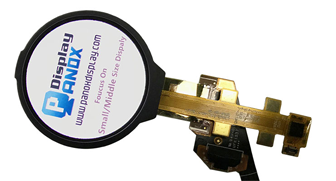




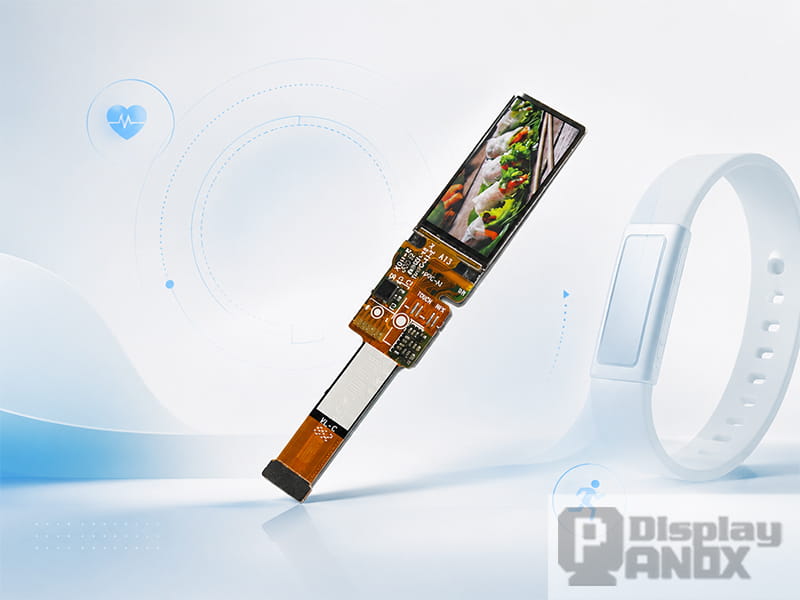
0.95 inch OLED On-cell PACP TP For Wearable Bracelet
A wearable display screen is the compact display panel used in smartwatches, fitness bands, medical wearables, outdoor sports devices, smart badges and other body-worn electronics. Compared with a phone or tablet screen, it has a much smaller active area, a tighter power budget and a more demanding viewing environment. A user may check it indoors, under direct sunlight, while running, during sleep tracking, or with only a quick glance at the wrist.
That is why a good wearable display screen is judged by more than resolution. It must balance power consumption, outdoor readability, touch performance, thickness, shape, interface, color quality and long-term reliability. Modern consumer products also show how central the display has become: Apple describes the Apple Watch display as central to every interaction, from notifications to workout metrics, and its newer wearable OLED design focuses on readability, wider viewing angles and always-on efficiency.
For engineers and product teams, choosing a wearable display panel is really a system-level decision. The screen affects battery life, UI layout, mechanical design, cover glass, firmware, driver board design and the final user experience.
1. What Makes a Wearable Display Different?
A wearable display works in a narrow physical space. The display module must fit into a small housing, leave room for sensors and battery, and remain comfortable on the wrist or body. This creates several design pressures at the same time.
First, the display must consume very little power. A smartwatch or fitness tracker cannot behave like a handheld device that is charged constantly during the day. The screen may need to support always-on watch faces, short wake-up interactions, sports data pages, notifications and low-power idle states. Recent research on AMOLED displays for smart wearable applications explains that wearable screens often keep content in the driver chip memory and update display data only when the screen content changes, which helps reduce power usage at both the display and system level.
Second, the screen must stay readable in changing light. A wearable device may be checked in a dark room, a shopping mall, a gym, a car, or direct sunlight. Brightness matters, but it is only one part of readability. Ambient contrast ratio, surface reflection, cover glass treatment, viewing angle and UI contrast also matter. A major review in Light: Science & Applications lists low power consumption, ambient contrast ratio, high resolution density, wide color gamut, viewing angle, fast response, thin profile and low cost as important display comparison metrics, which fits wearable design very closely.
Third, the display must support a strong industrial design. Round, square, rectangular and strip-type screens all create different product identities. A round AMOLED panel may suit a premium smartwatch face, while a narrow strip OLED or PMOLED panel may be better for a bracelet-style device. Flexible OLED also gives designers more freedom when the product needs a curved surface or a softer visual form.
2. Main Types of Wearable Display Screens
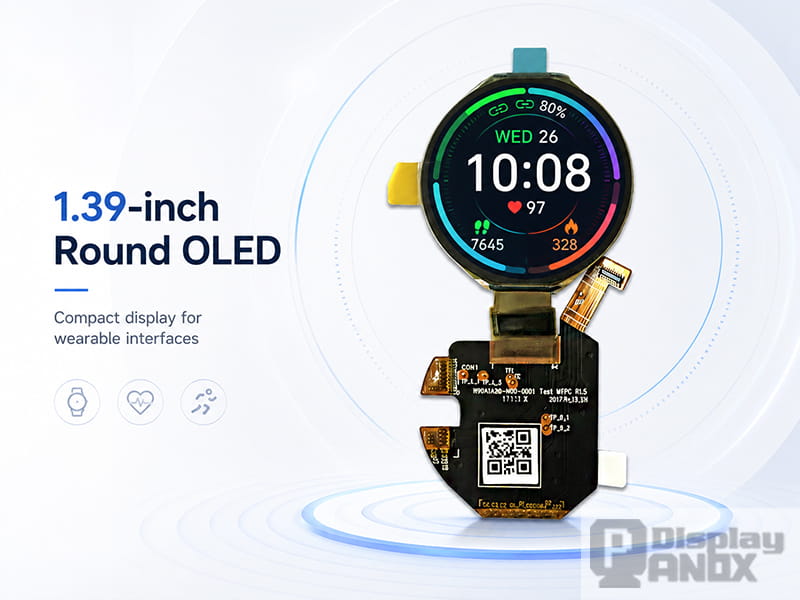
1.39 inch Round/Circular OLED For Wearable Smartwatch
There is no single “best” wearable display technology for every product. The right choice depends on the device category, UI complexity, battery target, viewing environment and cost range.
AMOLED and OLED Wearable Displays
AMOLED is widely used in modern smartwatches because each pixel emits its own light. This allows deep black, high contrast, vivid color and fast response. It also helps with dark UI design, because black pixels can stay off or consume very little power depending on the driving condition. OLED’s self-emissive structure supports thin and lightweight modules, which is valuable for compact wearable devices.
AMOLED is especially suitable for products that need rich watch faces, animated UI, colorful health data, maps, notification cards and premium visual quality. It also supports round and shaped displays very well. In Panox Display’s wearable category, AMOLED options cover compact round, square and portrait modules for smartwatch and bracelet applications, including on-cell touch options and flexible OLED directions.
The trade-off is that AMOLED power consumption changes with brightness, content and operating mode. A bright full-white screen at high refresh rate will consume more power than a dark watch face in idle mode. For wearable projects, the UI should be designed together with display power strategy, including dark background, reduced idle refresh, short boost-brightness time and careful always-on mode design.
PMOLED Displays
PMOLED is often used for simpler wearable interfaces, especially small displays with limited graphics. It can work well for fitness bands, status indicators, simple icons, monochrome or low-color UI, and compact devices where the display does not need a high-resolution smartwatch-style interface.
Compared with AMOLED, PMOLED is usually simpler in structure and easier to apply in small low-information screens. It is less suitable for complex animations, high-density watch faces or large active areas. For simple wearable information display, though, it remains a practical and cost-sensitive option.
Memory LCD and Transflective LCD
Memory LCD and transflective LCD technologies are valuable when the wearable device needs long standby time and outdoor visibility. Sharp explains that Memory LCD integrates a one-bit memory circuit into every pixel, allowing image retention after writing and reducing the need for continuous refresh on still images. Sharp also states that Memory LCD can consume far less power than STN-LCD and AM-TFT LCD while offering reflective display performance without a backlight.
This makes Memory LCD attractive for outdoor watches, sports wearables, industrial badges, low-power meters and always-visible data screens. The image quality is different from AMOLED: colors, contrast and animation performance are usually more limited. Its strength is practical readability and power saving, especially when the displayed content changes slowly.
TFT-LCD and IPS LCD
TFT-LCD and IPS LCD panels can still be useful in wearable or wearable-adjacent products. They are often easier to source, cost-effective, and available with mature interfaces such as SPI, RGB or MCU/CPU-style driving. IPS LCD can provide stable viewing angles and good color for compact embedded devices.
The main limitation is the backlight. A standard TFT-LCD needs a light source, so power consumption and module thickness can become harder to control in very small battery-powered devices. For some industrial wearable terminals, compact controllers, medical equipment or prototype systems, TFT-LCD remains a reasonable option when cost, availability and development simplicity matter more than ultra-thin always-on performance.
MicroLED as an Emerging Direction
MicroLED is becoming an important future direction for premium wearable displays because it can offer very high brightness, strong outdoor readability and high efficiency potential. Garmin’s fēnix 8 Pro MicroLED, for example, is officially described as using more than 400,000 individual LEDs and reaching up to 4,500 nits for direct-sunlight readability.
For most custom wearable projects today, MicroLED may still be limited by cost, supply chain maturity and integration complexity. It is worth watching, especially for outdoor and rugged wearables, but AMOLED, PMOLED, Memory LCD and TFT-LCD remain more accessible choices for many commercial projects.
3. Key Specifications to Check Before Choosing a Wearable Display Screen
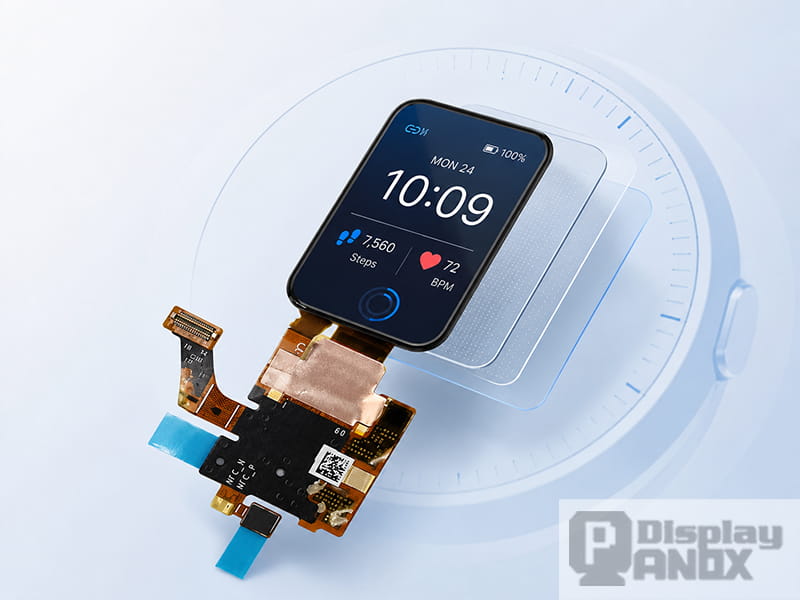
1.6 inch OLED On-cell PACP TP 500cd brightness For Wearable
Power Consumption and Working Modes
Power consumption should be evaluated by real use mode, not only by one brightness number. A wearable screen may work in normal mode, outdoor boost mode, idle mode and standby mode. Research on smart wearable AMOLED power design shows that different modes can have very different power consumption, depending on pixel-on ratio, luminance, refresh rate and standby state.
For a smartwatch-style AMOLED project, ask these questions early:
Can the display support a low-power always-on interface?
How much power does it consume with a dark UI?
How long will the screen stay in high-brightness outdoor mode?
Does the driver IC support memory, partial refresh or idle mode?
Can the firmware reduce refresh rate when the displayed content is static?
For a Memory LCD or transflective LCD project, the focus is different. The question becomes how often the content updates, how much ambient light is available, and whether a front light or backlight is needed for night use.
Sunlight Readability
Sunlight readability depends on brightness, contrast, reflectance and surface structure. A high-nit OLED may perform well outdoors, while a reflective Memory LCD may use ambient light to its advantage. For rugged sports devices, diving equipment, outdoor meters and navigation wearables, sunlight readability should be tested with the actual cover glass, bonding method and UI colors.
Apple’s wide-angle OLED design for Apple Watch Series 10 shows how wearable display development is moving beyond simple front-view brightness. Apple states that the display is up to 40% brighter than the previous generation when viewed from an angle, improving glance readability.
Resolution, PPI and UI Density
Wearable displays are small, so pixel density matters. A low-resolution panel may still work for icons and numbers, but a smartwatch face with text, charts, maps or health data needs sharper rendering. Round screens also need careful UI planning because corners are unavailable and the usable safe area is smaller than the physical diameter suggests.
For premium smartwatch projects, high PPI improves text clarity and watch-face detail. For fitness bands, a portrait or strip display may use fewer pixels but still feel clean if the UI is designed with large numbers, simple icons and strong contrast.
Touch Structure and Module Thickness
Many wearable devices need touch, but adding a separate touch panel can increase thickness and optical loss. On-cell and in-cell touch structures integrate capacitive touch closer to the display layer, helping reduce stack thickness and improve compactness. This is especially useful for smartwatch modules where every fraction of a millimeter matters.
Panox Display’s wearable range includes on-cell AMOLED modules for compact smartwatch designs. For example, the 1.41-inch OLED On-cell PCAP touch module is listed with MIPI interface, 320 × 360 resolution, 60 Hz refresh rate and sunlight-readable wearable use. Another 1.6-inch on-cell AMOLED option is listed with 320 × 360 resolution, SPI/MIPI interface, 500 cd/m² typical luminance, 100% DCI-P3 color and wearable-device application.
Interface and Driver Support
A wearable display panel must match the mainboard, processor, firmware resources and product schedule. Common interfaces include SPI, QSPI, MIPI, RGB and CPU/MCU-style interfaces.
SPI and QSPI are useful for compact displays, simpler UI and lower pin-count designs. MIPI is common for higher-resolution AMOLED panels where bandwidth and image quality are important. RGB or MCU interfaces may fit TFT-LCD projects and embedded systems. For engineering teams, the available datasheet, initialization code, connector, demo kit and controller board support can be as important as the display panel itself.
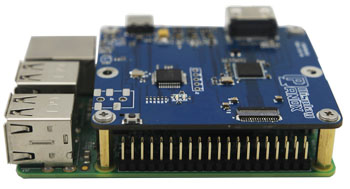
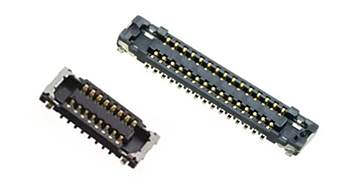
Panox Display’s wearable tag page also emphasizes support around cover glass, touch panels, connectors and controller/driver boards, which is useful when a project team needs more than a bare panel.
4. How to Choose the Right Wearable Display Screen by Application
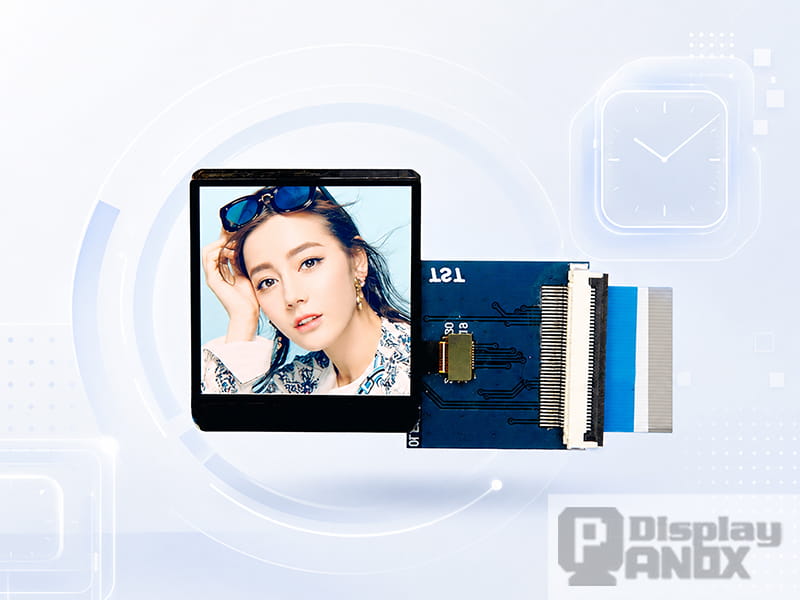
1.63 inch OLED For Wearable Smartwatch
For a consumer smartwatch, AMOLED is usually the first technology to evaluate. It supports vivid UI, dark watch faces, smooth interaction and a premium look. Round AMOLED panels are suitable for classic watch-style designs, while square or portrait AMOLED panels are often better for information-heavy interfaces.
For a fitness band or smart bracelet, the display can be narrower and simpler. A compact AMOLED, PMOLED or strip-type OLED can show steps, heart rate, battery level, workout time and notifications with a clean UI. Power consumption and sunlight readability should stay at the center of the decision.
For outdoor and sports wearables, the display must remain readable under strong ambient light. AMOLED with high brightness can work well for rich interfaces, while Memory LCD or transflective LCD may be more suitable for long-duration always-on data screens.
For medical and industrial wearables, reliability becomes more important. The panel may need stable supply, wide operating temperature, clear data readability, strong cover glass, glove-friendly interaction or a simple interface that can be maintained for years. In these cases, the best display is the one that fits the whole product environment, not the most eye-catching one on a spec sheet.
For curved or design-led wearable devices, flexible OLED can open a different path. Panox Display’s 1.5-inch flexible AMOLED module is listed as an LTPS-AMOLED panel with SPI/MIPI interface, 120 × 240 resolution, lightweight structure and wearable-device use, making it a useful direction for compact curved concepts and bracelet-style designs.
5. Panox Display Wearable Display Screen Options
Panox Display supplies wearable display panels for smartwatches, smart bands and compact wearable electronics. The wearable category covers small display modules for wrist and portable devices, with circular, square and strip-type form factors in AMOLED, PMOLED and transflective LCD technologies. The category introduction highlights low power consumption, outdoor readability, compact thickness and high PPI as core requirements for wearable visualization.
For premium smartwatch projects, AMOLED and on-cell touch modules are suitable when the product needs full-color UI, high contrast and a thin module stack. For bracelet-style products, narrow OLED or PMOLED modules can support lightweight information display. For outdoor and long-standby devices, Memory LCD and transflective LCD options can help improve visibility and reduce display power usage.
Panox Display can also support related integration work such as customized cover glass, touch panel design, connectors and controller/driver board solutions. This is helpful when a wearable project needs panel sourcing, electrical testing and mechanical integration to move forward together.
6. Wearable Display Screen Selection Checklist
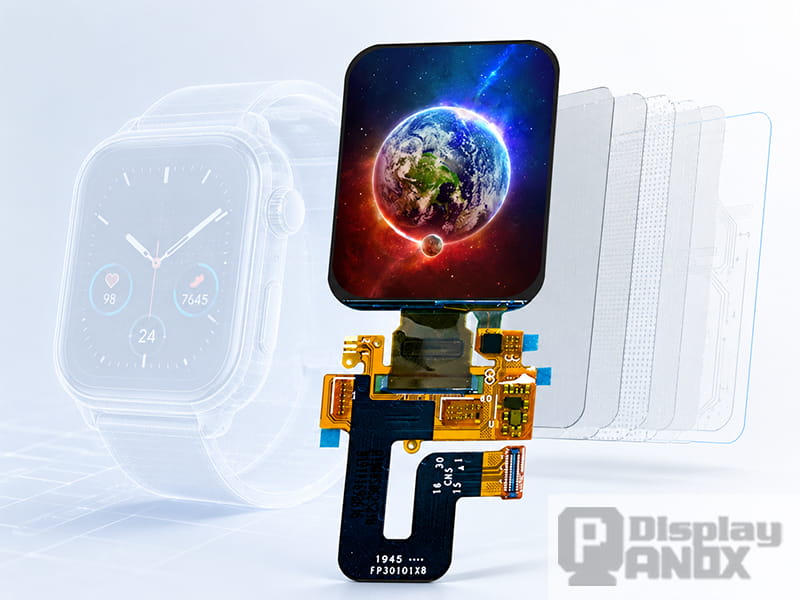
1.78 inch OLED On-cell PACP TP For Wearable Smart Watch
Before selecting a wearable display screen, define the product experience first. A display for a luxury smartwatch, a child tracker, a sports band, a medical wrist device and an industrial smart badge will not use the same priorities.
A practical selection process should include these questions:
What is the target device shape: round, square, portrait or strip?
Will the display be always on, gesture-wake, or mostly off?
Is the device mainly used indoors, outdoors, or both?
Does the UI need full color, animation, maps or only simple data?
What is the battery capacity and target working time?
Which interface can the main processor support: SPI, QSPI, MIPI, RGB or MCU?
Does the project need integrated touch, custom cover glass or optical bonding?
What operating temperature, storage temperature and lifetime are required?
Will the product need stable long-term supply for mass production?
Answering these questions early can prevent many later problems. A beautiful display that consumes too much power, a bright display with the wrong interface, or a thin panel without suitable cover glass support can all slow down development.
7. Conclusion
A wearable display screen is a small component with a large influence on the final product. It shapes the user interface, battery life, industrial design, outdoor usability and even the perceived quality of the device.
AMOLED is a strong choice for premium smartwatches and colorful wearable interfaces. PMOLED works well for simpler compact information displays. Memory LCD and transflective LCD are valuable for long-standby and sunlight-readable devices. TFT-LCD remains practical for cost-sensitive and embedded wearable-related projects. Flexible OLED adds more design freedom when the product needs a curved or lightweight visual form.
For product teams developing smartwatches, fitness bands, medical wearables, outdoor devices or compact smart hardware, Panox Display provides a range of wearable display panels and related support, including AMOLED, PMOLED, Memory LCD, TFT-LCD, on-cell touch options, flexible OLED directions, cover glass customization and driver board solutions.
A good wearable screen should feel effortless to the user. Behind that effortless glance is a careful balance of display technology, power strategy, optical design and product engineering.
FAQs:
What is a wearable display screen?
A wearable display screen is a compact display panel designed for body-worn electronic products such as smartwatches, fitness bands, medical wearables, smart badges and outdoor sports devices. It must be small, readable, power-efficient and suitable for close-range interaction.
What is the best display technology for a smartwatch?
AMOLED is often the preferred choice for premium smartwatches because it offers high contrast, vivid color, thin structure and strong support for dark UI design. For long-standby outdoor watches, Memory LCD or transflective LCD may be more suitable.
Is AMOLED good for wearable devices?
Yes. AMOLED is widely used in wearable devices because it supports thin modules, high contrast, fast response and rich full-color interfaces. The final power performance depends on brightness, UI color, refresh strategy, driver IC and always-on mode design.
What matters more for outdoor wearables: brightness or contrast?
Both matter. Brightness helps, but sunlight readability also depends on ambient contrast ratio, reflection control, cover glass, optical bonding, viewing angle and UI design. A high-brightness display with strong reflection may still be difficult to read outdoors.
Which interface is better for a wearable display screen?
It depends on the panel resolution and host system. SPI and QSPI are useful for compact and lower-bandwidth displays. MIPI is common for higher-resolution AMOLED screens. RGB and MCU-style interfaces can be practical for TFT-LCD and embedded display projects.
Can Panox Display support custom wearable display projects?
Yes. Panox Display supplies wearable display panels and can support related integration needs such as cover glass, touch panel customization, connectors, demo kits and controller/driver board solutions for development and batch projects.