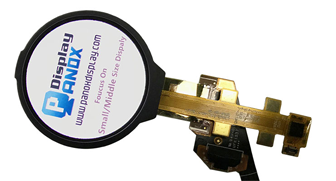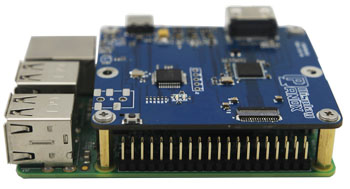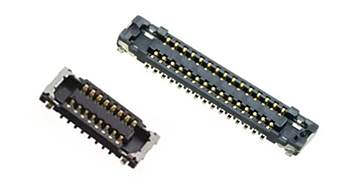




1. Quick Overview: Understand Sony Micro OLED in 3 Minutes
Sony Micro OLED (also commonly referred to as OLED on Silicon / OLEDoS) deposits an OLED emissive layer onto a silicon backplane (CMOS process), rather than a traditional glass substrate. Because silicon processes can produce extremely small pixels, Micro OLED typically achieves very high pixel density. In near-eye displays, this can significantly reduce the screen-door effect, delivering a finer and smoother image.Learn more:high-contrast display panel
Sony Micro OLED’s core selling points usually focus on three areas: high contrast, wide color gamut, and ultra-fast response. These characteristics make it less prone to motion blur in high-speed content and more suitable for AR/VR optical systems designed for near-eye, magnified viewing. Beyond headsets, Micro OLED has also been widely used in professional camera electronic viewfinders (EVF) as well as medical and industrial optical equipment—typical scenarios where space is limited and image quality must be maximized.
2. What Is Sony Micro OLED (OLEDoS)?
2.1 Micro OLED vs. Conventional OLED: What’s the Difference?
Micro OLED is not simply “making a smartphone OLED smaller.” The key differences lie in the backplane and manufacturing approach:* Backplane material: silicon wafer (CMOS) vs. glass/plastic (e.g., LTPS)
* Pixel density: semiconductor lithography enables smaller pixels and higher PPI, better suited for magnified near-eye viewing
* Product positioning: a microdisplay for near-eye displays and optical systems, rather than a general consumer panel
In other words, conventional OLED is strong in large-area scalability and a mature supply chain; Micro OLED is strong in ultra-high pixel density and miniaturization, aligning more closely with AR/VR’s “optics + display” combined requirements.
2.2 How to Quickly Read Key Specifications
Here is an “engineering viewpoint” translation of common specs into practical judgments:* Brightness and Duty Drive (duty cycle)
Near-eye displays often use low persistence to reduce motion blur, which reduces the on-time. A rough way to understand it is:
Average brightness ≈ peak brightness × duty
For example, “1000 nit @ 20% duty” means maintaining average brightness with a shorter on-time, making the system more sensitive to peak brightness and drive capability.
* Contrast and black level
OLED’s self-emissive nature enables cleaner blacks and stronger tonal layering, which is a key factor behind the “premium look” of VR/MR immersion.
* Interfaces (bandwidth and ecosystem)
AR/VR devices often focus on balancing bandwidth and power consumption for solutions such as MIPI (D-PHY). Some traditional professional devices (e.g., certain EVF solutions) may place greater emphasis on interference immunity and engineering stability (such as LVDS families).
* Response time (core to motion clarity)
Micro OLED response is typically very fast. Combined with high refresh and low-persistence driving, it helps reduce smear and motion blur during head turns. In writing, it is recommended to consistently use a “microsecond-level response” description to avoid internal inconsistency caused by mixing with “millisecond-level” wording.
3. Sony Micro OLED Product Lineup: Key Models and “Why They Matter”
| Model | 0.68 inch Micro OLED 5000 Brightness Fast Response |
0.71 inch Micro OLED 1920x1080 LVDS 3000 nits |
0.71 inch Micro OLED FHD For AR |
0.5 inch micro OLED For AR |
| Image | 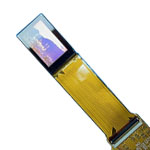 |
 |
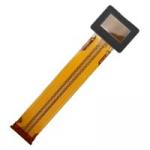 |
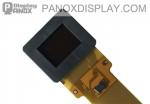 |
| Size | 0.68inch | 0.71inch | 0.71inch | 0.5inch |
| Resolution | 1920 × 1200 (WUXGA) | 1920(RGB)×1080, FHD 3078 PPI |
1920x1080 | 1024x768 |
| Interface | SPI,LVDS | LVDS | LVDS | LVDS |
| Brightness | 5000 cd/m² | 3000 cd/m² (Typ.) | 230 cd/m² (Typ.) | 500 cd/m² (Typ.) |
| Active Area | 15.84 × 9.90 mm | 15.8(W)×8.99(H) mm | 15.8X8.99 mm | 10.336(W)×7.801(H) mm |
| Refresh Rate | 60–120 Hz | 60 Hz | 60Hz | - |
| Aspect Ratio | 16:10 | 16:9 (H:V) | 16:9 (H:V) | - |
| Contrast Ratio | >100,000:1 | 10000:1 (Min.) (TM) | 10000:1 (Typ.) (TM) | 100000:1 (Typ.) (TM) |
Sony’s Micro OLED products commonly cover multiple near-eye needs: from AR-glasses-leaning priorities such as high pixel density and high brightness, to VR/MR-leaning priorities such as high resolution and low-persistence motion performance. When writing this section, it is recommended to use a table to list “size / resolution / brightness (including duty conditions) / interface / typical use” side by side—readers will more easily build an intuitive link of “model = scenario,” rather than only remembering a string of specifications.
News:AR Glasses on the Verge of a Breakout: Shipments to Reach 32.1 Million Units by 2030, Surging 50× from This Year
4. Applications of Sony Micro OLED
Near-Eye Visual Experience Concept (Micro OLED Focus)
4.1 AR/VR Headsets & MR: The Core of Near-Eye Displays
In AR/VR devices, the screen sits very close to the eyes, so any weakness is amplified. As a result, Micro OLED’s advantages are very direct:* Ultra-high PPI: remains fine after lens magnification, significantly reducing the screen-door effect
* High contrast: purer blacks and stronger layering; dark scenes (starfields, night scenes, sci-fi scenes) look more “real”
* Fast response + high refresh: helps reduce motion smear and blur, strongly affecting comfort and immersion
This part of your original draft had strong marketing impact; only some absolute wording was slightly restrained to make it more defensible.
4.2 Camera EVF: A “Digital Window” for Professional Photography
EVF is a very mature battlefield for Micro OLED, and the advantages are easier to understand: the closer the image is to real exposure and color, the faster the shooting decisions.* What you see is what you get: contrast and gamut help judge exposure, shadow detail, and highlight clipping more directly
* Low-smear tracking: during panning and continuous AF tracking, it is less likely to become a distracting “blurred mess”
4.3 Medical & Industrial Optics: The “Micro Core” of Precision Systems
In medical and industrial fields, Micro OLED’s value is often not “looking prettier,” but “delivering reliable high information density in an extremely small space.”* More compact modules: highly integrated drive circuits support miniaturized optical systems
* More visible detail: high resolution helps observe fine structures (e.g., tissue texture, boundary details)
* Fits harsh scenarios: embedded devices with strict requirements for power, volume, and stability are also common
5. Why Micro OLED Is Best for AR/VR
5.1 Image Quality: Black Level Defines the “Premium Feel”In near-eye displays, black level and contrast directly shape the base of “realism.” Self-emissive pixels can switch independently, keeping dark scenes cleaner and making spatial layering in virtual environments easier to establish.
5.2 Clarity: High PPI Is the Foundation of Immersion
Near-eye displays most fear “graininess” and “pixel grid visibility.” High PPI makes pixels harder to perceive, so the image feels more like a continuous real world rather than a display “covered by a grid.”5.3 Speed: Low Smear and Low Persistence Determine Comfort
High refresh improves fluidity, while low persistence mainly targets the motion problem of “everything smears when you turn your head.” Combined together, and supported by fast response, interaction becomes more natural and discomfort is reduced.6. Micro OLED vs. Micro LED vs. LCoS: Which Fits Which Device?
Near-eye displays have no “single truth,” only the solution that best matches the product positioning. The conclusion logic can usually be written like this:* Micro OLED: strong in image quality and miniaturization; one of the most mainstream and mature routes in today’s high-end VR/MR
* Micro LED: stronger brightness potential, especially attractive for outdoor see-through AR, but full-color integration, mass production, and uniformity remain key barriers
* LCoS: still has practical engineering advantages in cost, ecosystem, and certain optical engine approaches, often used as a more pragmatic choice
| Technical Metrics | Micro OLED (OLEDoS) | Micro LED (LEDoS) | LCoS (Liquid Crystal on Silicon) |
| Brightness Potential | Moderate (Limited by organic lifespan) | Ultra-High (Inorganic, millions of nits) | High (Depends on light source) |
| Maturity | High (Complete supply chain) | Low (Full-colorization bottleneck) | Very High (Extremely mature) |
| Cost | Medium (Decreasing with volume) | Ultra-High (Mass transfer challenges) | Low (Best cost control) |
| Production Status | Mass Commercialization | R&D / Early Pilot Stage | Mature Mass Production |
| Engine Volume | Small (Self-emissive) | Ultra-Small (Most compact) | Larger (Requires external source/PBS) |
| Color & Black Level | Excellent (Pure black, high contrast) | Excellent (High contrast) | Average (Reflective, impure blacks) |
| Recommended For | High-end MR/VR, HD Cinema | Ultra-light All-weather AR | Entry-level AR, Info-prompts |
7. Panox Display Expert Views (in a More “Interview Summary” Tone)
How we view the strengths of Sony Micro OLEDIn high-end AR/VR projects that pursue extreme image quality and consistency, Sony Micro OLED’s advantages are very direct: high pixel density enables finer near-eye presentation, while high contrast and color consistency make binocular fusion more stable and visuals more uniform. For optical engine designs that are highly sensitive to size and weight, it also makes it easier to achieve results that are both “workable and good-looking” within limited space.
The most common pitfalls in customer selection
What is most commonly underestimated in engineering implementation is thermal management and the brightness chain: sustained high temperature affects lifetime and color stability, while optical systems (such as Pancake) can introduce significant optical efficiency loss—so the final brightness to the eye is not equal to the specified brightness. It is recommended to budget cooling, duty cycle, and target eye-box brightness together early, confirm interface and bandwidth plans in advance, and manage long-term static content risk with measures such as pixel shifting.
8. Conclusion: Who Is Sony Micro OLED For, and What’s Next?
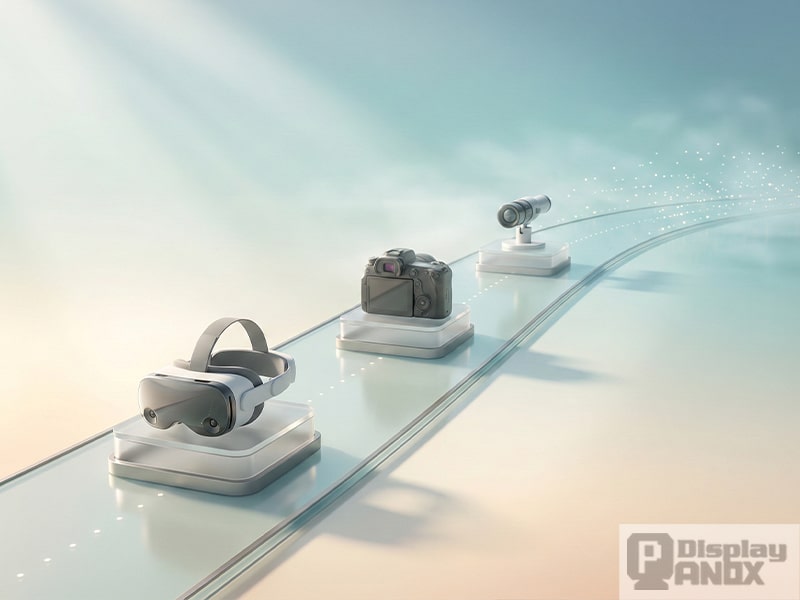
Micro OLED Use Cases (AR/VR, EVF, and Precision Optics)
8.1 Who Is Sony Micro OLED Best For?
If your product targets high-end AR/VR/MR headsets, or needs “retina-level fineness” for professional EVF and medical/industrial optical systems, Sony Micro OLED’s advantages can translate very directly into user experience and product strength. It is especially suitable for projects that demand top-tier image quality, compactness, and binocular consistency, and are willing to pay for a mature supply chain and stable yield.Learn more:What Are the Key Features of Medical Device Display Solutions?
8.2 Next: The Evolving View of Spatial Computing
Future progress will likely focus on three things: higher brightness (especially for outdoor AR needs), higher resolution, and lower-smear driving design. As processes and ecosystems mature and costs continue to drop, Micro OLED may also expand from high-end markets into broader consumer form factors—helping “spatial computing” move from niche experiences toward more mainstream productization.News:Samsung Reportedly Begins Producing OLEDoS Displays for Galaxy XR Headset, Joining Sony as Panel Supplier