






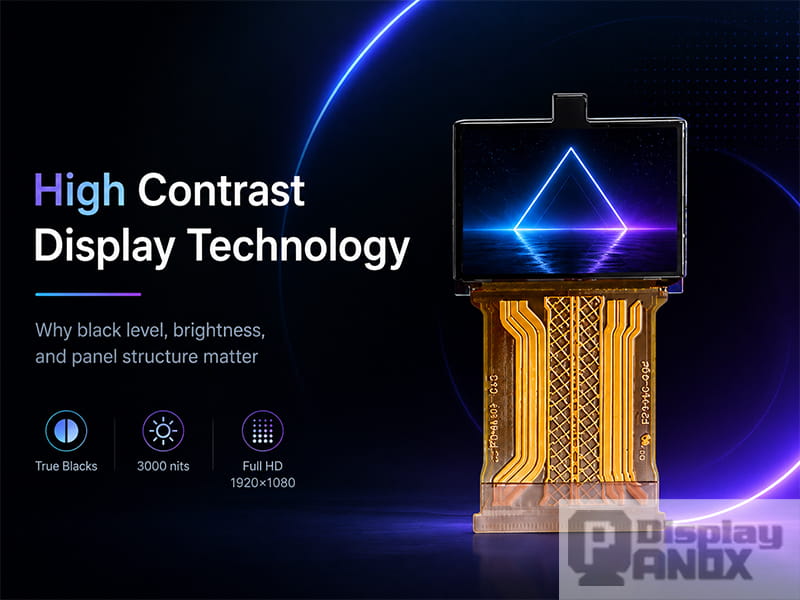
0.71 inch Micro OLED 1920x1080 LVDS 3000 nits
High contrast display technology is one of the most important factors behind a clear, vivid and comfortable screen. Resolution tells users how many pixels a display has, brightness tells them how much light it can produce, and color gamut tells them how wide the color range can be. Contrast decides how much visual separation exists between the deepest black and the brightest white on the same display.
That separation is what gives an image depth. It helps white text remain readable on a dark interface, makes UI icons look sharper, keeps shadow detail visible in video, and allows a small display to feel more precise than its physical size suggests. For compact OLED modules, Micro OLED panels, VR displays, handheld devices, wearable screens and high-resolution LCD panels, contrast is often the difference between a screen that simply turns on and a screen that feels usable in a real product.
For engineers and product developers, high contrast should be understood as a system-level display quality. It comes from panel structure, light control, surface treatment, driving method, touch stack, cover glass, ambient light conditions and image tuning. A display may have an impressive contrast ratio in a dark-room datasheet, while another panel may look more readable in an actual device because it handles reflection, viewing angle and brightness more effectively.
Panox Display supplies OLED, AMOLED, Micro OLED, flexible OLED and high-resolution TFT-LCD panels for different product categories. In high contrast display applications, the right choice depends less on chasing the largest number and more on matching the display technology to the optical environment, product form factor and user scenario.
What Is Contrast Ratio in a Display?
Contrast ratio describes the difference between the luminance of white and the luminance of black. In simple terms, it compares how bright the brightest state is against how dark the darkest state is. A higher contrast ratio usually means darker blacks, stronger visual depth and clearer separation between foreground and background elements.
However, contrast ratio can be measured in different ways. A full-on/full-off test compares a completely white screen with a completely black screen. This method often produces a large number, especially for emissive displays. ANSI contrast uses a checkerboard pattern, measuring black and white areas at the same time. This is usually closer to what users see when a real interface contains bright and dark elements together.
There is also ambient contrast ratio, which considers the effect of surrounding light. This is particularly important for mobile devices, outdoor instruments, automotive displays, medical handhelds and AR/VR-related applications. Even a display with excellent dark-room contrast can lose perceived black depth when reflections lift the black level. Once ambient light hits the surface, the viewer no longer sees only the display’s own black state; they also see reflected light from the environment.
This is why high contrast display technology cannot be judged by one datasheet number alone. A useful evaluation should ask three questions:
-
How low is the panel’s black level in the intended operating condition?
-
How much luminance can the panel maintain without washing out color and grayscale?
-
How much ambient reflection does the front surface introduce?
For product design, these questions are more practical than asking which panel has the highest advertised contrast ratio.
Why High Contrast Matters More Than It First Appears
High contrast improves perceived sharpness. Even when two displays have the same resolution, the one with deeper blacks and stronger edge separation often appears clearer. This matters for small screens because users may read fine UI elements, icons, menus, instrument values or camera information within a very limited active area.
High contrast also improves low-light usability. In dark environments, a weak black level can make the whole interface look gray. For OLED and Micro OLED panels, pixel-level light control allows black UI areas to stay extremely dark, which is useful for night modes, viewfinders, wearable screens and near-eye display systems.
In bright environments, contrast becomes closely linked to brightness and reflection control. A display used outdoors or inside a vehicle must fight ambient light. The panel needs enough luminance, but it also needs low surface reflection and a suitable optical stack. Increasing brightness alone can help, yet it may raise power consumption and heat. A better design balances luminance, anti-glare treatment, bonding, cover glass and UI color choices.
High contrast also supports better visual hierarchy. In industrial control interfaces, dark backgrounds can separate warning icons, measurement data and navigation elements. In medical or inspection devices, contrast helps users distinguish subtle information. In 3D printing and exposure systems, high-resolution LCD panels must control light precisely, so contrast and pixel-level optical behavior affect the clarity of the final pattern.
How OLED Achieves High Contrast
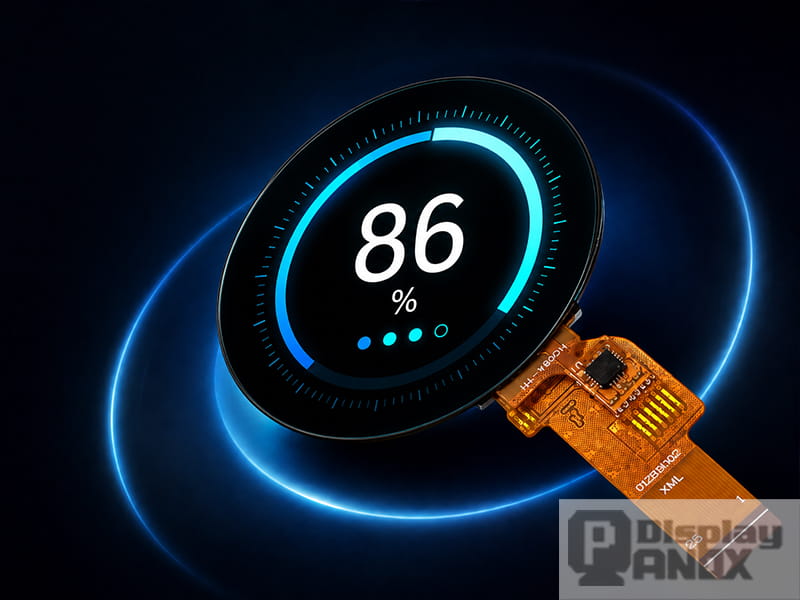
1.28 inch Round LCD TFT 240X240 SPI 55Hz PCAP Touch Panel
OLED and AMOLED displays are naturally strong in contrast because each pixel emits its own light. When a pixel is asked to display black, it can greatly reduce or stop light emission at that point. This is different from a backlit LCD structure, where a backlight shines through liquid crystal layers and filters.
This pixel-level light control gives OLED panels several advantages in high contrast display technology. Dark UI backgrounds look cleaner, bright objects can appear next to black areas with strong separation, and the image does not rely on global backlight behavior. OLED also tends to have fast response, which helps motion clarity and reduces smearing in many applications.
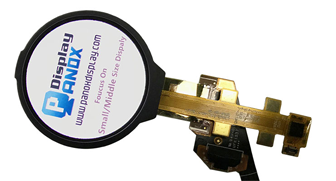
For compact devices, OLED is especially attractive because the display can be thin, light and visually rich. Panox Display’s high-contrast product range includes small AMOLED panels for wearables and handheld devices, such as compact round or rectangular modules, as well as larger AMOLED and flexible OLED panels for premium mobile and embedded applications.
A high contrast OLED panel is often a good fit for:
-
Smart wearable devices with dark UI design
-
Handheld instruments that require clear icons and menus
-
Portable monitors and compact control displays
-
Premium mobile or tablet-like devices
-
Flexible or curved product concepts
-
Near-eye or viewfinder-style applications using Micro OLED
OLED still needs careful integration. Static UI elements, thermal design, long-term brightness behavior, touch stack transparency and cover glass reflection can all influence final performance. A panel with strong native contrast should still be paired with the right driving board, optical adhesive, front glass and interface tuning.
Why Micro OLED Is Important for High Contrast Display Technology
Micro OLED, also called OLED-on-silicon or Si-OLED, uses a silicon backplane to achieve extremely high pixel density in a very small display area. This makes it valuable for AR, VR, electronic viewfinders, FPV systems, optical modules and compact imaging devices.
In near-eye applications, high contrast is more than a visual preference. The display is magnified by an optical system, so black level, pixel structure, brightness uniformity and grayscale control become highly visible. A weak black state can make the virtual image look hazy. Strong contrast helps text, symbols and image details stay legible after the light passes through lenses, prisms or waveguides.
Panox Display’s high contrast category includes Micro OLED options such as FHD-class micro displays, high-PPI Si-OLED panels, and compact modules with MIPI, LVDS, RGB or SPI-related driving options depending on the model. For product developers, the main selection factors are usually resolution, pixel density, luminance, interface, optical engine compatibility and the availability of a suitable driver board.
Micro OLED is commonly selected when the product needs:
-
Very high pixel density in a small active area
-
Deep black for near-eye viewing
-
Fast response for motion or video
-
Compact module size
-
Compatibility with optical systems
-
High visual precision for symbols, camera preview or immersive content
A Micro OLED panel should be evaluated with the final lens or optical path, because perceived contrast after magnification may differ from panel-only measurement. Reflection, optical efficiency and image size all affect the final result.
How LCD Panels Can Improve Contrast
LCD panels use a backlight. The liquid crystal layer modulates how much light passes through each pixel, while color filters create the image. Because the backlight exists behind the panel, LCD black levels are usually limited by light leakage. Even when the image is black, some light may pass through the stack.
That does not make LCD unsuitable for high contrast applications. Modern TFT-LCD panels can still deliver excellent readability, high resolution, stable supply, strong brightness options and cost-effective integration. The contrast requirement simply needs to be understood in a different way.
LCD contrast can be improved through panel mode, polarizer quality, optical films, black matrix design, backlight control, local dimming in larger systems, anti-reflective surface treatment and good mechanical integration. High-resolution TFT-LCD panels are also widely used in 3D printing, VR, tablet-style displays, industrial devices and embedded systems where resolution, brightness, interface availability and reliability are just as important as black depth.
Panox Display’s high contrast category includes TFT-LCD options for VR, 3D printing, tablets and embedded display systems. Examples include high-resolution LCD panels with MIPI, LVDS or eDP interfaces, as well as compact TFT modules for handheld and control applications. In these cases, contrast should be evaluated together with pixel density, aperture ratio, viewing angle, transmittance and backlight design.
LCD remains a practical choice when the product needs:
-
High brightness under stronger ambient light
-
Mature interface and controller options
-
Stable long-term supply
-
Good cost-performance balance
-
High-resolution exposure or imaging use
-
Larger screen sizes where OLED cost may be higher
The key is to avoid treating LCD and OLED with the same selection logic. OLED wins when deep black and pixel-level contrast are the priority. LCD can be more suitable when brightness, cost, durability, availability or exposure-system requirements are more important.
Static Contrast, Dynamic Contrast and Ambient Contrast
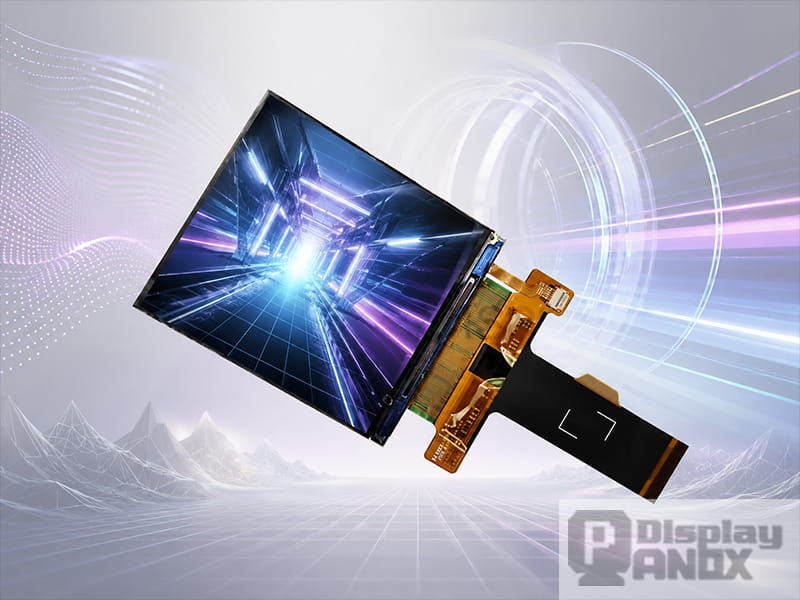
2.9 inch LCD 2K Resolution 90 Hz For VR
A common mistake in display selection is comparing contrast numbers without checking how they were measured. Three terms appear often in display discussions: static contrast, dynamic contrast and ambient contrast.
Static contrast usually describes the relationship between the brightest and darkest states under fixed test conditions. This is useful for comparing native panel behavior, especially when the test method is clearly stated.
Dynamic contrast involves brightness control over time. In LCD systems, this may come from dimming the backlight in dark scenes and raising it in bright scenes. In OLED systems, image processing and pixel driving can also influence perceived contrast. Dynamic contrast numbers can look impressive, but they may not describe what happens in a mixed real-world interface.
Ambient contrast describes readability when external light is present. This is critical for outdoor, automotive, industrial and portable devices. A display with lower dark-room contrast may sometimes look better in ambient light if it has higher brightness, lower reflectance and better optical bonding.
For a product engineer, ambient contrast is often the most honest question: can the user still read the screen where the product is actually used?
High Contrast and Brightness Need to Work Together
Contrast and brightness are closely related, but they solve different problems. Contrast creates separation. Brightness helps the display overcome ambient light. A display that is very bright but has poor black level can look washed out in dark scenes. A display with excellent black level but insufficient brightness can look weak under sunlight or strong indoor lighting.
Research on ambient contrast ratio shows that in low ambient light, native contrast plays a major role. As ambient light increases, brightness becomes increasingly important. This is easy to understand from a user’s point of view. In a dim room, black depth makes the image feel rich. Under bright light, the display also needs enough luminance to keep white, color and mid-tones visible above reflections.
For this reason, high contrast display technology should be selected by scenario:
| Application Scenario | Display Priority | Suitable Technology Direction |
|---|---|---|
| Wearable device | Deep black, low power UI, small module size | AMOLED or small OLED |
| AR / viewfinder | High PPI, deep black, fast response | Micro OLED |
| Handheld instrument | Readability, interface clarity, touch integration | AMOLED or TFT-LCD depending on brightness need |
| 3D printing / exposure | High resolution, pixel precision, optical control | High-resolution TFT-LCD |
| Industrial control | Stable supply, brightness, readability | TFT-LCD or AMOLED |
| Premium portable display | Color, contrast, slim structure | AMOLED or OLED |
| Flexible device concept | Thin profile, bendable structure, high contrast | Flexible OLED |
This table should be treated as a selection guide rather than a strict rule. Final choice depends on the whole product design.
The Role of Touch Panel, Cover Glass and Optical Bonding
Many display projects lose contrast after integration. The bare panel may look excellent during testing, while the finished module looks dull because the front stack adds reflection or haze.
Touch panels, cover glass, air gaps, adhesives, anti-glare coatings and mechanical bezels all affect perceived contrast. An air gap between the cover glass and display can increase internal reflection. Poor surface treatment can turn black areas gray under ambient light. A thick or low-transmittance touch stack can reduce brightness and color clarity.
Optical bonding can help by reducing internal reflection and improving outdoor readability. Anti-reflective or anti-glare glass may also be useful depending on the product. For industrial or handheld products, the cover lens must balance optical quality with strength, chemical resistance, impact resistance and touch performance.
Panox Display supports customized cover glass and touch panel services, including capacitive touch integration and cover glass selection. For high contrast projects, this service is not an accessory detail. It is part of the image quality design.
Driver Boards and Interface Choices Affect Final Contrast
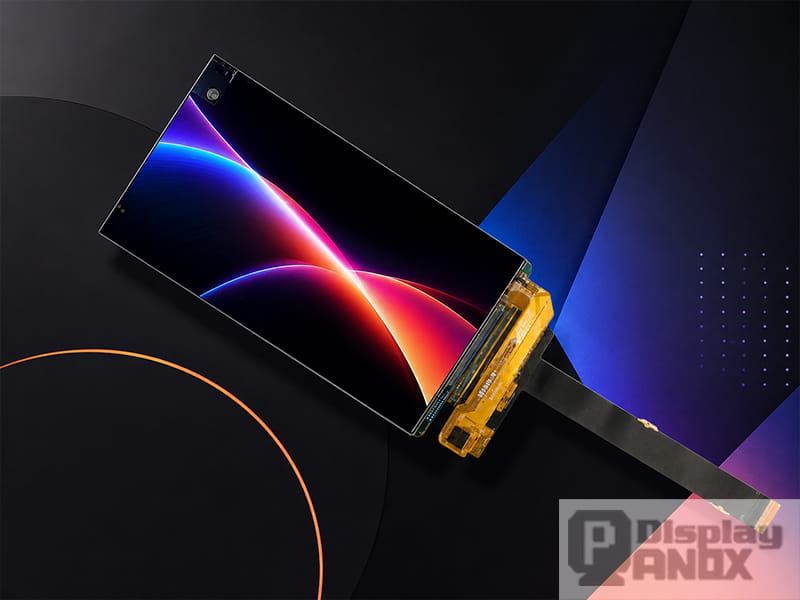
5.5 inch OLED FHD On-cell PACP TP For Cellphone
A high-quality panel still needs the right driving solution. Gamma setting, brightness control, power sequencing, refresh rate, color depth, interface bandwidth and signal stability all affect display performance.
For OLED and AMOLED, driver tuning can influence grayscale behavior, low-brightness detail, color uniformity and power behavior. For LCD, backlight driving, PWM frequency, current stability and gamma curves are important. In VR or high-resolution applications, the interface must support the required timing without artifacts.
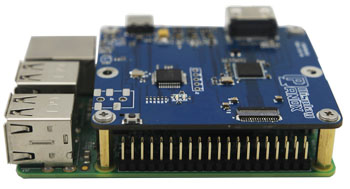
Panox Display provides controller and driver board solutions for interfaces such as HDMI, Type-C video input, MIPI, RGB, LVDS and eDP depending on project requirements. This matters for customers who need to connect a display panel to a PC, Raspberry Pi, embedded board, mobile platform or custom hardware. Instead of treating the panel as a separate part, the display, driver board, connector, touch panel and cover glass should be designed as one visual system.
How to Choose a High Contrast Display Panel
A good high contrast display panel should be chosen from the application backward. Start with the environment, then define the display technology.
For indoor wearable products, AMOLED is often a strong option because it supports dark UI design, compact size and excellent black levels. For AR and optical modules, Micro OLED is usually more suitable because high pixel density and deep black are essential after magnification. For embedded products requiring larger active areas, high-resolution TFT-LCD or AMOLED may both be suitable depending on budget, brightness and lifetime requirements. For 3D printing and exposure systems, the decision should focus on resolution, transmittance, monochrome or color structure, pixel precision and interface compatibility.
When comparing panels, review these practical points:
-
Native contrast and black level
-
Brightness under the required operating condition
-
Surface reflection and cover glass design
-
Resolution and pixel density
-
Viewing angle and color shift
-
Interface type and driver board availability
-
Touch panel requirement
-
Power consumption and thermal design
-
Mechanical outline and FPC direction
-
Supply stability and customization support
The best high contrast panel is the one that keeps the target content readable, stable and visually clean inside the finished product.
Panox Display High Contrast Display Solutions
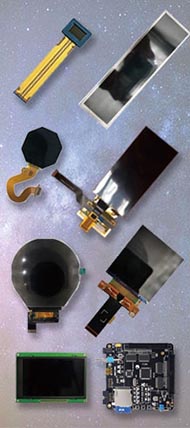
Panox Display’s high contrast product category covers multiple display technologies, including Micro OLED panels for AR and optical systems, AMOLED panels for handheld and wearable devices, flexible OLED panels for curved concepts, and TFT-LCD panels for high-resolution embedded applications.
For near-eye applications, compact Micro OLED panels provide high pixel density, deep black and fast response in a small size. For wearable and handheld applications, AMOLED panels offer rich color, thin structure and excellent contrast. For larger mobile-style or portable products, OLED and AMOLED options support premium image quality and slim product design. For 3D printing, VR and industrial use, high-resolution TFT-LCD panels provide practical integration, mature interfaces and strong pixel detail.
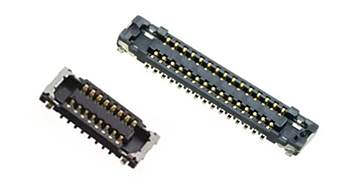
Panox Display also supports the parts around the panel: connectors, customized touch panels, cover glass and controller boards. This is important because contrast is affected by the final display stack, not only the bare panel.
If your project requires a high contrast display panel, the most useful starting point is to define the environment and content type. A dark-themed wearable UI, a high-PPI AR module, a 3D printing exposure system and an industrial HMI may all need “high contrast,” but they need it in different ways.
Conclusion
High contrast display technology is about controlling light with precision. OLED and Micro OLED achieve deep black through self-emissive pixels. LCD improves contrast through panel design, backlight control, optical films and careful integration. Ambient light, cover glass, touch panel structure and driver tuning can all change how much contrast the user actually sees.
For product development, contrast should be treated as a complete optical system. A good display choice considers panel type, brightness, black level, reflection, interface, touch stack, driver board and real application conditions together.
Panox Display provides OLED, AMOLED, Micro OLED, flexible OLED and TFT-LCD panels for high contrast applications, together with customization support for touch panels, cover glass, connectors and controller boards. By selecting the right display technology for the final environment, developers can create products with clearer interfaces, richer images and more reliable visual performance.
Learn more: High Contrast Display Applications: Where OLED, Micro OLED and LCD Panels Are Used
FAQ
What is high contrast display technology?
High contrast display technology refers to the panel structure, light control method, optical stack and driving design used to create strong separation between dark and bright image areas. It improves readability, visual depth and image clarity.
Is OLED better than LCD for contrast?
OLED usually has stronger native contrast because each pixel emits its own light and can become extremely dark when displaying black. LCD panels rely on a backlight, so their black level is usually limited by light leakage. However, LCD may still be better for some applications that need high brightness, mature supply or specific exposure performance.
Why does a display look less contrasty outdoors?
Outdoor light reflects from the display surface and raises the perceived black level. This reduces ambient contrast. Brightness, anti-reflective treatment, optical bonding and cover glass design all affect outdoor readability.
Is contrast ratio the only factor to check?
No. Contrast ratio should be checked together with brightness, surface reflectance, resolution, viewing angle, grayscale, interface, driver board and the final touch or cover glass stack.
Which Panox Display products are suitable for high contrast applications?
Panox Display offers Micro OLED panels for AR and optical modules, AMOLED panels for wearable and handheld devices, flexible OLED panels for curved applications, and high-resolution TFT-LCD panels for VR, 3D printing and embedded systems.