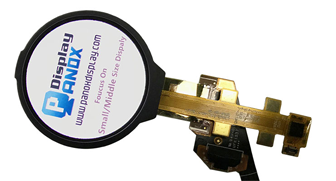




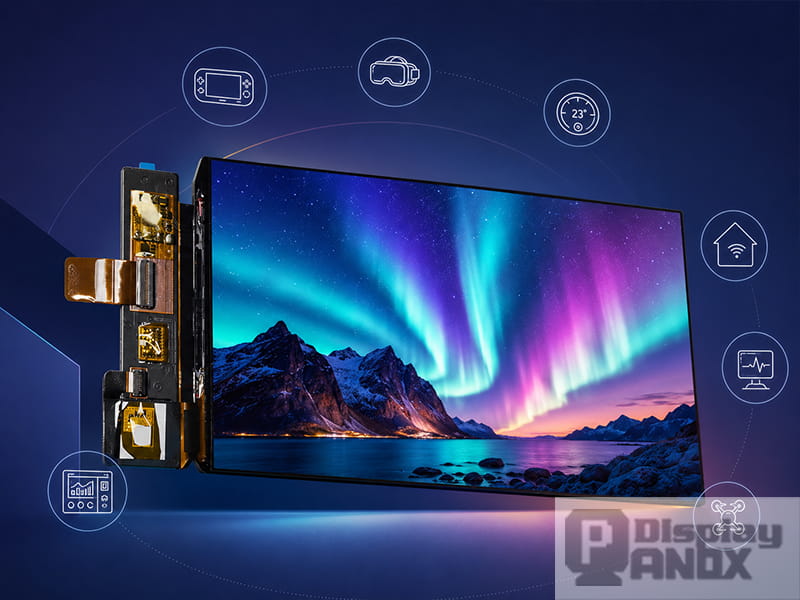
7 inch AMOLED OLED 1920X1080 Mipi
High contrast display panels are used wherever visual information needs to stay clear, sharp and readable. In some products, contrast creates a premium viewing experience. In others, it supports safety, optical precision, exposure accuracy or fast decision-making. A high contrast OLED panel used in a handheld device, a Micro OLED used in AR glasses, and a monochrome LCD used in a 3D printer all serve different purposes, yet they share the same basic requirement: the display must separate dark and bright information cleanly.
This is why high contrast display applications cover many product categories. They appear in AR and FPV optical systems, VR headsets, wearable devices, smart home controllers, mobile-style displays, 3D printing systems, medical viewers, industrial instruments and embedded control panels. The right display technology depends on the application environment, required resolution, brightness, interface, touch structure, optical path and mechanical space.
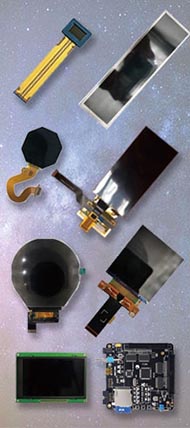
Panox Display’s high contrast display panel category includes Micro OLED, AMOLED, TFT-LCD, round LCD, round AMOLED, high-resolution LCD and monochrome LCD products. Some are designed for near-eye optical systems. Some are better suited to compact user interfaces. Others are used for exposure, projection or embedded display systems. This article explains where these panels are used and how to choose the right display direction for each application.
1. AR Glasses, FPV Goggles and Near-Eye Optical Systems
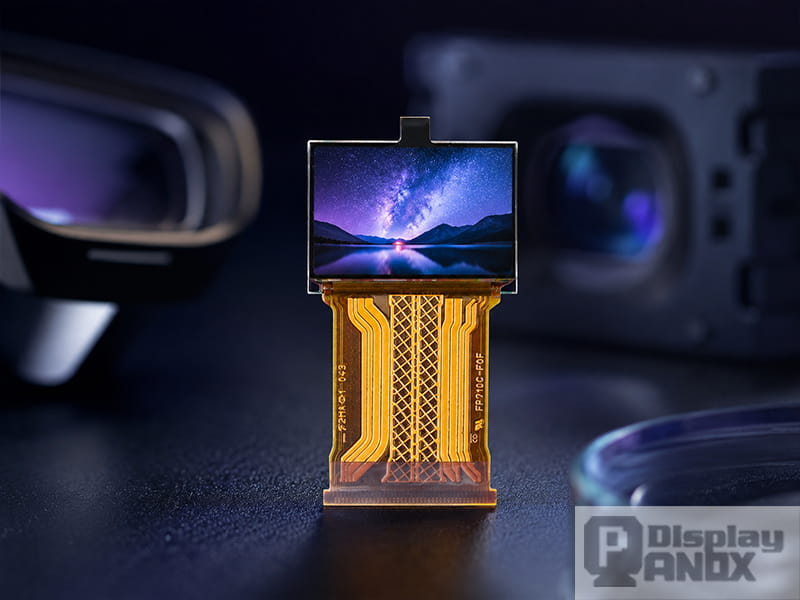
0.71 inch Micro OLED 1920x1080 LVDS 3000 nits
AR and FPV devices are among the most demanding applications for high contrast displays. The display panel is very small, but the image is enlarged through lenses, prisms, birdbath optics, waveguides or eyepiece systems. Once a display image is magnified, small weaknesses become easier to see. Low contrast can make virtual content look hazy. Poor black level can reduce image depth. Insufficient pixel density can make text and fine symbols harder to read.
Micro OLED is widely used in near-eye applications because it combines compact size, high pixel density, fast response and strong contrast. Since Micro OLED is self-emissive, the panel can produce deep black areas without a backlight. This is valuable in AR and FPV systems where the optical path may already reduce brightness and contrast.
A strong example is the 0.71 inch Micro OLED 1920×1080 LVDS 3000 nits panel. It uses a silicon-based Micro OLED structure, 1920(RGB)×1080 FHD resolution, 3078 PPI, LVDS interface and Sony source. For AR, EVF, FPV and compact optical modules, this combination is useful because the display can deliver a detailed image in a very small optical engine. The 3000 nits brightness direction is also relevant for systems where optical efficiency loss must be considered.
Another important option is the 1.03 inch Micro OLED Display 2K for AR/FPV. It is listed as a Micro OLED panel with 2560×2560 resolution, I2C/MIPI interface and Panox Display source. This square, high-resolution format is suitable for AR/FPV systems that need a larger visual field or a more balanced optical image. In drone goggles, remote operation viewers and professional eyepiece modules, high contrast helps users read fine visual details quickly.
For near-eye systems, the display should be evaluated together with the optical design. The panel may look bright and sharp during bench testing, while the final image changes after passing through lenses or waveguides. For this reason, AR and FPV display projects usually need more than a bare panel. They may also require a driver board, signal conversion, FPC matching, mechanical alignment and optical compatibility testing.
2. VR Headsets and Immersive Display Systems
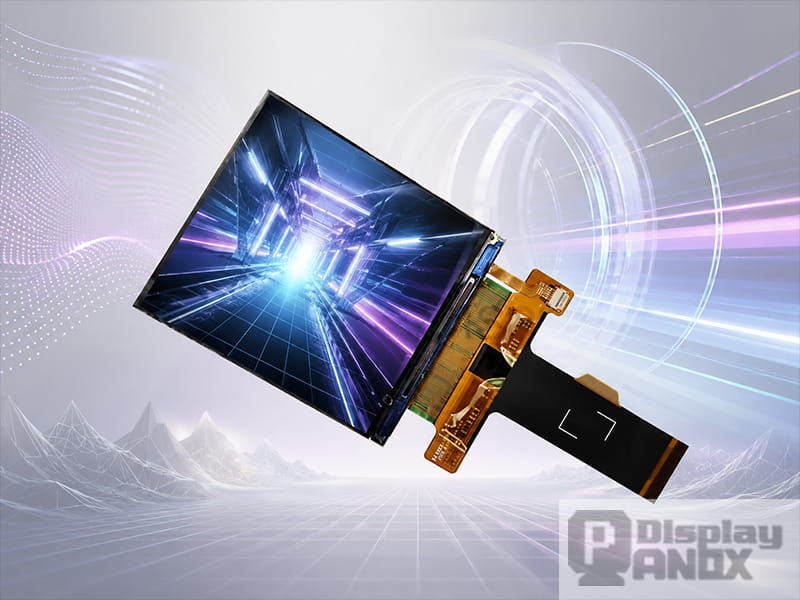
2.9 inch LCD 2K Resolution 90 Hz For VR
VR displays need high resolution, smooth refresh behavior and clear contrast. The user looks at the display through lenses, and the image often fills a large part of the visual field. Any weakness in pixel structure, motion clarity or contrast becomes more noticeable than it would be on a normal handheld screen.
For VR, contrast contributes to immersion. Dark scenes need enough black depth to feel convincing, while bright UI elements and highlights must remain visible. When the display image looks washed out, virtual environments lose depth and fine information becomes harder to read. This is especially important in VR training, simulation, gaming, industrial visualization and professional design review.
Panox Display lists a 2.9 inch LCD 2K Resolution 90 Hz For VR with TFT-LCD technology, 2160×2160 resolution, MIPI interface and Sharp source. This type of square, high-PPI VR LCD is designed for optical systems where resolution and refresh rate matter. The 90 Hz refresh rate is useful for motion-rich viewing, while the 2160×2160 resolution supports finer detail after optical magnification.
Another VR-related option is the 3.5 inch LCD 90 Hz For VR, listed with TFT-LCD technology, 1440(RGB)×1600 resolution, MIPI interface and BOE source. Panox Display also lists a 3.81 inch OLED 90Hz For VR with AMOLED technology, 1080(RGB)×1200 resolution, MIPI interface and AUO source. These options show two different VR directions: LCD can support high-resolution and mature integration, while OLED can provide stronger native black level and self-emissive contrast.
When choosing a high contrast display for VR, contrast should be considered together with refresh rate, resolution, optical distortion correction, brightness and lens transmittance. A panel with strong contrast on its own still needs the right optical system and driver tuning before it can deliver a comfortable final image.
3. Smart Watches, Wearables and Round User Interfaces
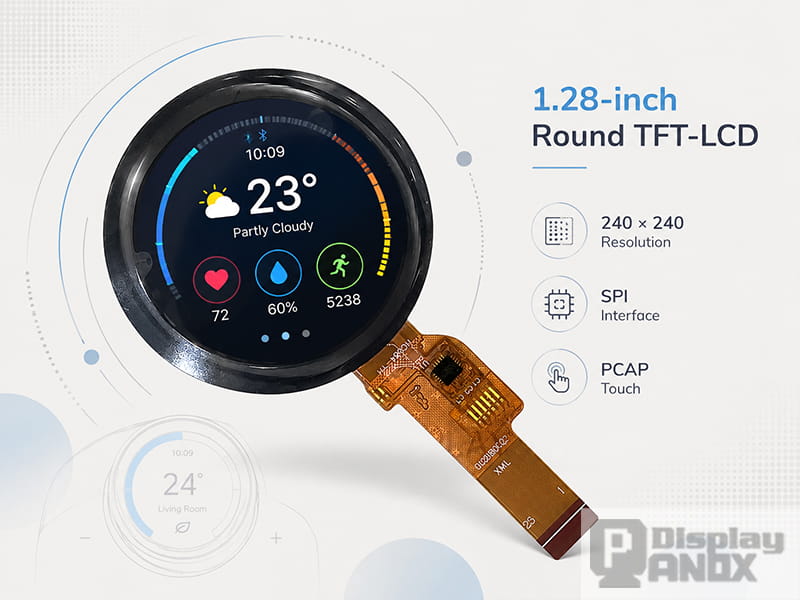
1.28 inch Round LCD TFT 240X240 SPI 55Hz PCAP Touch Panel
Wearable devices often have small screens and short viewing moments. Users may glance at the display while walking, exercising or moving their wrist. This makes contrast especially important. The display must show time, status, icons, notifications and health data clearly within a limited active area.
Round displays are common in watches, compact controllers and circular UI products because the shape feels natural for dials, gauges and simple status interfaces. High contrast allows a round screen to use dark backgrounds, bright rings, clear numbers and simple icons without feeling crowded.
The 1.43 inch AM-OLED Full Color On-cell PCAP Touch panel is a good example for this category. It uses OLED/AMOLED technology, 466×466 resolution, SPI interface and Panox Display source. For wearable-style products, this size and resolution can support a sharp circular interface with vivid colors and deep black backgrounds. The on-cell PCAP touch structure is also useful when the product needs a compact, interactive display module.
For LCD-based circular interfaces, the 1.28 inch Round LCD TFT 240×240 SPI 55Hz PCAP Touch Panel is another relevant option. It uses TFT-LCD IPS technology, 240×240 resolution, SPI interface and touch support. It can be used for compact smart controls, small instruments, DIY embedded devices and wearable prototypes where a round touch interface is needed.
In wearable and compact UI applications, contrast is not only about making images look attractive. It helps the interface remain readable at small sizes. A dark UI with bright white or colored elements can reduce visual clutter and help users identify the most important information faster.
4. Smart Home Controllers and Circular Control Panels
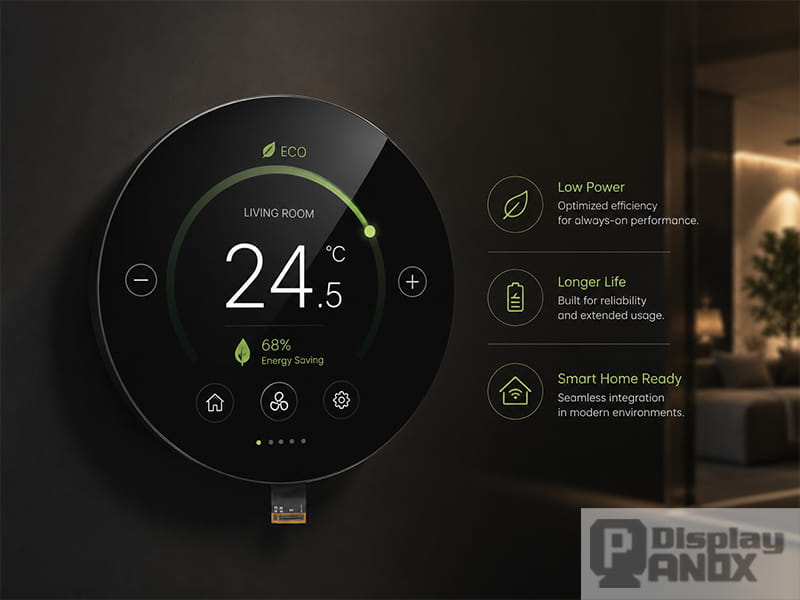
5.0 inch Round/Circular LCD Cover Glass Optional For Smart Home
Smart home products often use displays as control surfaces. Thermostats, lighting panels, wall controllers, smart knobs and home status screens need information to be readable in both bright and dim environments. A high contrast display makes this easier because the UI can separate temperature, lighting, security and status information with clear visual hierarchy.
A larger round display can be very suitable for smart home interfaces because it gives enough space for circular menus, central temperature readouts, ring-style sliders and icon-based controls. Panox Display’s 5.0 inch Round/Circular LCD Cover Glass Optional For Smart Home is positioned for smart home and medical equipment applications. It supports HDMI driver board use and can be connected as a monitor through a controller board solution, which makes it practical for prototype and embedded interface development.
For smart home projects, contrast must work with cover glass and touch structure. A glossy cover can make the product look premium, but reflection may reduce readability. A matte or anti-reflective surface can help in bright rooms. Optical bonding can also improve perceived contrast by reducing internal reflection between the display and cover lens.
In wall-mounted or tabletop smart home products, the display may be viewed from different angles and distances. This means the design should not rely on small low-contrast text. A clear black background, large temperature numbers, bright icons and simple color coding can make the interface easier to use.
5. Mobile, Handheld and Portable Display Devices

5.5 inch Full Color OLED 1920x1080 G1548 MIPI Touch Panel
Mobile and handheld products often need high contrast because users interact with them at close range. A handheld display may show menus, camera preview, test data, media content, medical information or industrial measurement values. In these situations, high contrast improves perceived sharpness and helps the device feel more refined.
AMOLED is often a strong choice for high contrast handheld products because of its self-emissive pixel structure and slim module design. Panox Display’s 5.5 inch OLED FHD On-cell PACP TP For Cellphone uses AMOLED technology, 1080(RGB)×1920 resolution, MIPI interface and AUO source. This type of panel fits mobile-style and handheld applications where FHD resolution, touch integration and vivid image quality are important.
Another relevant option is the 5.48 inch Full Color OLED 1920×1080 G1548 MIPI Touch Panel, listed with 1080(RG/BG)×1920 FHD resolution, 327 PPI, MIPI interface and GVO/Visionox source. A display like this can be used in handheld monitors, portable instruments, compact media devices and custom embedded products that need a bright, rich and high-contrast viewing experience.
For smaller handheld systems, the 3.92 inch AMOLED PCAP 1080×1240 MIPI/eDP panel provides a compact high-resolution touch option. Its resolution and interface options make it suitable for control devices, industrial handhelds and premium embedded UI products where space is limited but image quality still matters.
In handheld products, the final display effect depends on touch panel integration, cover glass transmittance, brightness control and mechanical design. A high contrast panel can lose part of its advantage if the cover glass introduces too much reflection or if the driver board does not support the intended brightness and color behavior.
6. 3D Printing, Projection and Exposure Systems
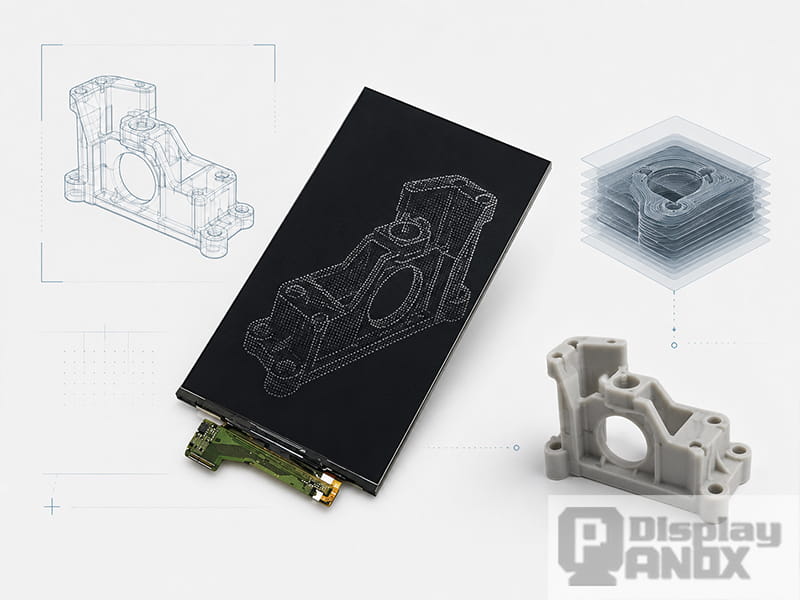
High contrast is also important in applications where the display is not mainly used for viewing. In resin 3D printing and exposure systems, the LCD panel works as an optical mask. It controls which areas receive light and which areas remain blocked. Contrast affects how cleanly the mask separates exposed and non-exposed regions.
If dark areas leak too much light, fine details may lose definition. Edges can become softer, small holes may close, and delicate structures may not form correctly. This is why LCD panels for 3D printing need high resolution, stable pixel control and good optical performance.
Panox Display’s 5.5 inch LCD 4K Resolution For 3D Printing/Projector uses TFT-LCD technology, 2160(RG/BR/GB)×3840 UHD resolution, 658 PPI, MIPI interface and Sharp source. This panel is suitable for compact high-resolution optical masking where pixel density is critical. The product page also lists 530 cd/m² typical luminance, 60 Hz refresh rate and 16.7M color depth.
The 6.08 inch Monochrome LCD 2K Resolution For 3D Printing is another application-focused option, with 1620×2560 resolution, MIPI interface and Tianma source. Monochrome LCDs are commonly used in resin printing systems because they can support exposure-focused optical structures more efficiently than ordinary color LCD panels, depending on the UV light source and system design.
For larger resin printing systems, the 8.9 inch Monochrome LTPS TFT-LCD Display for 3D Printer is listed with 3840×2400 WQUXGA resolution, 508 PPI, LVDS interface and BOE source. This type of display is useful when the product needs both a larger exposure area and fine detail capability.
In 3D printing applications, “high contrast” should be understood as light control. It is less about beautiful images and more about exposure boundary accuracy. The display must support consistent masking behavior, stable driving and mechanical alignment with the light engine.
7. Medical and Professional Optical Equipment
Medical and professional optical equipment often uses compact displays in viewers, inspection tools, diagnostic instruments and imaging systems. These applications require clear image information because users may need to judge fine details quickly.
Micro OLED can be useful in medical viewers and professional optical systems because it offers high pixel density in a compact form factor. A 0.71 inch FHD Micro OLED or 1.03 inch 2K Micro OLED can be integrated into eyepiece-type systems where the user views information through an optical path. High contrast helps improve the separation between image detail, measurement overlays and dark background areas.
Round and medium-size displays can also be used in medical control panels. A 5.0 inch round LCD can provide a clean interface for equipment status, control settings or simplified monitoring. In these applications, contrast should work together with brightness, viewing angle, cover glass cleanliness and long-term stability.
For medical and inspection applications, display selection often needs careful communication between the panel supplier and product developer. The display must match the optical path, mechanical envelope, interface design and expected usage environment. A strong display specification alone is not enough if the final module cannot be integrated reliably.
8. Industrial Control and Embedded Equipment
Industrial equipment uses displays for machine status, measurement values, alarms, control menus and real-time system feedback. High contrast makes this information easier to read under variable lighting conditions. In a factory, lab, warehouse or vehicle-mounted system, the user may not have ideal viewing conditions. A display needs to remain clear when there is glare, dust, motion or a limited viewing angle.
TFT-LCD panels are widely used in industrial products because they offer mature supply, flexible sizes, stable interfaces and cost-effective integration. AMOLED can be selected when the product needs richer contrast, slimmer structure or a more premium interface. Round LCD and round AMOLED modules can also be used for dial-style controllers, status indicators and compact control panels.
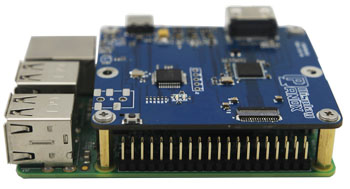
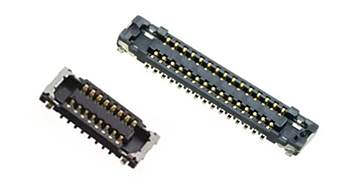
For embedded display projects, the interface can be just as important as the panel type. Panox Display’s product range includes MIPI, LVDS, SPI, eDP and HDMI-related controller board directions. A display chosen for high contrast still needs a suitable driver board, correct signal timing, stable power and reliable FPC/connector matching.
Industrial products also benefit from customized cover glass and touch panels. A strong cover lens can protect the display, while a carefully selected optical stack can help preserve contrast. For control systems, this balance between visual clarity and mechanical reliability is often more important than chasing one extreme specification.
9. High Contrast Display Application Guide
The table below summarizes selected Panox Display product directions for different high contrast display applications. These examples show how contrast is used differently depending on the final device.
| Application | Product Example | Key Specifications | Why High Contrast Matters |
|---|---|---|---|
| AR glasses, EVF, optical modules | 0.71 inch Micro OLED 1920×1080 LVDS 3000 nits | 1920(RGB)×1080, 3078 PPI, LVDS, Sony source | Supports compact near-eye optics, deep black, high brightness and fine image detail |
| AR/FPV goggles | 1.03 inch Micro OLED Display 2K for AR/FPV | 2560×2560, I2C/MIPI, Micro OLED | Helps deliver sharp close-eye imagery for FPV, AR and optical engine systems |
| VR headsets | 2.9 inch LCD 2K Resolution 90 Hz For VR | 2160×2160, MIPI, Sharp source, 90 Hz | Supports high-resolution immersive viewing and motion-oriented display design |
| VR display systems | 3.5 inch LCD 90 Hz For VR | 1440(RGB)×1600, MIPI, BOE source | Balances resolution, refresh rate and mature LCD integration for headset projects |
| Wearable and compact round UI | 1.43 inch AM-OLED Full Color On-cell PCAP Touch | 466×466, SPI, AMOLED, Panox Display source | Provides vivid color, deep black and touch support for compact circular interfaces |
| Small round controllers | 1.28 inch Round LCD TFT 240×240 SPI 55Hz PCAP Touch | 240×240, SPI, IPS TFT-LCD, PCAP touch | Supports simple high-contrast UI for compact smart controls and embedded devices |
| Smart home and medical controls | 5.0 inch Round/Circular LCD Cover Glass Optional For Smart Home | Round LCD, HDMI driver board support, up to 60 Hz | Offers larger circular UI space for control panels and status interfaces |
| Mobile-style handheld displays | 5.5 inch OLED FHD On-cell PACP TP For Cellphone | 1080(RGB)×1920, MIPI, AMOLED, AUO source | Creates strong visual depth, rich color and high readability in handheld products |
| Portable embedded devices | 5.48 inch Full Color OLED 1920×1080 G1548 MIPI Touch Panel | FHD, 327 PPI, MIPI, touch support | Suitable for compact premium interfaces requiring vivid image quality |
| High-density handheld UI | 3.92 inch AMOLED PCAP 1080×1240 MIPI/eDP | 1080×1240, MIPI/eDP, AMOLED | Provides a compact high-resolution touch display for embedded and handheld devices |
| 3D printing and projection | 5.5 inch LCD 4K Resolution For 3D Printing/Projector | 2160×3840 UHD, 658 PPI, MIPI, Sharp source | Improves fine exposure mask control for compact resin printing and projection systems |
| Resin 3D printing | 6.08 inch Monochrome LCD 2K Resolution For 3D Printing | 1620×2560, MIPI, Tianma source | Supports exposure-focused masking and clearer light separation |
| Large-format 3D printing | 8.9 inch Monochrome LTPS TFT-LCD Display for 3D Printer | 3840×2400, 508 PPI, LVDS, BOE source | Combines larger exposure area with fine detail capability |
| Tablet-like embedded display | 10.5 inch AMOLED 2560×1600 Touch Screen MIPI | 2560(RGB)×1600, 287 PPI, MIPI, Samsung source | Delivers high-resolution touch display quality for larger portable or embedded systems |
10. How to Choose the Right High Contrast Display for an Application
Choosing a high contrast display panel starts with the application, not with the largest contrast number. A near-eye display needs high PPI, compact size and optical compatibility. A VR panel needs resolution, refresh rate and lens performance. A wearable display needs glance readability and efficient UI design. A 3D printing LCD needs pixel control and exposure stability. A smart home display needs a clear interface under changing room light.
For AR and FPV projects, Micro OLED is often the first direction to evaluate because the display must fit into a compact optical engine. The 0.71 inch FHD Micro OLED and 1.03 inch 2K Micro OLED are relevant choices for developers who need a small high-resolution image source.
For VR projects, square or near-square high-resolution LCD panels can be practical. The 2.9 inch 2160×2160 90 Hz LCD is suitable for systems where high pixel density and refresh rate are central requirements. OLED options can be considered when black level and self-emissive contrast are more important.
For wearable and round control interfaces, round AMOLED and round TFT-LCD panels should be selected based on UI style, touch needs, power strategy and cost. A 1.43 inch round AMOLED can support premium wearable-like interfaces, while a 1.28 inch round TFT-LCD touch panel can serve compact control products.
For 3D printing, the decision should focus on resolution, pixel density, monochrome or color structure, UV compatibility, optical transmission, interface and mechanical alignment. A 5.5 inch 4K LCD or 8.9 inch monochrome LTPS LCD is selected for exposure behavior rather than normal image viewing.
For mobile, handheld and embedded products, AMOLED panels are useful when the product needs vivid color, deep black and a slim structure. TFT-LCD panels remain useful when brightness, availability, cost and controller compatibility matter more.
11. Panox Display Support for High Contrast Display Projects
Panox Display supports high contrast display projects across Micro OLED, AMOLED, TFT-LCD, round LCD, round AMOLED and high-resolution LCD categories. The same supplier can help with different product stages: display selection, connector matching, controller board direction, touch panel customization and cover glass options.
This is important because many display projects fail between the product sample stage and the final assembled device. A panel may look excellent on its own, but the final product may require a different cover lens, signal board, FPC length, mounting structure or brightness setting. High contrast must be preserved through the full stack.
For application-driven projects, a useful starting point is to define the real use case first:
A near-eye optical module needs a compact high-PPI image source.
A VR headset needs high resolution and stable motion behavior.
A wearable device needs glance readability and strong black contrast.
A smart home control panel needs a clear UI under day and night lighting.
A 3D printer needs precise optical masking.
A medical or industrial system needs reliable information display under practical working conditions.
Once the application is clear, the display panel, interface, touch structure, cover glass and controller board can be selected more accurately.
Conclusion
High contrast display panels are used in many different applications because contrast affects both visual quality and functional performance. In AR and FPV systems, contrast supports clear near-eye imagery. In VR, it helps build immersion and improves UI readability through lenses. In wearables and round smart controls, contrast makes small interfaces easier to read. In mobile and handheld devices, it creates a premium viewing experience. In 3D printing, contrast helps control exposure boundaries. In industrial and medical equipment, it supports fast and reliable information reading.
Panox Display’s high contrast product category includes Micro OLED panels such as 0.71 inch FHD and 1.03 inch 2K options, VR LCD panels such as 2.9 inch 2160×2160 90 Hz, round AMOLED and round LCD panels for compact controls, AMOLED mobile-style displays, and high-resolution LCD panels for 3D printing and projection.
The best high contrast display is the one that matches the real application. A strong display choice should consider panel technology, resolution, brightness, black level, refresh rate, interface, touch structure, cover glass and the final environment together.
Learn more: Why Is High Contrast Important in Display Panels?
FAQ
What are the main applications of high contrast display panels?
High contrast display panels are used in AR, FPV, VR, wearable devices, smart home controllers, handheld products, 3D printing systems, medical optics and industrial equipment.
Which display technology is best for AR and FPV?
Micro OLED is often a strong choice for AR and FPV because it offers compact size, high pixel density, fast response and strong contrast. Examples include 0.71 inch FHD Micro OLED and 1.03 inch 2K Micro OLED panels.
Why does VR need high contrast displays?
VR displays are viewed through lenses and fill a large part of the user’s visual field. High contrast helps dark scenes, UI overlays and depth cues remain clearer after optical magnification.
Are round displays suitable for smart home applications?
Yes. Round LCD and round AMOLED panels are suitable for thermostats, lighting panels, wall controllers, smart knobs and compact home status interfaces. A 5.0 inch round LCD can provide enough space for circular smart home UI design.
Why is contrast important in 3D printing LCDs?
In resin 3D printing, the LCD controls where light passes and where it is blocked. Higher contrast helps define exposure boundaries more clearly and supports fine detail reproduction.
How does Panox Display support high contrast display applications?
Panox Display supplies Micro OLED, AMOLED, TFT-LCD, round LCD, round AMOLED and high-resolution LCD panels, and can support related needs such as connectors, touch panels, cover glass and controller boards.