






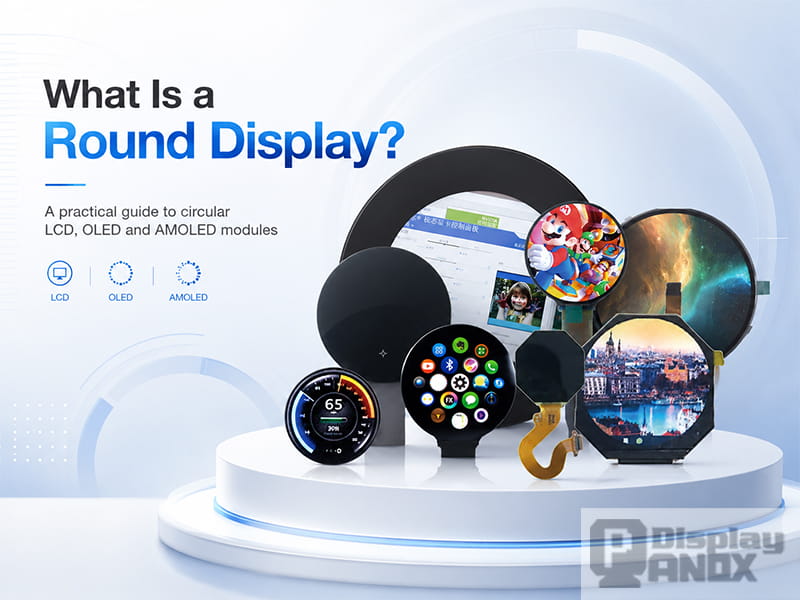
A round display is a display module designed with a circular or near-circular viewing area. It is widely used in smartwatches, fitness trackers, smart home controllers, medical instruments, automotive gauges, industrial meters, compact HMI panels and experimental embedded devices. The appeal is easy to understand: many products already use round forms, from watches and knobs to dials and instrument clusters, so a circular screen often feels more natural inside the product housing.
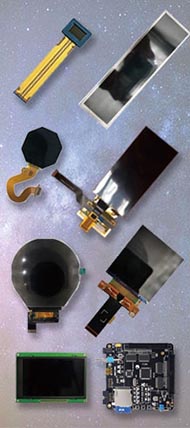
From an engineering point of view, a round display is still built on familiar display technologies such as TFT-LCD, AMOLED, OLED or Memory LCD. What changes is the mechanical shape, optical stack, pixel mapping, backlight design, FPC routing, touch sensor layout and cover glass. These details make circular display modules more specialized than standard rectangular panels. Panox Display’s circular display range, for example, includes compact 1.2-inch AMOLED and Memory LCD modules, 1.28-inch and 2.1-inch round TFT-LCD touch displays, high-resolution 2.54-inch round TFT-LCD modules, and larger 3.4-inch and 5.0-inch round LCDs for smart home, medical and industrial applications.
What is a round display?
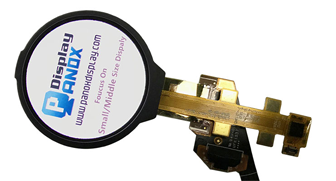
A round display, also called a circular display or round screen, is a display panel whose visible active area is shaped as a circle. Some modules are fully circular in the active area, while the physical panel may still include a small flat section or hidden border for the driver IC, FPC, bonding area or connector. In many circular LCD and OLED modules, the panel is cut by laser, and the internal routing is adapted to keep the image area round while still leaving space for electrical connection.
This is where packaging methods such as COF, or Chip-on-Film, become useful. In a traditional structure, part of the driving circuit may need space on the glass edge. With COF, the driver IC can be mounted on a flexible film, helping reduce the visible border and giving designers more freedom when building compact or curved products. Sharp’s COF research describes chip-on-film technology as a compact, flexible packaging method for LCD driver ICs, developed for mobile and space-limited devices.
A round display can be simple, such as a small SPI TFT-LCD for a knob interface, or very advanced, such as a high-PPI AMOLED module for a premium smartwatch. The right choice depends less on the shape itself and more on brightness, power budget, interface, viewing environment, touch requirements, mechanical thickness, lifetime and supply stability.
How round displays work
The circular shape changes the module design, while the core display principles remain close to rectangular displays.
In a TFT-LCD round display, a backlight shines through liquid crystal layers, color filters and polarizers. Thin-film transistors control the pixels, and the backlight determines much of the brightness and outdoor readability. LCD technology is often chosen when a project needs good lifetime, predictable cost, high brightness or stable performance in bright environments.
In an OLED or AMOLED round display, each pixel emits its own light. This gives OLED panels deep black levels, high contrast, fast response time and a thinner structure because no backlight is required. AMOLED is especially common in smartwatch displays where high pixel density, vivid color and slim mechanical design are important.
A review article in Light: Science & Applications compared LCD and OLED technologies across response time, contrast ratio, color gamut, lifetime, power efficiency and panel flexibility. The review notes that LCDs have advantages in cost, lifetime, resolution density and peak brightness, while OLEDs offer true black, fast response, thin profiles and better flexibility.
For product design, this means a round LCD display and a round OLED display can both be excellent choices. The better option depends on the actual use case: an outdoor industrial meter may benefit from a bright TFT-LCD, while a slim wearable device may benefit from AMOLED’s contrast and compact stack.
Main types of round display modules
Round TFT-LCD display
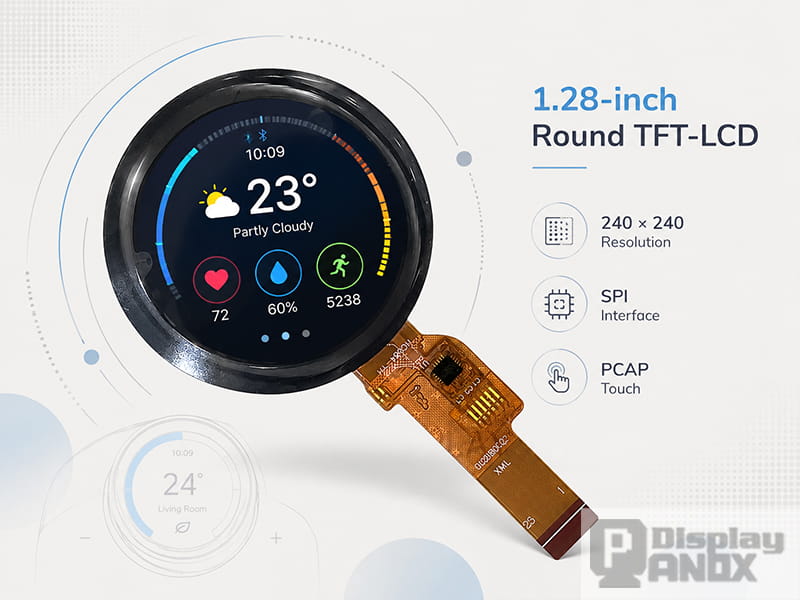
A round TFT-LCD is usually a good choice for smart home controls, industrial HMIs, instrument panels, medical devices, automotive accessories and embedded projects where brightness, cost control and long-term availability matter. TFT-LCD modules can support SPI, RGB, MIPI and other interfaces depending on resolution and refresh requirements.
For small MCU-based projects, a 1.28-inch round TFT-LCD is a common starting point. Panox Display’s 1.28-inch round LCD uses a 240 × 240 resolution, SPI interface, GC9A01 driver IC and PCAP touch integration, with a listed pixel density of 265 PPI and typical luminance of 300 cd/m².
For larger interactive products, a 2.1-inch round TFT-LCD gives more room for icons, menus and touch gestures. Panox Display’s 2.1-inch model offers 480 × 480 resolution, 3SPI + 18RGB interface support, integrated touch functionality and compatibility with common development platforms such as STM32, Raspberry Pi and Arduino.
Round OLED and AMOLED display
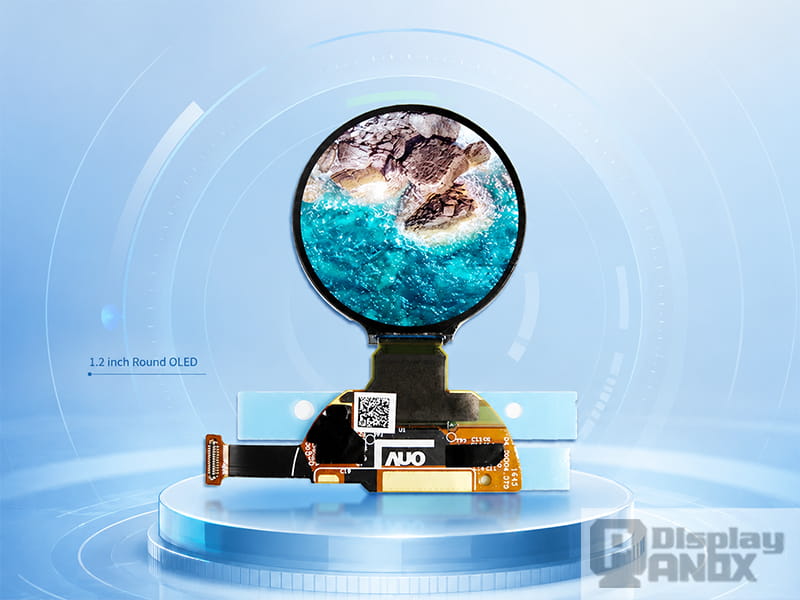
Round OLED and AMOLED displays are widely used in smartwatches and compact premium devices. Their strengths are high contrast, fast response, slim thickness, rich color and strong viewing performance. They are especially suitable when the user interface relies on dark backgrounds, animated icons, watch faces or fine visual details.
Panox Display’s 1.2-inch AMOLED round display has a 390 × 390 resolution and supports MIPI/SPI communication, making it suitable for smartwatches, vehicles, smart home devices, instruments and dynamic information displays.
The 1.39-inch round AMOLED size is also popular in smartwatch projects. Panox Display lists AUO and EDO versions with 400 × 400 resolution and MIPI interface, noting that this size is widely used for smartwatch applications.
For newer wearable designs, the 1.43-inch round AMOLED with 466 × 466 resolution and QSPI interface offers higher pixel density and a sharper visual experience. It is suited to wristwear and small devices that need a bright, colorful and responsive interface.
Flexible round AMOLED display
Flexible round AMOLED modules give industrial designers more freedom when the product surface is slightly curved or when mechanical shock resistance matters. Panox Display’s 1.39-inch flexible round AMOLED uses LTPS-AMOLED technology, has 400 × 400 resolution, and includes a polarizer, driver IC on COF and FPC structure.
This type of panel is valuable for wearable products where the enclosure cannot be treated as a simple flat box. It can also help reduce stress in compact assemblies, although the final mechanical design still needs careful validation.
Round Memory LCD
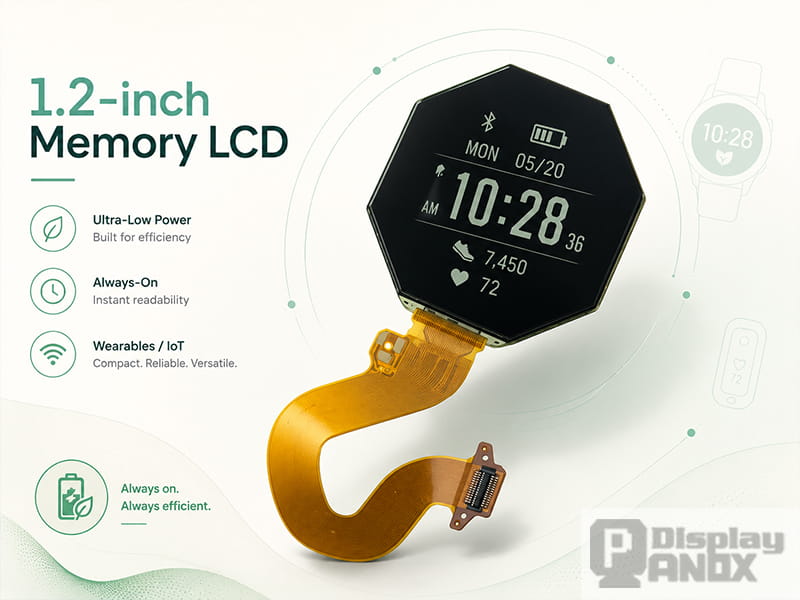
Memory LCD is useful for low-power, always-on displays. Unlike a conventional LCD that needs regular refresh of the whole image, Memory LCD embeds memory into each pixel so the display can retain static content with extremely low power consumption. Sharp describes Memory LCD as a matrix display technology with a one-bit memory circuit embedded in every pixel, designed for ultra-low power, extended battery life and good readability.
For sports watches, outdoor trackers, small IoT devices and battery-powered meters, this can be a strong option. Panox Display’s circular product list includes a 1.2-inch Memory LCD with 218 × 218 resolution and RGB interface, positioned for smartwatch use.
Why round displays are harder to manufacture
Round displays look simple from the outside, yet they require more careful production than rectangular displays. A round panel gives lower utilization from the same mother glass because fewer circular pieces can be cut compared with rectangular panels. For LCD modules, the backlight also needs a custom circular design to achieve uniform brightness across the active area. Panox Display notes that round LCD/OLED panels are typically more expensive because fewer round displays can be cut from the same cell area, and circular LCD backlights are more difficult to produce.
The challenge continues after the panel is made. The touch sensor must match the visible circle, the cover glass must align with the housing, the FPC must bend in the available mechanical space, and the driver board must support the correct interface and initialization code. If the product needs optical bonding, anti-glare coating, waterproof structure or outdoor readability, the circular geometry affects tooling and inspection.
For this reason, a round display project should start with both the electrical specification and the industrial design. It is safer to confirm active area, outline size, FPC direction, connector model, cover glass shape, touch panel stack and controller board plan before freezing the enclosure.
Important specifications when choosing a round display
The first specification is size, usually measured by diagonal active area. A 1.2-inch or 1.39-inch round AMOLED works well for watches and wrist devices. A 2.1-inch round TFT-LCD is more suitable for knob displays, small dashboards and smart home controllers. A 3.4-inch or 5.0-inch round LCD gives enough space for richer menus, medical readings or control panels.
Resolution and pixel density matter when users view the screen up close. A smartwatch display should have enough PPI for smooth watch faces and small text. A knob display or industrial meter may work well with lower PPI if the interface uses large icons and clear numbers.
The interface is another key decision. SPI is simple and common for small MCU projects, although bandwidth is limited. RGB can be useful for certain TFT-LCD modules and embedded boards. MIPI DSI is preferred for higher-resolution displays and compact mobile-style designs because it offers high-speed communication, low power, low EMI and reduced pin count. The MIPI Alliance describes MIPI DSI as a high-speed serial interface between a host processor and a display module, widely used in smartphones, wearables, IoT, automotive and VR/AR applications.
Touch integration should be planned early. Some round displays come with PCAP touch, while others need a custom external touch panel. On-cell or in-cell touch can simplify the stack, while external PCAP may be better when the cover glass shape or product ID design is unique.
Brightness and contrast should be matched to the environment. For indoor smart home controls, moderate brightness may be enough. For outdoor wearables, sunlight readability becomes more important. For dark UI designs and premium visual quality, AMOLED’s black level is attractive. For bright content and long service life, TFT-LCD may be the safer choice.
Where round displays are used
Round displays fit naturally into products that already use circular visual language. Smartwatches are the best-known example, but the same logic applies to thermostat dials, audio controllers, coffee machine knobs, bicycle computers, health monitors, automotive gauges, industrial instruments and small public information displays.
In smartwatch design, the circular screen changes how information should be arranged. Research on round smartwatch interaction found that the lack of corners and the omnidirectional edge can make bezel-initiated gestures more challenging, especially when users interact without looking at the screen. The same paper reported that segment count affects selection accuracy on a round smartwatch bezel.
This has a practical lesson for UI design. A round display works best when important information is placed near the center, secondary information follows a radial or ring-based structure, and edge controls are kept large enough for reliable touch. Overcrowded circular menus may look impressive in a rendering, yet they can become difficult to use on a small touchscreen.
In smart home and industrial products, round screens often pair well with rotary controls. A circular display inside a physical knob can show temperature, volume, mode, speed, brightness or status. The user turns the knob, and the screen updates in the same visual rhythm. This creates a more intuitive experience than forcing a rectangular UI into a round mechanical part.
Panox Display round display examples
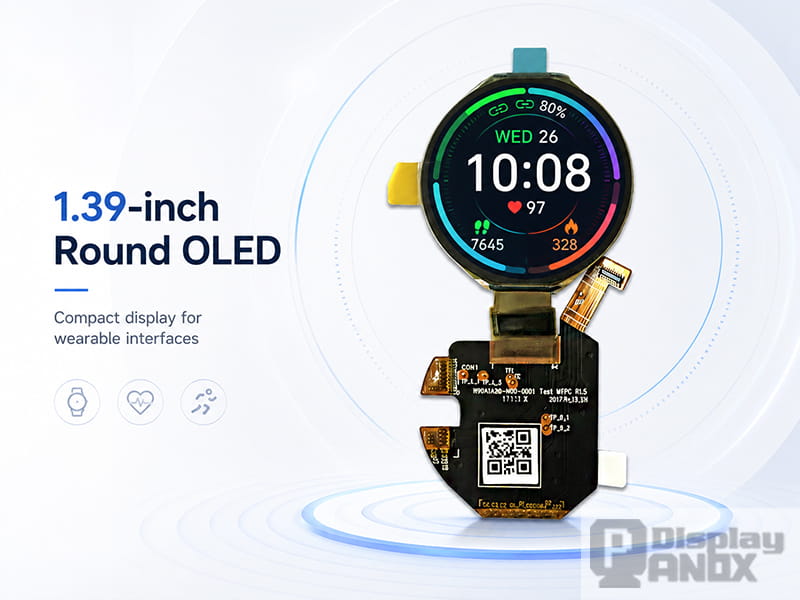
The following examples show how different round display modules can match different product directions.
| Project direction | Suitable display type | Panox Display examples |
|---|---|---|
| Compact smartwatch or wearable | AMOLED / flexible AMOLED | 1.2-inch AMOLED 390 × 390; 1.39-inch AMOLED 400 × 400; 1.43-inch AMOLED 466 × 466 |
| MCU prototype or small knob display | Round TFT-LCD with SPI | 1.28-inch round TFT-LCD 240 × 240 with PCAP touch |
| Smart home controller or compact HMI | Larger round TFT-LCD touch display | 2.1-inch TFT-LCD 480 × 480; 3.4-inch TFT-LCD 800 × 800; 5.0-inch TFT-LCD 1080 × 1080 |
| VR, handheld or high-detail instrument | High-resolution TFT-LCD with MIPI | 2.54-inch TFT-LCD 1440 × 1600, 90 Hz |
| Low-power outdoor wearable | Memory LCD | 1.2-inch Memory LCD 218 × 218 |
Panox Display’s circular display tag pages list these round LCD, AMOLED, OLED, flexible AMOLED and Memory LCD options across two product pages, while individual product pages provide details such as resolution, interface, driver IC, touch availability, controller board options and application direction.
How to choose the right round display for your project
If the project is a smartwatch, wristband or wearable sensor, start with power consumption, thickness, cover glass, touch method and outdoor visibility. AMOLED is often preferred for premium watch faces and rich color UI. Memory LCD is worth considering when the product needs long battery life and always-on information.
If the project is a smart home knob or desktop controller, a 1.28-inch or 2.1-inch round TFT-LCD touch module may be easier to integrate. SPI models are friendly to MCU development, while RGB or MIPI models can support richer interfaces and smoother animation.
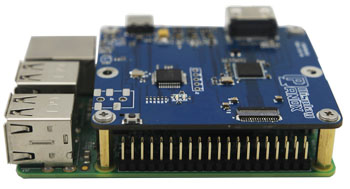
If the project is a medical, automotive or industrial device, focus on operating temperature, brightness, lifetime, supply stability, touch reliability and the availability of a controller board. A larger 3.4-inch or 5.0-inch round LCD gives more space for data visualization and clear readings. Panox Display also provides HDMI to MIPI DSI controller boards for some larger round LCD modules, which helps engineers test displays quickly before custom hardware is ready.
If the product is still in concept design, choose the display before finalizing the enclosure. Round modules have specific FPC directions, connector positions, cover glass requirements and active-area limits. Changing the display after tooling can cause avoidable delays.
Customization: cover glass, touch panel and controller board
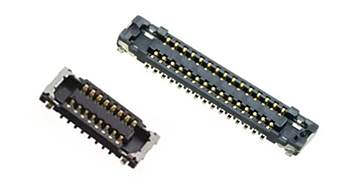
A display panel is only the beginning of a real product. Most round display projects also need a cover glass, touch panel, driver board, connector, FPC extension, mechanical bracket or firmware support. Panox Display provides customized cover glass and touch panel services, with cover glass options from brands such as Gorilla, AGC and Panda, and touch driver IC support from Goodix and Focaltech.
For projects that need direct video input, Panox Display can provide customized controller or driver boards with interfaces such as HDMI, Type-C video input, MIPI, RGB, LVDS and eDP. These boards can support functions such as brightness adjustment, touch interface and additional data transmission depending on the project requirements.
This is especially useful for teams that want to evaluate a round display with a PC, Raspberry Pi or embedded system before building the final PCB. It also reduces the risk of choosing a panel that looks suitable in the datasheet but becomes difficult to drive in the actual product.
Final thoughts
A round display is more than a rectangular screen cut into a circle. It is a specialized display module that combines panel technology, optical design, mechanical packaging, touch integration and interface engineering. When selected well, it can make a product feel more intuitive, more compact and more aligned with the shape users already expect.
For a premium wearable, choose a high-PPI round AMOLED. For a smart home dial or industrial HMI, consider a round TFT-LCD with touch and a practical controller board. For a low-power outdoor product, evaluate Memory LCD. For projects with curved or compact housings, flexible AMOLED and COF-based structures can open more design space.
Panox Display supplies round OLED, AMOLED, TFT-LCD, flexible AMOLED and Memory LCD modules for development and production projects. To choose the right module, define the product size, operating environment, interface, touch requirements, cover glass design, brightness target and production quantity as early as possible.
FAQs:
What is a round display used for?
A round display is used in products where a circular interface fits the mechanical design or user experience. Common applications include smartwatches, fitness trackers, smart home knobs, medical devices, automotive gauges, industrial meters, embedded controllers and compact information displays.
Is a round OLED display better than a round LCD display?
A round OLED or AMOLED display is better for high contrast, slim thickness, fast response and premium wearable UI. A round TFT-LCD is often better for high brightness, cost control, longer lifetime and some industrial or smart home applications. The better choice depends on the environment, content style, power budget and product lifetime requirement.
Can a round display have a touch screen?
Yes. Many round displays can support PCAP touch. Some modules have integrated touch, while others require a customized touch panel and cover glass. For round products, touch design should be planned with the enclosure because the cover glass shape, active area and sensor layout need accurate alignment.
Why are round displays more expensive than rectangular displays?
Round displays usually have lower cutting efficiency from the original panel glass. LCD versions also need a more complex circular backlight. In addition, touch panels, cover glass and driver routing may require custom design, which can increase tooling and production cost.
Which interface is best for a round display?
SPI is simple and useful for small MCU-driven displays. RGB is common in some TFT-LCD modules. MIPI DSI is a strong choice for higher-resolution round displays because it supports high-speed data transmission with fewer pins. For quick evaluation, an HDMI or Type-C controller board can make testing easier.
Can Panox Display provide a custom round display solution?
Yes. Panox Display can support round display modules, customized cover glass, customized touch panels, connectors and controller or driver boards. This helps teams move from sample testing to product integration with fewer display-side engineering risks.