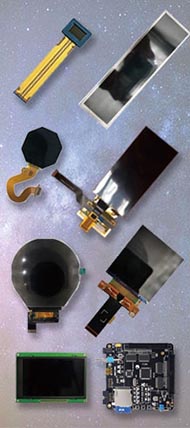







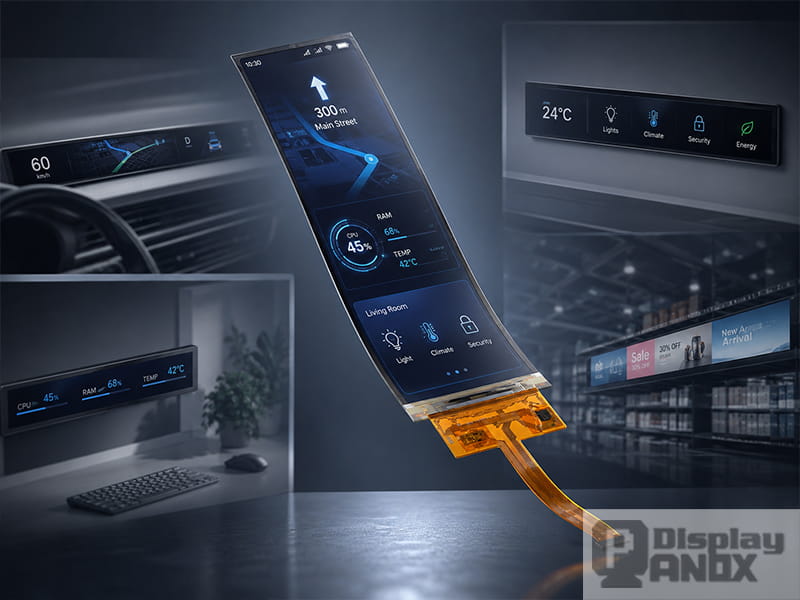
In many hardware products, the most valuable display area is not a large rectangular space. It is often a slim surface left between buttons, vents, shelves, dashboards, bezels, handles, camera modules, or mechanical structures. A long strip LCD or OLED display is useful exactly in these spaces. It turns a narrow area into a clean information layer for system status, navigation, warnings, price labels, machine data, or compact controls.
Panox Display’s long-strip display category includes several stretched-format LCD and OLED options, such as 2.99-inch 268 × 800 IPS LCD, 6.52-inch flexible OLED 2520 × 840, 6.8-inch 480 × 1280 IPS TFT-LCD, 7.84-inch 1280 × 400 TFT-LCD, 8.8-inch 1920 × 480 TFT-LCD, and 14-inch 3840 × 1100 TFT-LCD modules. These panels cover compact handheld products, AIDA64 PC sub-displays, automotive auxiliary displays, flexible curved interfaces, and touch-bar-style embedded applications.
The strength of a long strip display is not just the unusual aspect ratio. Its real value appears when the screen format matches the shape of the information. Route progress, battery status, fan speed, CPU load, temperature curves, shelf pricing, next-stop information, and machine alerts are all naturally linear. They do not need a large screen; they need a focused screen in the right place.
Why application should drive the display choice
A long strip display is usually selected for one of three reasons: the product has a narrow installation space, the information itself is linear, or the industrial design needs a display that blends into a slim structure. In these cases, using a standard 16:9 panel can create wasted space, awkward bezels, or a user interface that feels forced.
The choice between LCD and OLED also depends on the application. LCD remains a strong option for cost-sensitive, high-availability, and brightness-focused projects. OLED, especially flexible OLED, is attractive when the design needs a thinner structure, high contrast, fast response, or curved integration. A technical review in Light: Science & Applications notes that LCDs have advantages such as lifetime, cost and peak brightness, while OLEDs are emissive and offer true black, fast response and an ultra-thin profile that enables flexible displays.
For product designers, this means the first question should not be “Which display looks most advanced?” A better question is: where will the screen live, what information must it show, and how long will it stay on every day?
Automotive dashboards and mobility interfaces
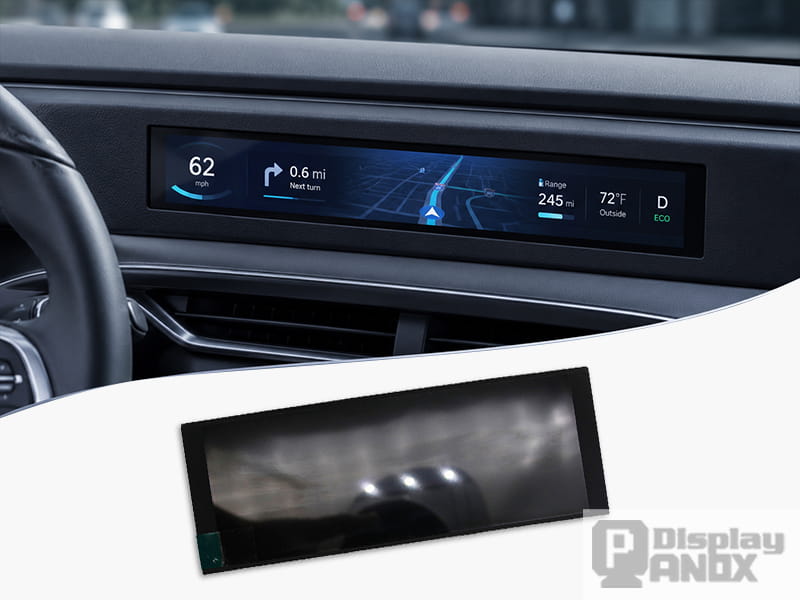
6.8 inch long strip LCD IPS TFT
Automotive interiors are one of the strongest application areas for long strip LCD/OLED displays. A vehicle cockpit already contains long horizontal and vertical surfaces: dashboards, mirror housings, center console edges, door trims, passenger-side information zones, and overhead panels. A stretched display can follow these surfaces more naturally than a conventional screen.
In vehicles, long strip panels can show speed, range, battery status, ADAS warnings, navigation prompts, climate information, rearview camera status, passenger entertainment controls, or vehicle health data. A 6.8-inch long strip LCD, for example, can be used in AIDA64 display, rearview mirror, smart home, industrial device, security, and dynamic information display applications, according to Panox Display’s product description. It uses a 480 × 1280 resolution, MIPI 40-pin interface, 550 cd/m² typical luminance, and an IPS-type TFT-LCD structure.
The layout is especially important in automotive use. A study on dashboard layout and driver performance found that dashboard usability is related to eye movement characteristics such as fixation duration, fixation times and pupil diameter, and that search time, reading time and reading accuracy can influence physiological response during dashboard reading. For a long strip display in a vehicle, this supports a practical design principle: place high-priority information where the driver can understand it quickly, and avoid turning a slim display into a crowded mini-desktop.
Flexible OLED expands this application further. LG Display describes automotive P-OLED as thin, light and bendable when tandem OLED is applied to a plastic substrate, making it suitable for curved surfaces inside vehicles. Panox’s 6.52-inch flexible OLED has a 3:1 aspect ratio, 2520 × 840 resolution, 407 PPI, MIPI interface, 90 Hz refresh rate, and in-cell touch, which makes it a strong candidate for curved dashboard strips, wraparound control areas, AR/MR-related devices, and premium embedded interfaces.
AIDA64 PC sub-displays and gaming setups
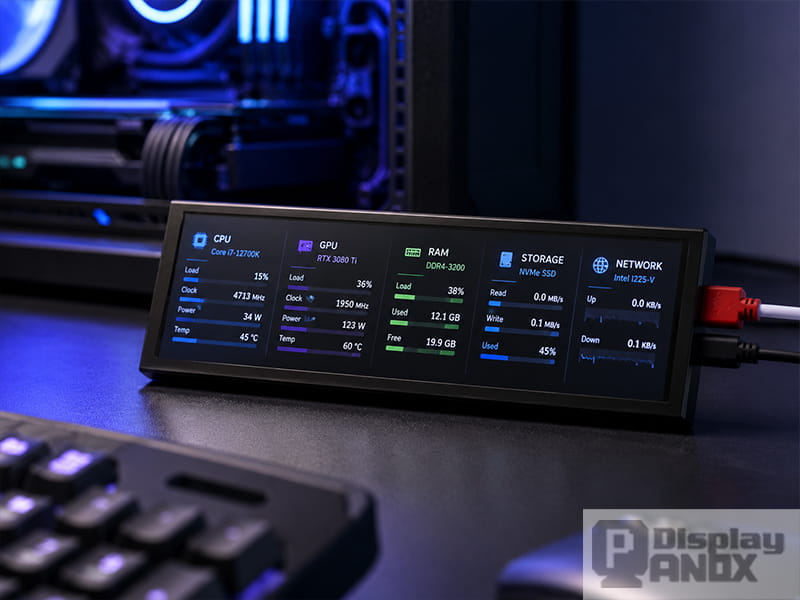
Long strip LCDs have become popular in custom PC builds because they fit neatly inside or near a desktop setup. Instead of opening a monitoring window on the main monitor, users can place CPU load, GPU temperature, fan speed, clock frequency, memory usage, FPS, network speed, and uptime on a dedicated slim display.
The 7.84-inch long strip LCD from Panox is positioned for PC sub-screen, vehicle, car, and stretched bar LCD applications. It uses a 1280 × 400 resolution, 171 PPI, MIPI interface, and can be tested with an HDMI-to-MIPI DSI controller board. The 8.8-inch long strip LCD is another more spacious option, using 1920 × 480 resolution and a 1:4 active display format. Panox notes that this 8.8-inch module is popular with PC gamers as a secondary display for AIDA64-style monitoring, including temperatures, FPS, frequency, and memory utilization.
For this application, the screen content should be designed in blocks. A long strip display looks clean when each module has a clear job: CPU, GPU, RAM, fan, storage, network, and time. Too many tiny labels can make the display look technical but difficult to read. The best AIDA64 layouts usually use fewer indicators, stronger spacing, and simple contrast.
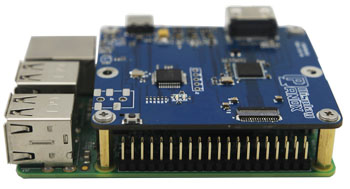
The controller board is also part of the application, not an accessory to think about later. If the panel uses MIPI and the host is a PC, Raspberry Pi, or mini PC, an HDMI or Type-C controller board can reduce development time. MIPI DSI itself is a high-speed serial interface between a host processor and a display module, designed to support high performance, low power, low EMI and reduced pin count. MIPI also notes that DSI is used in smartphones, tablets, laptops, automotive dashboard displays, in-car infotainment, wearables, IoT and AR/VR applications.
Retail shelf-edge displays and commercial signage
Retail is another natural use case for long strip LCD/OLED displays. Shelf edges are narrow, linear, and close to the product. That makes them ideal for product prices, promotions, QR codes, inventory status, product comparisons, membership offers, and short video loops.
The connection between display placement and message relevance matters. A field study on in-store digital display ads examined how location, content type and goal relevance influence customer processing of display messages. The study found that screen location and customer shopping goals affect how people respond to digital signage content. This is directly useful for shelf-edge display design: a long strip panel should not only look bright; it should show the right message at the point where the shopper is making a decision.
The broader digital signage industry also supports this direction. An ITU-T Technology Watch report describes digital signage as an innovative medium for targeted information, entertainment, merchandising and advertising, and explains that digital signage systems usually include displays, media players and content management or delivery systems.
For shelf-edge use, LCD often has advantages in cost, availability and brightness. OLED may be suitable for premium retail fixtures, curved shelves, luxury product displays, or special-shaped brand installations. In both cases, the real project questions are practical: brightness under store lighting, anti-glare cover glass, content update method, heat, service life, mounting, cable routing and maintenance.
Industrial HMI and equipment status panels
Industrial machines often need information to be visible without taking over the whole control surface. A long strip LCD can serve as a status bar for production lines, test equipment, rack-mounted devices, security systems, power systems, CNC equipment, or laboratory instruments. It can show machine mode, alarms, temperature, pressure, speed, progress, error messages, and operator prompts.
This fits the role of HMI hardware. Eaton defines a human machine interface as a way for operators to monitor and control machinery and processes, and lists display, touchscreen, communication ports and keypad as HMI hardware elements. In an industrial design, a stretched display can become the “always visible” layer for essential information, while deeper settings remain on a larger HMI or external software interface.
The 6.8-inch long strip LCD is relevant here because Panox lists industrial device, security and dynamic information display among its applications. Its IPS viewing angle and 550 cd/m² typical luminance make it suitable for many indoor embedded systems, while its MIPI interface keeps the connection compact. For smaller handheld tools, Panox’s 2.99-inch long strip IPS LCD was designed for dictionary and scan pen products, with 268 × 800 resolution, 282 PPI and integrated on-cell touch.
Industrial buyers should pay special attention to temperature range, lifetime, connector reliability, backlight stability, touch integration and enclosure design. A long strip display may be visually small, but it often carries high-priority information. The installation should protect the FPC, PCB, cover glass and connector area from vibration, dust and accidental impact.
Public transportation and wayfinding systems
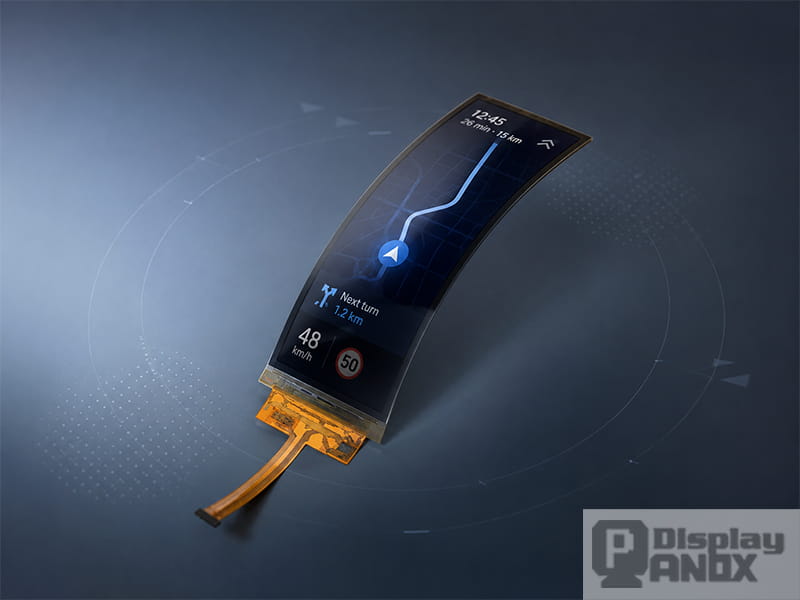
Long strip displays are also useful wherever people need short, directional information in a narrow space. Buses, metro cars, taxis, train stations, airport corridors, ticket counters and platform barriers often have limited display areas but a steady need for route, schedule and alert information.
Panox’s long-strip category page mentions use cases such as bus and subway indoor station screens, taxi roof screens, subway compartments and vehicle arrival information. This matches the wider digital signage concept described by ITU, which notes that digital displays are increasingly present at points of wait, sale and transit, often as centrally managed networks for targeted information, entertainment, merchandising and advertising.
In transportation projects, long strip LCDs can display next stop, destination, arrival time, route progress, service alerts, platform direction, queue guidance and emergency messages. The content should be readable at a glance. Large type, strong contrast, simple icons and restrained motion usually work better than dense animation.
Smart home, appliances and compact consumer devices
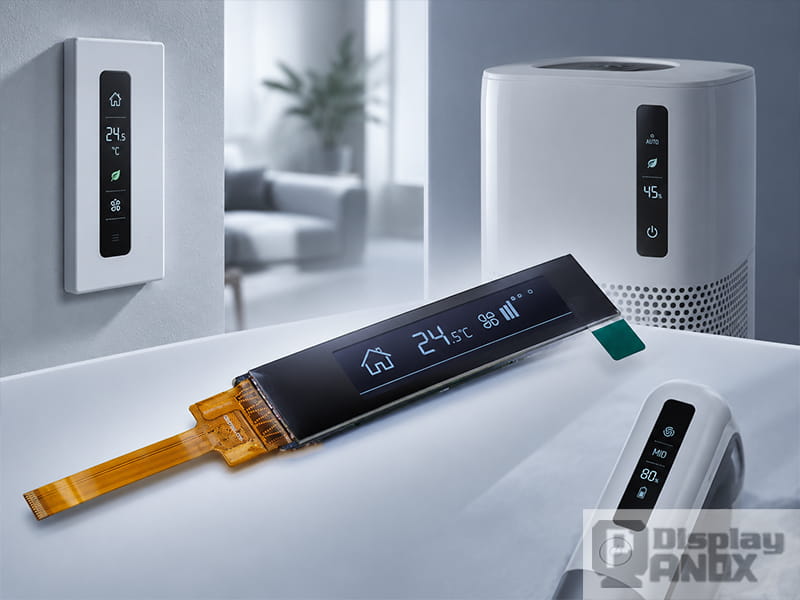
A long strip display can also work as a clean front interface for smart home devices and appliances. Examples include air purifiers, smart speakers, thermostats, kitchen appliances, door locks, security panels, charging docks and compact control bars. In these products, the display usually does not need to show a full app interface. It needs to show state: temperature, mode, timer, connection, battery, alert, or one step in a workflow.
This is where slim LCD and OLED modules can give a product a more polished appearance without making the enclosure larger. For compact handheld products, a small long strip screen can sit along the body of a scan pen, measurement tool, translator, label printer or portable testing device. Panox’s 2.99-inch long strip LCD is a good example of this direction because it combines a narrow form factor, high PPI and on-cell touch in a small module.
For products with curved surfaces, flexible OLED gives the industrial designer more freedom. OLED is self-emissive, and its thin layered structure makes it suitable for flexible display design. The technical review in Light: Science & Applications notes that OLED is an emissive display, and that the total thickness of OLED device layers can be very thin, making OLED a strong candidate for flexible displays.
High-resolution touch bars and professional control surfaces
Some long strip displays are chosen not for compactness, but for information density. A 14-inch bar-type panel can act as a notebook touch bar, aviation-style information panel, studio control strip, medical equipment auxiliary display, broadcast console, rack display, or command interface.
Panox’s 14-inch long strip TFT-LCD uses a 3840 × 1100 resolution, 283 PPI, 16.7M colors, 72% NTSC color gamut, eDP signal interface, and a 350.52 × 118.65 × 2.5 mm outline. The product page describes it as suitable for notebook touch bar long strip applications.
For this type of application, interface planning becomes critical. High-resolution long strip panels may require eDP, LVDS, HDMI controller boards or customized driving solutions. Designers should confirm the native resolution, timing, refresh rate, voltage rails, connector type and software rotation early, because UI design and hardware architecture depend on those details.
Choosing the right long strip display for each application
A stretched display project usually becomes easier when the application is matched with the panel direction from the beginning.
| Application | Suitable display direction | Practical reason |
|---|---|---|
| PC system monitoring / AIDA64 | 7.84-inch or 8.8-inch TFT-LCD | Wide format fits CPU, GPU, RAM, fan, storage and network monitoring blocks. |
| Vehicle auxiliary display | 6.8-inch or 7.84-inch IPS TFT-LCD | Narrow panel fits dashboard, mirror, console and dynamic information areas. |
| Curved dashboard or premium interface | 6.52-inch flexible OLED | Thin, high-contrast and bendable structure supports curved product surfaces. |
| Shelf-edge retail display | Long strip TFT-LCD or OLED depending on budget | Linear format matches price labels, QR codes, product messages and promotional strips. |
| Industrial machine status bar | IPS TFT-LCD with suitable temperature range | Can show alarms, process data, status and operating mode in a compact zone. |
| Compact handheld device | 2.99-inch long strip IPS LCD | Small high-PPI display fits scan pens, portable tools and narrow device bodies. |
| Notebook touch bar / professional console | 14-inch high-resolution bar TFT-LCD | High pixel density supports detailed icons, controls and multi-zone interface design. |
LCD is usually a safer starting point for cost-sensitive projects, long operating hours and high-brightness needs. OLED is more attractive when the design needs deep black, high contrast, a very thin stack, fast response or a curved surface. For static UI applications, OLED content should be managed carefully because image retention and lifetime are practical concerns in automotive and always-on display use. Analog Devices notes that OLED displays can suffer from image retention after showing static images for a long time, and that their lifetime is shorter than LCDs in a general technology comparison.
Engineering details that should be checked before production
A long strip LCD/OLED display should be evaluated as part of the whole device, not just as a panel. Active area, outline size, FPC position, connector direction, cover glass, touch structure, mounting method and heat path all affect the final product.
Brightness and viewing angle should be tested under the real environment. A PC sub-display on a desk is different from a retail shelf display under strong lighting, and both are different from a vehicle display exposed to changing daylight. The Society for Information Display’s International Committee for Display Metrology produces the Information Display Measurements Standard, which includes about 140 display measurements and is intended to quantify electronic display characteristics and qualities. In practical sourcing, this means brightness, contrast, color, viewing angle and response should be compared with consistent measurement conditions instead of treated as isolated numbers.
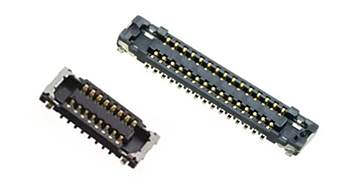
The interface should also be confirmed early. Many compact long strip LCD/OLED modules use MIPI, while larger or controller-board-based solutions may involve HDMI, eDP, LVDS or Type-C input through a driver board. Panox’s long-strip category notes controller/driver board support for inputs such as VGA, HDMI, DVI, DP, Type-C, MIPI, RGB, LVDS and eDP, depending on the project.
Touch integration is another early decision. Some displays have in-cell or on-cell touch, while others require an external PCAP touch panel and cover glass. This affects optical bonding, thickness, tooling, touch IC choice, cover lens shape and final mechanical tolerance.
Design tips for long strip display UI
The display content should be designed for the native resolution. Stretching a normal desktop, mobile UI or 16:9 visual into a bar-shaped screen usually creates poor readability. A better approach is to divide the long strip into zones, each with one clear function.
For vehicle and transportation displays, the interface should prioritize quick recognition. Use large numbers, short labels, consistent icon language and limited animation. For PC sub-displays, block-based dashboards work well because users read them in small chunks. For shelf-edge displays, product name, price, offer and QR code should be more important than decorative motion. For industrial HMI, alerts and operating status should be readable before secondary data.
A long strip display also benefits from strong spacing. Because the panel is narrow, the temptation is to fill every pixel. Leaving enough breathing room often makes the display feel more professional and easier to use. The screen is small, but the design should not act nervous. Let it breathe a little — even pixels need personal space.
Long strip LCD/OLED and other custom-shaped displays
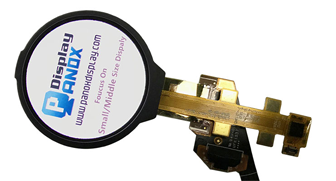
Long strip displays are part of a wider custom-shaped display strategy. A Round Display is suitable for circular products such as smartwatches, gauges, knobs, compact smart home controllers and certain medical or automotive interfaces. A long strip LCD/OLED is better for linear surfaces such as dashboards, shelves, racks, scan pens, control bars and status panels.
The choice should follow the product shape. If the product is based on a circular interaction, use a circular display. If the product needs a slim information layer across a line, a long strip display will usually feel more natural.
Conclusion
Long strip LCD/OLED displays are useful because they bring information to spaces that ordinary screens cannot use well. They fit dashboards, PC cases, retail shelves, industrial panels, transportation systems, smart home devices and compact handheld products. Their value is not only in the panel shape, but in how naturally that shape matches linear information.
For most projects, TFT-LCD offers a practical balance of cost, brightness, availability and durability. Flexible OLED opens the door to curved, high-contrast and premium product designs. The best choice depends on where the display will be installed, how it will be viewed, what content it will show, and how long it will operate each day.
Panox Display provides long strip LCD and OLED options from compact 2.99-inch modules to high-resolution 14-inch bar-type panels, along with controller board, connector, cover glass and touch panel support for development and customization. For a new project, the fastest path is to start with the application, confirm the mechanical space, then match the display size, resolution, interface, brightness, touch requirement and controller solution.
Learn more:What Is a Long Strip Stretched Display Panel?
FAQs:
What applications are best for long strip LCD/OLED displays?
Long strip displays are best for linear information, such as route guidance, system monitoring, shelf pricing, machine status, warning messages, progress bars, smart home controls and compact dashboard interfaces.
Is LCD or OLED better for long strip display applications?
LCD is usually better for cost-sensitive, high-brightness and long-duty applications. OLED is better for thin, high-contrast, fast-response or curved designs. Flexible OLED is especially useful when the screen needs to follow a curved surface.
Can long strip LCDs be used as AIDA64 PC sub-displays?
Yes. The 7.84-inch and 8.8-inch long strip LCD formats are commonly used for AIDA64-style PC monitoring, especially when paired with a suitable HDMI-to-MIPI or Type-C controller board.
Are long strip displays suitable for automotive dashboards?
Yes, especially for auxiliary information zones, rearview mirror displays, route strips, center console status panels and passenger information areas. Automotive projects should also evaluate brightness, viewing angle, operating temperature, lifetime, vibration and driver readability.
Can a long strip display support touch?
Some long strip displays support touch through on-cell, in-cell or external PCAP touch solutions. Touch structure should be confirmed early because it affects cover glass, optical stack, thickness and mechanical design.
How should I choose a long strip display for my product?
Start with the application environment, available mechanical space, display content, viewing distance, brightness requirement, interface, touch requirement and target production volume. Then match the panel size, resolution, active area, outline size and controller board.