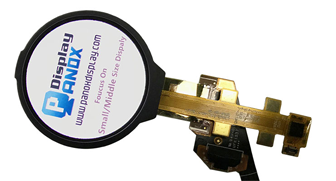







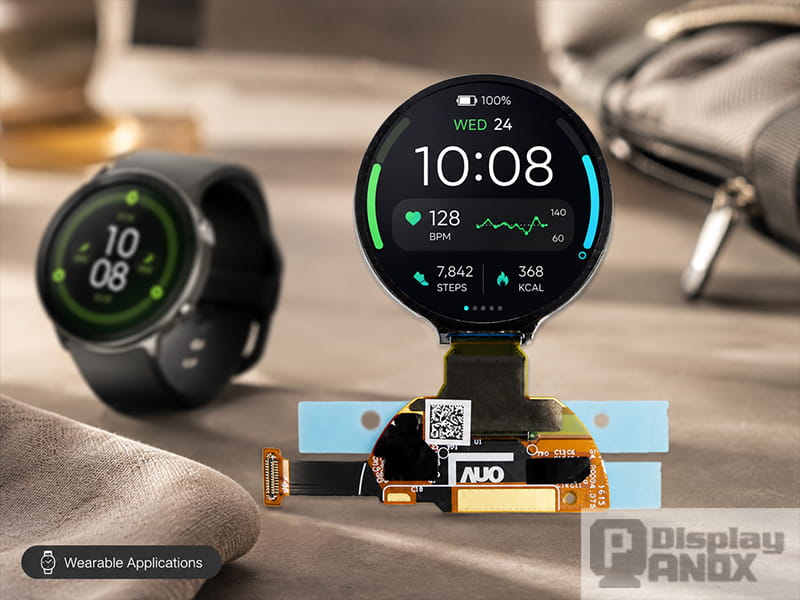
1.2 inch Round/Circular OLED For Wearable Smartwatch
Wearable display screens are no longer limited to simple time and step-count interfaces. Today, they are used in smartwatches, fitness bracelets, medical monitoring devices, sports trackers, industrial safety wearables, smart badges and compact IoT terminals. Each application asks the display to do something slightly different: show rich color, save battery, stay readable outdoors, respond to touch, fit into a thin body or survive harsh working conditions.
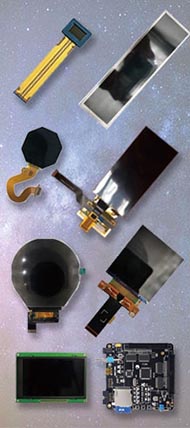
This is why application matters so much when selecting a wearable display screen. A premium smartwatch, a lightweight fitness band and a worker safety badge may all use small displays, yet their display priorities can be completely different. Panox Display’s wearable display portfolio covers circular, square and strip-type form factors across AMOLED, PMOLED and transflective LCD technologies, with a focus on low power consumption and outdoor readability for smartwatches and fitness trackers.
1. Smartwatches: The Core Application for Wearable Display Screens
Smartwatches are the most recognizable application for wearable display screens. In this category, the screen carries nearly every user interaction: time, notifications, activity rings, heart rate, workout data, calls, messages, app cards and always-on watch faces. A poor display makes the whole product feel weaker, even if the sensor system and software are well designed.
AMOLED is widely used in smartwatch displays because it offers self-emissive pixels, high contrast, vivid colors, fast response and a thin structure. Panox Display describes AM-OLED screens as having faster response speed, self-illumination, strong display effects and lower power consumption compared with traditional TFT screens.
For round smartwatch designs, a circular AMOLED display is often used to create a classic watch-like appearance. Panox Display’s 1.2 inch round OLED module uses 390 × 390 resolution, SPI/MIPI interface, in-cell touch and integrated power IC, making it suitable for smartwatch products that need vivid color, wide viewing angle and compact integration.
For square or rounded-rectangle smartwatches, a larger active display area can show more information on one screen. Panox Display’s 1.78 inch OLED on-cell touch module uses 368 × 448 resolution, MIPI/SPI interface and integrated CTP, with listed applications including wearable and medical equipment.
2. Fitness Bands and Smart Bracelets
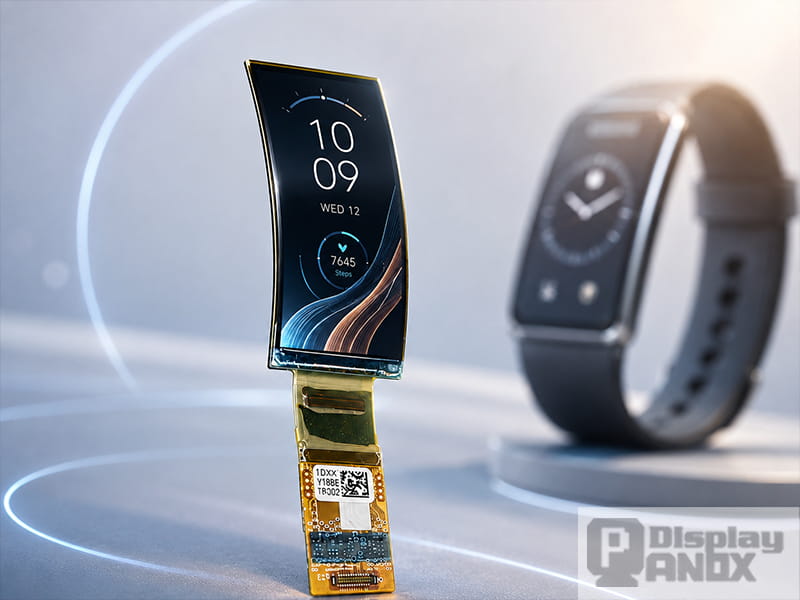
1.5 inch Flexible OLED For Wearable Smart Watch
Fitness bands and smart bracelets usually need a different display strategy from premium smartwatches. The device body is narrower, the battery is smaller, and the interface is often focused on quick data: steps, heart rate, sleep, calories, workout time, battery level and simple notifications.
For this type of product, a wearable display screen should be slim, efficient and easy to read at a glance. A strip-type OLED, compact AMOLED or PMOLED can work well when the UI is simple and the screen does not need to show complex maps or long text. Panox Display’s wearable category includes square, circular and strip-type OLED options, as well as transflective LCD choices for smart watches and bracelets.
Flexible display modules can also support bracelet-style concepts where the product needs a slimmer or more curved design language. Panox Display lists a 1.5 inch flexible AMOLED module with 120 × 240 resolution and SPI/MIPI interface, as well as a 1.8 inch flexible PMOLED module with 160 × 32 resolution and SPI interface for wearable bracelet applications.
In fitness products, the best display is usually the one that matches the information level. A simple bracelet UI does not always need a large high-resolution screen. It needs a display that makes numbers clear, saves power and fits the product shape cleanly.
3. Health and Medical Wearable Interfaces
Health monitoring is one of the fastest-growing reasons people wear smart devices. Smartwatches and wearable devices are used to display heart rate, sleep trends, blood oxygen data, movement reminders, workout recovery, fall alerts and other health-related information. A review on smartwatches in healthcare reports that smartwatch applications have shown promise in areas such as heart disease detection, movement disorder monitoring and early signs of infectious disease, though real medical use still depends on validation and regulation.
The display matters because health data must be easy to read quickly. Small numbers, low contrast or poor viewing angle can reduce usability, especially for elderly users, outdoor users or professional monitoring devices. For medical and health-oriented wearables, the display should support clear typography, stable brightness, wide viewing angle and reliable touch interaction.
Panox Display’s 1.78 inch OLED on-cell touch module is positioned for wearable and medical equipment, with 368 × 448 resolution, MIPI/SPI interface and integrated capacitive touch. This type of display direction is suitable for compact health-monitoring interfaces where color, touch response and information density matter.
At the same time, health-related wearable products should avoid overstating medical functions. The FDA has stated that it has not authorized, cleared or approved any smartwatch or smart ring that measures or estimates blood glucose values on its own. For display suppliers and device developers, this means the screen can support health data visualization, alerts and user guidance, while regulated medical claims must be handled carefully by the final device manufacturer.
4. Outdoor Sports and Adventure Wearables
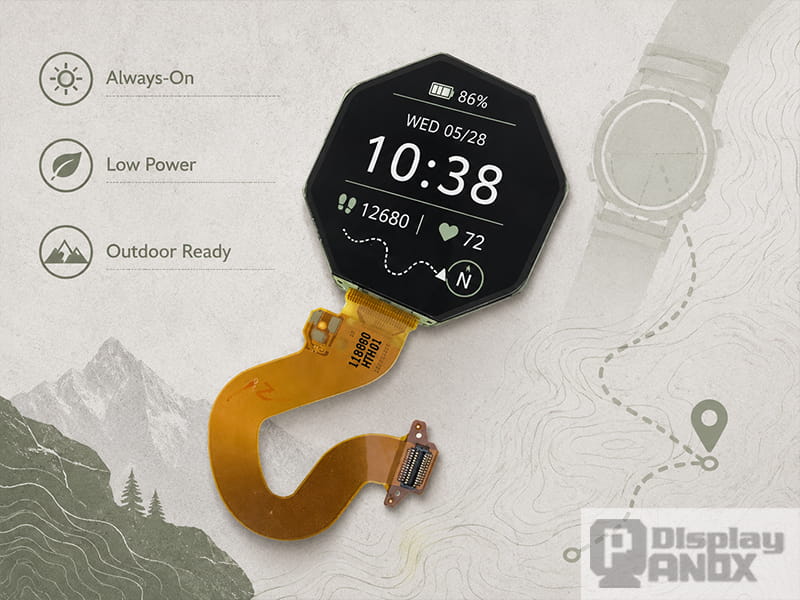
1.2 inch Memory LCD Colorful/Chromatic For Smartwatch
Outdoor sports wearables need displays that remain useful under sunlight, cold weather, sweat, rain and rapid movement. A runner may only glance at the screen for one second. A cyclist may view it from an angle. A hiker may need the display under strong sunlight. In these conditions, the display must support clear contrast, suitable brightness and stable visibility.
Panox Display’s 1.2 inch round OLED page lists advantages including wide operating temperature, working well under -40℃, readability under the sun, high PPI, thin structure, high contrast, vivid image and low consumption. These features match the needs of outdoor watches and compact sports devices.
For outdoor products that need long standby time and always-visible information, reflective or transflective display directions can also be considered. Panox Display’s wearable category includes transflective LCD technologies alongside AMOLED and PMOLED, which gives product developers more options for sports, outdoor and battery-sensitive devices.
The application should guide the choice. A colorful AMOLED watch is suitable for premium sports interfaces with maps, charts and rich UI. A more power-focused display can be better for long-duration outdoor tracking, simple data screens or equipment that must remain visible for many hours.
5. Industrial Wearables and Worker Safety Devices
Wearable display screens are also used in industrial environments. Examples include smart security badges, wrist-worn terminals, portable meters, worker safety monitors and compact control devices. These products may display alerts, status messages, identity information, environmental readings, task instructions or emergency notifications.
Industrial wearable applications often care more about reliability than visual luxury. The display should be readable, durable, stable under temperature changes and easy to integrate with the device housing. A 2025 review on wearable sensors in industrial ergonomics reports that wearable devices have significantly influenced ergonomic conditions in industrial settings, especially as AI and sensor integration develop further. Another review on wearable sensors for industrial workers discusses their use in workplace safety and health monitoring, including high-risk environments.
Panox Display’s wearable page also lists industrial and IoT devices as target applications, including industrial handhelds, smart security badges and portable metering devices. For these products, OLED, AMOLED, PMOLED or LCD selection should be based on alert visibility, power budget, enclosure design, interface support and expected working conditions.
6. Smart Badges, Access Devices and Compact IoT Terminals
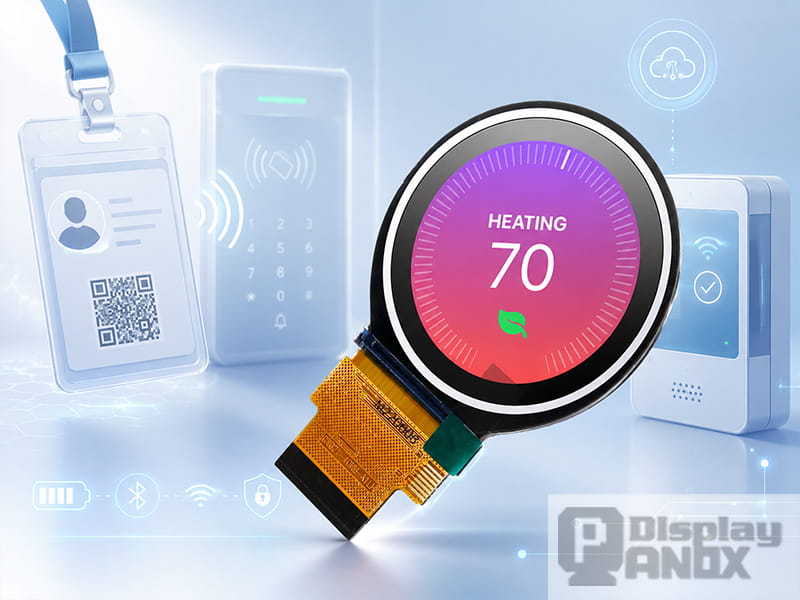
Not every wearable display needs a full smartwatch interface. Some devices only need to show identification, a QR code, connection status, battery level, access information or a short alert. Smart badges, electronic ID devices, access-control wearables and IoT tags can use smaller displays with simpler UI.
PMOLED or compact TFT-LCD panels can be practical when the content is simple. AMOLED may be used when the product needs color, stronger contrast or a more premium visual impression. For smart badge and IoT applications, the display interface is also important. SPI, QSPI and MCU-style interfaces are often useful for compact embedded systems because they can reduce wiring complexity and simplify development.
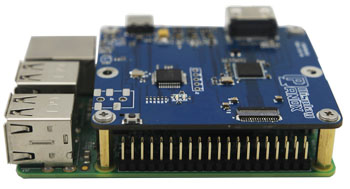
Panox Display’s product and category pages emphasize support beyond the bare display, including datasheets, display drawings, IC datasheets, circuit schematics and controller-board assistance for development. This matters for IoT and badge projects where engineering teams may need a faster display bring-up process.
7. Fashion, Lifestyle and Design-Led Wearables
Some wearable products are designed around appearance as much as function. Smart bracelets, fashion bands, wellness accessories and compact lifestyle devices may use the display as part of the product identity. In these cases, shape, curve, thickness, black-state appearance and cover glass integration become very important.
Flexible OLED and flexible PMOLED can support more distinctive wearable designs. Panox Display’s flexible display category includes small flexible AMOLED and PMOLED options for wearable and bracelet-style products, including modules with SPI or MIPI interfaces depending on the product direction.
For design-led wearables, the display should be chosen with the housing and UI together. A narrow flexible PMOLED can work for simple bracelet notifications. A small AMOLED can work for premium color effects. A round display can create a more traditional watch-like feeling. A square display can support more structured data and app-style interfaces.
8. Medical, Instrument and Professional Portable Devices
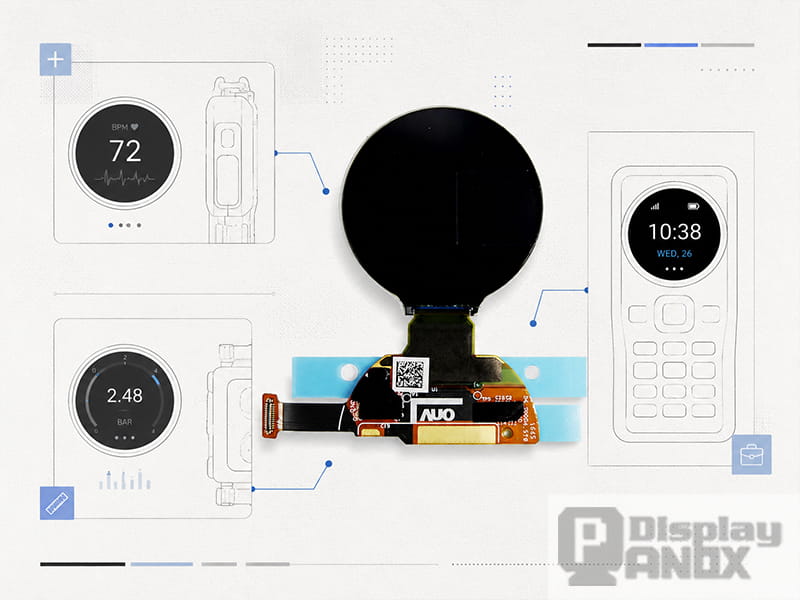
1.2 inch Round/Circular OLED For Wearable Smartwatch
Wearable display screens can also appear in professional compact devices that are close to the body or carried during work. These may include portable health instruments, inspection devices, small controllers, smart home control units, security equipment and dynamic information displays.
Panox Display’s 1.2 inch round OLED page lists use cases beyond smartwatches, including vehicle, smart home, instrument, industrial device, security and dynamic information displays that require low consumption and high-quality color image performance. This shows that a wearable display panel can often fit adjacent compact-device applications when the size, interface and brightness meet the project requirements.
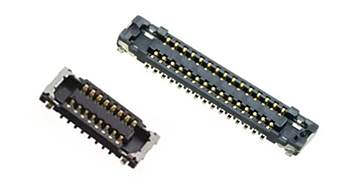
For professional devices, the display should be selected with a stronger focus on supply stability, operating temperature, connector reliability and driver support. A beautiful sample is not enough if the final product requires long-term production and field reliability.
9. Matching Display Type to Application
Different applications need different display technologies. AMOLED is strong for premium smartwatch interfaces, colorful UI and high contrast. PMOLED is useful for simpler bracelet and compact data displays. Transflective LCD can fit outdoor and long-standby applications. Flexible OLED and PMOLED can support curved or design-led wearable products.
| Application | Main Display Requirements | Suitable Display Direction |
|---|---|---|
| Premium smartwatch | High contrast, vivid color, touch, high PPI, smooth UI | Round or square AMOLED, on-cell or in-cell touch |
| Fitness band | Low power, slim shape, quick readability | Strip-type OLED, PMOLED, compact AMOLED |
| Health wearable | Clear data, stable brightness, reliable touch | AMOLED with touch, compact color OLED |
| Outdoor sports device | Sunlight readability, wide temperature, long battery life | High-brightness AMOLED, transflective LCD |
| Smart badge / IoT tag | Simple data, low power, easy interface | PMOLED, small TFT-LCD, compact OLED |
| Industrial wearable | Reliability, readable alerts, durable integration | OLED, TFT-LCD, transflective LCD depending on environment |
| Fashion bracelet | Slim form, curved design, visual identity | Flexible AMOLED or flexible PMOLED |
This table is only a starting point. The final decision should also consider battery capacity, UI complexity, display interface, cover glass, touch structure, mechanical design and expected production volume.
10. Panox Display Wearable Display Options for Different Applications
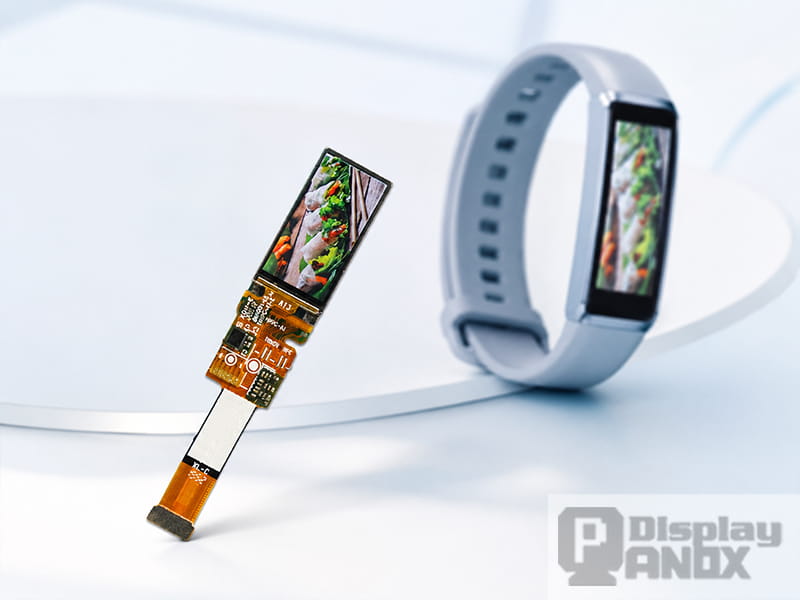
0.95 inch OLED On-cell PACP TP For Wearable Bracelet
Panox Display supplies wearable display screens for smartwatches, smart bracelets, medical wearables, outdoor devices, industrial equipment and compact IoT hardware. The available directions include AMOLED, PMOLED, transflective LCD and flexible display modules, with circular, square and strip-type form factors for different product structures.
For smartwatch projects, Panox Display provides round and square AMOLED options, including integrated touch modules for compact wearable design. For fitness bands and smart bracelets, compact OLED, PMOLED and flexible display options can support slim body design and simple information display. For industrial and medical-related products, display selection can be matched with readability, interface, temperature range and long-term supply needs.
Panox Display can also support related development requirements such as customized cover glass, touch panel design, connectors, demo kits and controller or driver board solutions. This helps developers evaluate the display earlier and move from sample testing to real product integration more efficiently.
Conclusion
Wearable display screens are used across many product categories, from smartwatches and fitness bands to health wearables, outdoor sports devices, smart badges, industrial safety equipment and compact IoT terminals. These applications may look similar in size, but their display requirements are very different.
A smartwatch usually needs rich color, high contrast and smooth touch. A fitness bracelet needs low power and quick readability. A medical wearable needs clear data and reliable interaction. An outdoor sports device needs sunlight visibility and stable operation. An industrial wearable needs durability and practical alert display.
The best wearable display screen is the one that fits the real application. By selecting the right display technology, shape, interface and integration support, developers can build wearable products that look better, last longer and feel easier to use in daily life.
Learn more: Why Is the Wearable Display Screen So Important for Smartwatch Design?
FAQs:
What are the main applications of wearable display screens?
Wearable display screens are used in smartwatches, fitness bands, smart bracelets, medical wearables, sports trackers, smart badges, industrial safety devices and compact IoT terminals.
Which display is best for a smartwatch?
AMOLED is often a strong choice for smartwatches because it offers high contrast, vivid color, thin structure and fast response. Round AMOLED displays are suitable for classic watch-style products, while square or rounded-rectangle AMOLED displays can show more information.
What display is suitable for a fitness band?
Fitness bands often use compact OLED, PMOLED or narrow strip-type displays. The best choice depends on UI complexity, battery target, body size and whether the product needs full color or simple data display.
Can wearable display screens be used in medical devices?
Yes, wearable display screens can be used in medical and health-related devices to show heart rate, alerts, reminders and monitoring data. However, regulated medical claims and diagnostic functions require proper validation and approval by the final device manufacturer.
Why are flexible displays useful in wearable products?
Flexible OLED and flexible PMOLED displays can support slim, curved or bracelet-style designs. They are useful when the product needs a different form factor from a flat watch face.
Can Panox Display support wearable display projects?
Yes. Panox Display supplies AMOLED, PMOLED, transflective LCD and flexible display modules for wearable applications, with support for cover glass, touch panels, connectors and driver board solutions.