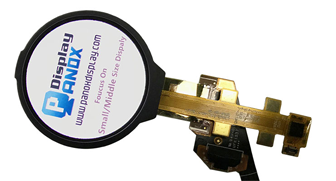







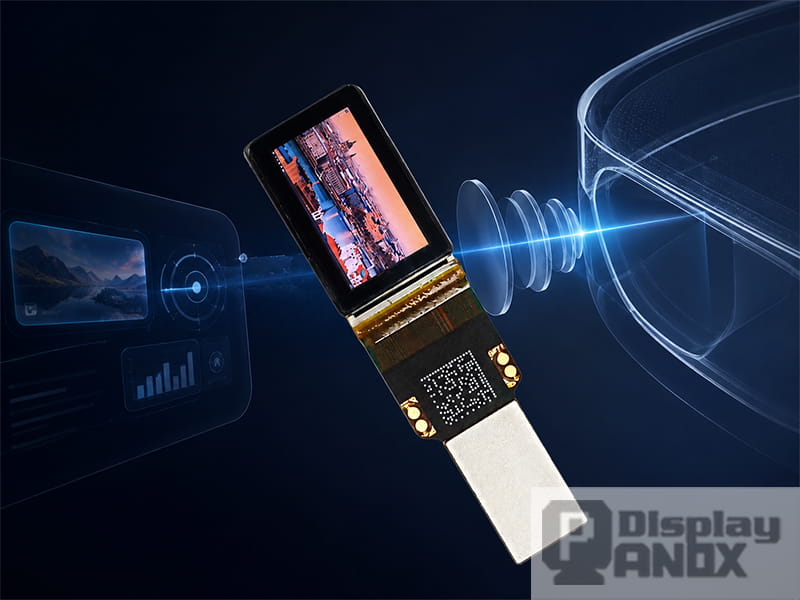
0.49 inch Micro OLED Display 1920X1080 MIPI Interface
1. What Is an AR Display?
Augmented reality is often described through software: spatial interfaces, real-time information, navigation prompts, industrial instructions, or floating screens in front of the eyes. Yet the quality of an AR product begins much earlier, inside the optical engine. Before any virtual object reaches the user, a tiny display panel must create the image, and the optical system must guide that image into the eye with enough brightness, clarity, contrast, and comfort.
An AR display is the image-generation part of an augmented reality system. In most wearable AR devices, the display panel works with magnifying optics, relay lenses, prisms, birdbath optics, or waveguides to create a virtual image that appears larger and farther away than the physical panel itself. A review on optical see-through AR near-eye displays describes a typical AR near-eye system as including a display unit or image source, magnifying or relay optics, and an optical medium that transmits the virtual image to the eye while allowing real-world light to pass through.
This is why AR display panel selection is more demanding than ordinary screen selection. A smartphone screen can be viewed directly. An AR display must survive optical losses, remain readable through ambient light, fit inside a compact temple or headset body, and deliver fine text without visible pixel structure. Field of view, eyebox, eye relief, brightness, resolution, color uniformity, contrast, power consumption, and thermal behavior all influence the final user experience.
1.1 What Makes an AR Display Different from a Normal Display?
An AR display panel is usually much smaller than a phone or tablet display, yet it needs extremely high pixel density. When the panel is magnified near the eye, small pixel defects, low resolution, weak contrast, and slow response become much easier to notice. For readable text and clean interface overlays, the display must provide high resolution in a very small active area.
In optical see-through AR, brightness becomes even more critical. The user is looking at both digital content and the physical world. Outdoor light, indoor lighting, optical combiners, and waveguides can all reduce the perceived brightness of the virtual image. Research on full-color OLED microdisplays for head-mounted wearables notes that AR applications often require high brightness above 2,000 cd/m² so that images remain visible in ambient lighting or through inefficient optical components.
The optical path also matters. Waveguide-based AR displays can make glasses slimmer and lighter by folding the optical path and expanding the exit pupil, but the waveguide introduces its own challenges in efficiency, uniformity, field of view, eyebox, eye glow, and ambient contrast. A Springer Nature review explains that the overall efficiency of an AR waveguide display depends on both the light engine and the waveguide combiner, so panel brightness alone does not determine final image visibility.
1.2 Main Display Technologies Used in AR
Several microdisplay technologies are used in AR and near-eye systems, including LCoS, DLP, OLED-on-silicon, Micro LED, and laser beam scanning. Each route has a different balance of brightness, contrast, optical efficiency, panel size, manufacturing maturity, color performance, and system complexity.
Micro OLED display, also known in many industry contexts as OLED-on-silicon or OLEDoS, has become one of the most practical choices for compact AR glasses, FPV goggles, electronic viewfinders, and wearable visual systems. Its strength comes from combining OLED’s self-emissive image quality with a silicon backplane capable of very high pixel density.
A 2025 review of OLED-on-silicon microdisplays highlights their high contrast, deep blacks, fast response, thin structure, and power-efficient self-emissive nature, all of which are important for XR and near-to-eye platforms. Sony Semiconductor also describes OLED microdisplays as using high-mobility monocrystalline silicon wafers to achieve around 4,000 ppi, with ultra-high contrast and fast response.
2. What Is a Micro OLED Display?
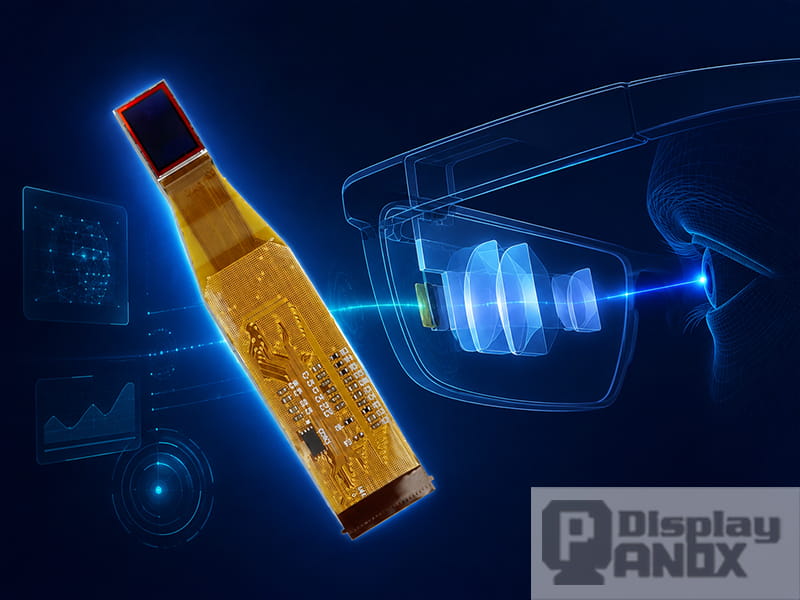
A Micro OLED display is a miniature OLED panel built on a silicon backplane. Unlike conventional glass-based OLED panels used in phones or watches, Micro OLED panels are designed for optical systems where the display is magnified close to the eye. The silicon backplane enables very fine pixel structures, integrated driving circuits, and compact module design.
Because each pixel emits its own light, Micro OLED does not need a separate backlight. This gives it strong contrast, deep black levels, and a thinner light engine structure. Sony lists native OLED microdisplay characteristics including a 100,000:1 contrast ratio and response speed of 0.01 ms or less, which are valuable for fast-moving near-eye applications.
For AR glasses, this combination matters in a very practical way. High pixel density helps text look sharp. High contrast helps icons and overlays separate from the real world. Fast response helps reduce motion blur. Compact dimensions help the optical engine fit into a wearable form factor. Lower module size also gives product designers more freedom in weight balance, temple thickness, battery placement, and thermal layout.
2.1 Why Micro OLED Is Strong for AR Display Panels
Micro OLED is especially attractive when the AR product needs a compact display engine with high perceived image quality. A small panel can support a large virtual image through optics, while high PPI keeps the image from looking coarse after magnification.
The main advantages include:
| Requirement in AR glasses | Why Micro OLED helps |
|---|---|
| Sharp virtual image | Very high pixel density supports readable text and fine UI details |
| Compact optical engine | Silicon-based microdisplays allow small panel size and integrated driving circuits |
| High contrast | Self-emissive pixels create deep blacks and clearer image separation |
| Fast response | OLED response helps reduce motion blur and latency perception |
| Lower optical complexity | No backlight can simplify the display engine compared with transmissive display routes |
| Premium visual quality | Rich color and high contrast improve media, navigation, and interface overlays |
Sony’s latest OLED microdisplay development also shows where the industry is moving: smaller pixels, higher brightness, and lighter AR glasses. Its 2024 ECX350F announcement describes a compact Full HD OLED microdisplay with 5.1 µm pixels, approximately 5,000 ppi, and peak brightness up to 10,000 cd/m², specifically targeting thinner and lighter AR glasses.
2.2 The Brightness Challenge in AR
Brightness is one of the hardest specifications to evaluate because the panel brightness is only the starting point. After the image leaves the microdisplay, light passes through lenses, prisms, combiners, or waveguides. Every stage can reduce the final luminance reaching the eye.
For indoor media glasses or assisted-reality displays, Micro OLED can deliver excellent visual quality. For bright outdoor optical see-through AR, the system may need a much higher-brightness light engine or a more efficient optical architecture. The waveguide literature describes ambient contrast ratio as a key metric because the visible image depends on both display luminance and ambient light transmitted through the waveguide. Under bright ambient conditions, a high-brightness light engine and efficient waveguide are both needed.
This is why AR display selection should not rely on one number alone. A 3,000 cd/m² panel can perform very differently depending on optical efficiency, field of view, dimming strategy, content type, and use environment. For an indoor-first wearable display, the priority may be contrast, resolution, power, and comfort. For outdoor industrial AR, brightness headroom and optical throughput become much more important.
3. How an AR Display Works Inside Smart Glasses
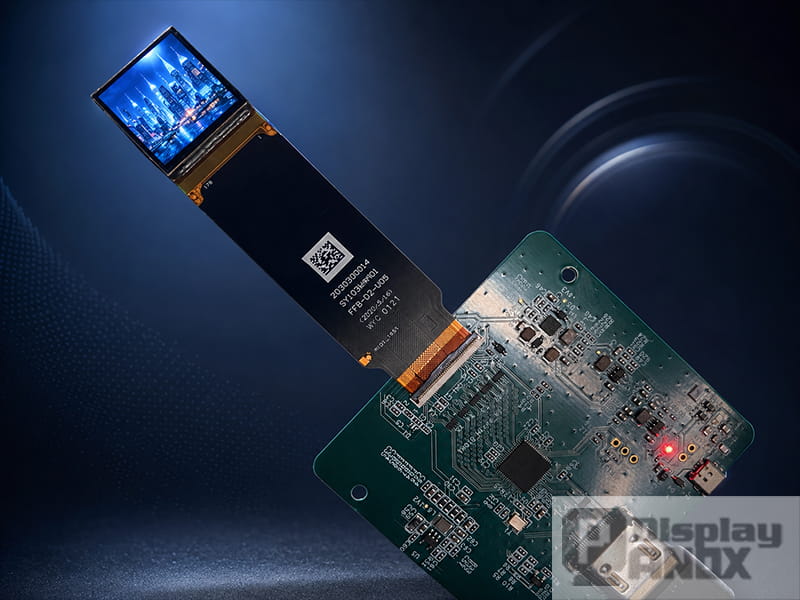
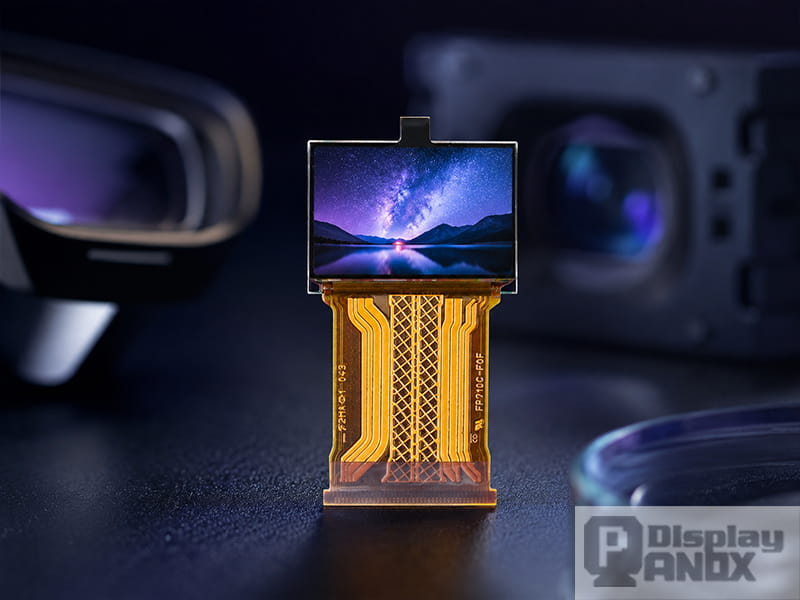
1.03 inch Micro OLED Display 2K for AR/FPV
A simplified AR display system has three layers: the image source, the optical path, and the user’s eye.
First, the Micro OLED display generates the image. This could be text, navigation arrows, subtitles, camera information, FPV video, industrial instructions, or a virtual screen. Then the optical system magnifies and redirects that image. Depending on the product design, this path may use birdbath optics, freeform prisms, waveguides, or other optical combiners. Finally, the virtual image reaches the eye and appears at a perceived distance.
The display panel is only one part of the system, but it influences almost everything downstream. Panel size affects optical engine volume. Resolution affects virtual image sharpness. Brightness affects visibility after optical losses. Interface type affects electronics design. Power consumption affects heat and battery life. Response time affects motion clarity. Color and contrast affect the perceived “premium” quality of the image.
For waveguide-based AR, the light engine must also match the optical requirements of the waveguide. Smaller display size can reduce the light engine volume, but maintaining field of view and resolution may require smaller pixel pitch and careful collimating optics.
4. Key Specifications When Choosing an AR Display Panel
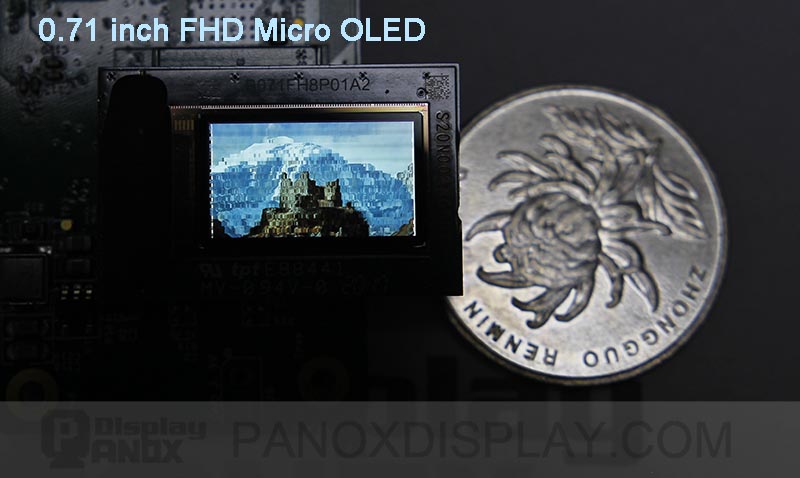
0.71 inch Micro OLED 1920x1080 LVDS 3000 nits
The right AR display panel depends on the final product. A lightweight notification display, a cinematic wearable screen, an FPV headset, and an industrial optical see-through device may all use Micro OLED, but their priorities are different.
4.1 Resolution and Pixel Density
Resolution tells how many pixels the display has. Pixel density tells how tightly those pixels are packed. For AR, both matter. A Full HD microdisplay can look very sharp when the pixel density is high and the optics are well matched. Higher-resolution panels are useful for larger virtual screens, denser text, and more immersive imaging.
Micro OLED panels commonly reach pixel densities far beyond ordinary direct-view displays. Sony notes that OLED microdisplays achieve ultra-high resolution of around 4,000 ppi thanks to monocrystalline silicon backplanes. For AR interfaces, this can make small text, icons, and fine graphics easier to read after optical magnification.
4.2 Brightness
Brightness should be considered together with optical efficiency and target environment. For indoor media glasses, moderate-to-high brightness may be enough. For optical see-through AR in bright environments, more brightness headroom is needed. Academic and industry research on OLED microdisplays for AR has repeatedly identified high luminance as a central requirement, especially because lenses and waveguides can be inefficient.
4.3 Contrast Ratio
High contrast helps digital elements appear cleaner, especially in dark UI designs, subtitles, menus, and media content. OLED’s self-emissive structure is naturally strong here because black pixels can remain off. In AR, contrast also affects how much the display area appears to glow or wash out against the surrounding environment.
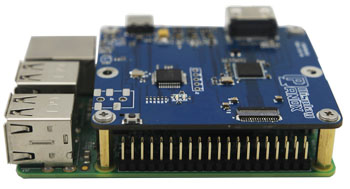
4.4 Interface and Driving Board
Common Micro OLED interfaces include MIPI, LVDS, RGB, SPI, and I2C control. The display interface must match the system processor, driver board, optical engine layout, firmware requirements, and available space. For prototyping, a controller board can shorten the development cycle. For mass production, a custom board can reduce size, simplify cabling, and improve integration.
4.5 Size and Optical Fit
A larger Micro OLED panel may support a larger virtual image or easier optical design, while a smaller panel can help reduce the size and weight of the optical engine. There is no universal “best” size. The best choice depends on field of view, eye relief, lens design, housing size, heat dissipation, and target application.
5. PanoxDisplay AR Display Panel Options
PanoxDisplay’s AR display panel category focuses mainly on Micro OLED displays for near-eye and wearable applications. The current AR tag page includes several useful options, such as 0.39-inch Micro OLED panels, 0.49-inch Full HD Si-OLED, 0.5-inch Micro OLED panels, 0.68-inch WUXGA Micro OLED, 0.71-inch Full HD Micro OLED panels, and a 1.03-inch 2560 × 2560 Micro OLED display for AR/FPV use.
For compact AR glasses or assistant-style eyewear, a smaller Full HD or XGA Micro OLED can help reduce optical engine volume. For higher-end wearable screens, FPV goggles, and professional near-eye systems, higher-resolution or higher-brightness options such as 0.68-inch WUXGA, 0.71-inch Full HD, or 1.03-inch 2K-class Micro OLED may be more suitable. The choice should be made according to the optical design rather than panel resolution alone.
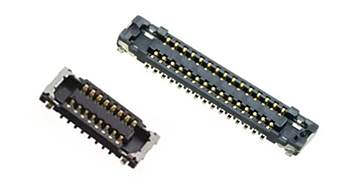
PanoxDisplay also supports practical integration around the display panel. The AR page notes that display selection is only the beginning, since clients may also need connectors, cover glass or touch panels, and customized controller or driver boards. PanoxDisplay can provide connectors, cover glass/touch panel support, and controller/driver boards with interfaces such as VGA, HDMI, DVI, DP, Type-C video input, MIPI, RGB, LVDS, and eDP.
That support is important for AR development because many early-stage projects fail in the gap between panel selection and system integration. A display panel that looks strong on a datasheet still needs the right cable, power sequence, board layout, firmware control, optical alignment, brightness tuning, and thermal plan.
6. Which AR Applications Use Micro OLED Displays?
Micro OLED displays are widely used in products where high image quality must fit into a compact near-eye device.
In AR glasses, Micro OLED panels can display notifications, subtitles, translation overlays, navigation prompts, AI assistant output, camera information, or a private virtual screen. In FPV and drone goggles, fast response, high contrast, and compact size help deliver clearer real-time video. In industrial systems, Micro OLED can support inspection, maintenance, warehouse guidance, medical assistance, and remote expert workflows. Sony also lists AR/VR glasses, drones and FPV, scopes, medical care, and professional electronic viewfinders among the application areas for OLED microdisplays.
The strongest use cases are usually those where the user benefits from a compact screen near the eye: hands-free information, private viewing, real-time visual guidance, or immersive first-person video. As optics, batteries, processors, and display panels improve together, Micro OLED will continue to support a wide range of wearable display products.
7. Micro OLED vs. Micro LED for AR: A Practical View
Micro LED is often discussed as a future direction for high-brightness transparent AR because it has strong potential in brightness, lifetime, and efficiency. However, full-color Micro LED microdisplays still face difficult manufacturing challenges, including RGB integration, color conversion, yield, pixel-level uniformity, and cost. The Springer Nature review notes that Micro LED-on-silicon still requires further development in directional angular distribution and small full-color pixel size to support high-brightness, high-resolution AR displays.
Micro OLED has a different advantage: it is commercially mature, compact, high contrast, high density, and already available in practical panel sizes and interfaces. For many AR glasses, smart glasses, FPV goggles, and wearable visual products, Micro OLED is the more realistic route for near-term product development. It gives engineering teams a stable display path while the wider AR display ecosystem continues to evolve.
8. How to Select the Right AR Display Panel
A reliable selection process starts with the optical system, not the panel list. Before choosing a Micro OLED display, define the target use environment, expected virtual image size, optical architecture, field of view, eye relief, brightness at the eye, interface, power budget, and mechanical space.
For indoor smart glasses, prioritize pixel density, contrast, comfort, low power, and compact module design. For FPV goggles, pay attention to response time, resolution, refresh rate, latency, and video interface. For outdoor industrial AR, brightness after optical losses, ambient contrast, thermal behavior, and optical efficiency become more important. For early prototypes, a display with an available driver board can speed up evaluation. For commercial devices, custom boards and stable supply are often just as important as the panel itself.
A good AR display panel should feel almost invisible in the product experience. Users should notice the information, image, or virtual screen, not the pixel grid, dim image, washed-out contrast, or heavy headset. That is the real value of Micro OLED in AR: it helps turn a tiny physical display into a clear, compact, and practical near-eye visual system.
9. Conclusion
An AR display panel is the foundation of the visual experience in smart glasses and near-eye devices. It must deliver high resolution, strong contrast, fast response, enough brightness, compact size, and stable integration with the optical engine. Micro OLED display technology fits many of these requirements because it combines OLED image quality with silicon-backplane pixel density and compact module design.
For AR glasses, FPV goggles, professional viewfinders, and wearable display systems, Micro OLED remains one of the most practical display technologies available today. Choosing the right panel means looking beyond resolution alone and considering the full system: optics, brightness, interface, power, thermal design, board support, and final use environment.
PanoxDisplay provides Micro OLED display panels for AR and near-eye applications, with options covering compact XGA and Full HD panels as well as higher-resolution and higher-brightness Micro OLED solutions. For development teams building AR glasses, wearable screens, FPV systems, or optical engines, the best starting point is a display panel that matches both the visual target and the integration path.