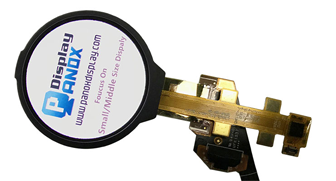




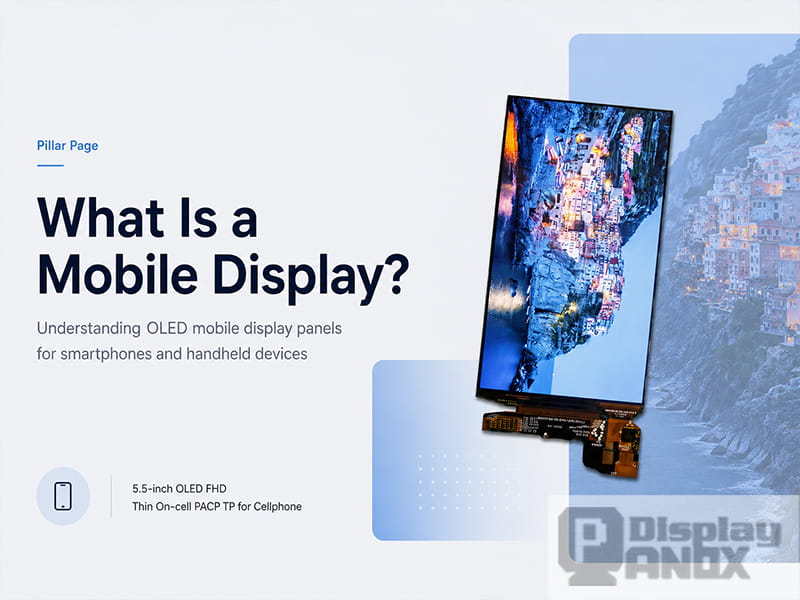
5.5 inch OLED FHD Thin On-cell PACP TP For Cellphone
A mobile display is the visual and touch interface used in portable electronic devices such as smartphones, handheld terminals, portable GPS units, game consoles, compact medical devices, and smart control systems. In the display supply chain, the term usually refers to the display panel or display module before it is fully assembled into the final device housing. For product designers and engineers, choosing a mobile display is a technical decision that affects image quality, power consumption, mechanical design, touch performance, outdoor readability, and user experience.
Modern mobile display panels are no longer judged by size and resolution alone. A practical selection also depends on luminance, contrast ratio, color depth, viewing angle, refresh rate, touch structure, interface, operating temperature, cover glass design, and driver board support. Professional display evaluation also relies on measurable parameters such as luminance, contrast, color performance, reflectance, and viewing behavior; SID’s ICDM standard focuses on standardized display measurement methods, while DisplayMate’s mobile display testing work is based on laboratory measurements of LCD and OLED displays in smartphones, smart watches, and tablets.
1. What Is a Mobile Display?
A mobile display is a compact, high-density display panel designed for devices that need clear imaging in a small and power-limited form factor. In a mobile phone or handheld device, the display is usually built from several functional layers: cover glass, touch sensor, optical film or polarizer, display cell, TFT backplane, driver IC, and FPC connection. For AMOLED displays, key technical components include substrates, thin-film transistors, OLED materials, and optical films.
In sourcing language, “mobile display,” “mobile display panel,” and “mobilephone display panel” may describe slightly different supply stages. A bare display panel may still need a matching FPC, connector, cover glass, touch panel, driver IC support, or controller board. A more integrated display module may already include touch functions such as in-cell or on-cell PCAP touch. This is why two panels with the same size and resolution can behave very differently in real product development.
2. Main Technologies Used in Mobile Displays
2.1 AMOLED and OLED Mobile Displays
AMOLED is one of the most common display technologies for modern smartphones and premium handheld devices. Unlike LCD panels that require a backlight, OLED pixels emit light directly. This gives OLED displays strong contrast, deep black levels, fast response, wide viewing angles, and a thinner structure. These characteristics are valuable for mobile devices where visual quality and slim mechanical design matter.
AMOLED power consumption depends heavily on displayed content. Research on smartphone AMOLED power behavior found that screen power varies with RGB composition, gray level, brightness, and the type of content shown on the display. Bright, white-heavy interfaces usually require more power, while dark interfaces can reduce pixel-level emission power.
2.2 Flexible OLED for Curved and Advanced Product Design
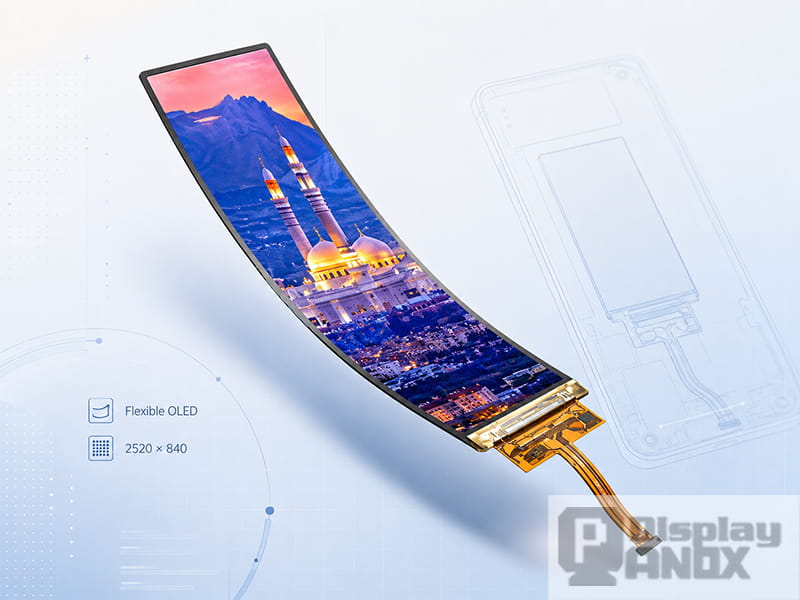
6.52 inch Flexible OLED 2520x840 Touch Panel
Flexible OLED uses flexible substrates and thin-film encapsulation instead of a rigid glass-only structure. This makes it suitable for curved, bent, foldable, or wraparound product concepts. The flexible structure is especially attractive for advanced smartphones, wearable-style devices, AR/MR prototypes, vehicle interfaces, and custom industrial terminals.
Thin-film encapsulation is a critical part of flexible OLED reliability because OLED materials are sensitive to oxygen and moisture. A review on flexible AM-OLED encapsulation describes TFE as a demanding requirement for protecting flexible OLED devices from water vapor and oxygen permeation.
2.3 TFT-LCD Mobile Displays
TFT-LCD remains useful in many mobile and handheld applications because it is mature, stable, and cost-effective. LCD panels use a backlight, so their power behavior is different from OLED. A bright white interface may be more predictable on LCD, while OLED can be more efficient with dark content. LCD can also be attractive for projects that prioritize cost control, long supply stability, or specific industrial brightness requirements.
For high-end smartphone-like design, AMOLED and flexible OLED are often preferred because they support thinner modules, higher contrast, curved mechanical possibilities, and strong visual impact. For rugged handheld devices or cost-sensitive platforms, TFT-LCD may still be the practical choice.
3. Key Specifications That Matter in a Mobile Display Panel
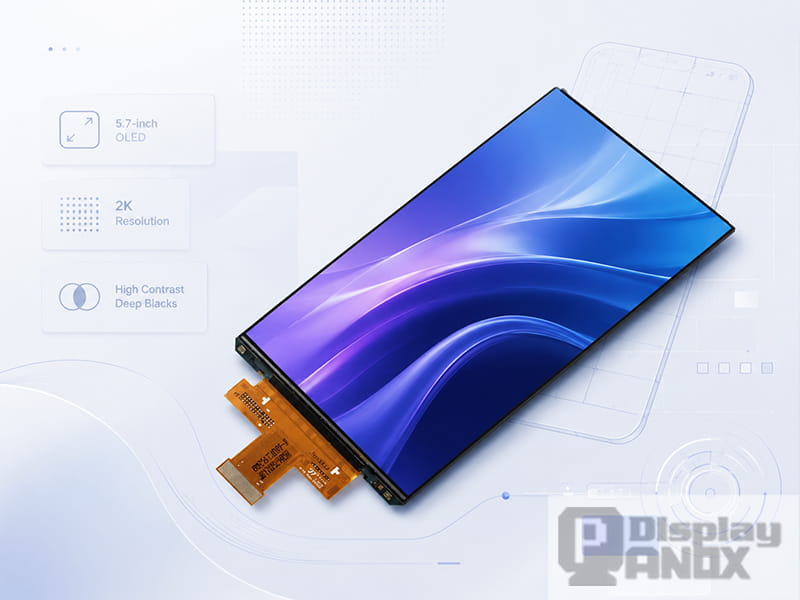
5.7 inch OLED 2K Resolutiion For Cellphone
3.1 Size, Aspect Ratio, and Active Area
The display size defines the diagonal measurement, but the active area and aspect ratio decide how the panel actually fits into a product. A 6.5-inch class mobile display can have a long portrait shape for smartphone design, while a special wide-ratio flexible panel may be better for curved, panoramic, or wraparound interfaces.
When selecting a mobile display, engineers should check the outline dimensions, active area, FPC position, IC location, bending direction, and available cover glass space. These details directly affect housing design and assembly feasibility.
3.2 Resolution and PPI
Resolution determines the number of pixels, while PPI shows pixel density. A high-PPI display is important for mobile products because users often view the screen from a short distance. Fine UI text, icons, map details, camera preview, and gaming graphics all benefit from higher pixel density.
For mobilephone display panels, common resolution choices include FHD, FHD+, and custom high-density formats. The best choice depends on processor capability, UI design, power budget, and viewing distance.
3.3 Luminance and Outdoor Readability
Outdoor readability depends on more than brightness alone. Ambient contrast ratio is influenced by display brightness, ambient light, surface reflection, and contrast performance. A study on ambient contrast ratio for LCD and OLED displays found that static contrast plays a key role in low ambient light, while higher display brightness becomes more important as ambient light increases.
This is why a mobile display for outdoor handheld devices should be selected with both luminance and surface treatment in mind. Anti-reflection cover glass, optical bonding, high-brightness driving, and suitable UI color design can all improve real-world readability.
3.4 Refresh Rate and Response
Refresh rate affects motion smoothness. A 60 Hz mobile display is suitable for many standard smartphone and terminal interfaces. Higher refresh rates such as 90 Hz, 120 Hz, or above can improve scrolling, gaming, camera preview, and interactive UI response.
Variable refresh rate technologies have also become important in advanced AMOLED displays. Recent research on LTPO-based AMOLED pixel circuits explains that variable refresh rate techniques adjust driving frequency according to content, using lower refresh rates for static images and higher refresh rates for fast motion such as gaming or video playback.
3.5 Interface: Why MIPI Is Common in Mobile Displays
MIPI is one of the most common interfaces for mobile display panels. MIPI Alliance describes DSI-2 as a scalable high-speed interface specifying the high-bandwidth link between host processors and displays.
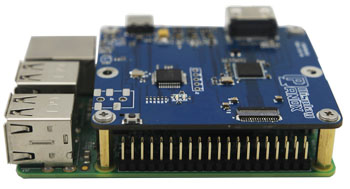
For engineers, this means a mobile display panel often needs a processor, bridge chip, or controller board that can output the correct MIPI signal. During early testing, an HDMI or Type-C controller board can help speed up evaluation before the final mainboard is ready.
4. In-cell and On-cell Touch in Mobile Display Panels
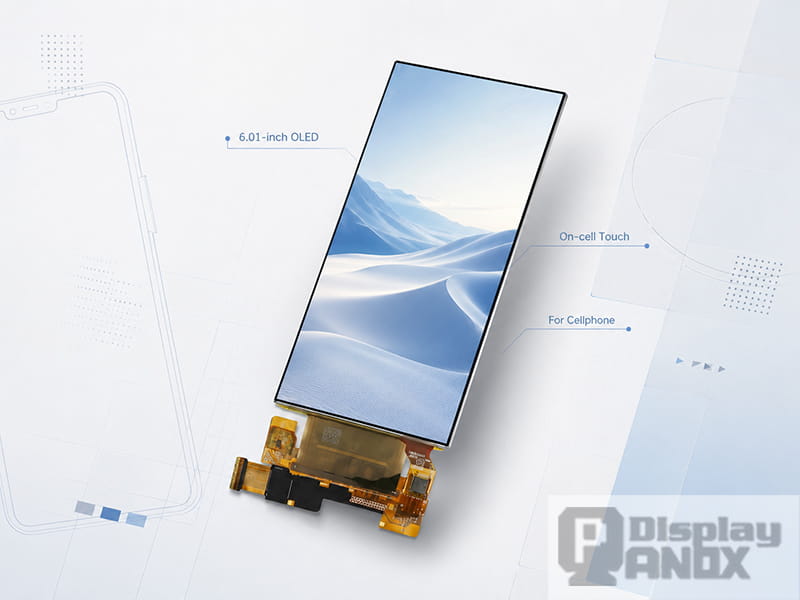
6.01 inch OLED On-cell PACP TP For Cellphone
Touch structure is an important part of mobile display design. In-cell touch integrates the touch function into the display cell, helping reduce module thickness and improve integration. On-cell touch places the touch sensor on the display panel structure, which can also support a thin and responsive touch module.
Panox Display notes that when a display has in-cell or on-cell touch, it may only need customized cover glass; panels without integrated touch may require an external touch panel.
In practical sourcing, this detail should be checked early. A display with integrated PCAP touch can simplify the front module stack, while a separate touch panel may offer more freedom for custom cover glass, special shapes, or industrial protection requirements.
5. Selected Panox Display Mobilephone Display Panels
Panox Display offers mobilephone display panels suitable for smartphone-like devices, handheld products, portable terminals, GPS devices, gaming consoles, and other compact electronics. For this mobile display guide, the following models are especially relevant.
| Product | Key Specifications | Suitable Use |
|---|---|---|
| 6.52-inch Flexible OLED Touch Panel | 2520 × 840 resolution, 407 PPI, MIPI interface, 90 Hz refresh rate, in-cell touch, 430 cd/m² luminance, flexible OLED structure | Curved mobile devices, wraparound display concepts, AR/MR-related prototypes, special handheld interfaces |
| 6.67-inch Flexible AMOLED for Smartphone | 1080 × 2400 resolution, 394 PPI, MIPI interface, 700 cd/m² luminance, 60 Hz refresh rate, in-cell PCAP touch, flexible AMOLED | Smartphone-like products, mobile terminals, slim handheld devices, development projects needing a high-quality flexible AMOLED panel |
| 7-inch AMOLED OLED MIPI Display | 1080 × 1920 resolution, 315 PPI, 800 cd/m² luminance, 165 Hz refresh rate, MIPI 4-lane signal, on-cell touch, 1.07 billion colors | Large mobile devices, portable GPS, handheld game consoles, high-refresh handheld products |
These products cover different mobile design directions. The 6.67-inch flexible AMOLED is close to a mainstream smartphone display format. The 6.52-inch flexible OLED is more suitable for special aspect-ratio or curved product concepts. The 7-inch AMOLED display is useful when a larger mobile screen, high refresh rate, and high luminance are needed.
6. How to Choose the Right Mobile Display
The best mobile display panel should match the product goal first. A smartphone-like device usually needs a slim AMOLED panel, high pixel density, integrated touch, and MIPI interface. A gaming handheld may prioritize refresh rate, response, color depth, and controller board support. A portable outdoor terminal may need higher luminance, durable cover glass, wide temperature performance, and reliable touch operation.
Power strategy should also be considered early. AMOLED panels can offer excellent contrast and power advantages with dark UI designs, but power consumption rises with bright content and high luminance. For outdoor applications, the screen may need to run at higher brightness for long periods, so thermal design, battery capacity, and UI brightness strategy should be evaluated together.
Mechanical design is just as important as optical performance. Before choosing a panel, confirm the active area, outline size, FPC direction, connector type, touch structure, IC position, bending limitation, and cover glass plan. This prevents a common problem in display projects: the panel looks suitable on the specification sheet, then becomes difficult to assemble into the actual product.
7. When Should You Use a Flexible AMOLED Mobile Display?
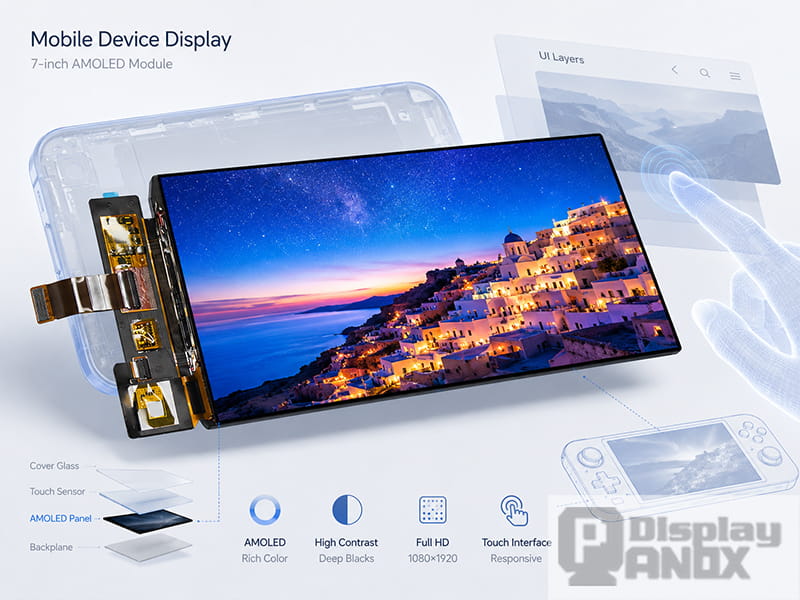
7 inch AMOLED OLED 1920X1080 Mipi
A flexible AMOLED mobile display is a good choice when the product needs a slim profile, curved edge design, light weight, high contrast, and premium visual quality. It is also useful for experimental products where the display is part of the industrial design language rather than a flat component hidden behind a frame.
Flexible AMOLED is especially suitable for smartphone prototypes, curved handheld terminals, wearable-style products, automotive control surfaces, AR/MR auxiliary displays, and custom devices where the display shape helps define the product identity.
For a standard rectangular handheld device, a rigid AMOLED or TFT-LCD may still be enough. For curved surfaces, foldable concepts, or narrow mechanical spaces, flexible OLED can open design possibilities that rigid glass panels cannot easily support.
8. Panox Display Support for Mobile Display Development
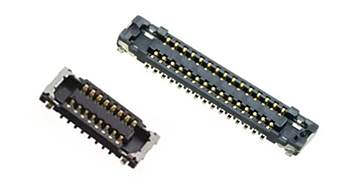
Choosing a mobile display panel is only the first step. A complete development path may also require datasheets, drawings, IC information, circuit reference, connectors, touch panel customization, cover glass design, and controller boards. Panox Display states that it can provide display datasheets, drawings, IC datasheets, circuit schematics, customized touch panels, and HDMI/Type-C controller board support for display testing and development.
For engineering samples, a controller board can make testing faster. For mass production, the final design usually needs a matched mainboard, stable supply plan, mechanical drawing review, and clear quality requirements.
9.Conclusion
A mobile display panel is one of the most important components in a portable device. It affects how the product looks, how long the battery lasts, how the user interacts with the interface, and how easily the device can be manufactured. For modern mobile products, AMOLED and flexible OLED panels offer strong advantages in contrast, thinness, response, and industrial design flexibility, while TFT-LCD remains useful for many stable and cost-sensitive applications.
Panox Display supplies mobilephone display panels including flexible OLED, flexible AMOLED, and high-refresh AMOLED options. For development or batch projects, Panox Display can help with panel selection, technical documents, connectors, customized touch panels, cover glass, and controller board support.
Learn more: Mobile Display Applications: Where Mobilephone Display Panels Are Used
FAQ: Mobile Display Panels
What is a mobile display?
A mobile display is a compact display panel or module designed for portable devices such as smartphones, handheld terminals, GPS units, game consoles, and smart controllers. It usually combines a high-density display cell, driver IC, FPC connection, and sometimes integrated touch.
Is AMOLED better than LCD for mobile devices?
AMOLED is usually better for high contrast, slim design, fast response, and flexible form factors. LCD can still be attractive for cost-sensitive, high-brightness, or stable long-term supply projects. The right choice depends on the product’s budget, usage environment, power strategy, and mechanical structure.
Does OLED always save power?
OLED power saving depends on brightness and content. Dark UI designs can reduce pixel emission power, while bright white screens and outdoor high-brightness use can increase consumption. Research on AMOLED smartphone power behavior shows that display content directly affects AMOLED screen power consumption.
What interface is commonly used for mobile display panels?
MIPI is widely used in mobile display panels because it supports high-speed display data transmission between a host processor and the display. For early testing, engineers can also use a suitable HDMI or Type-C controller board when available.
What information should I provide when asking for a mobile display quotation?
Provide the target screen size, resolution, brightness requirement, interface, touch requirement, cover glass drawing, operating environment, expected quantity, and application. If the project is still in early development, share the device concept and available space so the supplier can recommend a suitable display.