



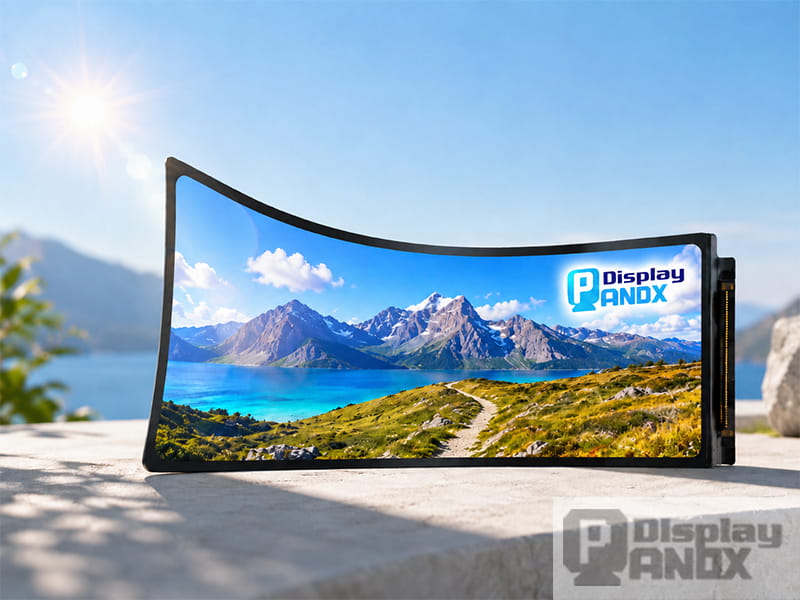
A display can look excellent in a meeting room and still fail the moment it is installed outdoors. This is one of the most common mistakes in display selection. Under strong daylight, the screen is no longer competing with ordinary indoor lighting. It is competing with sunlight, surface reflection, heat, changing viewing angles, and the user’s need to read information quickly.
That is why sunlight readability matters.
For outdoor display products, readability is directly connected to usability, safety, product reliability, and customer confidence. A screen that becomes washed out under sunlight can make a device feel unfinished, even when the electronic design and mechanical structure are otherwise well made. For product developers, choosing a sunlight readable display panel is therefore an early design decision, not a last-minute brightness upgrade.
1. Sunlight Readability Decides Whether the Product Can Be Used in the Real Environment
Outdoor products rarely work under perfect lighting. A parking payment terminal may face direct afternoon sun. A handheld scanner may be used in a warehouse doorway. A marine display may reflect sky and water. A wearable screen may need to be checked while running, cycling, or working outside. In all these cases, the display must remain readable in the actual environment where the product is used.
The challenge is simple to describe but difficult to solve: sunlight adds reflected light to the display surface. This reflected light makes dark areas look brighter and weakens the difference between the image and the background. Once the contrast drops, the user may still see that the screen is on, but text, icons, warning symbols, maps, and menus become harder to recognize.
This is why engineers often care about ambient contrast, not only the contrast value measured in a dark room. A high contrast ratio on a datasheet does not automatically mean high readability outdoors. The final viewing result depends on display brightness, surface reflection, internal reflection, cover glass, bonding method, viewing angle, and interface design.
2. Readability Affects Speed, Safety, and User Confidence
For consumer electronics, poor outdoor readability is annoying. For industrial, vehicle, medical, marine, and public equipment, it can become a real operational problem.
A user standing in front of an EV charging station needs to read the charging status, payment instructions, QR code, and warning messages without guessing. An operator using an industrial controller needs to confirm machine status and alarm information quickly. A driver or marine user may only have a short moment to check navigation data. In these situations, the screen is part of the decision-making process.
A sunlight readable display panel helps reduce hesitation. The user does not need to cover the screen with one hand, move closer, tilt the device repeatedly, or search for shade. The interface feels more reliable because the information remains visible at the moment it is needed.
This is also why sunlight readability should be considered in the early prototype stage. If the product is tested only indoors, the display may appear acceptable until the first outdoor trial. By then, changing the panel, cover glass, driver board, backlight system, or mechanical stack can become expensive.
3. High Brightness Helps, but Reflection Control Matters Just as Much
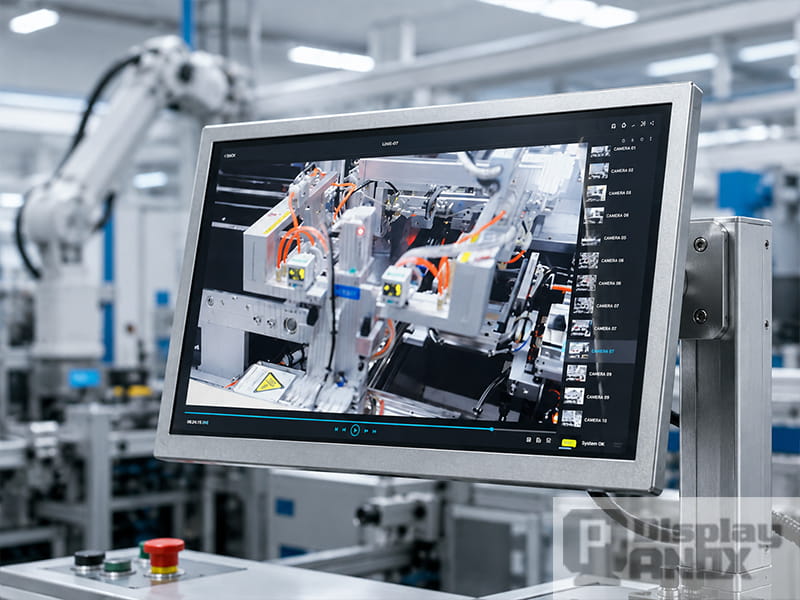
12.1-inch industrial-grade TFT-LCD display
Many teams first think of sunlight readability as a brightness problem. That is understandable. A brighter panel gives the image more strength against ambient light. High-brightness TFT LCD and IPS LCD panels are widely used in outdoor terminals, public equipment, industrial control systems, vehicle dashboards, and self-service machines.
For example, Panox Display’s 12.1 inch 1280×800 LVDS high-brightness industrial TFT-LCD is positioned for public equipment and rugged outdoor applications. It is a good example of a display direction suitable for bus stop displays, parking barrier gates, ticket vending machines, self-service payment kiosks, queue calling systems, information kiosks, and ATM-style devices. Its high-brightness design gives product teams a stronger starting point when the screen needs to work under strong ambient light.
At the same time, brightness alone cannot carry the whole design. If the front surface reflects too much sunlight, the display still looks pale. If the cover glass and touch layer create internal reflections, the user sees glare and ghosting instead of clean information. This is where optical bonding, anti-glare surface treatment, anti-reflection coating, and proper cover glass selection become important.
A more practical outdoor display design usually combines sufficient luminance with a cleaner optical stack. The goal is not simply to push the backlight harder. The goal is to let useful display light reach the user while reducing the unwanted light reflected back from the surface.
4. Outdoor Displays Also Need Better Thermal and Power Planning
Sunlight readable displays often operate at higher luminance, and higher luminance usually means more power and more heat. This is especially important for LCD modules that use stronger LED backlights. In a sealed outdoor enclosure, heat can build up quickly, especially under direct sun.
This affects more than the display. It can influence the battery, driver board, adhesive layers, touch panel, housing material, and long-term reliability of the whole device. A display that looks bright during a short demo may still need thermal testing in the real enclosure before mass production.
For portable products, power consumption becomes even more sensitive. A handheld device, wearable product, or outdoor instrument cannot always run at maximum brightness. The display technology needs to match the actual usage pattern.
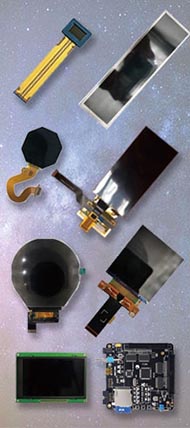
This is where different display technologies begin to separate. A high-brightness TFT LCD may be suitable for fixed public equipment. A transflective LCD may work better when the device benefits from ambient light. A Memory LCD can be attractive for always-on data displays with low power needs. AMOLED can be a strong choice for compact full-color wearable interfaces. Micro OLED is more suitable for optical systems where high pixel density and compact size are critical.
5. Different Outdoor Products Need Different Display Solutions
There is no single “best” sunlight readable display panel for every product. The right choice depends on the application, viewing distance, image content, power budget, housing design, interface, and expected working environment.
For public equipment and industrial terminals, high-brightness LCD remains a very practical direction. Panox Display’s 12.1 inch high-brightness industrial TFT-LCD and 6.5 inch industrial LCD with 800 nits brightness show two different size ranges for this type of application. Larger panels are useful when users need to read instructions, menus, video feeds, or operating data from a distance. Smaller industrial LCDs are often more suitable for vehicle equipment, compact control panels, and rugged embedded systems.
For handheld devices, meters, and outdoor instruments, the situation can be different. The user may need long battery life and quick visibility rather than a large full-color interface. A 2.2 inch transflective LCD for handheld devices is relevant here because transflective technology can use ambient light to support visibility instead of relying only on backlight output. A 3.2 inch Memory LCD for handheld devices also fits this logic, especially when the product mainly shows status data, numbers, icons, or simple graphics for long periods.
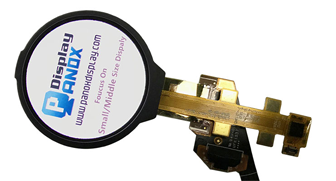
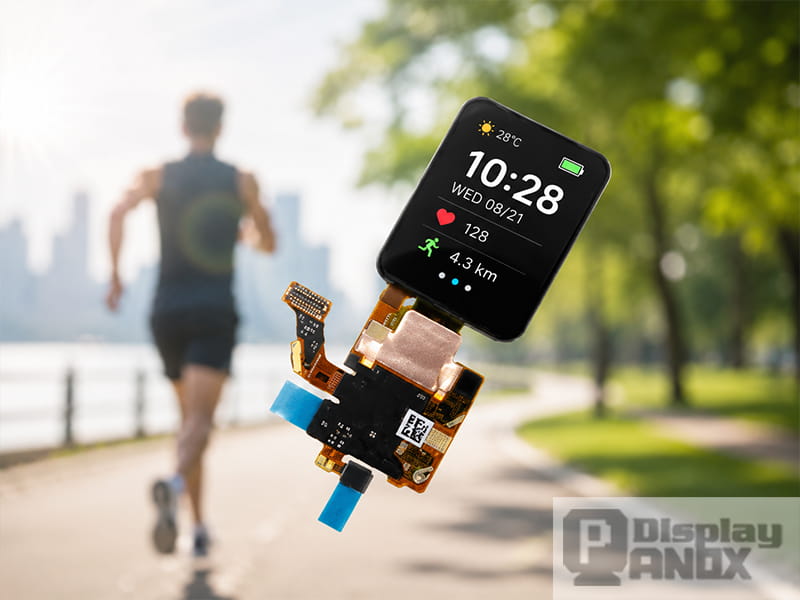
For wearable devices, the display must be small, bright enough for quick outdoor viewing, and visually attractive. Panox Display’s 1.91 inch OLED for wearable smartwatch, 2.04 inch AM-OLED full-color on-cell PCAP touch display, and 1.39 inch round OLED 454×454 800 nits display represent the type of AMOLED panels that can be used for compact full-color interfaces. In smartwatch and wearable projects, sunlight readability is not only about maximum brightness. It also depends on black level, UI contrast, font size, touch structure, and how quickly the user can recognize information at a glance.
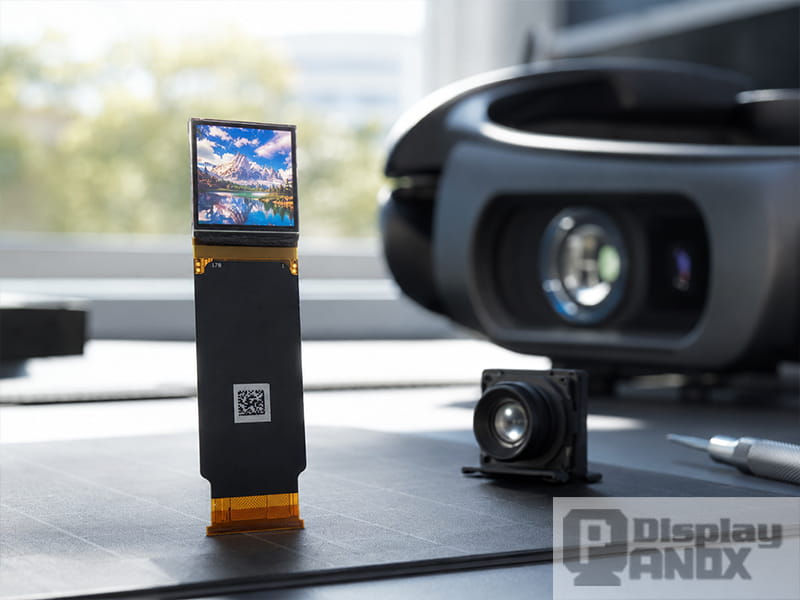
For AR, FPV, electronic viewfinders, and compact optical engines, the display is not viewed directly like a phone or industrial panel. The image passes through lenses, prisms, waveguides, or other optical elements before reaching the eye. This means brightness loss and optical efficiency become part of the readability problem. Panox Display’s 0.71 inch Micro OLED 1920×1080 LVDS 3000 nits, 0.68 inch Micro OLED 5000 brightness, and 1.03 inch Micro OLED 2560×2560 for AR/FPV are more relevant to this type of design. These panels are small, high-density display sources for systems where the final image quality depends on both the microdisplay and the optical path.
6. Sunlight Readability Also Changes UI Design
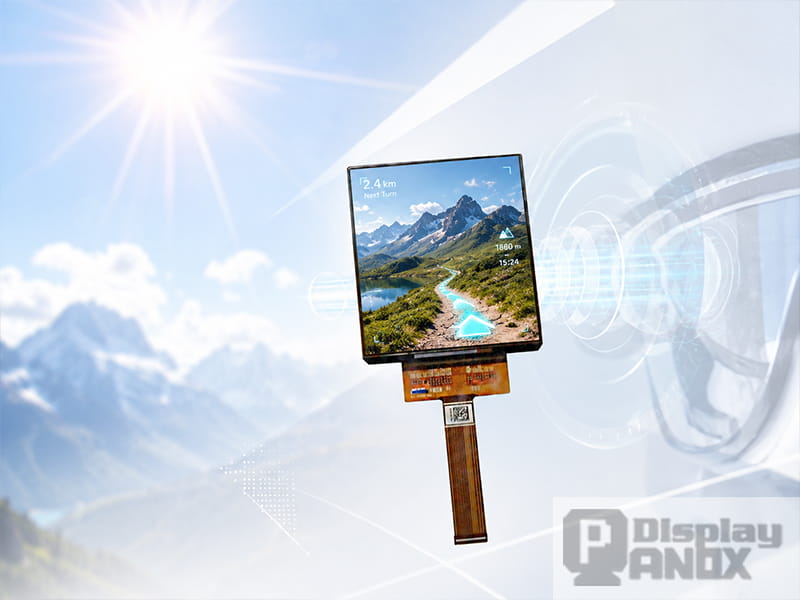
Even with the right panel, outdoor readability can still be weakened by poor interface design. Thin gray text, pale icons, low-contrast buttons, decorative gradients, and crowded layouts often fail under bright light.
Outdoor UI should be designed for quick recognition. The user may be standing in sun, wearing gloves, walking, driving, or checking the screen from an angle. Large text, strong visual hierarchy, clean icon shapes, and high contrast between foreground and background can make the same display easier to use.
AMOLED and OLED interfaces often benefit from dark backgrounds and bright accent colors, especially in wearable devices. Industrial LCD interfaces usually need clear blocks, readable labels, and strong warning states. Micro OLED interfaces for AR or viewers need special care because small text can become difficult to read after optical magnification, distortion, or brightness loss.
In real product development, sunlight readability is a combination of hardware and interface decisions. A brighter panel helps, but good UI design helps the brightness work harder.
7. It Improves Long-Term Product Value
A sunlight readable display can make a product feel more professional because users experience fewer failures in daily operation. This matters for OEM devices, industrial equipment, outdoor terminals, medical tools, and wearable products. When the screen remains clear in sunlight, the product feels more dependable.
It also helps reduce support problems after installation. Many display complaints appear only after a customer starts using the device outdoors. The user may report that the product is “too dim,” “hard to read,” or “not suitable for outdoor use,” even when the display was technically working. Selecting the right panel and optical design early can prevent that kind of mismatch.
For suppliers and product teams, sunlight readability also makes the product easier to position. Instead of selling only by size, resolution, or interface, the product can be matched to a real application: outdoor kiosk, vehicle terminal, wearable device, field instrument, AR viewer, FPV goggles, or public equipment display.
8. How to Evaluate Sunlight Readability Before Final Selection
Before selecting a display, it is helpful to describe the real use environment in plain engineering terms. Will the product be used in direct sun or only in shade? Will the user read small text or large icons? Is the screen always on? Does it need a touch panel? Is battery life important? Will the product be sealed inside a hot enclosure? Will users view it through sunglasses, lenses, or an optical engine?
These questions often narrow the choice more effectively than resolution alone. A high-resolution AMOLED may be ideal for a wearable UI, while a Memory LCD may be better for an always-on outdoor data display. A 1000-nit industrial TFT-LCD may be appropriate for a kiosk, while a 3000-nit Micro OLED may be required before the image passes through AR optics.
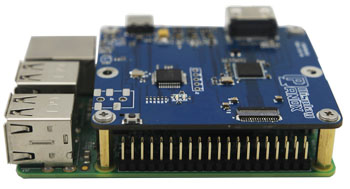
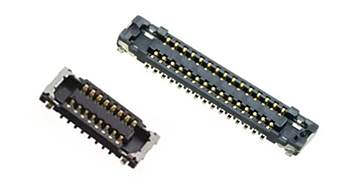
The final display choice should consider brightness, reflectance, optical bonding, cover glass, touch structure, temperature range, power consumption, interface compatibility, and supply stability. For projects that need a complete module, driver board support is also important. Panox Display’s product pages and service information show support for display panels, customized touch panels, cover glass, connectors, and controller or driver boards, which can help product teams move from panel selection to actual integration.
Conclusion
Sunlight readability is important because outdoor products must remain useful outside the controlled lighting of an office, lab, or showroom. When the screen is hard to read, the whole product feels less reliable. When the screen remains clear under daylight, the user can act faster, make fewer mistakes, and trust the device more.
For fixed public equipment, high-brightness TFT LCD and IPS LCD panels are often a strong starting point. For handheld and low-power devices, transflective LCD and Memory LCD can make better use of ambient light. For wearables, AMOLED and OLED panels offer compact full-color interfaces with strong contrast. For AR, FPV, EVF, and compact optical engines, Micro OLED panels provide the high pixel density and brightness needed for near-eye systems.
The best sunlight readable display panel is selected according to the real application environment. Brightness matters, but the final result also depends on contrast, reflection control, thermal behavior, power budget, optical structure, UI design, and integration support. For outdoor, industrial, wearable, and near-eye display projects, Panox Display can help evaluate suitable LCD, OLED, AMOLED, Memory LCD, transflective LCD, and Micro OLED options based on the product’s actual use case.
Learn more: What Is a Readable-Under-Sun Display Panel and Why Does It Matter?
FAQs
Why is sunlight readability important for outdoor display panels?
Sunlight readability is important because strong ambient light can reduce screen contrast and make information difficult to read. For outdoor products, a readable display improves usability, safety, operating speed, and customer confidence.
Is high brightness enough for a sunlight readable display?
High brightness is useful, especially for LCD panels, but it is only one part of the design. Surface reflection, internal reflection, optical bonding, cover glass, touch structure, viewing angle, power consumption, heat, and UI contrast all affect the final outdoor viewing result.
Which display technology is better for outdoor devices?
The best technology depends on the product. High-brightness TFT LCD is common for industrial and public equipment. Transflective LCD and Memory LCD are useful for low-power outdoor devices. AMOLED is suitable for compact full-color wearable displays. Micro OLED is used in AR, FPV, EVF, and near-eye optical systems.
Why do wearable displays need sunlight readability?
Wearable devices are often checked quickly during outdoor activity. The user may only look at the screen for one or two seconds, so the display must show time, health data, notifications, and fitness information clearly under daylight.
Why do AR and FPV devices need high-brightness Micro OLED?
In AR, FPV, and viewer-type devices, the display image passes through optical components before reaching the eye. Part of the brightness is lost in that path, so the microdisplay often needs high luminance, strong contrast, and high pixel density to keep the final image readable.